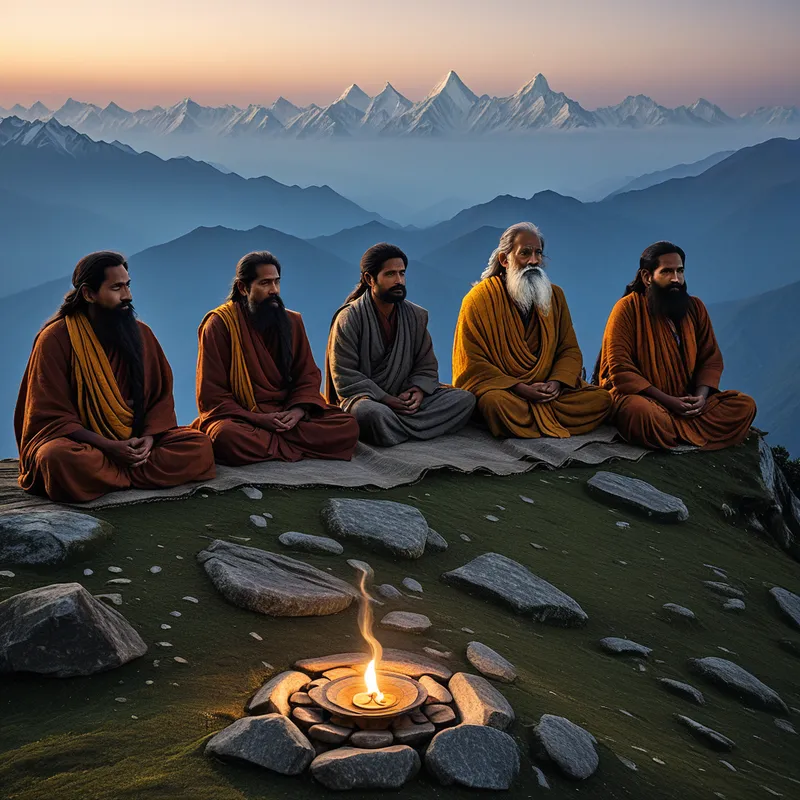
The Rishis Myth Meaning & Symbolism
The myth of the Rishis, the primordial seers who perceived cosmic law and gave voice to the sacred hymns that structure reality.
The Tale of The Rishis
In the beginning, before time was measured in sunrises, there was only the One—a boundless, silent potential. From that stillness, a vibration arose, a primordial hum that was the first thought and the first sound. And listening to that sound, born from it and yet its perceivers, were the Rishis.
They were not born as we are born. They emerged from the very fabric of existence, their consciousness woven into the dawn of creation. Some say there were seven, the Saptarishi. Others whisper of countless more, a luminous network of awareness scattered across the epochs. They dwelled in the high, thin air of the mountains, where earth meets sky, and in the deep, silent forests where the roots of trees drink from [the underworld](/myths/the-underworld “Myth from Greek culture.”/).
Their eyes were closed, yet they saw. They saw the dance of the atoms and the sweep of the galaxies as a single, flowing pattern. They saw the laws that bind fire to heat and [water](/myths/water “Myth from Chinese culture.”/) to flow—not as separate rules, but as verses of a grand, rhythmic hymn. And this hymn demanded a voice.
So, they listened deeper. They turned their awareness inward, past the chatter of the mind, into the cavern of the heart where the echo of that first hum still resonated. And there, in that sacred silence, they heard. They heard the Veda. It was not composed; it was revealed. Syllable by luminous syllable, mantra by world-structuring mantra, the universe sang its own nature to them.
The sage Vashishta heard the hymns of cosmic order and royal duty. Vishvamitra, once a king, heard the strains of power transformed into spiritual might through terrible [tapas](/myths/tapas “Myth from Hindu culture.”/). [Vyasa](/myths/vyasa “Myth from Hindu culture.”/) perceived the great stories, the Itihasa, bubbling up from the well of time. Patanjali discerned the precise architecture of the mind itself.
Their breath became the meter of the hymns. Their focused intention became [the vessel](/myths/the-vessel “Myth from Alchemical culture.”/) that carried this divine sound into the realm of the audible. They did not speak for themselves; they became conduits, the human strings upon which the cosmos played its eternal song. They gave the formless a form, the silent a sound, and in doing so, they laid the sonic and psychic foundations upon which all of reality—gods, humans, and demons alike—would dance.

Cultural Origins & Context
The Rishis are [the cornerstone](/myths/the-cornerstone “Myth from Biblical culture.”/) of the Hindu spiritual and cultural edifice. They are the attributed “seers” of the Vedas, texts so ancient they define the very category of revealed scripture (shruti). This was not a myth confined to storybooks; it was the living bedrock of knowledge. The myth emerged from and validated the oral tradition—the flawless, guru-to-disciple transmission of the Vedic hymns over millennia.
Societally, the Rishi was the ultimate authority, but not of political power. Their authority derived from direct perception (drishti) of truth (satya). They were the archetypal brahmins, but not as a mere priestly class; they were the living bridges between the human and the divine, the ones who could hear the will of the cosmos and translate it into law, ritual, and ethics. Their function was to maintain Dharma by embodying and articulating it. Every king needed a Rishi as preceptor, for the king enforced [the law](/myths/the-law “Myth from Biblical culture.”/) the Rishi could see.
Symbolic Architecture
The Rishi is not merely a historical or religious figure; they are a profound psychological [symbol](/symbols/symbol “Symbol: A symbol can represent an idea, concept, or belief, serving as a powerful tool for communication and understanding.”/). They represent the faculty of inner [perception](/symbols/perception “Symbol: The process of becoming aware of something through the senses. In dreams, it often represents how one interprets reality or internal states.”/)—the [capacity](/symbols/capacity “Symbol: A measure of one’s potential, limits, or ability to contain, process, or achieve something, often reflecting self-assessment or external demands.”/) of [consciousness](/symbols/consciousness “Symbol: Consciousness represents the state of awareness and perception, encompassing thoughts, feelings, and experiences.”/) to turn [inward](/symbols/inward “Symbol: A journey toward self-awareness, introspection, and the exploration of one’s inner world, thoughts, and unconscious mind.”/) and apprehend the foundational patterns of [reality](/symbols/reality “Symbol: Reality signifies the state of existence and perception, often reflecting one’s understanding of truth and life experiences.”/) and [the self](/myths/the-self “Myth from Jungian culture.”/).
The Rishi does not conquer external worlds, but perceives the internal architecture of the one world that contains all others.
The [mountain](/symbols/mountain “Symbol: Mountains often symbolize challenges, aspirations, and the journey toward self-discovery and enlightenment.”/) or [forest](/symbols/forest “Symbol: The forest symbolizes a complex domain of the unconscious mind, representing both mystery and potential for personal growth.”/) hermitage symbolizes the isolated, purified consciousness, withdrawn from the sensory projections of [the world](/myths/the-world “Myth from Tarot culture.”/) (Maya) to commune with the substrate. Their matted [hair](/symbols/hair “Symbol: Hair often symbolizes identity, power, and self-expression, reflecting how we perceive ourselves and how we wish to be perceived by others.”/) (jata) represents the tangled, unkempt vitality of ascetic power (tapas) gathered and stored, not for vanity but for [vision](/symbols/vision “Symbol: Vision reflects perception, insight, and clarity — often signifying the ability to foresee or understand deeper truths.”/). Their hearing of the Veda symbolizes the [moment](/symbols/moment “Symbol: The symbol of a ‘moment’ embodies the significance of transient experiences that encapsulate emotional depth or pivotal transformations in life.”/) when the chaotic contents of [the personal unconscious](/myths/the-personal-unconscious “Myth from Jungian Psychology culture.”/) are suddenly perceived as part of a coherent, universal order—the personal [psyche](/myths/psyche “Myth from Greek culture.”/) touching the collective, archetypal [layer](/symbols/layer “Symbol: Layers often symbolize complexity, depth, and protection in dreams, representing the various aspects of the self or situations.”/).
The different Rishis, with their distinct “hearings,” represent the [specialization](/symbols/specialization “Symbol: Focusing on a specific skill or body part, often reflecting identity formation, anxiety about competence, or emotional compartmentalization.”/) of this inner perception: Vashishta is the [archetype](/symbols/archetype “Symbol: A universal, primordial pattern or prototype in the collective unconscious that shapes human experience, behavior, and creative expression.”/) of the serene, established sage; Vishvamitra is the fierce, striving will that transforms itself; [Narada](/myths/narada “Myth from Hindu culture.”/) is the divine messenger, the [intuition](/symbols/intuition “Symbol: The immediate, non-rational understanding of truth or insight, often described as a ‘gut feeling’ or inner knowing that bypasses conscious reasoning.”/) that connects disparate realms. Together, they form a complete map of the possible orientations of enlightened consciousness.
The Dreamer’s Resonance
When the archetype of the Rishi stirs in the modern dreamer, it often manifests not as a bearded sage, but as a quality of perception. One might dream of hearing a complex, beautiful language they don’t understand, yet feel its truth. They might find a book with glowing, living script, or encounter a guide who speaks in riddles that somehow make profound sense.
Psychologically, this signals a process of deep listening. [The ego](/myths/the-ego “Myth from Jungian culture.”/) is being called to stop its frantic doing and interpreting, and to instead become a vessel for a deeper intelligence. It is the somatic feeling of a knot in the chest or mind suddenly loosening, not through effort, but through a shift in attention. The dreamer is in a phase where the unconscious is ready to reveal its own inherent order—its personal “Veda”—if the conscious mind can adopt the receptive, meditative stance of the Rishi. It is the psyche’s move from neurotic conflict to symbolic understanding.

Alchemical Translation
The myth of the Rishis models the alchemical process of illumination, the illuminatio stage where the hidden gold is revealed. The struggle is the fierce tapas—the discipline of withdrawing projections, sitting with silence, and confronting the chaos within. The rising action is the deepening of attention, the turning away from the “ten thousand things” to the single source.
The triumphant resolution is not an acquisition, but a revelation. The “I” does not gain something new; it discovers what was always, foundationally true. The personal psyche aligns with the transpersonal pattern.
Individuation, in this light, is not about becoming uniquely idiosyncratic, but about becoming uniquely attuned—hearing and embodying the particular note of the cosmic hymn that is your own existence.
For the modern individual, the alchemical translation is this: Your life’s confusion, your recurring patterns, your deepest yearnings—these are not random. They are the distorted echoes of your own “Veda,” your intrinsic law of being. The Rishi’s path invites you to stop trying to rewrite the script from the ego’s limited perspective. Instead, go into the inner wilderness. Listen. In the silence beneath the anxiety, beneath the planning, you may begin to hear the first syllables of the hymn that you, and only you, were born to articulate into the world. Your task is not to create your truth, but to perceive it, and in that perception, become a co-creator of a more harmonious reality.
Associated Symbols
Explore related symbols from the CaleaDream lexicon: