The Riddle of the Sphinx from Myth Meaning & Symbolism
A winged monster guards a sacred road with a deadly riddle, challenging all travelers to know themselves or perish.
The Tale of The Riddle of the Sphinx
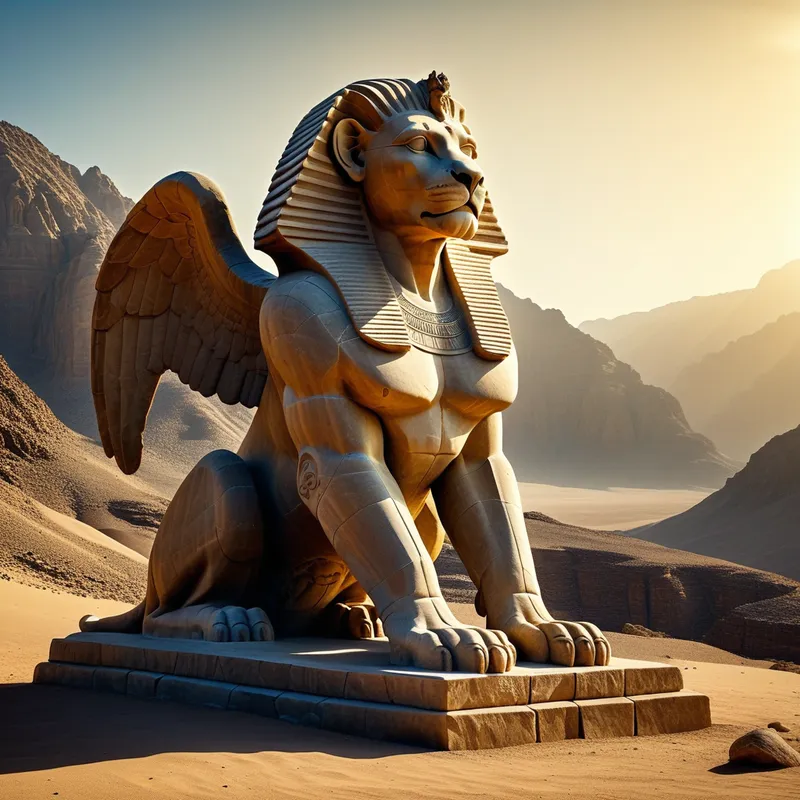
The road to Thebes was a gash of dust and dread through the scorched mountains. It was a place where [the wind](/myths/the-wind “Myth from Various culture.”/) did not whistle but whispered, carrying the dry sighs of the dead. For here, upon a sun-blasted outcrop that commanded the pass, sat the Devourer, the Watcher, the One Who Asks. She was the [Sphinx](/myths/sphinx “Myth from Greek culture.”/), sent by the gods in their wrath—a creature of terrible beauty, with the powerful body of a lioness, the great wings of an eagle, and the hauntingly serene face of a woman. Her eyes held the patience of stone and the hunger of [the abyss](/myths/the-abyss “Myth from Kabbalistic culture.”/).
Her law was simple, her [justice](/myths/justice “Myth from Tarot culture.”/) absolute. No traveler, be they king, soldier, or merchant, could pass her perch. She would descend, a sudden storm of feathers and shadow, and pose her question—a single, coiled riddle. To answer wrongly was to be torn apart by her claws, bones added to the grim cairn that littered the path below. Thebes languished in terror, its gates shut, its people offering their youth to the monster in a futile hope of appeasement. The city was dying of a question it could not answer.
Then came [Oedipus](/myths/oedipus “Myth from Greek culture.”/), a man marked by fate, fleeing one prophecy only to march blindly toward another. He was footsore, proud, and clever. As he approached the fateful rocks, the air grew still. [The Sphinx](/myths/the-sphinx “Myth from Greek culture.”/) stirred, her wings unfolding like a thunderhead, casting him into shadow. She did not roar. Her voice was calm, clear, and cold as mountain spring, carrying the weight of ages.
“Tell me,” she spoke, and the very stones listened. “What creature goes on four legs in the morning, two legs at noon, and three legs in the evening?”
The silence that followed was a living [thing](/myths/thing “Myth from Norse culture.”/). Oedipus did not look at the scattered bones. He looked inward, into the deep well of human experience. He thought not of monsters, but of [the hearth](/myths/the-hearth “Myth from Norse culture.”/), the field, the slow march of a single life from cradle to staff. The answer did not come as a shout, but as a quiet realization, a truth so fundamental it was almost forgotten.
“Man,” he said, his voice cutting the silence. “For in the morning of his life, he crawls on all fours as an infant. At the noon of his life, he walks upright on two legs. And in the evening of his life, he walks with a staff as a third leg.”
A sound like cracking marble filled the air. The Sphinx’s serene face did not contort in rage, but seemed to soften into a profound and terrible understanding. Her riddle, the core of her being, was undone. With a cry that was neither defeat nor [triumph](/myths/triumph “Myth from Roman culture.”/), but a release, she hurled herself from the precipice, dashing herself upon the rocks below. The road to Thebes was open. The monster was gone. But the man who answered, who knew the fate of all humanity, did not yet know his own.
Cultural Origins & Context
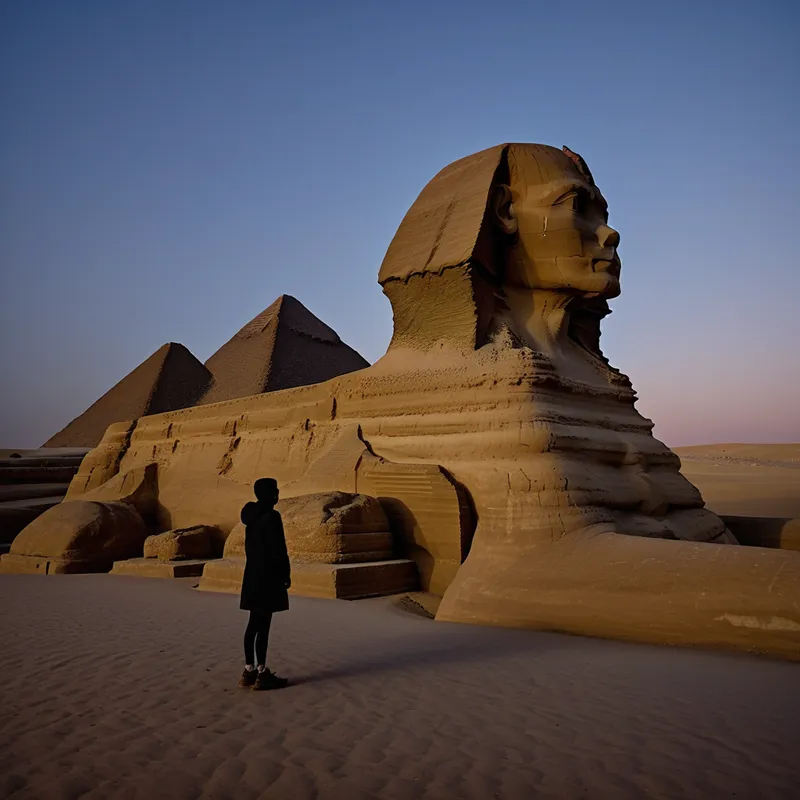
The myth of the Sphinx and her riddle is most famously preserved in the Theban Cycle of Greek mythology, crystallized in the plays of Sophocles. However, the archetype of the riddling guardian is a universal one, a mytheme that echoes from the vǫttr of Norse sagas to the enigmatic gatekeepers in the folklore of countless lands. In its Greek form, it was a foundational civic myth for Thebes, explaining a past calamity and celebrating the cunning of its savior-king, Oedipus. It was transmitted by bards and later tragedians not merely as entertainment, but as a profound cultural teaching story. Its function was societal: it reinforced the supreme value of [metis](/myths/metis “Myth from Greek culture.”/) (cunning intelligence) over brute force, and it served as a stark, public meditation on the human condition—our stages, our fragility, our inevitable decline. The story was told to bind the community in shared awe at a solved mystery, while simultaneously pointing to the greater, unsolved mystery of [the self](/myths/the-self “Myth from Jungian culture.”/).
Symbolic Architecture
The [Sphinx](/symbols/sphinx “Symbol: The Sphinx is a mythical creature that embodies the convergence of strength and intelligence, often associated with mystery, protection, and the challenge of riddles.”/) is no mere [monster](/symbols/monster “Symbol: Monsters in dreams often symbolize fears, anxieties, or challenges that feel overwhelming.”/). She is the composite embodiment of the primal, instinctual world (the [lion](/symbols/lion “Symbol: The lion symbolizes strength, courage, and authority, often representing one’s inner power or identity.”/)), the lofty but detached [realm](/symbols/realm “Symbol: The symbol of ‘Realm’ often signifies the boundaries of one’s consciousness, experiences, or emotional states, suggesting aspects of reality that are either explored or ignored.”/) of intellect and [spirit](/symbols/spirit “Symbol: Spirit symbolizes the essence of life, vitality, and the spiritual journey of the individual.”/) (the wings, the [human](/symbols/human “Symbol: The symbol of a human represents individuality, complexity of emotions, and social relationships.”/) head), and the eternal feminine [mystery](/symbols/mystery “Symbol: An enigmatic, unresolved element that invites curiosity and exploration, often representing the unknown or hidden aspects of existence.”/) (the woman’s face). She is the [guardian](/symbols/guardian “Symbol: A protector figure representing safety, authority, and guidance, often embodying parental, societal, or spiritual oversight.”/) of [the threshold](/myths/the-threshold “Myth from Folklore culture.”/) between the known world and the sacred or royal [space](/symbols/space “Symbol: Dreaming of ‘Space’ often symbolizes the vastness of potential, personal freedom, or feelings of isolation and exploration in one’s life.”/) (Thebes), and her [riddle](/symbols/riddle “Symbol: A puzzle or enigmatic statement requiring cleverness to solve, symbolizing hidden truths, intellectual challenge, and the search for meaning.”/) is the price of [passage](/symbols/passage “Symbol: A passage symbolizes transition, movement from one phase of life to another, or a journey towards personal growth.”/).
The guardian at the threshold does not demand a password, but a piece of your soul—the recognition of your own mortal nature.
The riddle itself is the perfect symbolic [knot](/symbols/knot “Symbol: A knot symbolizes connections, commitments, complications, and the binding or untying of relationships and situations.”/). It is not a test of obscure [knowledge](/symbols/knowledge “Symbol: Knowledge symbolizes learning, understanding, and wisdom, embodying the acquisition of information and enlightenment.”/), but of fundamental self-[awareness](/symbols/awareness “Symbol: Conscious perception of self, surroundings, or internal states. Often signifies awakening, insight, or heightened sensitivity.”/). The “[creature](/symbols/creature “Symbol: Creatures in dreams often symbolize instincts, primal urges, and the unknown aspects of the psyche.”/)” is the human being in time. The four, two, and three [legs](/symbols/legs “Symbol: Legs in dreams often symbolize movement, freedom, and the ability to progress in life, representing both physical and emotional support.”/) map the arc of a single [life](/symbols/life “Symbol: The symbol of ‘Life’ represents a journey of growth, interconnectedness, and existential meaning, encompassing both the joys and challenges that define human experience.”/)—dependency, autonomy, and dependency again. To solve it is to consciously acknowledge the [pattern](/symbols/pattern “Symbol: A ‘Pattern’ in dreams often signifies the underlying structure of experiences and thoughts, representing both order and the repetitiveness of life’s situations.”/) of one’s own existence, to name the shape of time as it wears upon the [body](/symbols/body “Symbol: The body in dreams often symbolizes the dreamer’s self-identity, personal health, and the relationship they have with their physical existence.”/). Oedipus’s victory is thus profoundly ironic. He correctly identifies “Man” in the abstract, demonstrating brilliant intellectual [insight](/symbols/insight “Symbol: A sudden, deep understanding of a complex situation or truth, often arriving unexpectedly and illuminating hidden connections.”/), yet remains utterly blind to the specific, horrific [truth](/symbols/truth “Symbol: Truth represents authenticity, honesty, and the quest for knowledge beyond mere appearances.”/) of his own personal [story](/symbols/story “Symbol: The symbol of ‘Story’ represents the narrative woven through our lives, embodying experiences, lessons, and emotions that shape our identities.”/)—that he has killed his [father](/symbols/father “Symbol: The father figure in dreams often symbolizes authority, protection, guidance, and the quest for approval or validation.”/) and married his [mother](/symbols/mother “Symbol: The symbol of ‘Mother’ represents nurturing, protection, and the foundational aspect of one’s emotional being, often associated with comfort and unconditional love.”/). The myth presents two levels of self-knowledge: the universal (which he passes) and the personal (which he fails, with catastrophic consequences).
The Dreamer’s Resonance
When this myth stirs in the modern unconscious, it often manifests as a dream of being tested or interrogated at a critical juncture—before a door, at the foot of a mountain, or in a sterile, official room. The dreamer faces an authority figure (a teacher, a judge, a shadowy presence) who asks a question that feels both absurd and vitally important. The somatic experience is one of frozen anxiety, a tightening in the chest, a dry mouth—the body’s memory of mortal threat.
Psychologically, this is the process of confronting a life transition or an existential dilemma. The Sphinx represents the accumulated, often unconscious, “knowledge” of the [psyche](/myths/psyche “Myth from Greek culture.”/) about the dreamer’s own life pattern—their habits, their aging, their unacknowledged fears of irrelevance or death. The riddle is the psyche’s way of demanding conscious integration: “Do you see the shape of your own life? Do you accept its terms?” To struggle with the answer is to be in a state of psychic resistance to one’s own reality. To find an answer—any coherent answer that fits the dream-logic—signals a willingness to engage with this deep self-knowledge, to “pass” the threshold into a new phase of consciousness, however difficult that new phase may be.
Alchemical Translation
In the alchemy of the soul, the myth models the quintessential process of individuation. The journey to Thebes is [the ego](/myths/the-ego “Myth from Jungian culture.”/)’s destined path. The Sphinx is the Shadow and the Anima/Animus combined—the terrifying, hybrid keeper of the gate to the deeper Self. She is not an enemy to be slain by sword, but a teacher to be engaged with mind and courage.
The confrontation with the Sphinx is the nigredo, the blackening—the necessary, dark encounter with one’s own foundational truth.
The riddle is the catalyst. To engage with it is to begin the work of [solutio](/myths/solutio “Myth from Alchemical culture.”/) (dissolution), where the rigid structures of the ego are softened by the waters of reflection. Solving it represents coagulatio (coagulation)—the forming of a new, more conscious understanding of the self in time. Oedipus’s intellectual answer is the first, necessary step. His subsequent, tragic failure represents the peril of stopping there, of believing cognitive insight is the same as embodied, ethical self-knowledge. The full alchemical translation requires both: the acknowledgment of the universal human condition and the brutal, personal excavation of one’s own history and complexes. The Sphinx’s suicide is symbolic; when her riddle—her reason for being—is integrated, that particular form of unconscious terror dissolves. It makes way for the next, often more painful, stage of the journey: entering the city of Thebes, the realm of relationship, history, and fate, where the real work of integration begins. The monster at the gate was only the first question. The city holds the rest of the examination.
Associated Symbols
Explore related symbols from the CaleaDream lexicon: