The Resurrection Myth Meaning & Symbolism
A divine teacher endures betrayal, death, and descent into the underworld, returning transformed to offer a new covenant of eternal life and liberation.
The Tale of The Resurrection
Listen, and hear the tale of the three days that shook the foundations of the world.
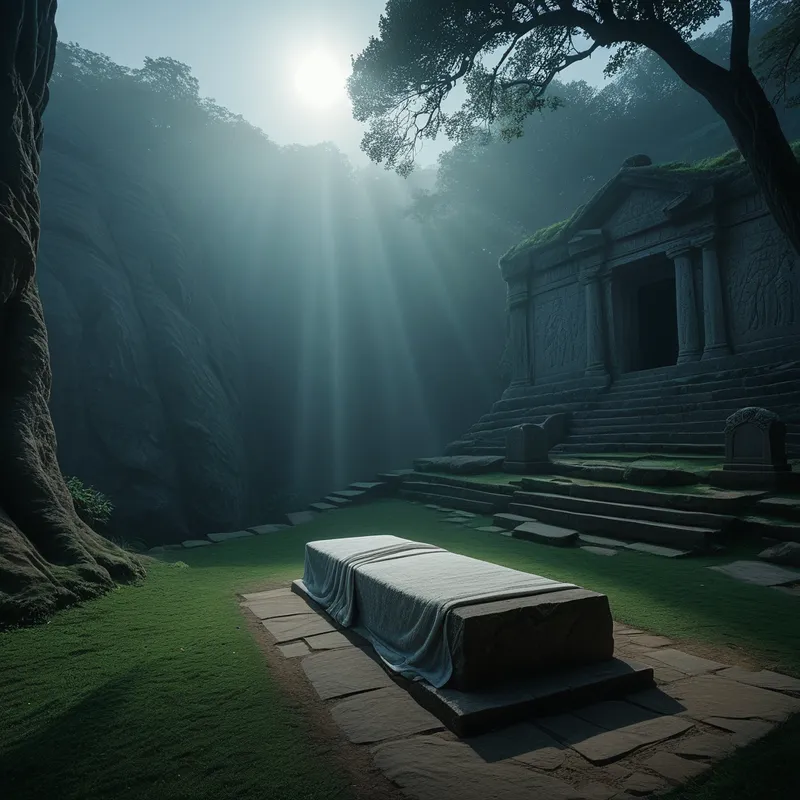
In the hour of deepest darkness, when even the stars seemed to weep, the teacher hung upon the tree. Yeshua, the one who spoke of a kingdom not of stone and sword but of spirit and heart, breathed his last. The sky tore itself asunder. The earth trembled. His followers, hearts shattered, laid his broken body in a borrowed tomb, a cold chamber hewn from rock. A great stone, heavy as despair, was rolled across the entrance, sealing the light of the world in darkness.
The Sabbath passed, a day of hollow silence. The world held its breath.
Then, in the grey hour before dawn on the first day of the week, the women came. Miriam of Magdala and others, bearing spices to anoint the dead, their footsteps heavy with grief. They approached the place of mourning, their only question: “Who will roll away the stone for us?”
But they found the stone already rolled back. The mouth of the tomb stood open, a gaping maw into emptiness. Peering inside, they saw not the body of their lord, but a young man clothed in dazzling white, sitting where the body had been. “Do not be alarmed,” he said, his voice like clear water in the silence. “You seek Yeshua of Nazareth, who was crucified. He is risen. He is not here. See the place where they laid him.”
Terror and amazement seized them. They fled, their message trembling on their lips, a truth too vast to speak.
But to Miriam, who remained weeping outside the tomb, a different revelation came. Through her tears, she saw a figure she took for the gardener. “Woman, why are you weeping?” he asked. “They have taken my Lord,” she pleaded, “and I do not know where they have laid him.”
Then he spoke her name. “Miriam.”
And in that single word, spoken with a familiarity that pierced the veil of death itself, she knew. It was him. The teacher, the rabbi, alive. Not a ghost, not a memory, but a presence more solid and real than the ground beneath her feet, transformed yet utterly himself. “Do not hold on to me,” he said, for he was moving between worlds, “but go to my brothers and tell them…”
Thus began the day of unmaking and remaking. He appeared among his followers behind locked doors, breathing on them a spirit of peace. He walked with the despairing on a road, his identity hidden until the breaking of bread. He showed his wounds to the doubting, not as scars of defeat, but as seals of a terrible victory. For forty days, he moved like a secret heartbeat within the world, teaching of a kingdom now unleashed within and among them, before his presence was withdrawn—not as an end, but as a new kind of beginning, a spirit poured out upon all flesh.
The stone was rolled away. The tomb was empty. And nothing would ever be the same.
Cultural Origins & Context
This narrative emerged from a first-century Jewish apocalyptic milieu, a culture yearning for divine intervention against Roman occupation and cosmic injustice. The earliest accounts are not detached histories but passionate proclamations—kerygma—spread orally by his followers. These were stories told in house churches, whispered in markets, and shouted in the face of persecution, forming the core of the Gospels written decades later.
Its primary societal function was identity-formation. For a scattered, often oppressed community, the Resurrection was the foundational event that validated Yeshua as the Messiah and inaugurated a new age. It transformed a devastating execution into a cosmic victory, redefining power from imperial force to sacrificial love. The ritual of baptism and the weekly gathering on “the Lord’s Day” (Sunday, the day of resurrection) became embodied re-enactments of this myth, knitting individuals into a living body bound by this shared, transformative truth.
Symbolic Architecture
At its heart, the Resurrection is not merely a physical event but a profound symbol of psychic inevitability. It represents the ultimate triumph of consciousness and integrative life over the dissociative, fragmenting power of the unconscious, symbolized by death.
The stone before the tomb is the hardened persona, the defensive ego that believes isolation is safety. Its rolling away is the necessary, often traumatic, rupture of that illusion.
The three days in the tomb mirror the necessary period of incubation in the unconscious. This is not passive decay but active alchemy in the dark. The hero descends, fully assimilating the shadow—the betrayal, the violence, the abandonment—and does not deny it. His return, bearing the wounds, signifies that integration, not perfection, is the mark of transformation. The empty tomb is the ultimate symbol of the liberated Self; the form is gone, but the essence is everywhere and uncontainable.
Yeshua as the Self achieves what the individual ego cannot: he consciously submits to the destructive aspect of the unconscious (death) and emerges, not by escaping it, by transmuting it into the very substance of new life.
The Dreamer’s Resonance
When this myth stirs in the modern dreamer, it signals a profound somatic and psychological process of renewal struggling to birth itself. To dream of being trapped in a dark, enclosed space—a tomb, a basement, a sealed room—that begins to crack with light from within, is to feel the pressure of a Self demanding emergence.
The somatic experience is often one of constriction followed by release: a feeling of being buried alive in one’s own life, roles, or grief, suddenly giving way to an inexplicable gasp of air, a surge of energy. Psychologically, it accompanies the end of an old identity—the death of a career, the collapse of a relationship, the dissolution of a long-held belief. The dreamer is in the “Saturday” phase, the silent, terrifying hiatus between what was and what will be. Dreams of meeting a familiar yet radiantly changed figure, or of discovering an empty space where a heavy burden once lay, confirm the process: the old structure has served its purpose and the core essence is preparing to reconstitute in a new, more authentic form.
Alchemical Translation
For the individual on the path of individuation, the Resurrection maps the final, most terrifying phase of psychic transmutation: the mortificatio and albedo.
First, one must consent to the crucifixion—the conscious suffering of the tension of opposites within. This is the sacrifice of the ego’s insistence on its own limited version of control and goodness. One is “betrayed” by one’s own complexes, “scourged” by insight, and “nailed” to the cross of one’s own nature.
The true resurrection begins not at the empty tomb, but in the Garden of Gethsemane, with the prayer: “Not my will, but thine be done.” This is the ego’s surrender to the larger process of the Self.
The subsequent descent into the tomb (mortificatio) is a mandatory dissolution. Here, in the dark, all previous identities and achievements rot away. This is not failure, but the fertile decay without which no new growth is possible. The “three days” represent the complete cycle of negation.
The emergence (albedo, the whitening) is not a return to the old life. The resurrected body is subtle—it passes through walls, yet eats fish. It is the integrated psyche: tangible and embodied, yet no longer bound by the literal, material laws of the ego’s old world. The mission now is to “breathe” this integrated spirit onto the fragmented parts of oneself and one’s community—to become a vessel of the very peace and forgiveness that was forged in the darkness. The myth teaches that liberation is not an escape from the human condition, but its ultimate fulfillment through a love that has consciously passed through and transformed its own annihilation.
Associated Symbols
Explore related symbols from the CaleaDream lexicon: