The Reindeer and the Sun Myth Meaning & Symbolism
A cosmic reindeer carries the sun across the sky, hunted by celestial wolves, in a myth of sacrifice that sustains the world's light and life.
The Tale of The Reindeer and the Sun
Listen. In the time before time, when the world was a blanket of endless snow and the sky was a dome of deepest blue, the sun did not move. It hung, a frozen jewel of gold and fire, in the vault of the heavens. The world below lay locked in an eternal twilight, neither fully day nor fully night, a silent, breathless realm where life slept in the roots of the World Tree.
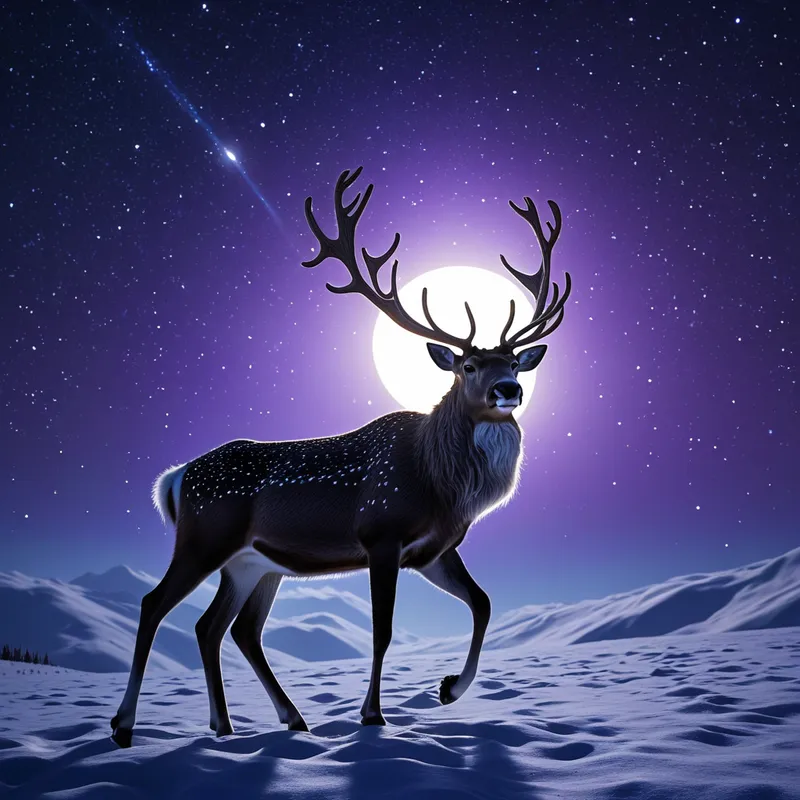
Then, from the place where the earth meets the sky, he came. Not a beast of flesh and blood, but a spirit made manifest. A Reindeer of such size and majesty that his hooves shook the mountains. His coat was the color of the winter sky at dusk, a deep violet threaded with silver. But his crown—his antlers—were the wonder. They were not bone, but living branches of ancient, polished wood, curling and reaching upward like the arms of a sacred tree, holding between their highest tines a sphere of pure, captured sunlight. He was the Master of Herds, and his burden was the hope of the world.
With a great snort that became the north wind, he began to run. Not across the tundra, but along the very curve of the sky. And as he ran, the sun moved. It rose, trailing fire and light, banishing the deep blue to the edges of the world. For the first time, true Day dawned. The ice wept into rivers, seeds stirred in their frozen beds, and the people below looked up in awe.
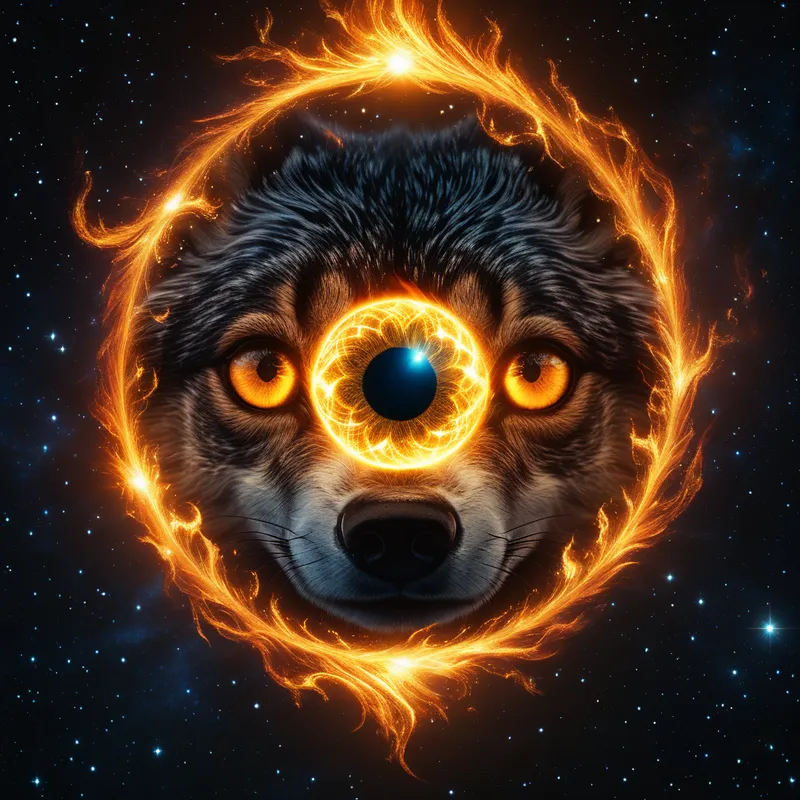
But the sky-road is not safe. For in the celestial shadows, born from the first cold and hunger of the universe, ran the Sky Wolves. Three of them, with coats of star-dust and eyes like black ice. Their purpose was not malice, but nature: to hunt the sun-bearer, to pull the light from the sky and return the world to stillness. Their howls were the first thunder.
And so the great cycle was set. Each dawn, the Reindeer would take the sun upon his crown and run his impossible race. All day, the wolves would pursue, their celestial jaws snapping at his heels. As evening fell, their chase would grow desperate. Often, they would catch him. They would tear at his flanks, and his spirit-blood, hot and golden, would spill across the sky, painting the sunsets in hues of crimson and amber. The sun would tumble, extinguished, below the edge of the world.
The Reindeer, wounded and weary, would descend into the Lower World, into the healing waters of a subterranean sea. There, through the long, cold night, his wounds would be licked clean by the spirits of his ancestors, and his strength would return. And each morning, without fail, he would rise again. He would ascend the World Tree, take up the newborn sun from its eastern cradle, and begin the race once more. His sacrifice was not a single act, but a perpetual vow—the endless journey that spins [the wheel of life](/myths/the-wheel-of-life “Myth from Tibetan Buddhist culture.”/).
Cultural Origins & Context
This myth is not a singular story from one tribe, but a profound cosmological motif woven through the spiritual fabric of many Indigenous peoples of Siberia, including the Evenki, Nenets, and Khanty. It belongs to the animistic and shamanic worldview where the boundary between the animal world, the human world, and the spirit world is porous and sacred. The myth was not “told” in the manner of a bedtime story for entertainment; it was enacted, sung, and journeyed to.
It was the core narrative of the shaman. During rituals, often involving the rhythmic beat of the drum—the “shaman’s horse”—the practitioner’s spirit would ascend along the axis of the World Tree to witness this celestial drama. The shaman might journey to aid the Reindeer, to plead with the wolves, or to gather the healing energies spilled in the cosmic struggle. The myth explained the fundamental rhythms of existence: the diurnal cycle, the seasons, and the necessary balance between light and darkness, effort and rest, sacrifice and renewal. The reindeer itself was the literal and spiritual sustenance of these cultures, providing food, clothing, and shelter; its elevation to a cosmic, sun-carrying deity reflected its absolute centrality to survival and cosmology.
Symbolic Architecture
At its [heart](/symbols/heart “Symbol: The heart symbolizes love, emotion, and the core of one’s existence, representing deep connections with others and self.”/), this is a myth of sublime, willing sacrifice. The [Reindeer](/symbols/reindeer “Symbol: Reindeer are symbols of endurance, transformative journeys, and cultural significance, often associated with winter celebrations.”/) is not a conquered [hero](/symbols/hero “Symbol: A hero embodies strength, courage, and the ability to overcome significant challenges.”/), but a conscious participant in a cosmic order that requires his perpetual offering.
The greatest service is not to conquer the dark, but to consent to be the vessel that carries the light through it, knowing the cost.
The sun represents [consciousness](/symbols/consciousness “Symbol: Consciousness represents the state of awareness and perception, encompassing thoughts, feelings, and experiences.”/), [life](/symbols/life “Symbol: The symbol of ‘Life’ represents a journey of growth, interconnectedness, and existential meaning, encompassing both the joys and challenges that define human experience.”/), creative fire, and the active principle. The Sky Wolves are not “evil,” but embody the necessary, pulling force of the unconscious, [entropy](/symbols/entropy “Symbol: In arts and music, entropy represents the inevitable decay of order into chaos, often symbolizing creative destruction, impermanence, and the natural progression toward disorder.”/), and the [dissolution](/symbols/dissolution “Symbol: The process of breaking down, dispersing, or losing form, often representing transformation, release, or the end of a state of being.”/) required for renewal. They are the [shadow](/symbols/shadow “Symbol: The ‘shadow’ embodies the unconscious, repressed aspects of the self and often represents fears or hidden emotions.”/) that gives the light its definition, the [fatigue](/symbols/fatigue “Symbol: A state of extreme tiredness or exhaustion, often symbolizing depletion of physical, mental, or emotional resources.”/) that makes rest sacred, the limits that shape the [journey](/symbols/journey “Symbol: A journey in dreams typically signifies adventure, growth, or a significant life transition.”/). The [chase](/symbols/chase “Symbol: Dreaming of a chase often symbolizes avoidance of anxiety or confrontation, manifesting as fleeing from something threatening or overwhelming in one’s waking life.”/) is the dynamic [tension](/symbols/tension “Symbol: A state of mental or emotional strain, often manifesting physically as tightness, pressure, or unease, signaling unresolved conflict or anticipation.”/) that creates time itself. The Reindeer’s nightly descent into the Lower World is a dive into the unconscious for healing and [integration](/symbols/integration “Symbol: The process of unifying disparate parts of the self or experience into a cohesive whole, often representing psychological wholeness or resolution of internal conflict.”/)—a daily [ritual](/symbols/ritual “Symbol: Rituals signify structured, meaningful actions carried out regularly, reflecting cultural beliefs and emotional needs.”/) [death](/symbols/death “Symbol: Symbolizes transformation, endings, and new beginnings; often associated with fear of the unknown.”/) that makes the next day’s [birth](/symbols/birth “Symbol: Birth symbolizes new beginnings, transformation, and the potential for growth and development.”/) possible.
The Dreamer’s Resonance
When this myth stirs in the modern psyche, it often manifests in dreams of profound, urgent journeys. You may dream of running, of carrying a precious but heavy light or responsibility, with a palpable sense of being pursued. The pursuers are often vague but menacing—shadows, deadlines, unnamed anxieties, or a trio of figures. There is a somatic feeling of exhaustion mixed with determination.
This dream pattern signals that the dreamer is in the midst of a crucial phase of carrying their own “sun”—a creative project, a personal truth, a responsibility, or a hard-won consciousness—through a period of intense pressure or “hounding” by life’s demands or internal critics. The wounding at sunset reflects the very real burnout, the feeling of being “torn apart” by one’s efforts. The dream is not a warning to stop, but an affirmation that this cycle of effort, depletion, and necessary retreat for healing is archetypal and sacred. It asks: What precious light are you carrying? What are the wolves that give your journey its necessary tension? And where is your subterranean healing spring?
Alchemical Translation
For the individual, this myth maps the alchemy of individuation. Our developing consciousness (the sun) is not a static achievement we possess, but a living fire we must agree to carry daily on the antlers of our attention and effort.
The work of the soul is a perpetual dawn. You are both the chosen bearer and the wounded animal who must nightly release its burden.
The “sky-road” is the path of our life’s purpose, fraught with challenges (the wolves) that are not mere obstacles, but the very forces that temper and define our journey. The key transmutation here is the shift from seeing sacrifice as a loss to recognizing it as the essential rhythm of a meaningful life. To “become the Reindeer” is to consciously take up one’s destined burden—one’s talents, loves, and responsibilities—and to run the race fully, knowing that exhaustion and wounding are part of the contract. The gold is produced not by avoiding the wolves, but in the daily return to the healing waters of the unconscious—through dream, rest, art, or nature—to be made whole again. The ultimate triumph is not winning the race, but the fidelity to the cycle itself, thereby sustaining the inner and outer worlds.
Associated Symbols
Explore related symbols from the CaleaDream lexicon:
- Reindeer — The divine carrier and willing sacrifice, representing the soul burdened with the sacred task of bearing consciousness through the trials of existence.
- Sun — The active principle of life, consciousness, creative fire, and the luminous goal that must be carried and released in a perpetual cycle.
- Journey — The central action of the myth, representing the destined path of the soul through time, marked by effort, pursuit, and necessary intervals of rest.
- Sacrifice — The core theme of willing, perpetual offering, where the giving of one’s energy and substance is what sustains the cosmic and psychological order.
- Wolf — The necessary force of pursuit, limitation, and dissolution; not an enemy, but the shadow that defines the light and necessitates the cycle of death and rebirth.
- Tree — The axis mundi or World Tree, the vertical connection between the underworld, earth, and sky along which the Reindeer travels, symbolizing the structure of reality itself.
- Death — The daily, symbolic death of the sun and the wounding of the carrier, representing the essential phase of dissolution and retreat required for renewal.
- Rebirth — The inevitable dawn, the promise of the cycle, where the healed carrier rises again to take up the light, modeling the soul’s resilience.
- Spirit — The essential nature of the Reindeer and Wolves, reminding us that this drama occurs in the non-material, archetypal realm that underlies physical reality.
- Shadow — Psychologically embodied by the Wolves, it represents the unconscious, entropic forces that chase consciousness, demanding integration and respect.
- Healing — Found in the subterranean waters of the Lower World, it is the restorative, unconscious process that follows sacrifice and makes continued effort possible.
- Light — The ultimate value carried and defended, symbolizing awareness, hope, truth, and the animating principle that banishes the stagnant darkness.