The Red Thread of Fate Myth Meaning & Symbolism
An ancient Chinese myth of an old lunar deity who binds destined souls together at birth with an invisible, unbreakable red thread.
The Tale of The Red Thread of Fate
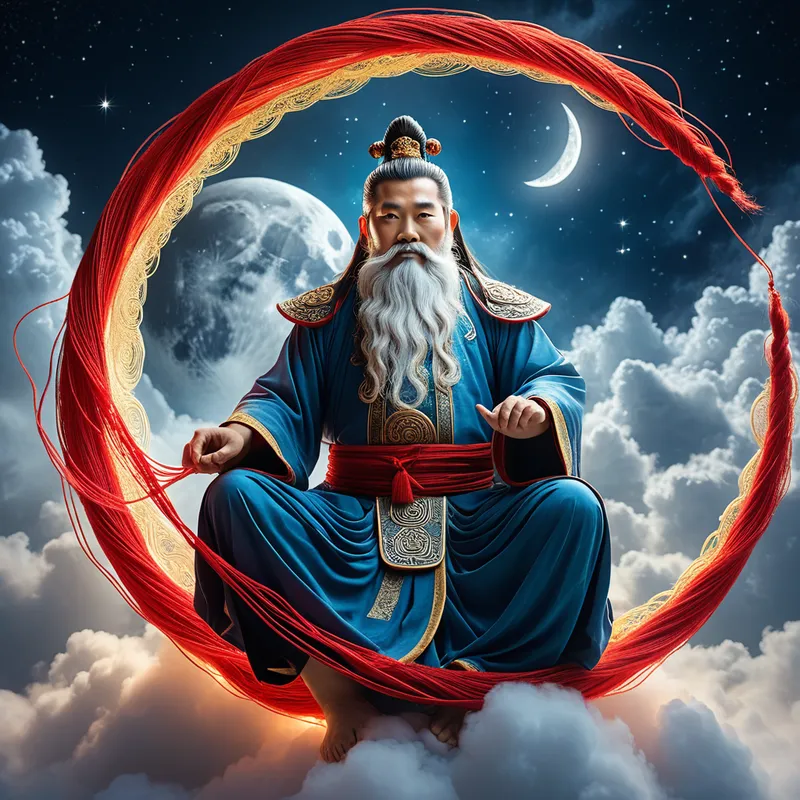
In the deep indigo vault of the night, when [the world](/myths/the-world “Myth from Tarot culture.”/) is held in the breath between waking and dream, the Yuelao stirs. His palace is not of jade or gold, but of quiet moonlight and the memory of first glances. He is ancient, his beard the color of winter clouds, his eyes holding the patient shine of the stars he charts. His sole companion is a great, silent book, its pages not of paper but of shifting constellations and whispered names.
His work is the weaving of the world’s most secret tapestry. From a spool that never empties, he draws a thread the color of joy’s first blush, of lifeblood, of the lanterns hung on a wedding night. This is no ordinary silk. It is spun from the substance of promise itself, invisible to mortal eyes, intangible to mortal touch, yet stronger than mountain chains and more enduring than empires.
On the night a soul is born into the world, crying its first breath, Yuelao turns a page. His finger, tracing the celestial script, finds a name. Then, with the certainty of tides, he finds another. With infinite care, he takes his crimson thread and loops it once, twice, around the ankles of these two distant, newborn hearts. The knot is not one of bondage, but of alignment. A gentle pull, a subtle tension, is set into the fabric of their lives.
The thread may stretch across vast deserts and wide oceans. It may tangle and loop through the crowded streets of lifetimes, caught on the brambles of hardship or the pillars of duty. The two connected may walk for years, oblivious, feeling only a strange tug at their spirit, a haunting sense of something missing that shapes the path they walk. They may pass each other in a market, feeling a sudden, inexplicable stillness in the chaos. They may be born as sworn enemies, their fates locked in conflict, yet bound by a connection that fuels both their hatred and, secretly, their deepest recognition.
The thread does not promise ease. It promises meeting. It ensures that, no matter the chaos, no matter the detour, the two souls will find their way to the necessary encounter. The moment of meeting is not always soft. It can be a collision, a shock, a disaster that unravels a former life. But in that moment, for those who have eyes to see, the invisible cord shimmers into being—a fleeting glimpse of red in a shared glance, a sense of a knot, long tied, finally coming snug.
And on the night of their union, be it in marriage or in a pact that changes the course of their days, it is said Yuelao smiles, and [the moon](/myths/the-moon “Myth from Tarot culture.”/) that night shines with a peculiarly warm, rose-tinted light.
Cultural Origins & Context
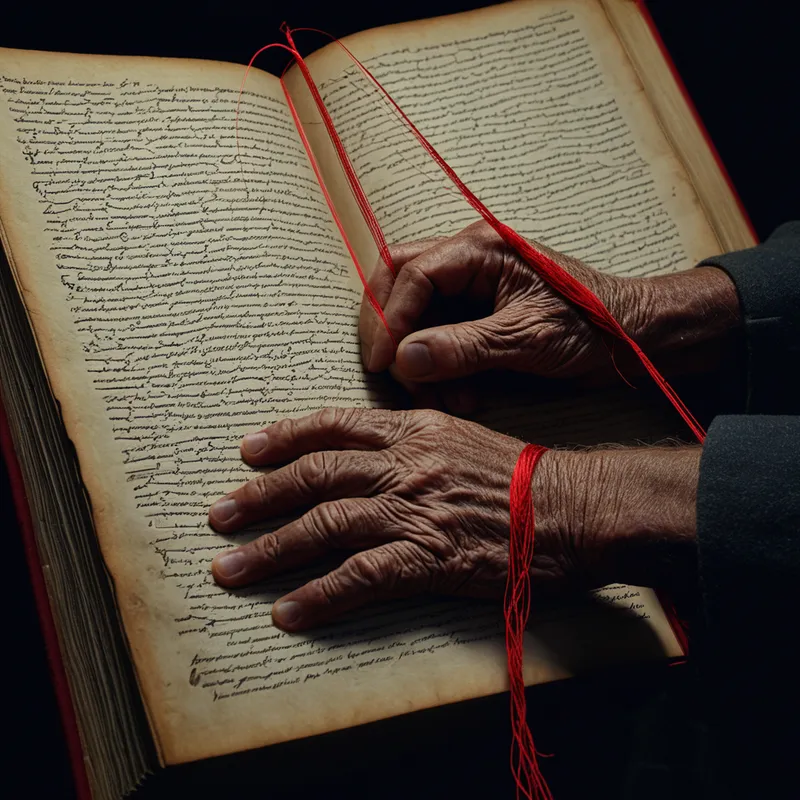
The myth of the Red Thread, or Hong Xian, is most famously associated with the Tang Dynasty story of Wei Gu. In this tale, a young Wei Gu encounters an old man reading a book by moonlight, who reveals himself as the guardian of the marriages of the world. He shows Wei Gu his future wife—a three-year-old girl from a poor family. Horrified, Wei Gu attempts to have [the child](/myths/the-child “Myth from Alchemy culture.”/) killed, only to find years later that his destined wife bears a small scar from the attempt, fulfilling the prophecy in a way he could never have foreseen. This story, recorded in folklore collections, cemented the image of the lunar matchmaker and his unbreakable threads.
The myth functioned as a profound social and psychological stabilizer. In a culture where marriages were often arranged for social, economic, or political reasons, the concept of the Red Thread provided a layer of spiritual meaning and inevitability to the union. It suggested that even within a pragmatic arrangement, a deeper, pre-ordained connection existed, fostering patience, commitment, and the search for harmony within the relationship. It was a story told by grandmothers, referenced in poetry and opera, and served as a comforting explanation for the mysterious, often inexplicable pulls of the heart that defy logic and social convention.
Symbolic Architecture
At its core, the Red Thread is a [symbol](/symbols/symbol “Symbol: A symbol can represent an idea, concept, or belief, serving as a powerful tool for communication and understanding.”/) of Yuanfen, a key concept describing the binding force of [destiny](/symbols/destiny “Symbol: A predetermined course of events or ultimate purpose, often linked to spiritual forces or cosmic order, representing life’s inherent direction.”/) and meaningful coincidence in relationships. It is not merely about romance, but about any profound, fateful [connection](/symbols/connection “Symbol: Connection symbolizes relationships, communication, and bonds among individuals.”/) that alters one’s [life](/symbols/life “Symbol: The symbol of ‘Life’ represents a journey of growth, interconnectedness, and existential meaning, encompassing both the joys and challenges that define human experience.”/) trajectory—a mentor, a sworn [friend](/symbols/friend “Symbol: A friend in dreams often represents companionship, connection, and the desire for social support, reflecting aspects of our interactions and relationships in waking life.”/), a pivotal rival.
The thread is not a leash, but a ley line of the soul. It does not dictate the journey, but ensures the destinations intersect.
Psychologically, the thread represents the invisible [architecture](/symbols/architecture “Symbol: Architecture in dreams often signifies structure, stability, and the framing of personal identity or life’s journey.”/) of the [psyche](/myths/psyche “Myth from Greek culture.”/) that draws us toward the people, experiences, and conflicts necessary for our completion. The Yuelao is an [archetypal image](/symbols/archetypal-image “Symbol: A universal, primordial symbol from the collective unconscious that transcends individual experience and carries profound spiritual or mythic meaning.”/) of [the Self](/myths/the-self “Myth from Jungian culture.”/)—the organizing, transpersonal center of the [psyche](/myths/psyche “Myth from Greek culture.”/) that orchestrates our encounters with the “other” who holds a [piece](/symbols/piece “Symbol: A ‘piece’ in dreams often symbolizes a fragment of the self or a situation that requires integration, reflection, or understanding.”/) of our own unknown wholeness. The [ankle](/symbols/ankle “Symbol: The ankle is often associated with flexibility and support in one’s life journey, and reflects both physical and metaphorical grounding.”/) is a potent symbolic locus: it is a point of connection far from the conscious mind (the head) and the emotional [heart](/symbols/heart “Symbol: The heart symbolizes love, emotion, and the core of one’s existence, representing deep connections with others and self.”/), suggesting this is a binding of [path](/symbols/path “Symbol: The ‘path’ symbolizes a journey, choices, and the direction one’s life is taking, often representing individual growth and exploration.”/) and [movement](/symbols/movement “Symbol: Movement symbolizes change, progress, and the dynamics of personal growth, reflecting an individual’s desire or need to transform their circumstances.”/) through life. We are tied at the point where we walk our [fate](/symbols/fate “Symbol: Fate represents the belief in predetermined outcomes, suggesting that some aspects of life are beyond human control.”/).
The thread’s invisibility speaks to the unconscious [nature](/symbols/nature “Symbol: Nature symbolizes growth, connectivity, and the primal forces of existence.”/) of this pull. We feel it as longing, as curiosity, as [obsession](/symbols/obsession “Symbol: An overwhelming fixation on a person, idea, or object that consumes mental energy and disrupts balance.”/), or as an unavoidable [series](/symbols/series “Symbol: A series in dreams can represent continuity, progression in life events, or the need for routine.”/) of “coincidences” that orchestrate a meeting.
The Dreamer’s Resonance
When the motif of the Red Thread appears in modern dreams, it often signals a psyche grappling with the tension between personal agency and a sensed destiny. The dreamer may see a red string tied to their own wrist or ankle, stretching off into a fog. They may be desperately following it, or trying to cut it. They may find themselves in a room where everyone is connected by a complex, tangled web of crimson filaments.
Somatically, this can correlate with a feeling of being “pulled” in a certain direction in waking life, or a sense of anxious anticipation, as if waiting for a crucial connection to manifest. Psychologically, it marks a process where the unconscious is making the pattern of one’s Yuanfen visible. The dream is highlighting a relationship—current, past, or potential—that carries a fateful weight. To dream of severing the thread may reflect a conscious rejection of a destined path or relationship, often leading to a period of disorientation and psychic rebellion. To dream of tying the thread oneself is a powerful act of claiming one’s role as co-author of one’s fateful connections.

Alchemical Translation
The myth models the alchemical process of coniunctio—[the sacred marriage](/myths/the-sacred-marriage “Myth from Various culture.”/) or union of opposites that is the goal of individuation. The struggle is not to find the other end of the thread, but to consciously recognize and honor the connection once it manifests, and to undertake the shared work it implies.
The alchemy occurs not in the tying of the knot by the deity, but in the conscious weaving of the two lives by the individuals once they find the thread in their hands.
The modern individual’s journey begins in a state of unconscious connection—feeling tugged by unseen forces, repeating relational patterns, yearning for a “missing piece.” The Yuelao represents the inner imperative toward wholeness that sets this longing in motion. The “rising action” is the often-chaotic, meandering path of life where the thread is tested by adversity, ignorance, and resistance.
The “meeting” is the [nigredo](/myths/nigredo “Myth from Alchemical culture.”/), the darkening, where the conscious ego is confronted with the reality of the fateful other. This can feel like a crisis, a destabilization of the former self. The true alchemical work is the albedo and [rubedo](/myths/rubedo “Myth from Alchemical culture.”/)—the whitening and reddening—where the two individuals, now conscious of their binding, choose to engage with it. They must integrate [the shadow](/myths/the-shadow “Myth from Jungian culture.”/) aspects the relationship reveals, transmuting the raw, fateful attraction into a conscious, creative partnership—be it in love, work, or art.
The [triumph](/myths/triumph “Myth from Roman culture.”/) is not a “happily ever after” in a fairy-tale sense, but the achievement of a conscious Yuanfen. It is the moment one stops being a puppet of the invisible thread and becomes a weaver at its loom, collaborating with destiny to create something that did not exist before: a shared, authentic life. The red thread thus becomes the warp, and our conscious choices become the weft, in the tapestry of a soul-made fate.
Associated Symbols
Explore related symbols from the CaleaDream lexicon: