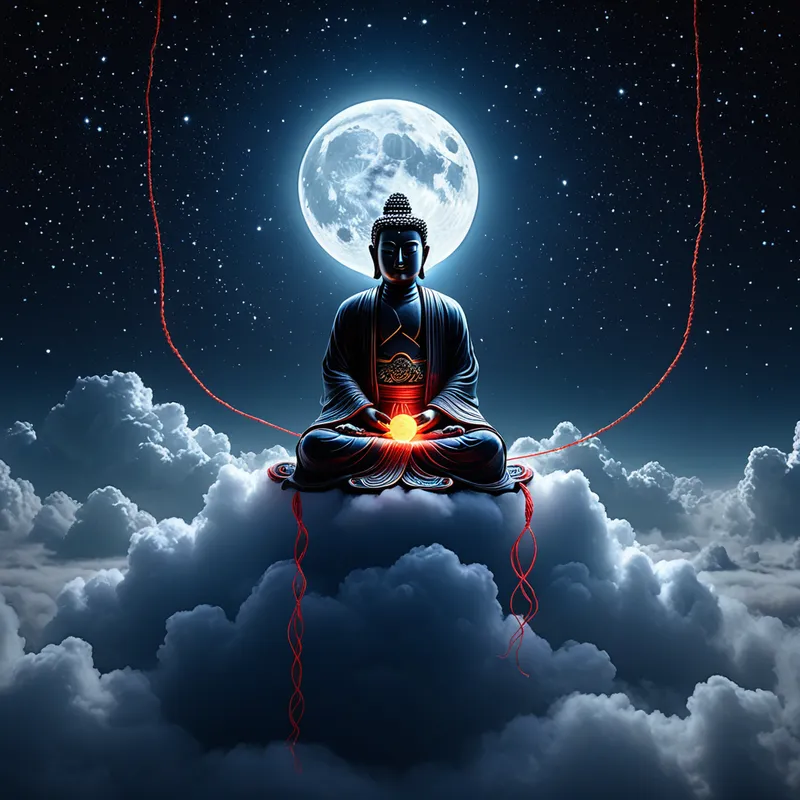
The Red String of Fate Myth Meaning & Symbolism
An invisible crimson thread connects those destined to meet, tied by a celestial matchmaker, guiding souls through time and circumstance toward their profound connection.
The Tale of The Red String of Fate
Listen, and hear a truth woven not with wool, but with starlight and breath. In the silent, velvet expanse between the turning of the heavens, there dwells an ancient one. Some call her Yue Xia Lao, the Old Man of the Moon. Others sense her as an ageless, nameless goddess of connections. Her palace is not of jade or gold, but of memory and potential, a loom-house at the axis of all that might be.
Her work is eternal, and her tools are simple: a boundless ledger of names written in fading ink, and a spool of thread the color of a newborn’s cry, of heart’s blood, of the first blush of dawn—a red that vibrates with the frequency of fate itself.
On a night when the moon is a sliver, a silver hook in the sky, she opens her book. Her finger, gnarled like an ancient root, traces a name. Wei. A boy, sleeping fitfully in a humble village, dreaming of a face he has never seen. The deity takes her thread. With a breath that smells of plum blossoms and cold stone, she ties one end gently, so gently it leaves no mark, around the smallest finger of his left hand. The thread, now alive with purpose, streams out from her chamber, a luminous filament diving through the clouds, across mountains black against the horizon, over a wide, sighing river.
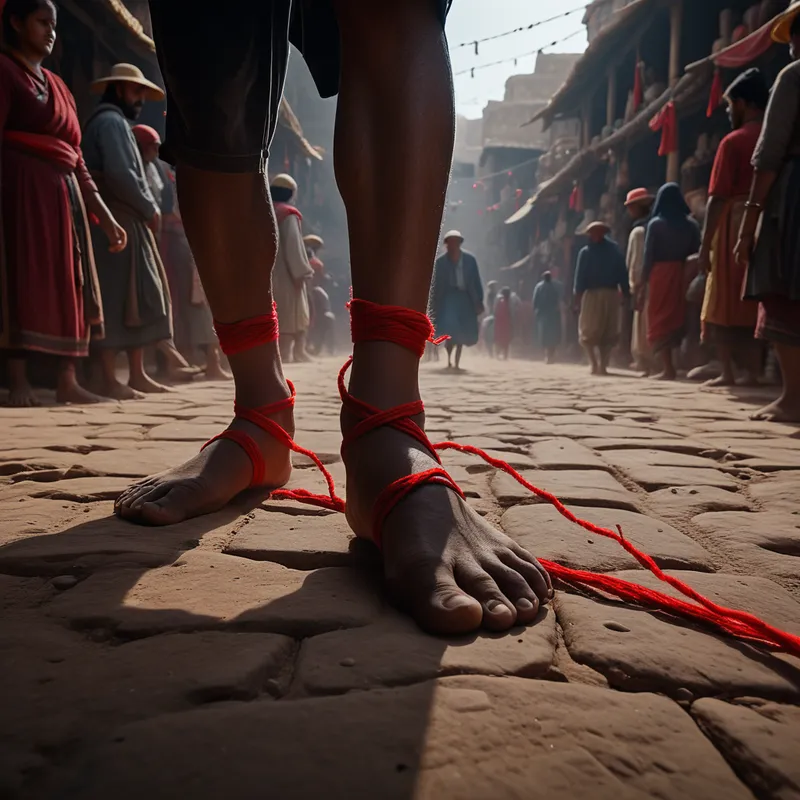
It snakes into another village, into a room where a girl named Ling stares at the same moon, her heart a hollow cup. The thread circles her ankle, a binding as soft as a sigh. She feels nothing but a sudden, inexplicable warmth and a longing that pulls at her ribs.
Years flow like the river. The thread does not tether them to one spot; it is not a leash. It is a compass needle buried in the soul. Wei becomes a scholar, traveling far to the capital. Ling’s family falls into hardship, and she journeys to the same bustling city to seek work. The thread between them tangles, loops, and knots around the lives of others—brief loves, mistaken turns, years of solitude. It is pulled taut by distance, then coils in slack confusion in the same crowded street, missing by a breath.
Until the day a storm sweeps the market. The crowd scatters like leaves. Wei, seeking shelter, stumbles into a narrow alcove. Ling is already there, shaking the rain from her sleeves. Their eyes meet. No thunderclap sounds. No choir of angels sings. But in that moment, the invisible thread, stretched and tested by a thousand journeys, hums like a plucked harp string. It pulls taut, not with force, but with a final, undeniable certainty. The celestial knot, tied in the silence before time, is now complete. They do not see the thread. They only feel, for the first time, that they have come home.
Cultural Origins & Context
The myth of the Red String of Fate is most prominently articulated in East Asian folklore, with its clearest documentation in Chinese legends surrounding Yue Xia Lao. From China, it wove its way into Korean, Japanese, and Vietnamese traditions, adapting to local nuances while retaining its core essence. It was not a myth confined to temple scrolls but a living, breathing story told by grandmothers, referenced in poetry, and invoked in quiet hopes. It served a profound societal function: it explained the mysterious, often painful, process of finding one’s destined partner in a world of arranged marriages and vast, impersonal empires. It offered comfort, suggesting that loneliness and wrong turns were not meaningless, but part of a celestial navigation. The randomness of life was, in fact, a guided journey. This myth gave agency to fate and sanctified the marital bond as pre-ordained, while also validating the deep, often frustrating, search that precedes it.
Symbolic Architecture
The myth’s power lies in its sparse, potent symbols. The red string itself is the central glyph. It is connection made visible to the cosmic eye, but invisible to the human one. It represents the intangible bonds of destiny, karma, and profound relational truth that operate beneath the surface of conscious life.
The thread is not a path laid out, but a tensile connection that endures all detours.
The celestial matchmaker (Yue Xia Lao) symbolizes the ordering principle of the unconscious itself—the Self, in Jungian terms—which orchestrates the connections essential for our psychological completion. This figure is not a micromanager but a initial binder, setting a potential into motion. The ankle or little finger signifies the point of contact where fate meets the individual body, the anchoring of transcendent pattern into earthly, somatic existence. The tangling, stretching, and knotting of the thread is a masterful symbol for life’s vicissitudes. The destined connection is not a straight line, but one that must be earned through the complex, messy process of living, through relationships that teach, wound, and prepare us.
The Dreamer’s Resonance
When this myth activates in the modern psyche, it often surfaces in dreams of searching, of missed connections, or of profound, wordless recognition. A dreamer may find themselves in an endless airport terminal, seeing a familiar back disappear through a gate. They may dream of holding one end of a string that leads into a fog, feeling a gentle, insistent pull. They may simply dream of a color—a vivid, overwhelming red.
These are not literal premonitions of a soulmate. Somatically, they signal the psyche’s navigation toward wholeness. The “other” connected by the thread is often an aspect of the dreamer’s own soul—the Anima or Animus—or the symbolic representation of a relationship that will crucially further their individuation. The frustration in the dream mirrors the ego’s resistance or blindness to this deeper movement. The final moment of connection in the dream can feel like a psychic click, a resolution of deep tension, indicating a nascent conscious realization of what the soul has already bound itself to.

Alchemical Translation
The alchemical journey modeled here is the transmutation of searching into finding, and of potential connection into actualized relationship. The initial state is one of separation, a soul unknowingly tethered but feeling the ache of that tether as loneliness or restless seeking. The long journey of tangles and near-misses represents the nigredo, the darkening, where the ego endures confusion, wrong turns, and the pain of relationships that are not “the one”—all of which serve to burn away immature fantasies about love and connection.
The work is not to find the thread, but to become strong enough to feel its tension and wise enough to follow its pull.
The moment of stormy meeting in the alcove is the coniunctio, the sacred marriage. This is not merely a romantic union, but the psychic integration of previously disconnected parts. The ego, having been humbled and prepared by life’s journey, finally aligns with the destiny orchestrated by the Self. The red thread, having always been there, now becomes functional; its purpose is fulfilled in conscious recognition. For the modern individual, this translates to the profound inner shift when we stop searching for what will complete us out there and begin to honor the mysterious, often inconvenient, pulls of our own deepest nature. We realize we are not forging our path in empty space, but walking a wire that has been held, all along, by the ancient, quiet hands of our own totality.
Associated Symbols
Explore related symbols from the CaleaDream lexicon: