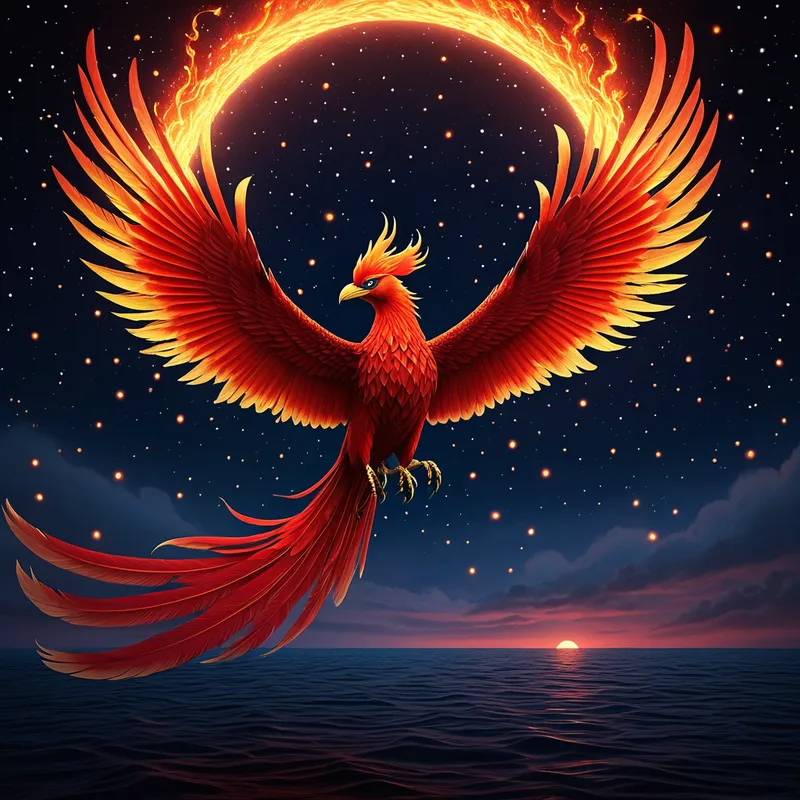
The Red Phoenix Myth Meaning & Symbolism
A celestial guardian of the south, the Red Phoenix embodies the alchemy of fire, heralding the death of the old and the glorious birth of the new.
The Tale of The Red Phoenix
Listen, and hear the whisper of the southern winds. In the time before time, when [the world](/myths/the-world “Myth from Tarot culture.”/) was a canvas of primal chaos, the Celestial Emperor decreed order from [the void](/myths/the-void “Myth from Buddhist culture.”/). From the four cardinal directions, he summoned his sovereign guardians. And from the blazing crucible of the south, she was born.
Her first cry was not a sound, but a color—a wave of vermilion that stained [the horizon](/myths/the-horizon “Myth from Various culture.”/). She was the [Zhuque](/myths/zhuque “Myth from Chinese culture.”/), the Red [Phoenix](/myths/phoenix “Myth from Egyptian culture.”/). Her body was not merely feathered, but woven from the essence of summer’s zenith: the crimson of the setting sun, the gold of ripening grain, the iridescent fire of molten metal. Her song was the crackle of a sacred flame, a melody that caused the five notes of the pentatonic scale to resonate in harmony. She did not walk upon [the earth](/myths/the-earth “Myth from Hindu culture.”/), for her domain was [the sky](/myths/the-sky “Myth from Persian culture.”/) and the pure, transformative element of fire.
For eons, she presided over the southern quadrant, a serene and majestic sovereign. Her presence ensured the sun’s journey to its highest point, the flourishing of life in the fierce heat, and the orderly procession of the seasons. Yet, her truest nature was not in perpetual reign, but in sacred cycle. As the world grew weary, as energies stagnated and forms became rigid, a deep knowing stirred within her celestial heart.
A stillness would fall. The winds from the south would cease. Then, with a gaze both sorrowful and resolute, she would begin to gather the very essence of her being. Not from the world around her, but from the accumulated wisdom, beauty, and virtue of her long reign. From the memory of every sunrise she had heralded, she plucked a feather of gold. From the [justice](/myths/justice “Myth from Tarot culture.”/) of her watch, a plume of scarlet. She wove them into a nest upon the highest branch of the Fusang tree, a nest that glimmered like a captured star.
Then, she would sing her final song of the age—a lament and a lullaby that shook the pillars of heaven. As the last note hung in the air, she would settle upon her glorious nest, bow her radiant head, and allow her own [sacred fire](/myths/sacred-fire “Myth from Various culture.”/) to consume her. Feather, bone, and spirit dissolved in a conflagration of blinding purity, a pyre that lit the heavens for nine days and nine nights. All that remained was a mound of silken ash, glowing with a gentle warmth.
But watch. From the heart of that ash, a subtle movement. A single, perfect vermilion feather, damp with dew, would push forth. Then another. Until, from the ashes of her former self, a new Zhuque would rise, more radiant, more potent, and more beautiful than before, her first cry heralding not an end, but a glorious and necessary beginning for all under heaven.

Cultural Origins & Context
The Red Phoenix, or Zhuque, is not a singular character from a linear tale, but a cosmological constant. Its origins are woven into the very fabric of early Chinese astrological and philosophical systems, such as the Wuxing (Five Phases) and the Si Xiang (Four Symbols). It served as the guardian of the southern quadrant of the sky, associated with the season of summer, the element of fire, and the color red.
This myth was not passed down by a single bard, but was cultivated by court astronomers, philosophers of statecraft, and folk tradition alike. For the imperial court, [the Phoenix](/myths/the-phoenix “Myth from Global/Universal culture.”/) was an emblem of the empress and virtuous rule, its cyclical rebirth mirroring [the Mandate of Heaven](/myths/the-mandate-of-heaven “Myth from Chinese culture.”/)—the idea that a dynasty ruled only with divine approval and would fall if it became corrupt, making way for renewal. For the common people, it was a potent symbol of resilience, a promise that after the most devastating fire (of war, famine, or personal tragedy), life could and would begin anew. Its societal function was profound: to provide a cosmic blueprint for change, assuring that destruction was never an absolute end, but a phase within a greater, benevolent order.
Symbolic Architecture
The Red [Phoenix](/symbols/phoenix “Symbol: The Phoenix symbolizes rebirth, transformation, and the cycle of life, often representing the ability to rise from challenges stronger and renewed.”/) is the ultimate [archetype](/symbols/archetype “Symbol: A universal, primordial pattern or prototype in the collective unconscious that shapes human experience, behavior, and creative expression.”/) of transformative fire. It is not the [wildfire](/symbols/wildfire “Symbol: A powerful natural force symbolizing rapid, uncontrollable change, destruction, and renewal.”/) of blind destruction, but [the alchemist](/myths/the-alchemist “Myth from Various culture.”/)’s [furnace](/symbols/furnace “Symbol: A furnace represents transformation through intense heat, purification, and the containment of powerful energy. It symbolizes both creative potential and destructive force.”/), the sacred hearth, the controlled burn that clears [the way](/myths/the-way “Myth from Taoist culture.”/) for new growth.
The Phoenix does not fear its own ashes, for it knows they are the fertile soil from which its greater self will rise.
Its association with the south and [summer](/symbols/summer “Symbol: Summer often symbolizes warmth, growth, and abundance, representing a time of vitality and fruition.”/) points to the [zenith](/symbols/zenith “Symbol: The highest point in the sky or life’s peak moment, representing spiritual culmination, achievement, and divine connection.”/) of power, the peak of influence, and the full [expression](/symbols/expression “Symbol: Expression represents the act of conveying thoughts, emotions, and individuality, emphasizing personal communication and creativity.”/) of one’s [nature](/symbols/nature “Symbol: Nature symbolizes growth, connectivity, and the primal forces of existence.”/). Psychologically, it represents [the ego](/myths/the-ego “Myth from Jungian culture.”/) at its most brilliant and accomplished [plateau](/symbols/plateau “Symbol: A flat elevated landform representing a period of stability, stagnation, or transition between phases of growth and decline.”/). The myth’s profound [lesson](/symbols/lesson “Symbol: A lesson in a dream signifies a learning opportunity, often reflecting personal growth or unresolved issues requiring attention.”/) is that even this peak is not permanent; to cling to it is to stagnate. The conscious, willing descent into the “fire” is an act of supreme courage—the sacrifice of a known and successful [identity](/symbols/identity “Symbol: Identity represents the sense of self, encompassing personal beliefs, cultural background, and social roles.”/) for the promise of an unknown, greater wholeness. The [nest](/symbols/nest “Symbol: A ‘nest’ symbolizes safety, home, and the nurturing aspects of personal and familial connections.”/) built from one’s own virtues signifies that the fuel for this transformation must come from within; we must consume our own accumulated achievements, [knowledge](/symbols/knowledge “Symbol: Knowledge symbolizes learning, understanding, and wisdom, embodying the acquisition of information and enlightenment.”/), and even our pride to be reborn.
The element of fire here is multifaceted: it is [passion](/symbols/passion “Symbol: Intense emotional or physical desire, often linked to love, creativity, or purpose. Represents life force and deep engagement.”/), [spirit](/symbols/spirit “Symbol: Spirit symbolizes the essence of life, vitality, and the spiritual journey of the individual.”/) (shen), [consciousness](/symbols/consciousness “Symbol: Consciousness represents the state of awareness and perception, encompassing thoughts, feelings, and experiences.”/), and the purifying force that separates essence from dross. The Phoenix models a [death](/symbols/death “Symbol: Symbolizes transformation, endings, and new beginnings; often associated with fear of the unknown.”/) not by external catastrophe, but by an internally guided process of [incineration](/symbols/incineration “Symbol: Complete destruction by fire, often representing purification, sacrifice, or irreversible transformation in spiritual and mythological contexts.”/) and refinement.
The Dreamer’s Resonance
When the Red Phoenix alights in the modern dreamscape, it signals a profound somatic and psychological tipping point. The dreamer is likely at the end of a significant life chapter—a career, a relationship, a long-held self-concept—that has run its course. There is a deep, often uncomfortable, sense of being “burned out” in the most literal archetypal sense.
Dreams may feature images of beautiful but crumbling structures, glorious sunsets, or [the self](/myths/the-self “Myth from Jungian culture.”/) surrounded by symbols of past success that now feel hollow. The Phoenix itself may appear, not in flight, but perched and watching, or even as a feeling of intense, contained heat in the chest or gut. This is the somatic resonance: the body knows a necessary death is imminent before the conscious mind can accept it. The psychological process is one of gathering—often amid anxiety and grief—the core virtues and lessons from the ending phase. The dream asks: What from this life you have lived is truly immortal? What will you carry into the fire? The terror of the dream is the fear of annihilation; its promise is that the dreamer contains the blueprint for their own renewal within the ashes of what must be let go.

Alchemical Translation
In the journey of individuation—the process of becoming one’s true, integrated Self—the Phoenix myth maps the critical stage of enantiodromia, where a state flows into its opposite. The conscious personality, having built a stable and competent identity (the reigning Phoenix), must eventually encounter its own limits. To grow further, this identity structure must undergo a voluntary dissolution.
The alchemy of the soul requires that the gold of the ego be willingly placed in the fire, not to be destroyed, but to be transmuted.
The modern individual engages in this “Phoenix Process” when they quit the secure job to find true vocation, end the familiar but lifeless relationship, or surrender a long-cherished belief about themselves. It is the “dark night of the soul” undertaken with purpose. The building of the nest from one’s own feathers is the inner work of reflection and integration—acknowledging one’s strengths and achievements not as permanent trophies, but as fuel for the next ascent. The fire is [the crucible](/myths/the-crucible “Myth from Alchemical culture.”/) of intense feeling, therapy, solitude, or crisis that breaks down the old form.
The rebirth is not a return to youth, but the emergence of a more complex consciousness. The new Phoenix has the wisdom of its previous cycles within it. For the individual, this translates to a hard-won authenticity. The passions that once burned uncontrollably (the destructive aspect of fire) are now integrated as focused will and creative spirit (the constructive aspect of fire). One rises from the ashes not simply recovered, but recalibrated—carrying forward the essence of all one has been, now serving a deeper, more sovereign purpose aligned with the true Self, the inner Shangdi. The myth assures us that within every ending, especially the ones we choose, are the glowing cinders of a destined beginning.
Associated Symbols
Explore related symbols from the CaleaDream lexicon: