The Rebis Myth Meaning & Symbolism
The alchemical tale of the sacred marriage of opposites, culminating in the creation of the Rebis, a unified being of perfected soul and matter.
The Tale of The Rebis
In the beginning, there was the One. But [the world](/myths/the-world “Myth from Tarot culture.”/), in its falling, shattered the One into a thousand glittering fragments of opposition. In the hidden heart of the world, in the secret workshop where earth dreams of becoming star, [the Great Work](/myths/the-great-work “Myth from Alchemical culture.”/) began not with fire, but with a sigh of longing.
The Materia Prima slept, a dark, formless sea. From it arose the King, crowned in solar gold, his heart a furnace of will and spirit. And from it arose the Queen, veiled in lunar silver, her being a chalice of soul and feeling. They were siblings, yet strangers; destined partners gazing across an abyss of their own natures. He was Sulphur, the lion of desire. She was [Mercury](/myths/mercury “Myth from Roman culture.”/), the winged spirit. Between them lay [the salt of the earth](/myths/the-salt-of-the-earth “Myth from Greek culture.”/), the heavy body that kept them apart.
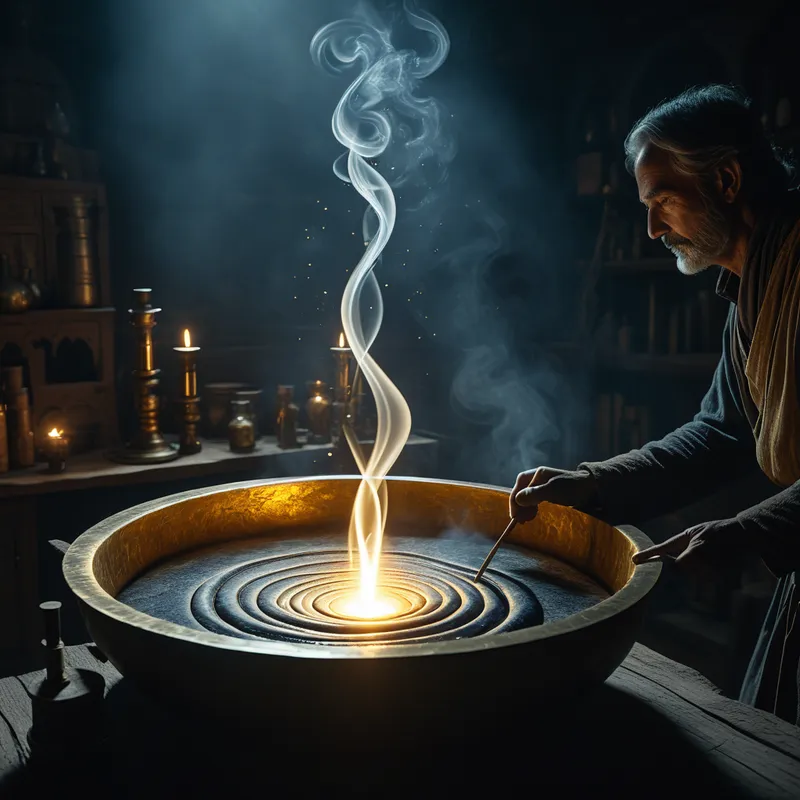
Their courtship was a war. [The alchemist](/myths/the-alchemist “Myth from Various culture.”/), the unseen midwife of this drama, subjected them to the ordeal. The King was plunged into the bath, his fiery pride dissolved into tears. The Queen was exposed to the flame, her reflective coolness heated to passion. This was the [Nigredo](/myths/nigredo “Myth from Alchemical culture.”/), the blackening. All distinction rotted in the dark of the sealed flask. Hope itself seemed to putrefy.
Yet, in that absolute night, a new longing stirred—not for dominance, but for completion. The purified King, no longer just fire, became a penetrating warmth. The purified Queen, no longer just fluid, became a clarifying light. In the Albedo, they washed each other clean of dross. He saw his reflection in her, and she saw hers in him. A conversation began in the silence of [the vessel](/myths/the-vessel “Myth from Alchemical culture.”/).
Then, [the sacred marriage](/myths/the-sacred-marriage “Myth from Various culture.”/), the Coniunctio. It was not a conquest, but a mutual surrender. Solar gold and lunar silver flowed together in [the alembic](/myths/the-alembic “Myth from Alchemical culture.”/), not as mixture, but as fusion. A child of their union was conceived—not a third [thing](/myths/thing “Myth from Norse culture.”/), but the One reborn. The process glowed with [the rose](/myths/the-rose “Myth from Persian culture.”/) of dawn and the fierce red of the setting sun, the [Rubedo](/myths/rubedo “Myth from Alchemical culture.”/).
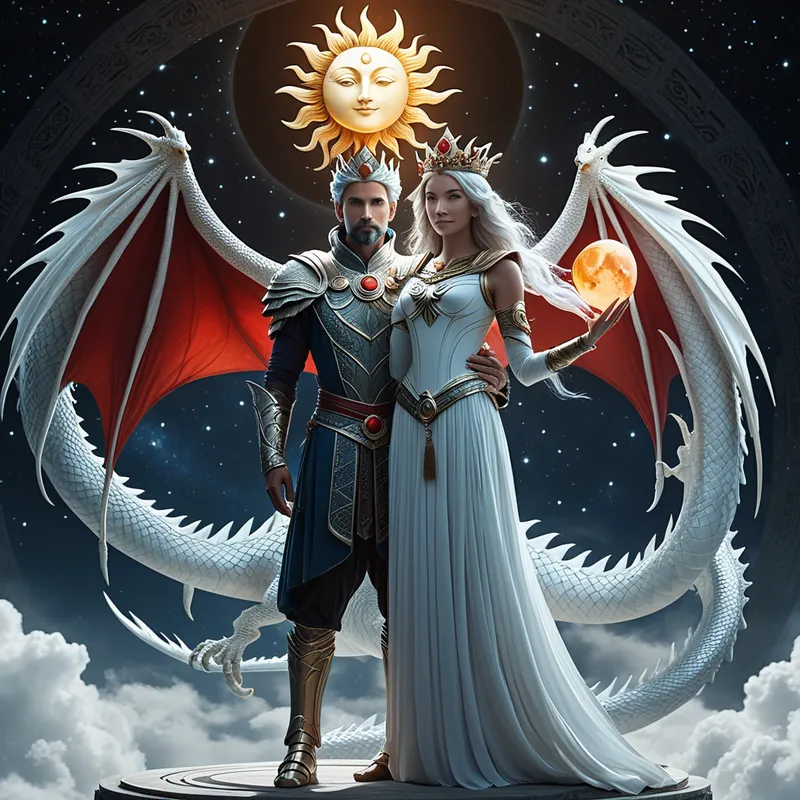
And from the fire-steeped athanor, it stepped forth: The [Rebis](/myths/rebis “Myth from Alchemical culture.”/). One body, seamless and whole, of fused red and white. Two heads—one crowned King, one crowned Queen—gazing in serene harmony upon a world no longer divided. In its four hands, it held the sun and [the moon](/myths/the-moon “Myth from Tarot culture.”/), a scepter and a chalice. Beneath its feet lay the vanquished Draco, the chaotic dragon of nature now tamed and serving as its throne. It was the [Philosopher’s Stone](/myths/philosophers-stone “Myth from Alchemical culture.”/) made flesh, the embodied whisper of the universe remembering its original, undivided state.
Cultural Origins & Context
The myth of the Rebis is not a folktale with a single author, but the culminating image of a centuries-long, cross-cultural intellectual and spiritual pursuit: Western alchemy. Emerging from the syncretism of Hellenistic Egypt, Islamic scholarship, and medieval Christian mysticism, alchemy was a langue des oiseaux (language of the birds). Its texts, like the [Rosarium Philosophorum](/myths/rosarium-philosophorum “Myth from Alchemical culture.”/) or the works of [Hermes Trismegistus](/myths/hermes-trismegistus “Myth from Greek culture.”/), were deliberately obscure, encoded to protect sacred knowledge from the profane and to ensure the seeker was psychologically prepared.
The myth was passed down through cryptic illustrations—woodcuts and engravings in hand-copied manuscripts—showing the stages of the Work. It was told in laboratories that were also chapels, where monks and adepts like Paracelsus saw no division between transforming lead and transforming the soul. Its societal function was dual: exoterically, it promised the transmutation of metals (funding many a patron’s hopes); esoterically, it was a map for individuation, a guide for the spiritual elite to achieve inner unity and gnosis. The Rebis was the ultimate emblem of this completed quest.
Symbolic Architecture
The Rebis is the archetypal [symbol](/symbols/symbol “Symbol: A symbol can represent an idea, concept, or belief, serving as a powerful tool for communication and understanding.”/) of the complexio oppositorum—the union of opposites. It represents the [resolution](/symbols/resolution “Symbol: In arts and music, resolution refers to the movement from dissonance to consonance, creating a sense of completion, release, or finality in a composition.”/) of every fundamental duality that fractures [human](/symbols/human “Symbol: The symbol of a human represents individuality, complexity of emotions, and social relationships.”/) experience: [spirit](/symbols/spirit “Symbol: Spirit symbolizes the essence of life, vitality, and the spiritual journey of the individual.”/) and matter, conscious and unconscious, masculine and feminine, thinking and feeling, [heaven](/symbols/heaven “Symbol: A symbolic journey toward ultimate fulfillment, spiritual transcendence, or connection with the divine, often representing life’s highest aspirations.”/) and [earth](/symbols/earth “Symbol: The symbol of Earth often represents grounding, stability, and the physical realm, embodying a connection to nature and the innate support it provides.”/).
The goal of the Work is not to choose a side, but to give birth to the vessel that can contain both.
The [King](/symbols/king “Symbol: A symbol of ultimate authority, leadership, and societal order, often representing the dreamer’s inner power or external control figures.”/) and [Queen](/symbols/queen “Symbol: A queen represents authority, power, nurturing, and femininity, often embodying leadership and responsibility.”/) are not merely [gender](/symbols/gender “Symbol: Gender in arts and music represents the expression, performance, and cultural construction of identity through creative mediums.”/) principles but psychological dominants. The [King](/symbols/king “Symbol: A symbol of ultimate authority, leadership, and societal order, often representing the dreamer’s inner power or external control figures.”/) symbolizes [the Logos](/myths/the-logos “Myth from Biblical culture.”/) principle: directed [consciousness](/symbols/consciousness “Symbol: Consciousness represents the state of awareness and perception, encompassing thoughts, feelings, and experiences.”/), discipline, and active will. The [Queen](/symbols/queen “Symbol: A queen represents authority, power, nurturing, and femininity, often embodying leadership and responsibility.”/) symbolizes the Eros principle: relatedness, [intuition](/symbols/intuition “Symbol: The immediate, non-rational understanding of truth or insight, often described as a ‘gut feeling’ or inner knowing that bypasses conscious reasoning.”/), and the [soul](/symbols/soul “Symbol: The soul represents the essence of a person, encompassing their spirit, identity, and connection to the universe.”/)‘s [depth](/symbols/depth “Symbol: Represents profound layers of consciousness, hidden truths, or the unknown aspects of existence, often symbolizing introspection and existential exploration.”/). Their violent [separation](/symbols/separation “Symbol: A spiritual or mythic division between realms, states of being, or consciousness, often marking a transition or loss of connection.”/) (Nigredo) is the necessary [crisis](/symbols/crisis “Symbol: A crisis symbolizes turmoil, urgent challenges, and the need for immediate resolution or change.”/) of [the ego](/myths/the-ego “Myth from Jungian culture.”/), which must be humbled and dissolved for a deeper Self to emerge. Their courtship and [marriage](/symbols/marriage “Symbol: Marriage symbolizes commitment, partnership, and the merging of two identities, often reflecting one’s feelings about relationships and social obligations.”/) are the [dialogue](/symbols/dialogue “Symbol: Conversation or exchange between characters, representing communication, relationships, and narrative flow in games and leisure activities.”/) between [the ego](/myths/the-ego “Myth from Jungian culture.”/) and the unconscious, a painful but creative [tension](/symbols/tension “Symbol: A state of mental or emotional strain, often manifesting physically as tightness, pressure, or unease, signaling unresolved conflict or anticipation.”/) that leads to a new center of [personality](/symbols/personality “Symbol: Personality in dreams often symbolizes the traits and characteristics of the dreamer, reflecting how they perceive themselves and how they believe they are perceived by others.”/).
The Rebis’s two heads signify a consciousness that can perceive from multiple, simultaneous viewpoints without internal conflict. Its single, androgynous [body](/symbols/body “Symbol: The body in dreams often symbolizes the dreamer’s self-identity, personal health, and the relationship they have with their physical existence.”/) is the incarnated Self, where [paradox](/symbols/paradox “Symbol: A contradictory yet true concept that challenges logic and perception, often representing unresolved tensions or profound truths.”/) becomes lived [reality](/symbols/reality “Symbol: Reality signifies the state of existence and perception, often reflecting one’s understanding of truth and life experiences.”/). The sun and [moon](/symbols/moon “Symbol: The Moon symbolizes intuition, emotional depth, and the cyclical nature of life, often reflecting the inner self and subconscious desires.”/) in its hands show mastery over the cycles of day and [night](/symbols/night “Symbol: Night often symbolizes the unconscious, mystery, and the unknown, representing the realm of dreams and intuition.”/), of [action](/symbols/action “Symbol: Action in dreams represents the drive for agency, motivation, and the ability to take control of situations in waking life.”/) and [reflection](/symbols/reflection “Symbol: Reflection signifies self-examination, awareness, and the search for truth within oneself.”/). The [dragon](/symbols/dragon “Symbol: Dragons are potent symbols of power, wisdom, and transformation, often embodying the duality of creation and destruction.”/) underfoot represents the redeemed instinctual and chthonic [energy](/symbols/energy “Symbol: Energy symbolizes vitality, motivation, and the drive that fuels actions and ambitions.”/), no longer an [enemy](/symbols/enemy “Symbol: An enemy in dreams often symbolizes an internal conflict, self-doubt, or an aspect of oneself that one struggles to accept.”/) but the very [foundation](/symbols/foundation “Symbol: A foundation symbolizes the underlying support systems, values, and beliefs that shape one’s life, serving as the bedrock for growth and development.”/) of one’s realized being.
The Dreamer’s Resonance
When this myth stirs in the modern dreamer, it signals a profound somatic and psychological process of integration. One may dream of meeting one’s double or opposite-gendered self; of two animals, like a lion and an eagle, fighting then merging; or of a room with two doors that suddenly become one archway.
Somatically, this can feel like a deep, central tension—a pull between two irreconcilable needs or identities—that begins to soften into a strange, warm vibration. Psychologically, it is the process of shadow-work reaching its zenith. The dreamer is not just confronting their shadow but wedding it. The emotional tone shifts from the anxiety of [the Nigredo](/myths/the-nigredo “Myth from Alchemical culture.”/) (dreams of rotting, being trapped) to the melancholic clarity of the Albedo (dreams of washing, white landscapes) and finally to the passionate, embodied certainty of [the Rubedo](/myths/the-rubedo “Myth from Alchemical culture.”/) (dreams of red gold, [sacred marriage](/myths/sacred-marriage “Myth from Alchemy culture.”/), radiant children).

Alchemical Translation
For the modern individual, the myth of the Rebis models the complete arc of psychic transmutation. Our base metal is the fragmented [psyche](/myths/psyche “Myth from Greek culture.”/), identified solely with the conscious ego (the King or the Queen). The furnace is the heat of lived experience—crises, relationships, and introspective work that forces a confrontation with all we have excluded.
Individuation is the alchemy of the soul: first, everything must fall apart so that it can come together correctly.
The Coniunctio is not a peaceful compromise but a fiery, creative confrontation with the inner other. It might manifest as the thinker learning to value emotion, the artist developing discipline, or the activist integrating contemplation. The birth of the Rebis is the emergence of the Self as the inner ruler. This is not a state of bland neutrality, but of dynamic wholeness where one can be decisive and receptive, firm and compassionate, individual and connected.
[The Philosopher’s Stone](/myths/the-philosophers-stone “Myth from Alchemical culture.”/) it holds is the transformed personality itself—now capable of “transmuting” base experiences into golden meaning, of touching the world with a [Midas](/myths/midas “Myth from Global/Universal culture.”/)-touch of consciousness. The myth assures us that the endpoint of our deepest struggles is not merely balance, but a transcendent, embodied unity. We are not meant to be half-beings in eternal search, but, through the ordeal of our own nature, to become the Rebis—the One who is Two, gazing upon a world made whole in its sight.
Associated Symbols
Explore related symbols from the CaleaDream lexicon: