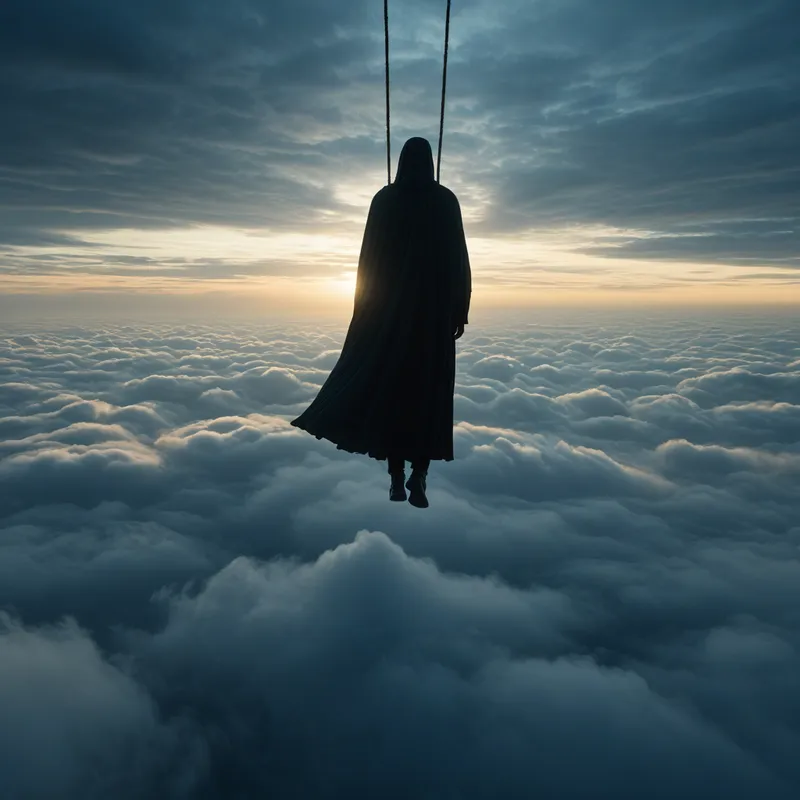
The Rapture Myth Meaning & Symbolism
A prophetic vision of the faithful being suddenly gathered to heaven, leaving a world in tribulation, symbolizing ultimate separation and divine judgment.
The Tale of The Rapture
Listen. There is a moment coming, a breath held at [the threshold](/myths/the-threshold “Myth from Folklore culture.”/) of [the world](/myths/the-world “Myth from Tarot culture.”/).
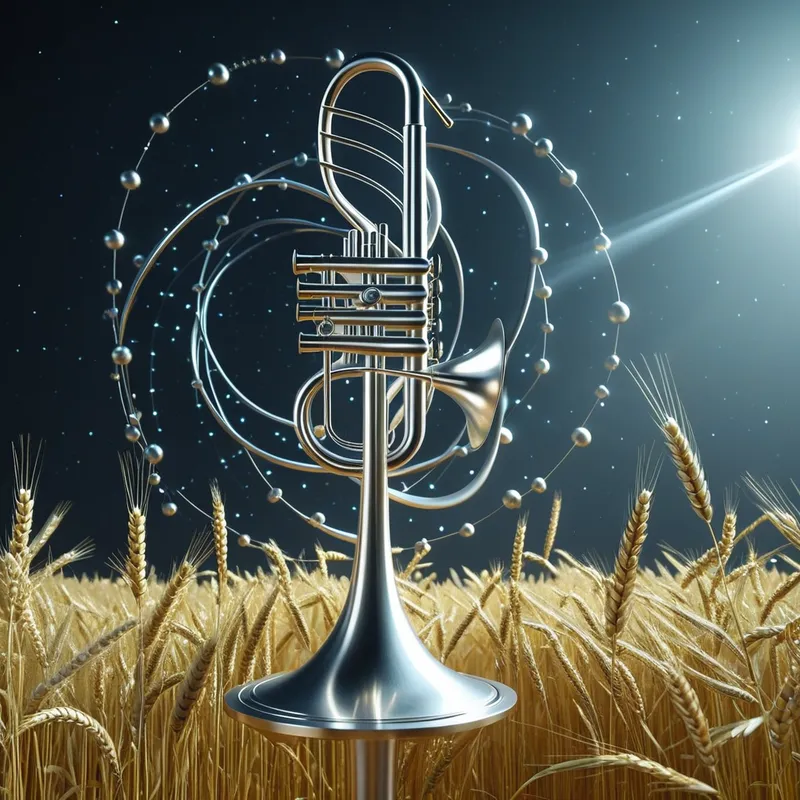
It begins not with a war, but with a vanishing. A sigh pulled from the fabric of things. On a day that dawns like any other—in fields where workers bend their backs, in markets humming with commerce, in the silent chambers where two sleepers share a bed—a sound is heard. Not a sound of crashing, but of calling. It is the voice of the Christos, a cry like a silver trumpet cleaving the air, a command uttered by the Archangel.
And [the earth](/myths/the-earth “Myth from Hindu culture.”/) trembles not in violence, but in release.
Those whose hearts are tuned to that frequency—the ones who loved in secret, who hoped against the visible evidence, who wore their faith like a hidden garment—feel a sudden lightness. It is a pull from the marrow of their bones, a gentle, irresistible summons upward. They do not struggle. They simply… let go. The farmer’s hand opens, and the plow falls. The merchant’s coin drops, ringing on the cobblestones. One sleeper rises from the bed, leaving behind the warm impression on the sheets, while the other remains, lost in a dream of absence.
They are caught up, the scriptures say. Harpazo. Seized. They ascend, not as ghosts, but in bodies transformed, streaming like living light toward the clouds. Below, the world does not end. It continues. But it is now a world of echoes. A car swerves on an empty highway, its driver gone. A meal cools on a table set for two. A cry of confusion rises, then multiplies into a global wail of incomprehension. The taken are a mystery, a wound in the normalcy of the world. What remains is the Left Behind—a planet plunged into a terrible, clarifying silence, now facing the unveiled machinery of a long-prophesied tribulation. The tale ends not with an ending, but with a severing, a great sorting of realities, as two destinies diverge under the same indifferent sun.

Cultural Origins & Context
This myth, known doctrinally as the Rapture, is a distinct thread within the broader tapestry of Christian eschatology. Its primary scriptural anchor is a passage in Paul’s first letter to the Thessalonians, which speaks of the living faithful being “caught up together… in the clouds to meet the Lord in the air.” For centuries, this was one mystical image among many.
Its transformation into the detailed, chronological narrative we recognize today is largely a product of 19th-century Dispensationalist theology, particularly through the work of John Nelson Darby. This framework divided history into distinct “dispensations” of God’s covenant with humanity, interpreting books like Revelation and Daniel as a precise blueprint for the end times. The Rapture became the pivotal hinge-event, the moment the true church is miraculously removed before a period of divine wrath.
The myth was propagated not from grand pulpits initially, but through study Bibles, prophetic conferences, and later, via mass media. It found potent expression in Hal Lindsey’s The Late, Great Planet Earth and, explosively, in the Left Behind novel series. Its societal function is multifaceted: it is a theodicy (explaining evil and suffering), a source of hope and identity for the in-group, a warning to the complacent, and a powerful narrative of cosmic [justice](/myths/justice “Myth from Tarot culture.”/) deferred but absolutely guaranteed. It is a myth born of persecution complexes and global anxiety, offering a story where the powerless are vindicated and the moral order of the universe is violently, finally, restored.
Symbolic Architecture
At its core, the [Rapture](/symbols/rapture “Symbol: A state of intense ecstasy or spiritual transcendence, often involving feelings of being lifted or transported beyond ordinary reality.”/) is a myth of ultimate [differentiation](/symbols/differentiation “Symbol: The process of distinguishing or separating parts of the self, emotions, or identity from a whole, often marking a developmental or psychological milestone.”/). It is the cosmological enactment of a value judgment so absolute it becomes a physical [separation](/symbols/separation “Symbol: A spiritual or mythic division between realms, states of being, or consciousness, often marking a transition or loss of connection.”/).
The psyche, in its depths, knows no gray areas in its moments of crisis; it demands a yes or a no, a movement toward the light or a consolidation in the shadow.
The central [symbol](/symbols/symbol “Symbol: A symbol can represent an idea, concept, or belief, serving as a powerful tool for communication and understanding.”/) is The Sudden Severance. It represents the inevitable [moment](/symbols/moment “Symbol: The symbol of a ‘moment’ embodies the significance of transient experiences that encapsulate emotional depth or pivotal transformations in life.”/) when a latent, internal [condition](/symbols/condition “Symbol: Condition reflects the state of being, often focusing on physical, emotional, or situational aspects of life.”/) becomes an irreversible, external fact. The wheat is separated from the tares. [The wise virgins](/myths/the-wise-virgins “Myth from Christian culture.”/) enter the wedding feast; the foolish are locked out. This is not merely [punishment](/symbols/punishment “Symbol: A dream symbol representing consequences for actions, often tied to guilt, societal rules, or internal moral conflicts.”/), but the natural consequence of a state of being. Psychologically, it mirrors the point in individuation where one can no longer tolerate the compromises of the unconscious [life](/symbols/life “Symbol: The symbol of ‘Life’ represents a journey of growth, interconnectedness, and existential meaning, encompassing both the joys and challenges that define human experience.”/). A commitment to [consciousness](/symbols/consciousness “Symbol: Consciousness represents the state of awareness and perception, encompassing thoughts, feelings, and experiences.”/)—to [truth](/symbols/truth “Symbol: Truth represents authenticity, honesty, and the quest for knowledge beyond mere appearances.”/), to love, to [the Self](/myths/the-self “Myth from Jungian culture.”/)—reaches a critical [mass](/symbols/mass “Symbol: Mass often symbolizes a gathering or collective experience, representing shared beliefs, burdens, or the weight of emotions within a community.”/), and a psychic “[event horizon](/symbols/event-horizon “Symbol: A point of no return in physics, often representing irreversible transformation, ultimate boundaries, and the unknowable in arts and music.”/)” is crossed. The old attachments, the “worldly” identifications (with collective opinions, [material](/symbols/material “Symbol: Material signifies the tangible aspects of life, often representing physical resources, desires, and the physical world’s influence on our existence.”/) [security](/symbols/security “Symbol: Security denotes safety, stability, and protection in one’s personal and emotional life.”/), or unexamined desires), are left behind.
The figure of the Christos here is the archetypal Self, the organizing center of the [psyche](/myths/psyche “Myth from Greek culture.”/) that calls the fragmented elements of the [personality](/symbols/personality “Symbol: Personality in dreams often symbolizes the traits and characteristics of the dreamer, reflecting how they perceive themselves and how they believe they are perceived by others.”/) home. The [trumpet](/symbols/trumpet “Symbol: The trumpet signifies power and confidence in expression, often associated with leadership and celebration.”/) is the clarion call of a [destiny](/symbols/destiny “Symbol: A predetermined course of events or ultimate purpose, often linked to spiritual forces or cosmic order, representing life’s inherent direction.”/) that can no longer be ignored. The silent, global aftermath symbolizes the stark, often desolate, [landscape](/symbols/landscape “Symbol: Landscapes in dreams are powerful symbols representing the dreamer’s emotional state, personal journey, and the broader context of life situations.”/) of [the ego](/myths/the-ego “Myth from Jungian culture.”/) that has refused the call to transformation—a [psyche](/myths/psyche “Myth from Greek culture.”/) now fully identified with its own [shadow](/symbols/shadow “Symbol: The ‘shadow’ embodies the unconscious, repressed aspects of the self and often represents fears or hidden emotions.”/) and facing the tumultuous, destructive process of confronting what it has denied.
The Dreamer’s Resonance
When this mythic pattern stirs in the modern dreamer, it rarely appears as biblical pageantry. Instead, it manifests as dreams of abrupt, inexplicable separation.
You may dream of being in a crowded elevator that opens onto a sublime, empty landscape, while the others inside simply vanish. You may dream of missing the last train, the last lifeboat, watching it depart from a silent dock as a fog rolls in. You may dream that your reflection in a mirror steps out and walks away, leaving you with a blank pane. These are somatic experiences of the harpazo—the sudden, somatic pull into a new state of being.
The psychological process is one of critical discernment. The dream-ego is undergoing a profound sorting of its own contents. What in me is essential, true, “faithful” to my deepest nature? And what is chaff—old habits, borrowed beliefs, relationships of convenience, or aspects of my personality that serve only to maintain a comfortable, unconscious existence? The anxiety in these dreams is the terror of the choice itself, and the grief of the impending loss. The body feels it as vertigo, as a literal lifting sensation, or as the hollow ache of abandonment. The dream is the psyche’s rehearsal for a necessary, and often frightening, act of self-definition.

Alchemical Translation
The alchemical opus is a process of separation ([separatio](/myths/separatio “Myth from Alchemical culture.”/)), purification, and reunion. The Rapture myth is a grand, externalized model of this internal, psychic operation.
[The first stage](/myths/the-first-stage “Myth from Alchemical culture.”/), the “catching up,” is the separatio. It is the moment when the aurum nostrum—our own gold, the nascent Self—is forcibly extracted from the massa confusa, the confused leaden mass of our undifferentiated psyche and life circumstances. This is not a gentle process, though it may be graceful. It is a rupture from the collective. The individual is “saved” from the impending [nigredo](/myths/nigredo “Myth from Alchemical culture.”/), the blackening or tribulation, which represents the chaotic, destructive phase that would inevitably follow if the unrefined psyche continued on its current path.
To be “raptured” is to consent to the death of the world as you know it, so that the world as you are meant to inhabit it can be born.
The period “left behind,” then, is not a punishment for others, but a symbolic depiction of what happens to the parts of ourselves we refuse to redeem. Those abandoned aspects—our unacknowledged anger, our latent talents, our childish dependencies—must now undergo their own brutal, chaotic tribulation. They are confronted with the full consequence of their separation from the guiding center.
The final union “in the air”—meeting the Christos in a liminal space between heaven and earth—symbolizes the goal of individuation: the conscious relationship between the ego and the Self. It is not an escape from reality, but an ascent to a vantage point from which one can see reality clearly, no longer enslaved by it. The transformed body is the fully integrated personality, capable of operating from a place of wholeness. Thus, the myth, stripped of its literalist apocalyptic framing, reveals itself as a powerful map for the most profound human journey: the terrifying, glorious work of becoming who one truly is, and leaving behind all that one is not.
Associated Symbols
Explore related symbols from the CaleaDream lexicon: