The Rainbow K'uychi Myth Meaning & Symbolism
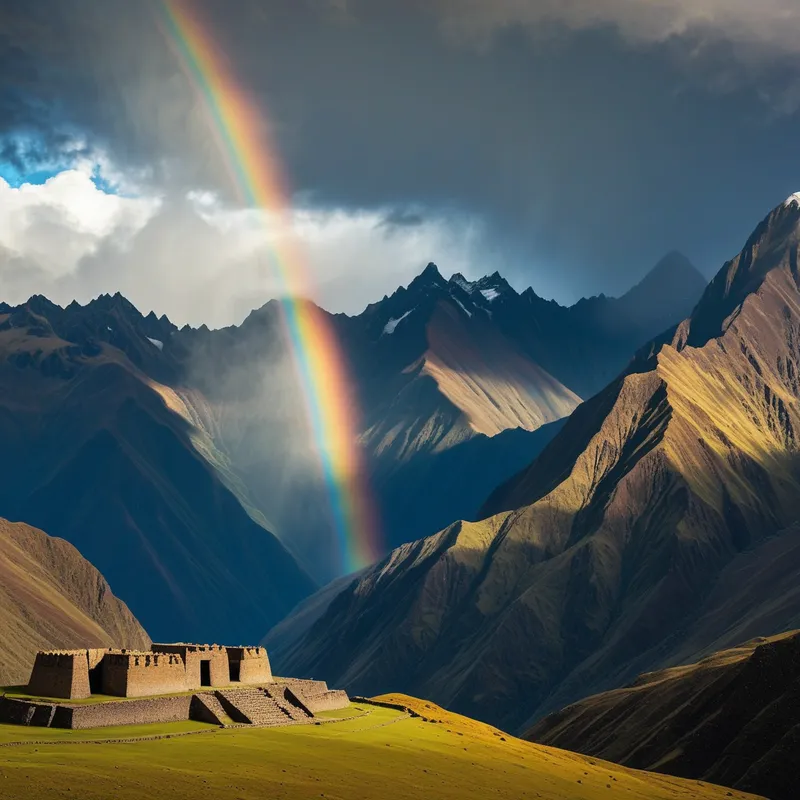
The myth of the Rainbow K'uychi tells of a celestial bridge born from sacred water, uniting the divided realms of the cosmos into a covenant of light.
The Tale of The Rainbow K’uychi
Listen. In the time when the world was raw and newly shaped, the sky, the Hanan Pacha, was a realm of brilliant, untouchable light. The sun, Inti, blazed with a father’s fierce love, and the moon, Mama Killa, shone with a mother’s cool silver gaze. But below, the earth, the Kay Pacha, lay in shadow. It was a place of fertile darkness, of stone and root and flowing water, tended by Pachamama. And deeper still lay the Uku Pacha, a realm of potent seeds, ancestors, and the waters of origin.
These worlds were separate. A great silence hung between them. The people of the Kay Pacha looked up and saw the gods as distant, burning specks. They felt the earth’s abundance but could not hear its deeper song. They knew the dead traveled below but could not sense their presence. A loneliness permeated all things—a cosmic isolation.
Then came the great rains, sent by Illapa. They were not gentle showers but a torrential weeping of the sky, washing the mountains, filling the springs of Pachamama to overflowing. As the storm passed and the first spear of Inti’s light pierced the retreating clouds, it struck not land, but the very tears of the sky caught in a million droplets suspended in the air, and the sacred waters rising from the springs below.
In that moment of meeting—the descending light of Hanan Pacha and the ascending vapor of Uku Pacha, mingling in the middle world of Kay Pacha—something was born. Not a god, but a manifestation. A bridge. It arched across the heavens in a sublime curve of impossible colors: red of blood and clay, yellow of gold and maize, green of thriving q’iwuña trees, blue of deepest lake and high altitude sky, violet of twilight and mystery.
This was the K’uychi. It did not speak, but its presence was a covenant. It was a promise written in light. It said: You are not separate. The fierce love of Inti could touch the nurturing body of Pachamama. The memory of the ancestors in Uku Pacha could be seen reflected in the living world. The people, standing in Kay Pacha, could look upon this bridge and know they were the sacred point of connection, the place where the worlds met and conversed in silent, radiant harmony.

Cultural Origins & Context
The myth of the K’uychi originates from the Andean cosmovision of the Inca Empire and the pre-Columbian cultures that preceded it. This was not merely a story told for entertainment, but a fundamental pillar of a worldview where reciprocity (ayni) and interconnectedness were the fabric of reality. The myth was likely passed down by amautas (wise teachers) and quipucamayocs (keepers of the knotted-string records, or quipus), often in relation to agricultural cycles, royal ceremonies, and astronomical observations.
Its societal function was profound. The K’uychi served as a divine sanction for the Sapa Inca, the emperor, who was considered the son of Inti. The rainbow’s appearance was an omen, a sign of celestial favor and a reminder of the Inca’s role as the mediator between the three worlds. For the common people, it was a daily reminder of the sacred order (Tawantinsuyu, the “four parts together”) and their place within it. It transformed a natural atmospheric phenomenon into a living theological and social principle, reinforcing the idea that harmony (sumaq kawsay) was maintained through respectful balance between all realms of existence.
Symbolic Architecture
The K’uychi is a master [symbol](/symbols/symbol “Symbol: A symbol can represent an idea, concept, or belief, serving as a powerful tool for communication and understanding.”/) of [connection](/symbols/connection “Symbol: Connection symbolizes relationships, communication, and bonds among individuals.”/), but its [architecture](/symbols/architecture “Symbol: Architecture in dreams often signifies structure, stability, and the framing of personal identity or life’s journey.”/) is multifaceted. Primarily, it is the Bridge. It transcends the [chasm](/symbols/chasm “Symbol: A deep fissure in the earth representing a profound division, transition, or psychological gap between states of being.”/) between opposites: [spirit](/symbols/spirit “Symbol: Spirit symbolizes the essence of life, vitality, and the spiritual journey of the individual.”/) and matter, conscious and unconscious, divine and [human](/symbols/human “Symbol: The symbol of a human represents individuality, complexity of emotions, and social relationships.”/), male (sun) and female ([earth](/symbols/earth “Symbol: The symbol of Earth often represents grounding, stability, and the physical realm, embodying a connection to nature and the innate support it provides.”/)/[water](/symbols/water “Symbol: Water symbolizes the subconscious mind, emotions, and the flow of life, representing both cleansing and creation.”/)). It does not erase the [difference](/symbols/difference “Symbol: Difference symbolizes diversity, change, and the contrast between ideas or people.”/) but provides a means of communication and exchange between them.
The bridge does not promise the end of the journey, but the possibility of the crossing. It is the moment of insight that links a problem to its solution, a wound to its healing.
It is also the [Serpent](/symbols/serpent “Symbol: A powerful symbol of transformation, wisdom, and primal energy, often representing hidden knowledge, healing, or temptation.”/) (often implied in its name and form), a near-universal symbol of transformation, cyclicality, and the chthonic energies of the Uku Pacha. The [rainbow serpent](/symbols/rainbow-serpent “Symbol: A powerful creator deity in Australian Aboriginal mythology, representing fertility, water, and the life cycle.”/) sloughs the old light to reveal the new, a [spectrum](/symbols/spectrum “Symbol: A continuum of possibilities, representing diversity, transition, and the full range of existence from one extreme to another.”/) born from the [marriage](/symbols/marriage “Symbol: Marriage symbolizes commitment, partnership, and the merging of two identities, often reflecting one’s feelings about relationships and social obligations.”/) of storm and sun. Furthermore, it is a [Covenant](/symbols/covenant “Symbol: A binding agreement or sacred promise between parties, often carrying deep moral, spiritual, or social obligations and consequences.”/). Unlike a contract, a covenant is a sacred bond. The K’uychi is the visible sign of the [universe](/symbols/universe “Symbol: The universe symbolizes vastness, interconnectedness, and the mysteries of existence beyond the individual self.”/)’s promise of wholeness, a non-verbal pact that [isolation](/symbols/isolation “Symbol: A state of physical or emotional separation from others, often representing a need for introspection or signaling distress.”/) is an illusion and that every part of creation is in [relationship](/symbols/relationship “Symbol: A representation of connections we have with others in our lives, often reflecting our emotional state.”/).
Psychologically, it represents the transcendent function—the psychic process that arises from the [tension](/symbols/tension “Symbol: A state of mental or emotional strain, often manifesting physically as tightness, pressure, or unease, signaling unresolved conflict or anticipation.”/) of opposites and creates a new, third thing that resolves the conflict. It is the symbol that emerges from the unconscious to illuminate a [path](/symbols/path “Symbol: The ‘path’ symbolizes a journey, choices, and the direction one’s life is taking, often representing individual growth and exploration.”/) forward when conscious reasoning fails.
The Dreamer’s Resonance
When the pattern of the K’uychi appears in modern dreams—whether as a literal rainbow, a brilliant bridge, or an arc of iridescent light—it signals a profound somatic and psychological process of integration. The dreamer is likely in a state of transition, feeling caught between two states of being: perhaps a career change, the end of a relationship, a spiritual crisis, or the struggle between a deeply held instinct and a conscious value.
The somatic feeling is often one of awe mixed with vertigo. The beauty of the bridge is captivating, but the chasm beneath it is real. This reflects the body’s awareness of risk in transformation. The dream is presenting a symbol of potential wholeness, but the ego must still make the crossing. It is an invitation from the deeper Self to acknowledge the divided parts of one’s psyche—the lofty ideals (Hanan Pacha), the grounded realities and traumas (Kay Pacha), and the buried instincts or ancestral patterns (Uku Pacha)—and to seek the mediating principle that can connect them. The dream K’uychi says, “Your fragmentation is an illusion. The elements for your wholeness are present and can be united.”
Alchemical Translation
The alchemical process mirrored in the K’uychi myth is the coniunctio oppositorum—the sacred marriage of opposites that yields the gold of the integrated Self. The modern individual’s path of individuation often feels like being stranded in the Kay Pacha, battered by the storms of life (Illapa’s rains), feeling disconnected from higher meaning and from the deep, instinctual roots of their own being.
The first stage is the Nigredo, the blackening: the storm, the conflict, the emotional torrent that feels destructive. This is necessary. It washes away the old, rigid structures and creates the suspended, reflective droplets—the raw, emotional material. Then comes the moment of Albedo, the whitening: the piercing light of consciousness (Inti) directed not away from this material, but into its very heart.
The philosopher’s stone is not found in the light or the dark, but in the spectrum that is born only when they consent to touch.
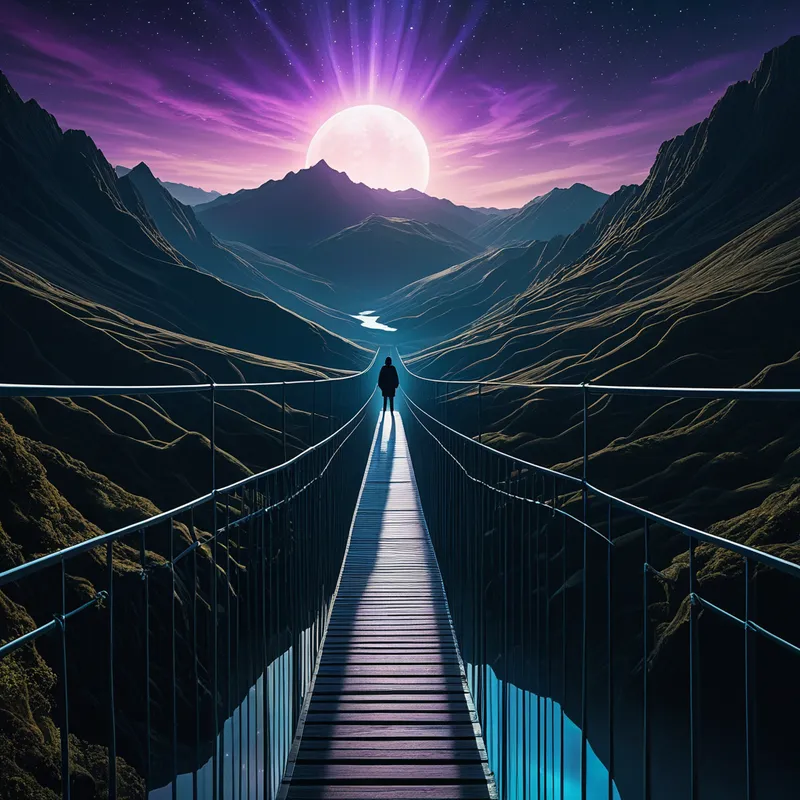
The K’uychi itself is the symbol of the Rubedo, the reddening, the culmination. It is the birth of the transcendent function—the rainbow bridge of the individuated psyche. It does not mean all opposites are dissolved into a bland unity. Rather, like the distinct bands of the rainbow, the differentiated parts of the self are brought into a harmonious, ordered relationship. The individual becomes the living Kay Pacha, the sacred middle world where spirit and instinct, persona and shadow, future and past, can meet, communicate, and create a life of authentic, colorful meaning. One becomes not just a traveler on the bridge, but the very ground from which it springs.
Associated Symbols
Explore related symbols from the CaleaDream lexicon:
- Rain — The cleansing, emotional torrent from the sky (Hanan Pacha) that prepares the world for the covenant, representing the necessary dissolution of old structures.
- Water — The sacred, ascending essence from Pachamama and the Uku Pacha, symbolizing the unconscious, emotion, and the fluid potential for life.
- Bridge — The core form of the K’uychi, representing connection, mediation, and the path that makes relationship between separated realms possible.
- Sun — Inti, the source of conscious light and fiery spirit, whose ray is the active, penetrating force that initiates the transformation.
- Earth — Pachamama, the receptive, nurturing ground of being and the source of the waters, representing the body, nature, and the tangible world.
- Serpent — The chthonic, transformative aspect of the K’uychi, embodying cyclical renewal, wisdom from the depths, and the healing power of integration.
- Light — The divine illumination made manifest in spectrum and form, representing consciousness, insight, and the revelation of hidden wholeness.
- Rainbow — The complete manifestation, the covenant in visible form, symbolizing hope, promise, and the beautiful, ordered spectrum of a unified psyche.
- Covenant — The sacred, unspoken pact the K’uychi represents, a bond of trust between different parts of the self and the cosmos.
- Journey — The process implied by the bridge, the movement from a state of separation toward a state of connection and wholeness.
- Healing — The ultimate result of the K’uychi’s mediation, the restoration of relationship and the end of psychic fragmentation.
- Rainbow Bridge — A direct modern echo of the K’uychi’s function, often representing a passage to a state of peace, unity, or understanding after a period of struggle.