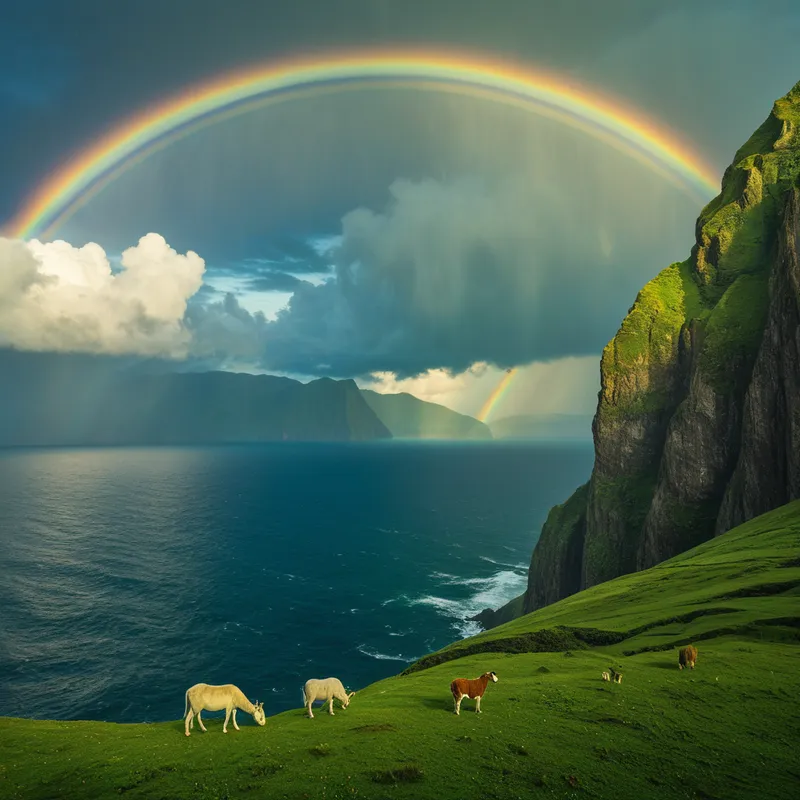
The Rainbow Covenant Myth Meaning & Symbolism
After a world-shattering flood, a deity makes a promise with all life, sealing it with a rainbow as a sign of a new, merciful relationship.
The Tale of The Rainbow Covenant
The world was a scream that had finally been heard.
For forty days and forty nights, the windows of the heavens were thrown open, and the fountains of the great deep broke apart. The waters above and the waters below met in a terrible, roaring marriage, swallowing the mountains and silencing the marketplace, the temple, and the field. All that was left was the sound of rain like drumbeats on a hollow world, and the groaning of a great wooden vessel adrift on an endless, churning sea.
Inside that vessel, Noah, a man heavy with the weight of every living breath, tended to his family and the shivering, bewildered cargo of all flesh. The scent was of damp wood, fur, and fear. The light was the dim glow of lamps on terrified eyes. They were alone, the last memory of a corrupted earth, cradled in a shell of gopher wood and divine instruction.
Then, a silence deeper than the flood descended. The rain ceased. The ark ground to a halt on the bones of a mountain. A wind from YHWH began to move over the face of the waters, and it was a wind of remembering. Noah sent out a raven, a black shadow that found no rest. He sent a dove, which returned with nothing but the taste of air on its beak. He waited, his heart a drum counting the slow beats of a dying world. He sent the dove again, and at evening, it returned, and in its beak was a freshly plucked olive leaf—a fragment of green promise, a word from the drowned earth.
The day came when the covering of the ark was rolled back. The light was a shock, clean and sharp. The air smelled of mud and newness. Noah, his wife, his sons, and their wives stepped out onto soft, wet earth. The animals followed, blinking, stumbling, then scattering to find their place in this blank slate of a world. They built an altar from rough stones, and Noah offered sacrifices from the clean animals. The smoke of the offering rose—a scent of devotion and surrender in the vast, empty sky.
And YHWH smelled the pleasing aroma. But it was not the scent of roasting meat that moved the heart of the Eternal. It was the scent of obedience, of fragile trust held fast in the chaos. A resolve settled within the divine mind, a covenant etched not in stone, but in the very fabric of relationship.
“I establish my covenant with you,” the voice spoke to Noah, and through him, to every living creature that emerged from the ark—to the hawk and the ox, to the creeping thing and the fish of the sea. “Never again shall all flesh be cut off by the waters of a flood. Never again shall there be a flood to destroy the earth.”
Then, the deity set a sign in the clouds, a bow of brilliant, refracted light. “This is the sign of the covenant I make between me and you and every living creature with you, for all future generations. I have set my bow in the cloud. When I bring clouds over the earth and the bow is seen in the clouds, I will remember my covenant.”
And so it was. The warrior’s bow of divine judgment was laid aside in the sky, unstrung, its arc turned not toward the earth, but toward the heart of heaven itself. A promise painted in water and light, for as long as the earth endured.
Cultural Origins & Context
This narrative forms the climax of the Flood story found in the Book of Genesis, the first book of the Tanakh and the Christian Old Testament. It is a foundational text of the Abrahamic traditions—Judaism, Christianity, and Islam (where Noah, or Nuh, is a major prophet). Scholars identify it as part of the “Priestly” (P) source, a stream of tradition concerned with order, covenant, and the proper relationship between the divine and the created world.
The story was not merely a etiological myth explaining rainbows. It served a profound societal function for a people defining themselves in covenant with a powerful, singular God. It established a theological cornerstone: the relationship between divinity and creation is now governed by a binding, unilateral promise of preservation. It moved the divine posture from one of reactive judgment to one of committed mercy, setting the stage for the later, more specific covenants with Abraham and Moses. It was told and retold to reinforce a worldview where cosmic order is guaranteed, not by human perfection, but by divine fidelity.
Symbolic Architecture
The Rainbow Covenant is a masterwork of symbolic architecture, built from the raw materials of catastrophe and hope. The flood itself represents the unconscious, chaotic waters of Tehom returning, a dissolution of a corrupted conscious order. The ark is the containing vessel of the psyche, the disciplined structure (the law, the tradition, the ego-complex) that can preserve the seeds of life through the storm of transformation.
The covenant is the moment the psyche decides its storms shall no longer be annihilating, but cleansing.
Noah represents the remnant of consciousness that submits to a process greater than itself. He is not a hero of action, but of endurance and faithful ritual. The true protagonist of the myth is the relationship itself. The rainbow is the supreme symbol. It is a bridge between heaven and earth, a fusion of the sun (consciousness) and the rain (the unconscious, tears, emotion). It is a divine weapon laid down, its violence transmuted into beauty. It signifies that the tension between judgment and mercy, between chaos and order, is now held in a dynamic, life-affirming balance. It is a sign of remembrance, but not a reminder for a forgetful deity; it is a sign for us, a psychological anchor pointing to the enduring promise of renewal after personal cataclysm.
The Dreamer’s Resonance
When this myth stirs in the modern dreamer, it often follows a period of profound emotional or psychological flooding. The dreamer may feel they have barely survived a great upheaval—a loss, a betrayal, a collapse of their personal world. Dreams of endless rain, rising waters, or being on a fragile boat are somatic echoes of this deluge.
To then dream of a rainbow is not a quaint symbol of hope, but a deep, somatic signal of a shift in the inner covenant. It marks the moment the punishing, critical voice of the inner judge (the super-ego or an internalized divine wrath) begins to relent. It is the psyche’s own promise to itself: “This level of self-annihilation will not happen again.” The rainbow in a dream appears when the unconscious is ready to offer a treaty, a new way of relating to one’s own depths. It signifies that the floodwaters of grief, rage, or depression are receding, and the first, fragile green shoot of a new attitude is breaking through the mud.
Alchemical Translation
The alchemical journey mirrored here is the opus contra naturam—the work against (one’s own) nature. The base metal is the old, corrupt “world” of the psyche, rigid yet sinful, requiring dissolution. The flood is the solutio, the return to the primal waters where all forms are broken down. The ark is the vas hermeticum, the sealed vessel where the opposing elements (the clean and unclean animals, the family tensions) are held in conflict without escape, forced to transform.
The covenant is the achievement of the rubedo, the reddening, not with the fire of anger, but with the lasting, warm light of a new and merciful consciousness.
Noah’s patient waiting, his sending out of birds, represents the separatio and coniunctio—testing the environment, discerning when the new psychic ground can bear weight. The sacrifice is the final surrender of the old identity that survived the storm. The resulting covenant is the prized lapis philosophorum, the philosopher’s stone: not a tool for perfect gold, but the discovery of a permanent, merciful principle at the core of one’s being. For the modern individual, the myth models the process of moving from a psychology of self-punishment and catastrophic fear to one grounded in a fundamental, inner covenant of self-preservation and grace. We learn to lay our bow of self-criticism in the cloud, and see our tears refracted into a promise.
Associated Symbols
Explore related symbols from the CaleaDream lexicon: