The Rainbow Bridge Bifröst in Myth Meaning & Symbolism
The shimmering, fiery bridge connecting the realms of gods and mortals, a path of awe, danger, and sacred connection.
The Tale of The Rainbow Bridge Bifröst
Hear now of the greatest road ever wrought, a path not of earth or stone, but of fire and promise. In the dawn of days, when the Ginnungagap had been tamed and the nine worlds hung upon the great Yggdrasil, the Aesir looked down from their high hall of Asgard. Below lay Midgard, the middle enclosure, and the other realms, each humming with its own life. A gulf, vast and cold, lay between them. Not a gulf of space, but of essence.
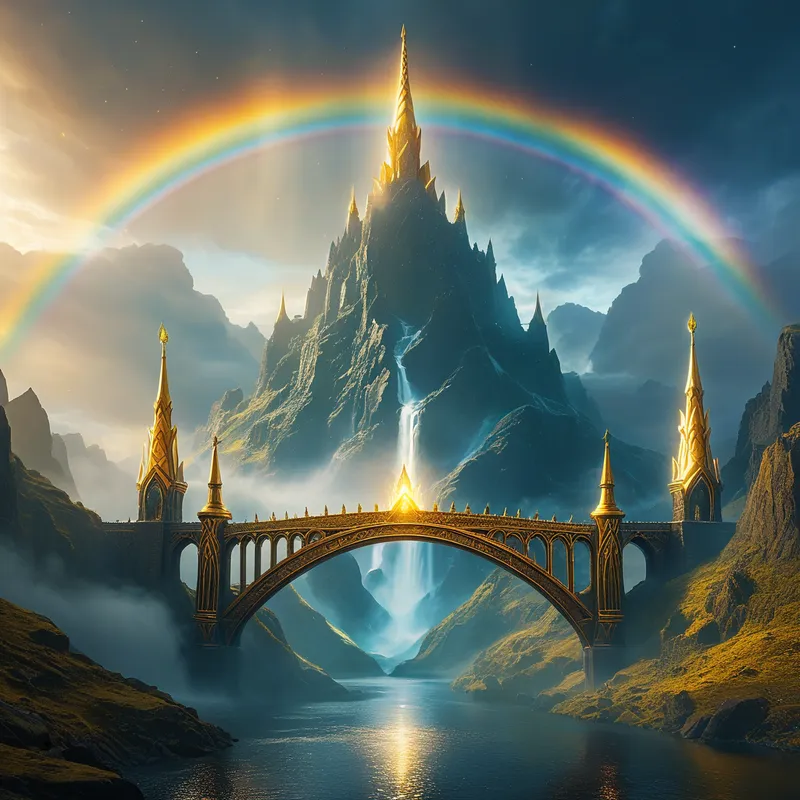
So the gods, in their wisdom and craft, built a bridge. But this was no mere causeway. They took the very stuff of the storm’s aftermath—the meeting of sun and retreating rain—and they set it aflame. They forged Bifröst, the “Trembling Path” or “Shimmering Way.” It arched, resplendent and terrifying, from the highest root of Yggdrasil near Asgard’s gates down to the well of Mimir and beyond, touching the world of men. It burned with three colors, a roaring, living rainbow that thrummed with the power to bear the weight of the divine.
And at its Asgard-end, where the bridge met the holy ground, they placed a sentinel. Not a wall, but a watchman: Heimdall, the whitest of the gods. His hearing was so keen he could hear the grass grow on Midgard and the wool grow on a sheep. His sight was so sharp he could see for a hundred leagues by night or day. He was given the great horn, Gjallarhorn, whose blast would echo through all the worlds. His duty was singular: to guard the bridge. For Bifröst was strong, yet it was not invincible. Its very fire was both its beauty and its ward, a test and a barrier.
The gods would ride across it daily, their horses’ hooves striking sparks from the colored flames, to hold council at the Well of Urd. It was their highway, a symbol of their connection to and governance over the cosmic order. Yet, in the whispers of the Norns, there was always an echo of an ending. They spoke of a time when the bonds would loosen, when the great wolf Fenrir would break free and the ship of the dead, Naglfar, would sail.
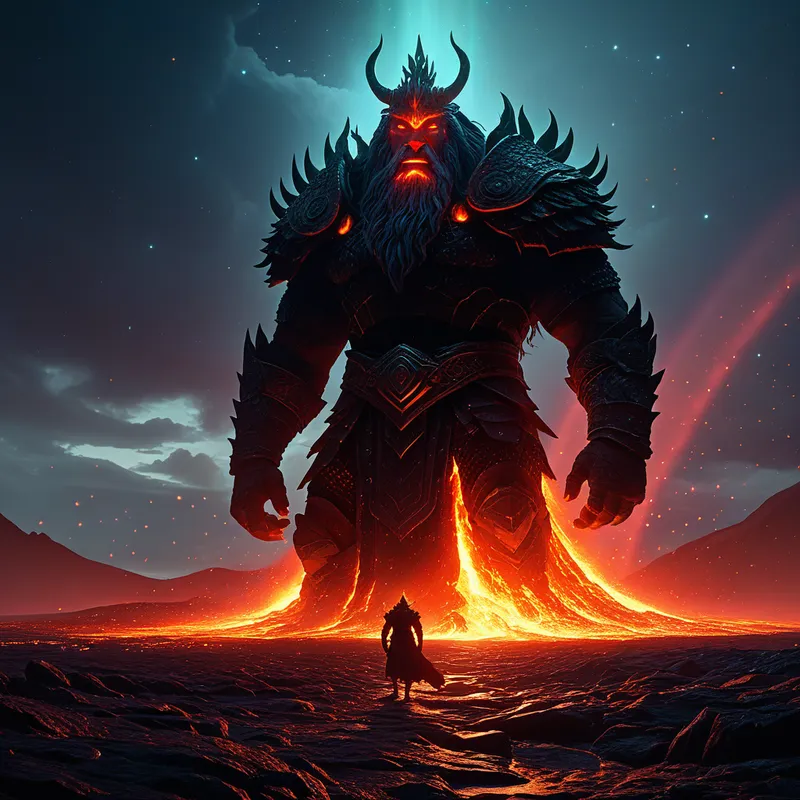
That time came. Ragnarök. The trembling of the bridge became a violent shudder. From the land of fire, Muspelheim, came the sons of Muspell, led by the giant Surtr. They marched not around, but upon the Bifröst, seeking the direct path to Asgard. Their weight was a weight of pure destruction, their heat a heat that sought to consume even divine fire. And as they crossed, the glorious bridge, strained beyond its limit, did what it was always destined to do. It shattered. With a sound that broke the sky, the burning rainbow fractured, its brilliant shards falling like dying stars into the abyss below. The path was broken. The connection was severed. The watchman had sounded his horn, and his watch was ended.
Cultural Origins & Context
The myth of Bifröst originates from the rich tapestry of Old Norse mythology, primarily preserved in 13th-century Icelandic texts like the Prose Edda of Snorri Sturluson and the older poetic lays of the Poetic Edda. This was not a religion of grand temples, but of storytelling around hearth-fires in longhouses, of skalds (poets) reciting in halls. The myth functioned as a cosmological map and a social metaphor.
Bifröst served to explain a natural phenomenon—the rainbow—by infusing it with cosmic significance. It was not just a pretty arch of light; it was a functional, sacred infrastructure of the universe, maintained by divine order (örlög). Its daily use by the gods reinforced their role as upholders of this order. The story was told to illustrate the precariousness of that order, the constant need for vigilance (embodied by Heimdall), and the inevitability of cyclical destruction and renewal. It was a narrative that acknowledged both the glory of connection and the terrifying fragility of the structures that make connection possible.
Symbolic Architecture
At its core, Bifröst is the archetypal symbol of the liminal, the threshold itself made manifest. It is not a place, but a passage. Its symbolism is triune:
First, it is the Bridge of Connection, linking the divine (Asgard/conscious ideals) with the human (Midgard/earthly reality) and the ancestral or subconscious (the well of Mimir). It represents the possibility of communication between different states of being, the aspiration to reach higher understanding, and the gods’ involvement in the human realm.
Second, it is the Bridge of Peril. Made of fire, it is beautiful but dangerous. It trembles. It can be broken. This speaks to the inherent risk in any act of connection or transcendence. To cross from one state of consciousness to another is to risk a fall, to be consumed by the very energies that enable the journey.
The most sacred paths are often the most fragile, for they traverse the greatest divides.
Third, and most profoundly, it is the Bridge of Doom. Its destruction at Ragnarök is not a failure, but a fulfillment of its nature. It symbolizes the necessary collapse of the old paradigm, the old ways of connecting, to make way for the new world that rises from the waters after the apocalypse. The bridge must shatter so that a new relationship between realms can be born.
The Dreamer’s Resonance
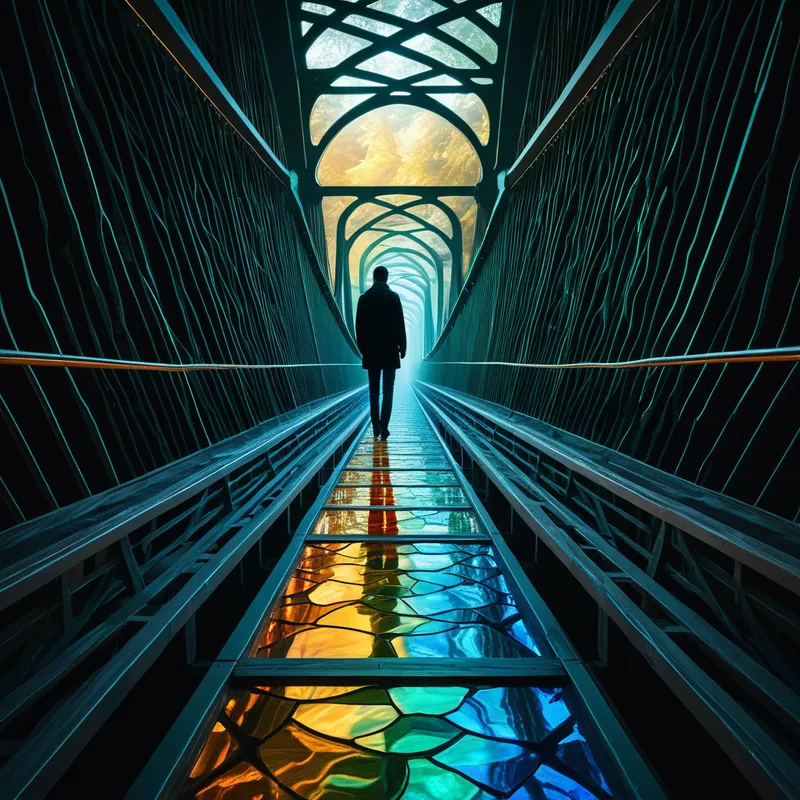
When the image of Bifröst appears in the modern dreamscape, it rarely comes as a literal rainbow. It manifests as any brilliant, compelling, yet terrifyingly insubstantial pathway. It might be a glowing walkway over a dark office canyon, a narrow beam of light across a chasm in a forest, or a shimmering staircase that appears in one’s home.
To dream of approaching such a bridge signifies a psychological recognition of a critical threshold. The dreamer is at the precipice of a major transition—a career change, a commitment, a deep inner realization. The beauty of the bridge represents the allure of the new state; the chasm below, the fear of the unknown and the cost of failure.
To dream of crossing it, especially with a sense of precarious balance, mirrors the somatic experience of anxiety during transformation. The body may feel the “trembling” of the path—a racing heart, shallow breath. This is the ego navigating the fiery, unstable process of leaving one psychic territory for another. To dream of it shattering often coincides with experiences of failed transitions, broken connections, or the shocking collapse of a long-held belief system that once structured one’s reality.
Alchemical Translation
For the individual on the path of individuation, the myth of Bifröst models the alchemical process of psychic transmutation. The journey from the leaden, confused state of the ego in Midgard to the more integrated, golden state of the Self is precisely such a bridge-crossing.
The initial construction of the bridge is the awakening of aspiration. The individual, through crisis or insight, sees a possibility of a higher order within themselves—a connection to the transpersonal (the gods/Self). This aspiration is fiery, vivid, and compelling.
Heimdall, the watchman, represents the function of consciousness and discrimination. He is the acute self-awareness needed to undertake the journey. Before one can cross, one must develop the “hearing” to listen to the subtle whispers of the unconscious and the “sight” to see one’s own patterns clearly. This is the vigilant ego preparing for the ordeal.
The crossing itself is the nigredo, the dark night of the soul. The bridge is on fire. This is the painful, burning work of confronting shadow material, enduring the tension of opposites, and holding steady while everything in one’s psyche seems to tremble and threaten to give way. It is a trial by fire.
The bridge does not exist to provide safe passage, but to be the crucible in which the traveler is transformed.
Finally, the shattering at Ragnarök is the necessary destruction of the old persona. The very structure that enabled the initial journey—a certain self-concept, a spiritual technique, a therapeutic framework—must eventually break under the weight of the new reality it has helped approach. This is not failure, but the final, terrifying stage of death-and-rebirth. The old connection must be severed for a new, more authentic relationship between the conscious and unconscious to emerge from the waters of the renewed world. One does not live on the bridge; one crosses it, and in its breaking, finds oneself irrevocably changed, standing on new ground.
Associated Symbols
Explore related symbols from the CaleaDream lexicon: