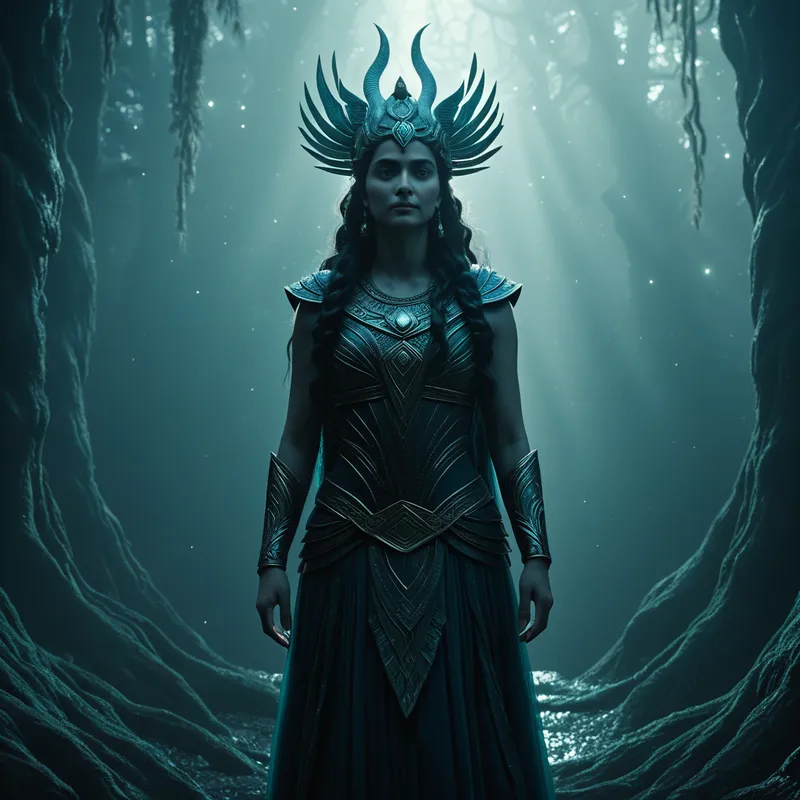
The Rainbow Body
A Tibetan Buddhist phenomenon where enlightened masters dissolve their physical form into pure light at death, leaving only hair and nails behind.
The Tale of The Rainbow Body
The tale does not begin with a grand spectacle, but in the quietude of a hermitage, high in the Himalayan snows. A master, having spent a lifetime in the most profound practice of Dzogchen, approaches the end of their earthly sojourn. They may speak to their closest disciples, not of sorrow, but of a coming departure. “I will soon leave this body,” they might say, their voice carrying the calm of a deep, still lake. Then, they retreat, often sitting in the meditation posture they have held for decades.
For days, sometimes weeks, the master remains in a state of profound, luminous meditation, the thukdam. The physical processes of the body slow to an imperceptible whisper; breath becomes subtle, the heat of the body remains, yet a profound stillness descends. To the devoted observer, the master is not dying, but dissolving. They are engaging in the final, most radical practice: the gathering and inward application of the subtle energies that bind consciousness to form.
Then, the moment arrives. The master’s consciousness, having fully recognized its innate nature as primordial, luminous awareness, withdraws from its material anchor. What follows is not decay, but a sublime vanishing. Over a period of days, the physical body begins to shrink. Its substance does not rot, but seems to be absorbed into a light that is both within and all around. The flesh, the bones, the very elements of the body, are transmuted. Witnesses speak of a room filled with an unearthly, rainbow-hued light. They may see spheres of light, or hear celestial music. The air thrums with a palpable peace.
When the light fades, all that remains where the master sat are their hair and nails—the impurities, the karmic residue that could not be transformed. Sometimes, a small, child-sized form is left, which further shrinks until it, too, vanishes into light. The master has not gone to another place, but has realized the ultimate nature of the place they have always been: the infinite, luminous expanse of reality itself, the [Dharmakaya](/myths/dharmakaya “Myth from Buddhist culture.”/). They have achieved the jalü, the [Rainbow Body](/myths/rainbow-body “Myth from Tibetan Buddhist culture.”/) of Light, leaving not a corpse, but a testament written in empty space.
Cultural Origins & Context
The Rainbow Body, or jalü (‘ja’ lus), is a phenomenon deeply rooted in the ancient Nyingma tradition of Tibetan Buddhism, particularly within its highest teachings, Dzogchen. Its origins are traced to the first transmission of these teachings in Tibet by the great master [Padmasambhava](/myths/padmasambhava “Myth from Buddhist culture.”/) in the 8th [century](/myths/century “Myth from Biblical culture.”/) and the primordial [Buddha](/myths/buddha “Myth from Buddhist culture.”/) Samantabhadra. It is not considered a supernatural miracle in the Western sense, but a natural, albeit extremely rare, result of a specific spiritual alchemy.
This achievement is the fruit of a lifetime (or lifetimes) dedicated to the direct realization of rigpa—the innate, pristine awareness that is the ground of all being. The practitioner, through Dzogchen practice, learns to recognize all phenomena, including their own body, as manifestations of this luminous emptiness. The Rainbow Body is thus the ultimate phowa, or consciousness transference, where the practitioner, having fully stabilized this recognition, does not transfer to another realm but dissolves the very boundary between self and the absolute ground. Historically, figures like Garab Dorje, the first human Dzogchen master, and numerous Tibetan yogis such as Jigme Lingpa and more recent masters like Khenchen Tsewang Rigdzin are said to have attained this state. It stands as the pinnacle of the Buddhist path, demonstrating the literal truth of the doctrine of emptiness ([shunyata](/myths/shunyata “Myth from Hindu culture.”/)): that form is emptiness, emptiness is form.
Symbolic Architecture
The [Rainbow](/symbols/rainbow “Symbol: Rainbows symbolize hope, promise, and the beauty found after turmoil, often viewed as a bridge between the earthly and divine.”/) [Body](/symbols/body “Symbol: The body in dreams often symbolizes the dreamer’s self-identity, personal health, and the relationship they have with their physical existence.”/) is not merely an [event](/symbols/event “Symbol: An event within dreams often signifies significant life changes, transitions, or emotional milestones.”/); it is a complete symbolic [architecture](/symbols/architecture “Symbol: Architecture in dreams often signifies structure, stability, and the framing of personal identity or life’s journey.”/) dismantling our deepest fears and assumptions about existence.
The body is not a prison to escape, but a mandala to be understood. In its dissolution, every atom is revealed as a droplet of primordial light, refracting the single, white source into the spectrum of manifestation. The rainbow is not an addition, but a subtraction—the scattering of illusion, revealing the unified light behind it.
The process inverts the ordinary [human](/symbols/human “Symbol: The symbol of a human represents individuality, complexity of emotions, and social relationships.”/) trajectory. Where conventional [death](/symbols/death “Symbol: Symbolizes transformation, endings, and new beginnings; often associated with fear of the unknown.”/) is a [disintegration](/symbols/disintegration “Symbol: A symbol of breakdown, loss of form, or fragmentation, often reflecting anxiety about personal identity, control, or stability.”/) into decay, the Rainbow Body is a [integration](/symbols/integration “Symbol: The process of unifying disparate parts of the self or experience into a cohesive whole, often representing psychological wholeness or resolution of internal conflict.”/) into coherence. The practitioner gathers the scattered elements of their psychophysical being—the [nadis](/myths/nadis “Myth from Hindu culture.”/) (channels), [prana](/symbols/prana “Symbol: In Hindu and yogic traditions, prana is the universal life force or vital energy that animates all living beings and permeates the cosmos.”/) (winds), and [bindu](/symbols/bindu “Symbol: A sacred point or dot representing the origin of creation, consciousness, and the universe in Hindu and Buddhist traditions.”/) (essences)—and, through the power of unwavering recognition, reverses their mundane function. The body, instead of being a [site](/symbols/site “Symbol: The concept of a ‘site’ in dreams often represents a specific location associated with personal memories, emotional experiences, or stages in one’s life.”/) of [solidification](/symbols/solidification “Symbol: The process of becoming solid, firm, or stable, often representing transformation, permanence, or the crystallization of ideas, emotions, or life circumstances.”/) and [karma](/myths/karma “Myth from Hindu culture.”/), becomes the [crucible](/symbols/crucible “Symbol: A vessel for intense transformation through heat and pressure, symbolizing spiritual purification, testing, and alchemical change.”/) for its own transcendence.
The leaving of hair and nails is the final, graceful gesture of the relative. It is the shedding of the last, most stubborn threads of individuated karma, the humble offering of impurity back to the earth, while the pure essence returns to the sky of mind.
This architecture presents a map of the [psyche](/myths/psyche “Myth from Greek culture.”/)’s potential. The physical form corresponds to our most concrete identifications. Its [dissolution](/symbols/dissolution “Symbol: The process of breaking down, dispersing, or losing form, often representing transformation, release, or the end of a state of being.”/) signifies the total deconstruction of the egoic self, not into [nothingness](/symbols/nothingness “Symbol: A profound emptiness or void, often representing existential anxiety, spiritual seeking, or emotional numbness in dreams.”/), but into the vibrant, knowing [space](/symbols/space “Symbol: Dreaming of ‘Space’ often symbolizes the vastness of potential, personal freedom, or feelings of isolation and exploration in one’s life.”/) from which it temporarily arose. The rainbow light is the symbolic display of wisdom (prajna) and compassionate means (upaya) in their indivisible union.
The Dreamer’s Resonance
For the dreamer navigating the inner landscapes, the myth of the Rainbow Body resonates as a profound metaphor for psychological and spiritual integration. It speaks to the possibility of a “[death](/myths/death “Myth from Tarot culture.”/)” that is not an end, but a consummation.
In the dreamscape, to encounter a figure dissolving into light is to witness [the ego](/myths/the-ego “Myth from Jungian culture.”/)’s surrender to a greater, transpersonal reality. It symbolizes the moment when a complex, a trauma, or a rigid identity structure—once felt as solid and burdensome as a physical body—is fully confronted, accepted, and thereby transmuted. It loses its solid, problematic form and is reabsorbed into the broader psyche as pure energy and understanding. The “hair and nails” left behind are the minor, residual habits or memories that remain even after a major transformation, harmless echoes of a former shape.
This resonance challenges the pathology of permanence. Our psychological suffering often stems from clutching to forms: the form of a past self, a fixed story, a desired outcome. The Rainbow Body proposes that health and wholeness lie not in building a better, more durable form, but in realizing the luminous, empty nature of all forms. It is the ultimate resolution of grief, for it reframes loss as return. To dream of such dissolution is to touch the core longing for liberation from the weight of a separate self, pointing toward an inner state where consciousness is experienced as unbounded, clear, and inherently free.
Alchemical Translation
The alchemy of the Rainbow Body is a precise inner technology. It translates metaphysical principles into a transformative process applicable to the soul’s journey.
The practitioner’s lifetime of meditation is the [solve et coagula](/myths/solve-et-coagula “Myth from Alchemical culture.”/)—the dissolving and coagulating—of perception. First, one dissolves (solve) the solid appearance of the external world and the internal self into their essential nature: luminous emptiness. This is the stage of cutting through (khregs chod), dismantling illusion. Then, one learns to rest in that recognition so completely that all arising phenomena are spontaneously “coagulated” (coagula) as the playful, radiant display of that same emptiness. This is the stage of direct crossing (thod rgal), where even sensory experience becomes a path.
The physical dissolution is the external signature of an internal completion. The yogi has so thoroughly identified with the clear light of the base (gdod ma’i ‘od gsal) that at the moment of death, they do not encounter the terrifying intermediate state (bardo), but merge with it seamlessly. The ordinary process of death—the sequential dissolution of elements—is consciously ridden like a wave back to its source.
In psychological alchemy, this parallels the process of individuation. One must first dissolve the [persona](/myths/persona “Myth from Greek culture.”/) and confront [the shadow](/myths/the-shadow “Myth from Jungian culture.”/) (the solve). Then, by integrating these fragments, one coagulates a new, more authentic relationship to [the Self](/myths/the-self “Myth from Jungian culture.”/), not as a fixed entity, but as a dynamic, luminous process. The Rainbow Body is the image of total integration, where every aspect of the psyche, even the most “physical” or base, is redeemed and recognized as an expression of the central, illuminating mystery. The fear of annihilation is alchemized into the joy of homecoming.
Associated Symbols
Explore related symbols from the CaleaDream lexicon:
- Rainbow — The spectrum of manifested reality, a bridge between earth and sky, symbolizing the beautiful, transient display of unified light after the storm of ignorance.
- Light — Primordial awareness and pure consciousness, the undifferentiated source from which all forms emerge and into which they ultimately dissolve.
- Body — The temporary vessel of experience and karma, the field for spiritual practice and the ultimate artifact to be transcended through understanding.
- Death — Not an end, but a profound transition and opportunity for liberation; the moment when the constructed self dissolves, revealing its true nature.
- Transformation Cocoon — The process of spiritual practice and the death process itself, a hidden period of radical inner reorganization preceding a luminous emergence.
- Mirror — The nature of mind, reflecting all phenomena perfectly yet holding none, symbolizing the clarity and emptiness of pristine awareness (rigpa).
- Dissolution — The alchemical process of breaking down solid identifications, returning compounded elements to their essential, luminous state.
- Bridge — The path of practice and the Rainbow Body itself, connecting the shore of samsaric existence to the shore of nirvanic freedom, the relative to the absolute.
- Mountain — The steadfast, unwavering commitment to practice and the lofty, stable ground of realized awareness upon which the yogi sits to achieve dissolution.
- Dream — The illusory, dream-like quality of all phenomenal existence, recognized by the practitioner, enabling them to change the dream’s fabric at its most fundamental level.