The Quinkans Myth Meaning & Symbolism
Trickster spirit beings of the rainforest, the Quinkans enforce ancestral law through mischief and terror, embodying the land's living conscience.
The Tale of The Quinkans
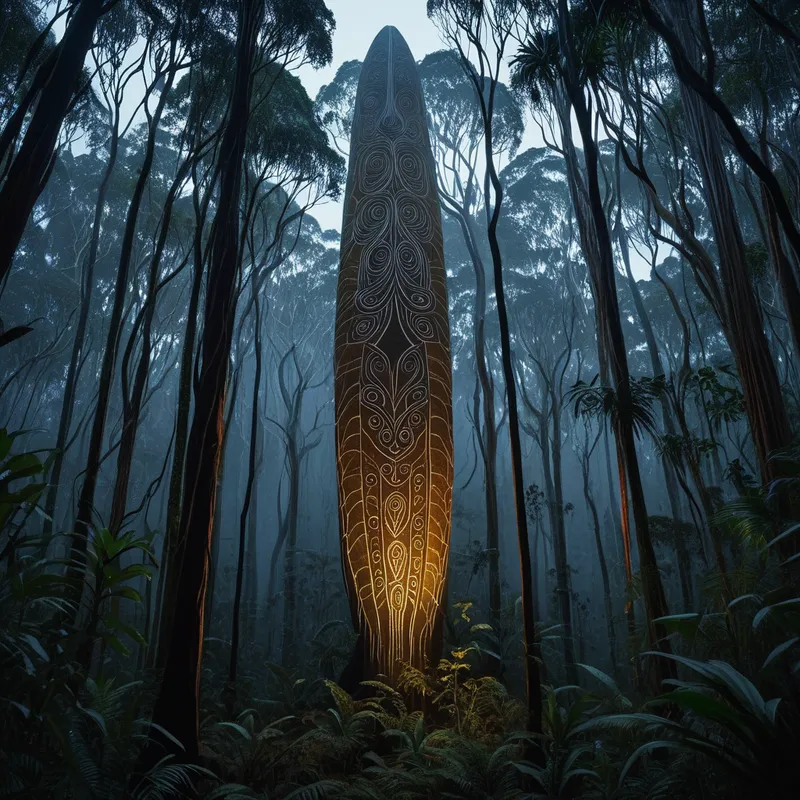
Listen. In the deep time, when the world was soft and the stories were being sung into the stone, there existed a place of dripping green and tangled shadow. This is the country of the Rainforest People, where the air is thick with the breath of leaves and the earth is a carpet of ancient dreams. Here, in the gullies where the light falls in shattered pieces, they dwell. The Quinkans.
They are not gods of the bright sun, but spirits of the creeping twilight. Their forms are impossibly long, stretched like shadows at the end of day—tall, thin figures that could be mistaken for a scribbly-gum trunk until they move. Their skin holds the memory of ochre and ash, painted with the signs of the first law. Some are Timaras, lurking near waterholes, waiting. Others are Kutjis, whose very glance can freeze the blood.
They do not build or sing creation songs. They enforce. They are the keepers of the Law, the living conscience of the land itself. When a person walks alone, especially at the time between times, and their heart holds a secret transgression—a broken taboo, a disrespectful thought toward the country, a withheld share of food—the air grows cold. A rustle comes not from animal, but from something that slides between the ferns.
The Quinkan appears not with a roar, but with a terrible, silent presence. It may mimic the cry of a child to lure the compassionate, or simply stand, a spectral sentinel blocking the path. Its eyes are deep pools of judgment. To see one is to feel the weight of all ancestral expectation, the terror of being found wanting by the land that birthed you. Its chase is not for meat, but for the soul’s acknowledgment. It drives the transgressor, not to death, but to the very edge of terror, until the lesson is seared into their being: the Law is not written on paper, but in the very sap of the trees and the flow of the creeks. Only when true remorse is felt, when balance is pleaded for, does the spectral pursuer melt back into the landscape, its duty done. The forest returns to its sounds, but the person is forever changed, walking now with a fearful reverence, a living testament to the price of disharmony.
Cultural Origins & Context
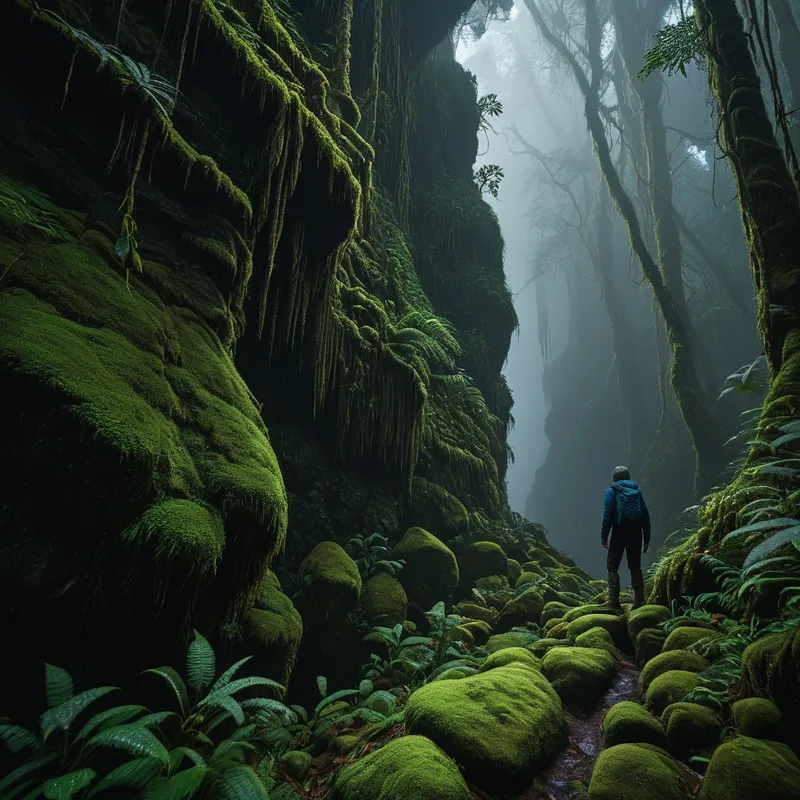
The mythos of the Quinkans belongs specifically to the Aboriginal nations of the Quinkan region in Far North Queensland, notably the Kuku Yalanji and other related groups. This is not a pan-Aboriginal story, but a deeply localized one, born from the unique, claustrophobic, and abundantly alive ecosystem of the rainforest. The stories were and are integral to the pedagogical and social framework of the community.
Elders transmitted these narratives not as mere campfire tales, but as vital Lore. They served a critical societal function: behavioral regulation and environmental stewardship. By instilling a respectful fear of the Quinkans, the Lore ensured that people adhered to complex kinship obligations, food-sharing protocols, and sacred site taboos. The Quinkan was the embodiment of social and ecological consequence. Its domain—rock shelters, deep gullies, isolated waterholes—often corresponded with physically dangerous or spiritually significant places, creating a perfect feedback loop between myth and practical safety. The stories were recorded in the world’s oldest continuous art tradition, painted in ochre on the sandstone escarpments of places like Guguyalangi (the Laura region), making the landscape itself a storybook of law and warning.
Symbolic Architecture
At its core, the Quinkan represents the externalized [Shadow](/symbols/shadow “Symbol: The ‘shadow’ embodies the unconscious, repressed aspects of the self and often represents fears or hidden emotions.”/) of the [community](/symbols/community “Symbol: Community in dreams symbolizes connection, support, and the need for belonging.”/)—but a [Shadow](/symbols/shadow “Symbol: The ‘shadow’ embodies the unconscious, repressed aspects of the self and often represents fears or hidden emotions.”/) with a divine mandate. It is not [chaos](/symbols/chaos “Symbol: In Arts & Music, chaos represents raw creative potential, uncontrolled expression, and the breakdown of order to forge new artistic forms.”/) for chaos’s sake, but chaos in the service of a higher, immutable order.
The true terror is not the monster in the dark, but the realization that the dark itself is watching, and it remembers the rules you agreed to when you were born.
The Quinkan is the psychic embodiment of [guilt](/symbols/guilt “Symbol: A painful emotional state arising from a perceived violation of moral or social standards, often tied to actions or inactions.”/) and [shame](/symbols/shame “Symbol: A painful emotion arising from perceived failure or violation of social norms, often involving exposure of vulnerability or wrongdoing.”/), not as personal pathologies, but as communal, binding forces. Its elongated form symbolizes the stretching and [distortion](/symbols/distortion “Symbol: The alteration of form, sound, or perception from its original state, often creating unsettling or creative effects.”/) of the self when it moves out of alignment with the ancestral [pattern](/symbols/pattern “Symbol: A ‘Pattern’ in dreams often signifies the underlying structure of experiences and thoughts, representing both order and the repetitiveness of life’s situations.”/). It does not punish arbitrary [crime](/symbols/crime “Symbol: Crime in dreams often symbolizes guilt, inner conflict, or societal rules that are being challenged or broken.”/); it pursues disharmony. Its [chase](/symbols/chase “Symbol: Dreaming of a chase often symbolizes avoidance of anxiety or confrontation, manifesting as fleeing from something threatening or overwhelming in one’s waking life.”/) is a brutal form of [soul](/symbols/soul “Symbol: The soul represents the essence of a person, encompassing their spirit, identity, and connection to the universe.”/)-retrieval, forcing the individual to re-incorporate the rejected aspects of [responsibility](/symbols/responsibility “Symbol: Responsibility in dreams often signifies the weight of duties and the expectations placed upon the dreamer.”/) and [connection](/symbols/connection “Symbol: Connection symbolizes relationships, communication, and bonds among individuals.”/). The Law it guards is not a list of prohibitions, but the living [pattern](/symbols/pattern “Symbol: A ‘Pattern’ in dreams often signifies the underlying structure of experiences and thoughts, representing both order and the repetitiveness of life’s situations.”/) of relationships—between people, between people and [country](/symbols/country “Symbol: Dreaming of a country often symbolizes a quest for belonging, identity, or exploration of one’s inner landscape through the metaphor of physical space.”/), between the seen and unseen worlds. To break it is to tear the fabric of [reality](/symbols/reality “Symbol: Reality signifies the state of existence and perception, often reflecting one’s understanding of truth and life experiences.”/), and the Quinkan is the [needle](/symbols/needle “Symbol: The needle is a powerful symbol of connection, precision, and the intricate threads of life that bind experiences and emotions.”/) that violently stitches it back together.
The Dreamer’s Resonance
When the motif of the Quinkan emerges in the modern dreamscape, it rarely appears as a literal painted spirit. Instead, it manifests as an atmosphere of being surveilled by an intelligent, non-human presence that knows your transgressions. You might dream of being pursued through a labyrinthine office building by a silent, elongated shadow. Or of a familiar family home where the corridors stretch unnaturally long, and a figure stands at the end, judging your every childhood secret.
Somatically, this dream pattern correlates with anxiety rooted in a deep, often unconscious, sense of having violated an internal or external code. The “Law” in the modern psyche may be a personal ethic, a forgotten promise, or the authentic calling of one’s own nature. The Quinkan-dream is a psychic immune response, creating the terror necessary to halt a path of dissonance. The psychological process is one of confrontation with the moral or authentic self. The dreamer is being forced by their own unconscious to stop, turn, and face the consequence of their actions or inactions. The chase only ends when the dreamer, in the dream, finally acknowledges their fault—a moment that often precedes waking with a gasp, followed by a profound, unsettling clarity.
Alchemical Translation
The individuation process requires the confrontation with personal and collective shadows. The Quinkan myth provides a stark model for this alchemical stage of nigredo—the blackening, the descent into the terrifying dark.
The modern individual’s journey is often away from communal, handed-down laws and toward the creation of a personal, authentic ethic. Yet, in that freedom, one can stray into a different kind of lawlessness: self-betrayal. The internal Quinkan activates when we ignore our own true nature, when we break promises to ourselves, live out of alignment with our values, or refuse the responsibilities of our own gifts. The ensuing psychological “chase”—manifesting as anxiety, depression, or a series of jarring life failures—feels like a malevolent external force.
The alchemical secret of the Quinkan is that the terror is the medicine. The spirit is not an enemy to be slain, but a fierce guardian of your own deepest law.
The transmutation occurs when, instead of continuing to flee, the individual stops and turns to face the pursuer. This is the moment of owning one’s shadow, of acknowledging, “Yes, I have broken my own law. I have been out of harmony with myself.” This acknowledgment does not destroy the Quinkan; it transforms the relationship. The terrifying enforcer becomes a respected, internalized guide—a reminder of the integrity required for wholeness. The external, punishing law becomes an internal, guiding compass. The individual earns the right to walk their own country not in fear, but in a state of vigilant, respectful authenticity, having integrated the fierce guardian of their own soul’s landscape.
Associated Symbols
Explore related symbols from the CaleaDream lexicon:
- Forest — The dense, shadowy rainforest is the physical and psychological domain of the Quinkan, representing the complex, unconscious mind where ancient laws reside.
- Shadow — The Quinkan is the ultimate embodiment of the cultural and psychological Shadow, the feared enforcer that holds the keys to integrity and wholeness.
- Law — This myth is fundamentally about the immutable, ancestral Law that structures reality, which the Quinkans protect with terrifying diligence.
- Fear — The primary tool of the Quinkan, not as a pointless emotion, but as a sacred, pedagogical force designed to correct disharmony and enforce social-ecological order.
- Dream — The state in which the Quinkan’s influence is strongest, and the modern arena where its archetypal pattern of pursuit and judgment continues to play out.
- Stone — The ancient rock shelters and galleries where Quinkan images are painted, symbolizing the permanence and enduring power of the Law they represent.
- Ritual — The entire encounter with a Quinkan is a terrifying, involuntary ritual of correction and reintegration into the sanctioned order of life and land.
- Journey — The solitary walk through the bush that invites Quinkan attention mirrors the individual’s life journey, where straying from one’s true path invites psychic correction.
- Spirit — The Quinkan is a spirit being, a non-corporeal intelligence of place that embodies the conscious, moral agency of the landscape itself.
- Root — The myth is deeply rooted in a specific place and its ecology, and the Quinkan enforces the fundamental, root-level connections that sustain life and culture.