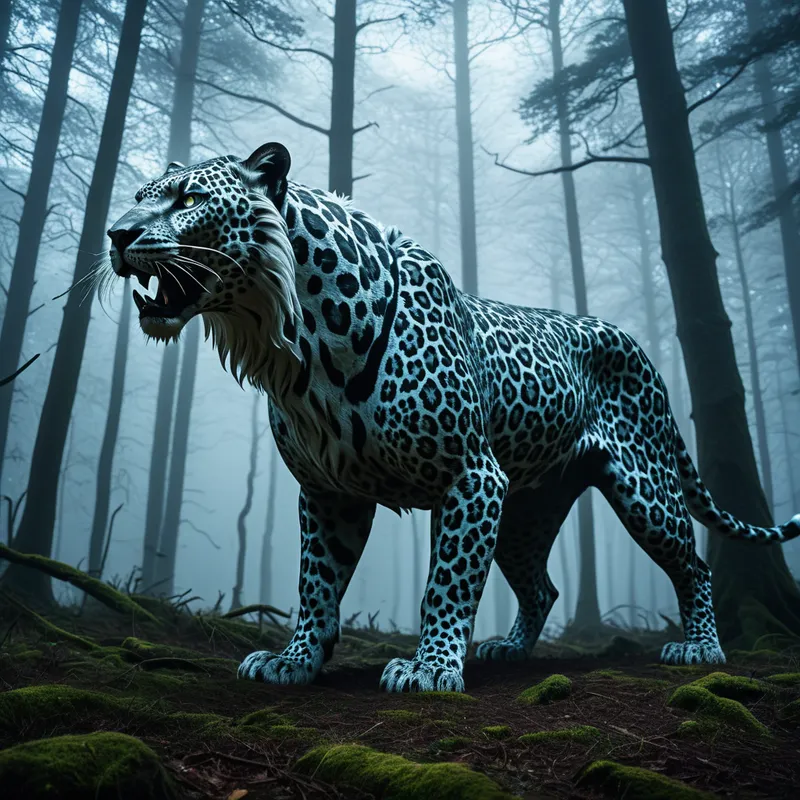
The Questing Beast Myth Meaning & Symbolism
A spectral creature whose cry sounds like hounds, pursued by knights. It embodies the eternal, elusive quest for the source of one's own inner torment and truth.
The Tale of The Questing Beast
Listen, and hear the sound that haunts the edges of [the world](/myths/the-world “Myth from Tarot culture.”/), in the deep woods where [the mist](/myths/the-mist “Myth from Celtic culture.”/) never lifts. It is not a howl, nor a roar, but the desperate, echoing cry of thirty pairs of hounds, baying as if from within the very earth. This is the call of the [Questing Beast](/myths/questing-beast “Myth from Arthurian culture.”/), and it draws the seeker into a chase without end.
The story begins not with a hero’s boast, but with a king’s despair. His name was Pellinore, and his life was not his own. It belonged to the sound. By day, he rode through tangled thickets and across desolate moors, his armor tarnished by endless weather. By night, he slept fitfully, the phantom baying threading through his dreams. He knew the Beast by its impossible form: a head like a serpent’s, a body spotted like a leopard’s, the feet of a hart, and from its belly, that ceaseless, internal clamor. He had seen it drink from a well, its strange eyes holding a sorrow as deep as the forest, before it vanished like smoke.
Others took up the call. The Saracen knight Palamedes, an outsider seeking a place in a foreign world, found his purpose in this phantom hunt. His quest was a prayer, a plea for belonging written in the language of pursuit. The greatest of all, Sir Percivale, glimpsed the Beast and saw in its flight a divine sign, a twisted thread in the tapestry of the [Grail Quest](/myths/grail-quest “Myth from Arthurian culture.”/). For him, the Beast was a [herald](/myths/herald “Myth from Greek culture.”/), a symbol that the world was stranger and more holy than it seemed.
But the chase never concluded with a glorious kill. No spear found its heart; no sword severed its head. The resolution was not conquest, but a transformation of the chase itself. Palamedes, through sheer, relentless devotion, was the one said to have finally achieved the quest. Yet the stories whisper that achieving it meant understanding it—that the pursuit was the purpose. The Beast, forever just beyond the next tree or over the next hill, remained, its haunting cry a permanent feature of the landscape of Logres, a reminder that some mysteries are not to be solved, but followed.

Cultural Origins & Context
The Questing Beast is a peculiar and haunting fixture of the later Arthurian Vulgate Cycle, specifically the Post-Vulgate and Sir [Thomas](/myths/thomas “Myth from Christian culture.”/) Malory’s seminal Le Morte d’Arthur. Unlike the archetypal dragons or giants of broader myth, the Beast is not a straightforward monster to be slain for treasure or glory. Its origins are murky, often tied to a sin—a popular version claims it was born of a princess and a demonic incubus—making it a creature of profound moral and cosmic disorder.
Its primary function in the Arthurian world was as a narrative engine of personal destiny. While [the Grail Quest](/myths/the-grail-quest “Myth from Arthurian culture.”/) served as the collective spiritual endeavor of the [Round Table](/myths/round-table “Myth from Arthurian culture.”/), the quest for the Beast was an individual, obsessive burden. It was a knight’s private penance or calling, often isolating him from the courtly community. Told by bards and scribes, the tale served as a counterpoint to chivalric norms. It questioned the very idea of the quest: what if the goal is not to conquer, but to be perpetually drawn forward? What if a knight’s greatest adversary is not a foreign enemy, but an elusive echo of his own inner state?
Symbolic Architecture
Psychologically, the Questing [Beast](/symbols/beast “Symbol: The beast often represents primal instincts, fears, and the shadow self in dreams. It symbolizes the untamed aspects of one’s personality that may need acknowledgment or integration.”/) is a supreme [symbol](/symbols/symbol “Symbol: A symbol can represent an idea, concept, or belief, serving as a powerful tool for communication and understanding.”/) of the [shadow](/symbols/shadow “Symbol: The ‘shadow’ embodies the unconscious, repressed aspects of the self and often represents fears or hidden emotions.”/) in its most dynamic and compelling form. It is not a dormant darkness, but a vocal one, constantly announcing its [presence](/symbols/presence “Symbol: Presence in dreams often signifies awareness or acknowledgment of something significant in one’s life.”/) with a sound that mimics the hunt itself. The [beast](/symbols/beast “Symbol: The beast often represents primal instincts, fears, and the shadow self in dreams. It symbolizes the untamed aspects of one’s personality that may need acknowledgment or integration.”/) externalizes an internal [condition](/symbols/condition “Symbol: Condition reflects the state of being, often focusing on physical, emotional, or situational aspects of life.”/).
The chase is the shape of the soul’s hunger; the quarry is the self we cannot name.
The composite [body](/symbols/body “Symbol: The body in dreams often symbolizes the dreamer’s self-identity, personal health, and the relationship they have with their physical existence.”/)—[serpent](/symbols/serpent “Symbol: A powerful symbol of transformation, wisdom, and primal energy, often representing hidden knowledge, healing, or temptation.”/), leopard, hart—suggests a chimeric [fusion](/symbols/fusion “Symbol: The merging of separate elements into a unified whole, often representing integration of self, relationships, or conflicting aspects of identity.”/) of instincts: the serpent’s wisdom (or poison), the leopard’s predatory aggression, the hart’s elusive nobility and [connection](/symbols/connection “Symbol: Connection symbolizes relationships, communication, and bonds among individuals.”/) to the [forest](/symbols/forest “Symbol: The forest symbolizes a complex domain of the unconscious mind, representing both mystery and potential for personal growth.”/) [soul](/symbols/soul “Symbol: The soul represents the essence of a person, encompassing their spirit, identity, and connection to the universe.”/). This is the unintegrated totality of one’s own [nature](/symbols/nature “Symbol: Nature symbolizes growth, connectivity, and the primal forces of existence.”/), perceived as a monstrous anomaly. Crucially, the sound of hounds emanates from within it. This signifies that the [pursuit](/symbols/pursuit “Symbol: A chase or being chased in dreams often reflects unresolved anxieties, unfulfilled desires, or internal conflicts demanding attention.”/) is self-contained; [the hunter](/myths/the-hunter “Myth from African culture.”/) and the hunted are part of a single, tortured [system](/symbols/system “Symbol: A system represents structure, organization, and interrelated components functioning together, often reflecting personal or social order.”/). The [knight](/symbols/knight “Symbol: The knight symbolizes honor, chivalry, and the pursuit of noble causes, reflecting the ideal of the noble warrior.”/) chasing the Beast is, in essence, chasing the sound of his own inner conflict, his own pack of barking anxieties, shames, and unresolved desires.

The Dreamer’s Resonance
When this mythic pattern stirs in the modern unconscious, it often manifests in dreams of perpetual, frustrating pursuit. The dreamer may be chasing a figure that always remains just out of sight, or fleeing from a threat whose nature is unclear. The core somatic experience is one of sustained anxiety, a low-grade psychic tinnitus—the “sound of the hounds” translated as a feeling of persistent urgency without a clear object.
This is the [psyche](/myths/psyche “Myth from Greek culture.”/) signaling a state of diverted seeking. The dreamer may be outwardly successful, yet feel haunted by a sense of meaningless striving. The Questing Beast dream asks: What is the true source of the baying you hear? What internal lack or wound are you trying to outrun or capture through external achievements, relationships, or busyness? The dream invites the dreamer to stop, turn inward, and listen to the quality of the inner noise itself, for within its signature is the clue to the deeper, unfulfilled need.

Alchemical Translation
The alchemical process modeled here is not the [solve et coagula](/myths/solve-et-coagula “Myth from Alchemical culture.”/) (dissolve and coagulate) of a single transformation, but the iterative refinement of the seeker through the act of seeking itself. The knight on this quest undergoes a slow, grinding transmutation.
The goal of this alchemy is not to capture the beast, but to become worthy of its call—to have one’s own inner noise harmonize with its strange music.
The initial stage is identification with the chase (Pellinore’s obsession). [The ego](/myths/the-ego “Myth from Jungian culture.”/) believes its wholeness depends on capturing the elusive shadow. The second stage is the recognition of the quest as path (Palamedes’s devotion). Here, the pursuit becomes a discipline, a way of life that structures and gives meaning, even in the absence of conclusion. The final, transcendent stage is the integration of the sound (Percivale’s insight). This is where the seeker realizes the Beast is not an enemy to be destroyed, but a guide. Its cry is the call of the unlived life, the unattended soul. To achieve the quest is to internalize its purpose: to understand that the relentless pursuit of outer solutions must turn into an attentive, compassionate listening to the inner chaos. The beast’s composite form then reveals itself not as a monster, but as a blueprint for a more complete self—where serpentine insight, passionate instinct, and spiritual agility can coexist. The chase ends only when we realize we were never hunting the beast, but following the thread of our own becoming.
Associated Symbols
Explore related symbols from the CaleaDream lexicon: