The Queen of Sheba Myth Meaning & Symbolism
A legendary queen journeys to test a king's famed wisdom, leading to a profound exchange that transcends politics and wealth.
The Tale of The Queen of Sheba
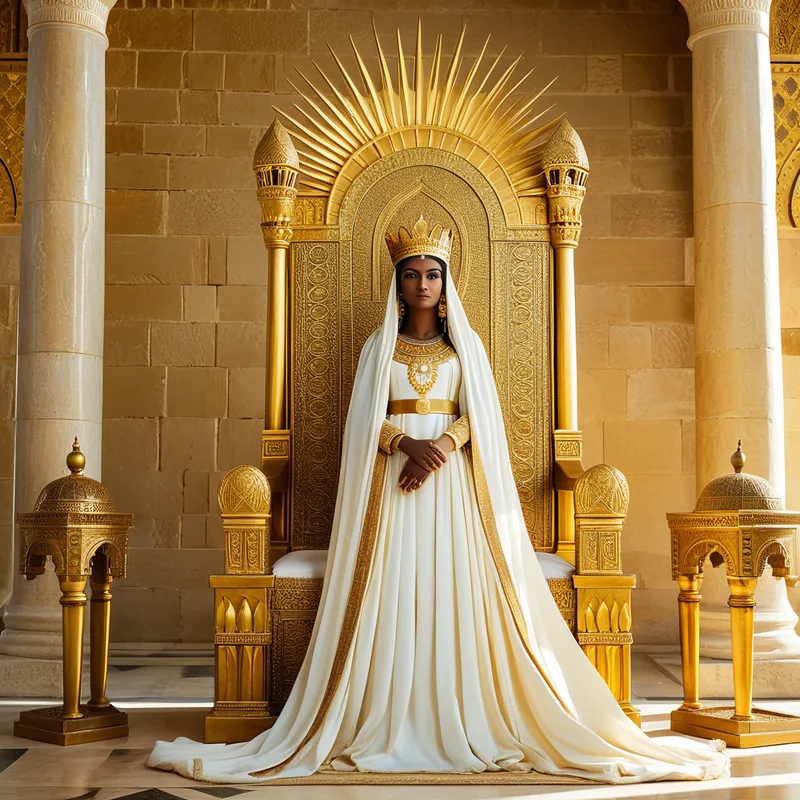
[The wind](/myths/the-wind “Myth from Various culture.”/) that sweeps across the frankincense groves carries whispers. Whispers of a king in the north whose wisdom is a fire that lights [the world](/myths/the-world “Myth from Tarot culture.”/), whose judgments are sharper than a Bedouin’s blade. In the kingdom of Sheba, where the air is thick with the scent of myrrh and [the earth](/myths/the-earth “Myth from Hindu culture.”/) yields gold, a queen listens. Her name is a secret held by [the desert](/myths/the-desert “Myth from Biblical culture.”/), but her title is known from the Red Sea to the Great River: Makeda, Bilqīs, the Queen.
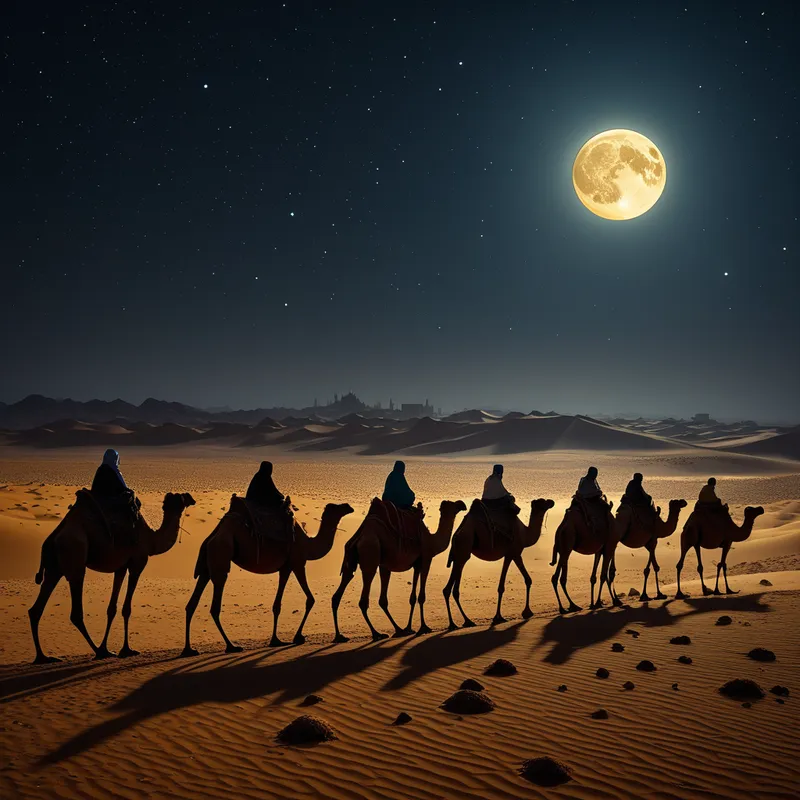
Her heart, a vessel of curiosity and sovereign will, could not abide mere rumor. To hear of a wisdom greater than her own was a challenge, a siren call from a distant throne. So she gathered the wealth of her land—caravans groaning under the weight of gold, jewels that caught the sun, and spices that wept fragrant resins. With a retinue of warriors and scribes, she turned her face toward the north, toward [Jerusalem](/myths/jerusalem “Myth from Biblical culture.”/). The journey was an epic of dust and stars, a pilgrimage of the intellect and spirit across the ribs of the earth.
She arrived not as a supplicant, but as an equal, a monarch of another sun. The court of [Solomon](/myths/solomon “Myth from Biblical culture.”/) was a spectacle of polished stone and murmured prayers, but she met its splendor with her own. And then came the testing. She posed to him hard questions, riddles woven from the deep lore of her people and the cunning of statecraft. She spoke of politics and nature, of [justice](/myths/justice “Myth from Tarot culture.”/) and paradox. [Solomon](/myths/solomon “Myth from Biblical culture.”/) answered all. He unraveled every knot of her inquiry, his understanding a deep well from which he drew clear, cool truth. He showed her the order of his kingdom, the justice of his hall, [the temple](/myths/the-temple “Myth from Jewish culture.”/) rising to his god.
The queen, who had come to test, found herself tested. The foundation of her certainty, built on her own formidable intelligence and the isolated wealth of her realm, was shaken by a greater, more terrifying architecture of mind and spirit. “The report I heard in my own country about your achievements and your wisdom is true,” she declared. “But I did not believe these things until I came and saw with my own eyes. Indeed, not even half was told me; in wisdom and wealth you have far exceeded the report I heard.”
In recognition, she gave him her treasures: 120 talents of gold, great quantities of spices, and precious stones. And Solomon, in turn, gave her “all she desired and asked for.” Then she turned her caravan homeward, back to the land of spice and sun, bearing not only the gifts of a king but the indelible imprint of an encounter that had changed the axis of her world.
Cultural Origins & Context
The Queen of Sheba appears primarily in two foundational texts: the Hebrew Bible (1 Kings 10:1-13 and 2 Chronicles 9:1-12) and the later Qur’an (Surah 27). In the Biblical account, she is a diplomatic and economic figure, a powerful monarch from a distant, wealthy land who validates Solomon’s divinely granted wisdom and the glory of his kingdom. Her visit serves as a high-[water](/myths/water “Myth from Chinese culture.”/) mark of Solomon’s reign, an international endorsement of Israel’s [golden age](/myths/golden-age “Myth from Universal culture.”/).
The story was passed down through scribal and priestly traditions, functioning as a testament to the reach and prestige of the Davidic monarchy under Yahweh’s favor. It was a narrative of legitimization. Later, in the Ethiopian national epic, the Kebra Nagast (“Glory of the Kings”), the tale expands dramatically. Here, the Queen (named Makeda) and Solomon conceive a son, Menelik I, who becomes the first emperor of Ethiopia and is said to have brought [the Ark of the Covenant](/myths/the-ark-of-the-covenant “Myth from Abrahamic culture.”/) to Aksum. This version transforms a diplomatic mission into a myth of dynastic and sacred origin, weaving the Queen directly into the fabric of a nation’s identity and divine right to rule.
Symbolic Architecture
At its core, the myth is a profound narrative of the encounter between Sol and Luna, between the known and the mysterious. Solomon represents established, divine, [logos](/myths/logos “Myth from Christian culture.”/)-oriented wisdom—the [king](/symbols/king “Symbol: A symbol of ultimate authority, leadership, and societal order, often representing the dreamer’s inner power or external control figures.”/) in his [city](/symbols/city “Symbol: A city often symbolizes community, social connection, and the complexities of modern life, reflecting the dreamer’s relationships and societal integration.”/), the judge on his [throne](/symbols/throne “Symbol: A seat of authority, power, and sovereignty, representing leadership, divine right, or social hierarchy.”/), the builder of temples. The [Queen](/symbols/queen “Symbol: A queen represents authority, power, nurturing, and femininity, often embodying leadership and responsibility.”/) of Sheba represents the wisdom of the other, of the distant and exotic, of intuitive intelligence and earthy [wealth](/symbols/wealth “Symbol: Wealth in dreams often represents abundance, security, or inner resources, but can also symbolize burdens, anxieties, or moral/spiritual values.”/) (spices, gold). She is the [anima](/symbols/anima “Symbol: The feminine archetype within the male unconscious, representing soul, creativity, and connection to the inner world.”/) figure who arrives from beyond the borders to question and complete the kingly [consciousness](/symbols/consciousness “Symbol: Consciousness represents the state of awareness and perception, encompassing thoughts, feelings, and experiences.”/).
The journey to meet one’s equal in wisdom is the most perilous and necessary pilgrimage. It risks the very sovereignty of the self to achieve a higher union.
Her riddles are not mere puzzles; they are the probing questions the unconscious poses to the conscious mind. Can your ordered [logic](/symbols/logic “Symbol: The principle of reasoning and rational thought, often representing order, structure, and intellectual clarity in dreams.”/) comprehend my paradoxical [nature](/symbols/nature “Symbol: Nature symbolizes growth, connectivity, and the primal forces of existence.”/)? Can your [temple](/symbols/temple “Symbol: A temple often symbolizes spirituality, sanctuary, and a deep connection to the sacred aspects of life.”/) contain the scent of my [frankincense](/symbols/frankincense “Symbol: A sacred resin used historically in religious rituals and healing, symbolizing purification, spiritual connection, and divine offering.”/)? The exchange of gifts is the critical symbolic act. It is not submission, but a sacred commerce—the [integration](/symbols/integration “Symbol: The process of unifying disparate parts of the self or experience into a cohesive whole, often representing psychological wholeness or resolution of internal conflict.”/) of opposites. She gives him the tangible wealth of the instinctual, natural world (gold, spices). He gives her “all she desired,” which tradition often interprets as wisdom itself. This creates a whole greater than its parts: enlightened sovereignty.
The Dreamer’s Resonance
When this myth stirs in the modern [psyche](/myths/psyche “Myth from Greek culture.”/), it often manifests in dreams of formidable journeys or momentous meetings. You may dream of traveling to a distant, awe-inspiring city to meet a figure of great authority or knowledge. You may dream of being tested, of presenting your own “riddles” (your creative work, your complex life situation) to a discerning other, or of being asked profound questions that challenge your self-concept.
Somatically, this can feel like a gathering of energy—a preparation of your inner “caravan”—followed by the tense, focused anticipation of a confrontation that is not hostile, but deeply significant. The psychological process is one of bringing the hidden wealth of [the self](/myths/the-self “Myth from Jungian culture.”/) to the seat of conscious judgment. The dreamer is the Queen, assembling the neglected gold of their talents, the spicy complexities of their emotions, and the precious stones of their unique experiences, and journeying to present them to the inner Solomon for recognition and valuation. The anxiety in the dream is the fear that this inner king will find your offerings lacking, or that you will be overwhelmed by his brilliance.
Alchemical Translation
The alchemical process modeled here is the Coniunctio, [the sacred marriage](/myths/the-sacred-marriage “Myth from Various culture.”/). For the individual pursuing individuation, the myth outlines a crucial stage: the conscious ego (Solomon in his Jerusalem) cannot become whole by itself. It must be visited, challenged, and enriched by the representative of the deep, often foreign-seeming psyche (the Queen from Sheba).
Individuation requires a royal audience with the parts of oneself kept in exile. Their questions are the keys to your treasury.
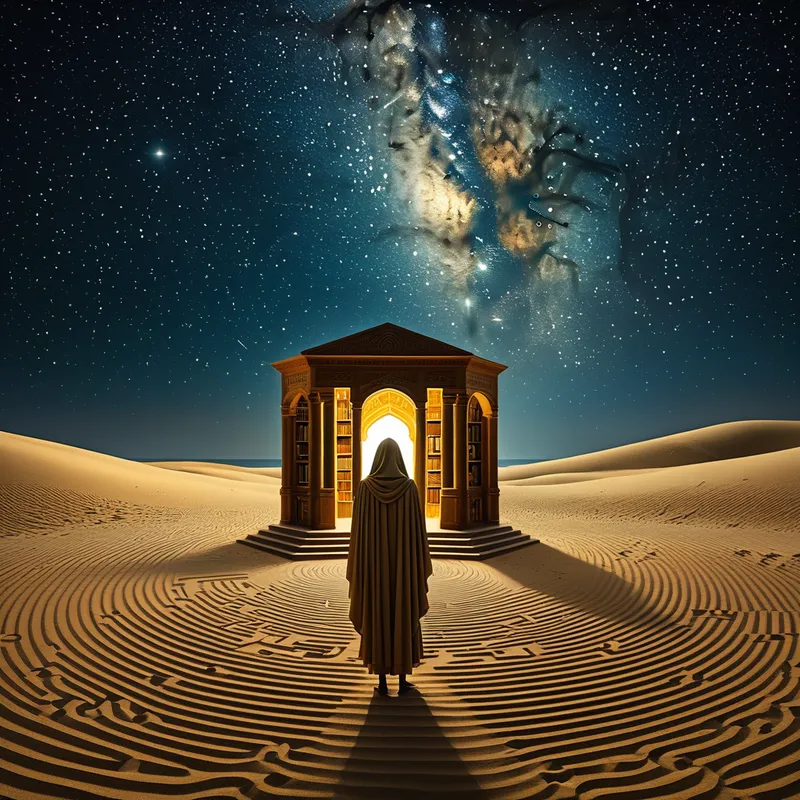
The “rising action” is the arduous journey to make this internal encounter conscious—the work of therapy, creative expression, or deep reflection that feels like crossing a desert. The “climax” is the fearless exchange: [the ego](/myths/the-ego “Myth from Jungian culture.”/) must answer the riddles posed by the unconscious (understand its symbols, endure its paradoxes), and the unconscious must offer up its raw, instinctual wealth to be integrated into the structure of the conscious life. The “gift” Solomon gives in return is the ordering principle, the meaning and context that transforms raw experience into coherent wisdom.
The final stage, often overlooked, is the return. The Queen goes back to her own land. Psychologically, this means the integrated content does not dissolve the ego but returns to enrich the broader, foundational psyche. You return to your life, to your “kingdom,” but you are no longer the same ruler. You govern with a wisdom that has been tempered by a dialogue with the ultimate other, and in doing so, you rule a more complete and fertile inner realm.
Associated Symbols
Explore related symbols from the CaleaDream lexicon: