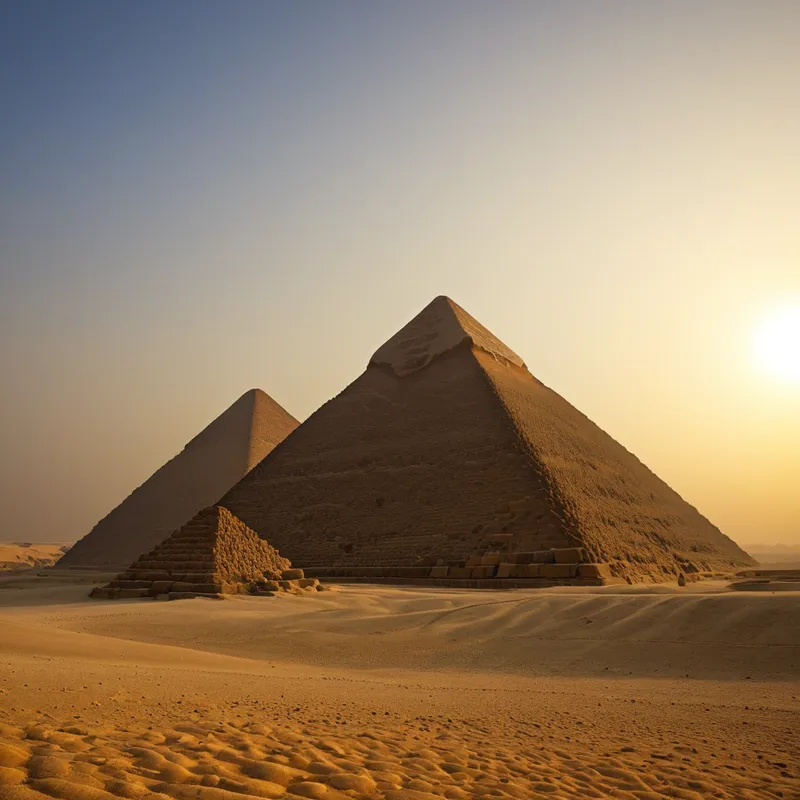
The Pyramids Myth Meaning & Symbolism
The myth of the pyramids is the story of the pharaoh's divine ascent, a stone prayer to reunite the soul with the imperishable stars.
The Tale of The Pyramids
Listen. Before [the world](/myths/the-world “Myth from Tarot culture.”/) was as it is, when the gods walked the black soil and the red desert was their shadow, there was a king. He was not merely a man; he was the [Horus](/myths/horus “Myth from Egyptian culture.”/), the son of Ra. His name was a secret, his body a vessel for the light that sailed the day-barque across the heavens. But flesh is a temporary garment, and even the [Horus](/myths/horus “Myth from Egyptian culture.”/) must shed it.
The king lay upon his bed of electrum and ebony, his Ka restless, his Ba already tasting the cool night air. He saw the imperishable stars, the Ikhemu-sek, circling the northern void, eternal and unchanging. To join them was the destiny of a god-king, but the path was a ladder through chaos. The world of the living, Kemet, was a precious island in the Nun. Death was a return to those waters, a dissolution—unless one had a mountain of stone to stand upon, a stairway to climb.
So the king summoned his vizier, the seal-bearer, and spoke with a voice that was already half-wind. “You will build me a mountain that is not a mountain. You will quarry the light of the sun and the bones of [the earth](/myths/the-earth “Myth from Hindu culture.”/). You will align its sides to the four pillars of Maat. Its heart will be a chamber of granite, a seed within the fruit. And its face will shine, so that when Ra journeys in his barque, he will see his own glory reflected and know this is the place of his son.”
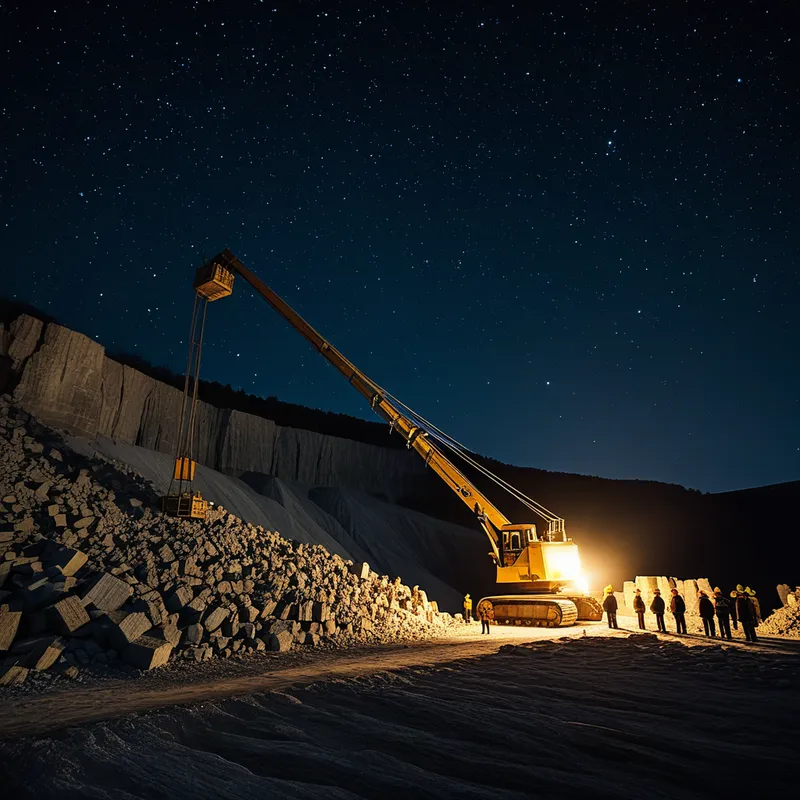
For decades, the land breathed with the effort. From the quarries of Tura came white stone, cut with copper and sand, dragged on sledges wet with the Nile’s gift. The people labored not as slaves to a man, but as the limbs of Egypt itself, performing a sacred duty that bound the land to [the sky](/myths/the-sky “Myth from Persian culture.”/). The pyramid rose, course by perfect course, a geometric incantation made solid. It was the Benben stone, the first solid [thing](/myths/thing “Myth from Norse culture.”/), recreated. It was the rays of the sun, petrified and focused to a point.
When the king’s breath left him, [the great work](/myths/the-great-work “Myth from Alchemical culture.”/) began anew. His body, anointed and wrapped, began the perilous journey. Through the long, ascending passageway, from the world of the living into the mountain’s core, priests carried [the sarcophagus](/myths/the-sarcophagus “Myth from Egyptian culture.”/). They performed the Opening of the Mouth in the King’s Chamber, awakening the statues and the mummy so [the Ba](/myths/the-ba “Myth from Egyptian culture.”/) could fly. Then they sealed the granite plugs, blocking the passage forever, leaving the king alone with the silence of millions of tons of stone.
But this was not an end. It was a launch. Within that perfect, dark geometry, a alchemy of the spirit occurred. The king’s Ba burst forth, not through the blocked passages, but straight through the very stone. It ascended the invisible ladder of the pyramid’s form, shooting upwards to the apex, where it joined [the solar barque](/myths/the-solar-barque “Myth from Egyptian culture.”/). He became one with the Ikhemu-sek, an eternal star in the body of Nut. The pyramid remained below, a silent, mighty machine of resurrection, a frozen lightning bolt of ascent connecting the dark, fertile earth to the blazing, unchanging heavens.
Cultural Origins & Context
The myth of the pyramids is not contained in a single [papyrus](/myths/papyrus “Myth from Egyptian culture.”/) scroll but is inscribed in the landscape itself and the meticulous rituals of the state. It emerged during the Old Kingdom (c. 2686–2181 BCE), a period where the divinity of the king was the absolute cornerstone of cosmic and social order. The pyramid complex was not a tomb in a modern sense, but a resurrection machine and an eternal palace. The myth was “told” through architecture, ritual texts (later compiled as the [Pyramid Texts](/myths/pyramid-texts “Myth from Egyptian culture.”/)), and the performed ceremony of the royal funeral.
The primary tellers of this myth were the priesthood and the state architects, who served as the technicians of the sacred. Its societal function was multifaceted: it validated [the pharaoh](/myths/the-pharaoh “Myth from Egyptian culture.”/)‘s absolute, god-given authority, it ensured the continued functioning of the cosmos (the king’s successful ascent guaranteed the sun would rise and the Nile would flood), and it provided a theological blueprint for elite—and later, more democratized—aspirations for an afterlife. The pyramid was the ultimate symbol of a culture obsessed with permanence, order (Maat), and the [triumph](/myths/triumph “Myth from Roman culture.”/) of conscious form over the ever-present threat of chaos (Isfet).
Symbolic Architecture
At its core, the [pyramid](/symbols/pyramid “Symbol: The pyramid symbolizes stability, strength, and the journey toward enlightenment, reflecting the connection between the earthly and the divine.”/) myth is a supreme act of world-making. It represents the [human](/symbols/human “Symbol: The symbol of a human represents individuality, complexity of emotions, and social relationships.”/) [psyche](/myths/psyche “Myth from Greek culture.”/)‘s desperate, glorious attempt to create a permanent [structure](/symbols/structure “Symbol: Structure in dreams often symbolizes stability, organization, and the framework of one’s life, reflecting how one perceives their environment and personal life.”/) of meaning in the face of the ultimate [chaos](/symbols/chaos “Symbol: In Arts & Music, chaos represents raw creative potential, uncontrolled expression, and the breakdown of order to forge new artistic forms.”/): [death](/symbols/death “Symbol: Symbolizes transformation, endings, and new beginnings; often associated with fear of the unknown.”/) and oblivion.
The pyramid is the psyche’s first and final argument against the void—a geometric prayer that asserts, “Here, consciousness took a stand.”
[The square](/myths/the-square “Myth from Platonic culture.”/) base, aligned to the cardinal points, symbolizes the ordered, manifest world, the [realm](/symbols/realm “Symbol: The symbol of ‘Realm’ often signifies the boundaries of one’s consciousness, experiences, or emotional states, suggesting aspects of reality that are either explored or ignored.”/) of Maat. The ascending triangular sides represent the converging paths of [ascent](/symbols/ascent “Symbol: Symbolizes upward movement, progress, spiritual elevation, or striving toward higher goals, often representing personal growth or transcendence.”/), the [soul](/symbols/soul “Symbol: The soul represents the essence of a person, encompassing their spirit, identity, and connection to the universe.”/)‘s [journey](/symbols/journey “Symbol: A journey in dreams typically signifies adventure, growth, or a significant life transition.”/) from multiplicity (the broad base of earthly concerns) to [singularity](/symbols/singularity “Symbol: A point of infinite density and potential, often representing a moment of profound transformation, unity, or the convergence of all possibilities.”/) (the apex, the point of union). The hidden [interior](/symbols/interior “Symbol: The interior symbolizes one’s inner self, thoughts, and emotions, often reflecting personal growth, vulnerabilities, and secrets.”/) chambers—the Descending [Passage](/symbols/passage “Symbol: A passage symbolizes transition, movement from one phase of life to another, or a journey towards personal growth.”/), the Grand [Gallery](/symbols/gallery “Symbol: A space for displaying art or personal expression, representing the dreamer’s desire for recognition, appreciation, or contemplation of aesthetic values.”/), the [King](/symbols/king “Symbol: A symbol of ultimate authority, leadership, and societal order, often representing the dreamer’s inner power or external control figures.”/)‘s [Chamber](/symbols/chamber “Symbol: A private, enclosed space representing the inner self, hidden aspects, or a specific stage in life’s journey.”/)—map the perilous [journey](/symbols/journey “Symbol: A journey in dreams typically signifies adventure, growth, or a significant life transition.”/) of the [soul](/symbols/soul “Symbol: The soul represents the essence of a person, encompassing their spirit, identity, and connection to the universe.”/) through the Duat, the [underworld](/symbols/underworld “Symbol: A symbolic journey into the unconscious, representing exploration of hidden aspects of self, transformation, or confronting repressed material.”/). The pyramid is thus a three-dimensional [mandala](/symbols/mandala “Symbol: A sacred geometric circle representing wholeness, the cosmos, and the journey toward spiritual integration.”/), a model of the [cosmos](/symbols/cosmos “Symbol: The entire universe as an ordered, harmonious system, often representing the totality of existence, spiritual connection, and the unknown.”/) and the stages of initiatory transformation, where the [hero](/symbols/hero “Symbol: A hero embodies strength, courage, and the ability to overcome significant challenges.”/)-[king](/symbols/king “Symbol: A symbol of ultimate authority, leadership, and societal order, often representing the dreamer’s inner power or external control figures.”/) ([the ego](/myths/the-ego “Myth from Jungian culture.”/)-[consciousness](/symbols/consciousness “Symbol: Consciousness represents the state of awareness and perception, encompassing thoughts, feelings, and experiences.”/)) must die to its mortal form to be reborn as a star (the integrated Self).
The Dreamer’s Resonance
When the pyramid appears in a modern dream, it is rarely a tourist postcard. It manifests as an immense, often solitary structure within a vast psychic landscape—a desert of the unconscious. Dreaming of being inside a pyramid suggests a process of deep, perhaps claustrophobic, introspection. The dreamer is in the “King’s Chamber” of their own psyche, undergoing a pressurized transformation. The narrow, ascending passages may symbolize a difficult but guided path toward a higher state of awareness or a specific goal that feels both monumental and isolating.
To dream of building a pyramid points to a colossal, long-term project of [the Self](/myths/the-self “Myth from Jungian culture.”/). The dreamer is engaged in structuring their identity or life’s work with immense effort, seeking to create something that will outlast them. Conversely, dreaming of a ruined or crumbling pyramid can signal a crisis of foundational beliefs, a feeling that the structures of meaning or order in one’s life are decaying. The pyramid in dreams is ultimately an archetypal symbol of ambition, legacy, and the soul’s yearning for a transcendent, ordered state beyond the flux of ordinary life.
Alchemical Translation
For the individual on the path of individuation, the pyramid myth models the alchemical process of coagulatio—the making solid—followed by a sublime sublimatio—ascent and spiritualization.
The first, laborious stage is the construction of the ego-structure. This is the hard work of consciousness: building a stable, well-defined identity (the square base), aligning one’s life with personal ethics (the cardinal directions), and developing competence in the world. This is the “[pharaoh](/myths/pharaoh “Myth from Egyptian culture.”/)” in his earthly reign. But this structure, impressive as it is, becomes a prison if one identifies with it completely. The necessary crisis is the “death” of this identification—the entombment of the old self in the granite chamber of solitude and introspection.
The alchemical gold is not found by adding more stone to the base, but by having the courage to let the confined self dissolve in the darkness so the essential spirit can ascend.
The true alchemical work happens in this sealed darkness. It is the incubation, the confrontation with [the shadow](/myths/the-shadow “Myth from Jungian culture.”/) in [the underworld](/myths/the-underworld “Myth from Greek culture.”/) of [the personal unconscious](/myths/the-personal-unconscious “Myth from Jungian Psychology culture.”/). The “ascent” is not an effortful climbing of the exterior, but a realization that emerges from the center. The integrated Self ([the star](/myths/the-star “Myth from Tarot culture.”/)-Ba) does not exit through the door it came in; it transcends the very structure that contained it. The pyramid, the once-painstakingly built life and identity, remains as a testament to the journey, but the individual is no longer confined within it. They have achieved a perspective from the apex—a connection to the transpersonal, the “imperishable stars” of the archetypal realm—while their earthly form remains grounded and ordered. They have become a conduit between heaven and earth, a living axis mundi.
Associated Symbols
Explore related symbols from the CaleaDream lexicon: