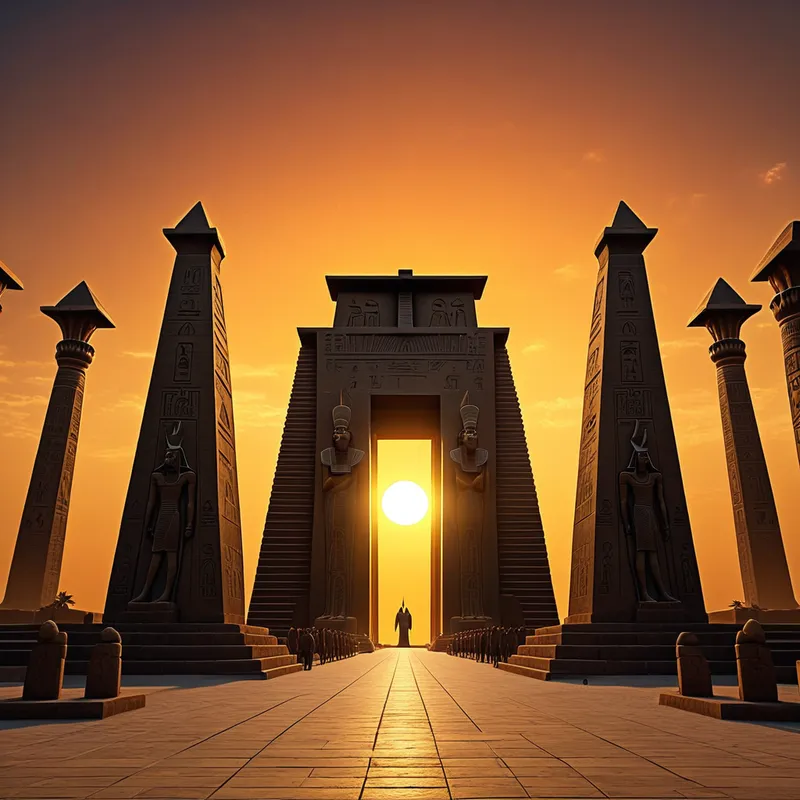
The Pylon Gates of Temples Myth Meaning & Symbolism
The myth of the solar barque's perilous nightly passage through the pylon gates of the underworld, guarded by terrifying deities, to be reborn at dawn.
The Tale of The Pylon Gates of Temples
Hear now the tale not of stone, but of spirit; not of monuments raised by mortal hands, but of the thresholds carved by the gods themselves in the fabric of night. This is the journey of Ra, he who is born at dawn and dies at dusk, only to be born again.
As the last crimson light bleeds from the western sky, a great sigh echoes across the land. The sun-disk, the Aten, sinks below the horizon. But this is not an end. It is a descent into the womb of potential. Ra, now in his night-form as the ram-headed god, boards his barque of millions of years. With him are his loyal crew: Thoth, the scribe who records the balance of the heart; Anubis, the guide through silent places; and the mighty Horus, his avenging eye.
Their destination is the Duat. But the Duat is not a single kingdom. It is a labyrinth of twelve regions, corresponding to the twelve hours of night. And guarding the passage into each region stands a Pylon Gate. These are not mere doors. They are living entities, massive trapezoidal jaws of stone and shadow. Their surfaces are alive with carved spells and terrifying guardians. At the first gate, the air grows cold and thick. From the gloom, a voice like grinding granite demands the sacred name of the gate. Thoth steps forward, his words weaving a shield of light. The gate groans open, revealing a cavernous passage where the river of night flows black and swift.
At each subsequent gate, the terror deepens. The guardians are no longer static carvings but living nightmares: serpent-demons with knives for teeth, crocodile-headed sentinels whose eyes burn with green fire, beings of pure chaos who shriek the names of forgetfulness. The barque, a fragile vessel of reeds and gold, is buffeted by winds that carry the whispers of non-existence. The greatest threat coils in the deepest dark: Apophis, who seeks to swallow the sun-barque whole, to plunge creation into eternal, formless night. Horus stands at the prow, his spear a lance of focused will, while the crew chants the names of power, binding the chaos with the cords of Ma’at.
The journey is an agony of tests. At the midpoint, in the silent sixth hour, Ra meets his own mummified form—his own potential death. He must recognize it, honor it, and move through it. Only by integrating this shadow can the barque proceed. Finally, after the twelfth and most terrible gate, where the guardians are the very faces of oblivion, a glimmer appears. It is not an exit, but a transformation. The barque, now bearing the scarab-form of Khepri, emerges from the eastern mountain. The gates of night have been passed. The sun is born anew, and the world breathes a sigh of relief, bathed in the gold of a dawn that is not a repetition, but a resurrection.
Cultural Origins & Context
This myth was not a single story told around a fire, but the sacred, enacted cosmology of the Egyptian state. It is found most completely in the Book of Gates and the Amduat, texts painted on the walls of royal tombs in the Valley of the Kings. These were not for public consumption; they were maps and manuals for the deceased pharaoh, who was identified with Ra in his journey.
The myth’s primary societal function was the maintenance of cosmic and social order (Ma’at). By ritually re-enacting Ra’s victory over chaos (Isfet) every night in temple liturgies and every year in festival cycles, the priesthood and the pharaoh ensured the sun would rise, the Nile would flood, and the kingdom would endure. The pylon gates of earthly temples—like those at Karnak or Abu Simbel—were their physical echoes, marking the transition from the profane world to the sacred precinct, mirroring the sun god’s passage from one state of being to another.
Symbolic Architecture
The Pylon Gates are the ultimate symbol of the limen—the transformative threshold. They represent the critical junctures in any profound process of change, where the old structure must be dismantled for the new consciousness to emerge.
The gate is not an obstacle to be destroyed, but a membrane to be permeated. It demands not force, but the correct password of the soul.
Each gate corresponds to an hour of night, symbolizing the necessary, sequential stages of dissolution and incubation. The terrifying guardians are not merely external monsters; they are the psychic complexes, repressed memories, and archetypal fears that rise to the surface when one commits to a journey into the depths of the self. Apophis is the embodiment of the regressive pull, the temptation to fall back into unconsciousness, to let the nascent self be dissolved before it can be born. Ra’s encounter with his own mummified form at the nadir of the journey is the pivotal moment of enantiodromia—the confrontation with one’s own shadow, the recognition that death and potential are two sides of the same coin.
The Dreamer’s Resonance
When the Pylon Gates appear in modern dreams, they signal a psyche engaged in a profound restructuring. The dreamer is likely at a life threshold: a career change, the end of a relationship, a spiritual crisis, or a deep therapeutic process.
Somatically, this may manifest as feelings of constriction in the chest (the gate as a narrowing passage), anxiety or dread (the approach to the guardians), or a paradoxical sense of awe and terror. The dream pylon is often immense, dwarfing the dreamer, emphasizing the magnitude of the internal shift underway. To dream of successfully passing through, especially with the aid of guiding figures (the Thoth or Horus within), indicates the ego’s alignment with the Self’s transformative agenda. To dream of being turned away or attacked at the gate suggests that some part of the psyche—a rigid attitude, an unacknowledged fear—is refusing to utter the necessary “password” of truth required for passage.
Alchemical Translation
The myth of the Pylon Gates is a perfect allegory for the Jungian process of individuation—the alchemical opus of becoming whole. The journey begins with the nigredo, the descent into the Duat (the unconscious). Each gate represents a stage of the separatio and solutio, where aspects of the personality are broken down and dissolved by the “guardians” (our own neuroses and defenses).
The rebirth of dawn is not granted; it is earned through the meticulous, hourly work of facing what the night reveals.
The central, dark-night encounter with the mummified self is the coniunctio oppositorum—the confrontation and marriage with the shadow. This is the crucial alchemical death (mortificatio) that makes new life possible. The final emergence as Khepri, the scarab, symbolizes the lapis philosophorum—the Self, born from the mud of the unconscious, capable of rolling the sun of consciousness forward anew. For the modern individual, the myth teaches that transformation is not a single leap, but a series of negotiated passages. Each “gate” in our lives—each crisis, ending, or deep introspection—requires us to name our truth to the guardians of our own fear, to integrate a piece of our shadow, and to trust that the vessel of our being, though fragile, is crewed by archetypal guides (our inner wisdom, courage, and integrity) and is ultimately bound for dawn.
Associated Symbols
Explore related symbols from the CaleaDream lexicon: