The Purification Process Myth Meaning & Symbolism
A soul's journey through dissolution in the prima materia, purification in the alembic, and rebirth as the philosopher's stone.
The Tale of The Purification Process
Listen, and I will tell you of the journey that is not a journey, of the death that is not an end, of the fire that does not consume but reveals.
In the beginning, there was only the [Prima Materia](/myths/prima-materia “Myth from Alchemical culture.”/)—a formless, chaotic, and melancholy substance. It was the orphaned soul of [the world](/myths/the-world “Myth from Tarot culture.”/), heavy with all that was and could be, yet conscious of nothing but its own profound lack. It dwelled in the [Nigredo](/myths/nigredo “Myth from Alchemical culture.”/), a realm of absolute blackness where stars were forgotten and light was a memory of a memory.
This substance yearned, though it knew not for what. Its yearning attracted the attention of the [Mercurius](/myths/mercurius “Myth from Alchemical culture.”/), a being of quicksilver and spirit, who appeared not as a person, but as a shimmering question in the dark. “What are you?” the question echoed. [The Prima Materia](/myths/the-prima-materia “Myth from Alchemical culture.”/) could only reply with its weight, its confusion, its base and leaden silence.
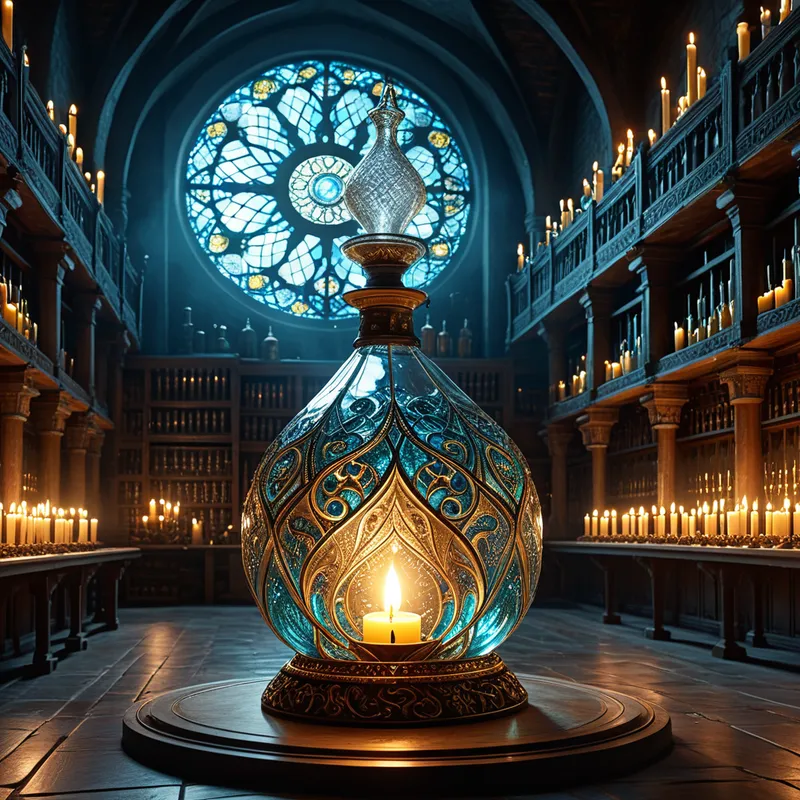
Seeing its plight, Mercurius led the substance to the [Vas Hermeticum](/myths/vas-hermeticum “Myth from Alchemical culture.”/), a glass vessel that was a universe unto itself. Here, the first fire was applied—the Fire of Sorrow. It was not a flame of destruction, but one of profound attention. Under its gaze, the Prima Materia began to weep. It dissolved into a seething, salty ocean of its own unrecognized grief and forgotten histories. Metals bled rust, stones shed dust, and all fixed things softened into a bitter, churning brine. This was the [Solutio](/myths/solutio “Myth from Alchemical culture.”/).
From the brine arose vapors—fantasies, angers, and prideful illusions—the Volatile. These rose to the top of [the vessel](/myths/the-vessel “Myth from Alchemical culture.”/), a storm cloud of psychic noise. But the vessel was sealed. The vapors could not escape; they condensed on the cool glass and rained back down into the boiling mass below. This cycle—evaporation and condensation, inflation and humiliation—repeated ten thousand times. It was the Circulatio, the great circulation. With each cycle, a little of the cloud’s arrogance was washed away, and a little more of the brine’s bitterness was clarified.
Then came the Albedo. The storm within calmed. The liquid, once dark and turbulent, became a still, milky-white pool. A moon shone within the vessel, casting a silver light. In this reflective silence, the substance saw itself for the first time—not as chaos, but as something capable of stillness. It had been washed clean of its grossest impurities, but it was pale, ghostly, and alone.
Now the fire changed. The Fire of Sorrow became the Fire of Love. The heat intensified, focusing on the heart of the white pool. A tension grew, a longing for something beyond mere purity. The white matter began to blush, then to glow with a deep, rosy hue—the [Rubedo](/myths/rubedo “Myth from Alchemical culture.”/). This was the most dangerous moment. The substance felt a glorious, radiant inflation, the temptation to become a beautiful ruby and remain forever in splendid isolation.
But the Fire of Love did not allow it. It pressed further, forcing the red glow to condense, to surrender its glorious color, to sink into itself with ultimate gravity. In a final, silent contraction, all color, all separation, all process collapsed into a single, dense, and radiant point.
The fire went out. The vessel cooled. And there, resting in the ashes, was no longer the melancholy Prima Materia, but the [Lapis Philosophorum](/myths/lapis-philosophorum “Myth from Alchemical culture.”/)—[the Philosopher’s Stone](/myths/the-philosophers-stone “Myth from Alchemical culture.”/). It was not large, but it was impossibly heavy with meaning and impossibly light with spirit. It was fixed and volatile, body and soul, lead and gold, united. It did not shine with a light that pushed darkness away, but with a clarity that understood darkness was part of its own nature, now redeemed.
Cultural Origins & Context
The myth of The Purification Process is not a single story from a single time, but the core narrative skeleton upon which centuries of European Hermetic Alchemy built its flesh of symbols. It emerged from a fusion of Hellenistic Egyptian craft, Arabic scholarship, and Christian mysticism between the 12th and 17th centuries. It was never a “folk tale” for the masses, but an esoteric allegory passed down in encrypted manuscripts, such as the [Rosarium Philosophorum](/myths/rosarium-philosophorum “Myth from Alchemical culture.”/) or the works of [Hermes Trismegistus](/myths/hermes-trismegistus “Myth from Greek culture.”/).
Its tellers were adepts in shadowy workshops, and its audience was the apprentice—or the seeker’s own soul. Its societal function was dual: outwardly, it encoded practical laboratory procedures for working with metals and acids; inwardly, it provided a precise, non-dogmatic map for the opus animae, the work of the soul. In a culture where explicit heresy could mean death, alchemical manuscripts, filled with images of kings dying and dragons fighting, served as a safe container for psychological and spiritual experimentation, allowing the individual to pursue a direct relationship with the divine and the depths of matter without direct conflict with ecclesiastical authority.
Symbolic Architecture
The myth is a perfect symbolic model for the [psyche](/myths/psyche “Myth from Greek culture.”/)‘s [movement](/symbols/movement “Symbol: Movement symbolizes change, progress, and the dynamics of personal growth, reflecting an individual’s desire or need to transform their circumstances.”/) from a state of unconscious suffering to conscious wholeness.
The Prima Materia represents the raw, unexamined contents of the personal and [collective unconscious](/symbols/collective-unconscious “Symbol: The Collective Unconscious refers to the part of the unconscious mind shared among beings of the same species, embodying universal experiences and archetypes.”/)—our complexes, inherited traumas, and unlived potentials. It is the “lead” of our base [nature](/symbols/nature “Symbol: Nature symbolizes growth, connectivity, and the primal forces of existence.”/), not evil, but unconscious and undirected.
The first stage of knowing is the dissolution of what you thought you knew.
The Vas Hermeticum is the total psychological [situation](/symbols/situation “Symbol: The ‘situation’ symbolizes the junction between the subconscious and conscious realms, often reflecting the current challenges or dynamics in the dreamer’s waking life.”/)—the [analysis](/symbols/analysis “Symbol: The process of examining something methodically to understand its components or meaning. In dreams, it represents the mind’s attempt to break down complex experiences.”/), the therapeutic container, the committed spiritual practice, or simply the unbearable [tension](/symbols/tension “Symbol: A state of mental or emotional strain, often manifesting physically as tightness, pressure, or unease, signaling unresolved conflict or anticipation.”/) of a [life](/symbols/life “Symbol: The symbol of ‘Life’ represents a journey of growth, interconnectedness, and existential meaning, encompassing both the joys and challenges that define human experience.”/) [crisis](/symbols/crisis “Symbol: A crisis symbolizes turmoil, urgent challenges, and the need for immediate resolution or change.”/) that forces introspection. It is the sealed [space](/symbols/space “Symbol: Dreaming of ‘Space’ often symbolizes the vastness of potential, personal freedom, or feelings of isolation and exploration in one’s life.”/) where escape is impossible, and one must face oneself.
The Circulatio symbolizes the tedious, repetitive work of [integration](/symbols/integration “Symbol: The process of unifying disparate parts of the self or experience into a cohesive whole, often representing psychological wholeness or resolution of internal conflict.”/). Every time an unconscious complex (the volatile [vapor](/symbols/vapor “Symbol: Vapor represents the intangible, ephemeral nature of artistic expression and the fleeting quality of inspiration, often symbolizing transformation between states.”/)) rises into [consciousness](/symbols/consciousness “Symbol: Consciousness represents the state of awareness and perception, encompassing thoughts, feelings, and experiences.”/), it is observed, understood (condensed), and returned to the psyche with new [awareness](/symbols/awareness “Symbol: Conscious perception of self, surroundings, or internal states. Often signifies awakening, insight, or heightened sensitivity.”/), gradually altering the whole [mixture](/symbols/mixture “Symbol: A mixture in dreams represents integration, blending of ideas, or conflicts between differing aspects of the self.”/). This is the core of [shadow](/symbols/shadow “Symbol: The ‘shadow’ embodies the unconscious, repressed aspects of the self and often represents fears or hidden emotions.”/) work.
The final production of the [Lapis](/symbols/lapis “Symbol: A deep blue stone historically revered as a celestial connection and symbol of wisdom, truth, and spiritual enlightenment.”/) Philosophorum symbolizes the [achievement](/symbols/achievement “Symbol: Symbolizes success, mastery, or reaching a goal, often reflecting personal validation, social recognition, or overcoming challenges.”/) of the individuated Self. It is not a state of perfect, [static](/symbols/static “Symbol: Static represents interference, disruption, and the breakdown of clear communication or signal, often evoking feelings of frustration and disconnection.”/) [bliss](/symbols/bliss “Symbol: A state of profound happiness and spiritual contentment, often representing fulfillment of desires or alignment with one’s true self.”/), but a dynamic, centered point of being that can contain and transmute [paradox](/symbols/paradox “Symbol: A contradictory yet true concept that challenges logic and perception, often representing unresolved tensions or profound truths.”/). The [Stone](/symbols/stone “Symbol: In dreams, a stone often symbolizes strength, stability, and permanence, but it may also represent emotional burdens or obstacles that need to be acknowledged and processed.”/) is [the ego](/myths/the-ego “Myth from Jungian culture.”/) that has made a right [relationship](/symbols/relationship “Symbol: A representation of connections we have with others in our lives, often reflecting our emotional state.”/) with [the Self](/myths/the-self “Myth from Jungian culture.”/).
The Dreamer’s Resonance
When this myth stirs in the modern dreamer, it announces a profound somatic and psychological process of de-structuring. You do not dream of [the alchemist](/myths/the-alchemist “Myth from Various culture.”/); you are the Prima Materia in the vessel.
Dreams of dissolving in [water](/myths/water “Myth from Chinese culture.”/) or acid, of buildings crumbling to dust, or of being trapped in a small, hot room mirror the Solutio and the oppressive heat of the vessel. Somatic experiences often accompany this: feelings of literal heaviness (the lead), digestive issues (the “cooking” process), or intense fatigue as the psyche’s energy is redirected inward. Dreams of repeated, futile tasks—washing something that never gets clean, climbing a staircase that leads back to the bottom—are the Circulatio in action. The appearance of a radiant jewel, a perfect geometric shape, or a serene, androgynous figure in the dream’s climax signals the nearing of the Rubedo and the emergence of a new, centering principle from the long turmoil.
Alchemical Translation
For the modern individual, the Purification Process is the blueprint for psychic transmutation. It teaches that transformation is not an act of willed self-improvement, but a necessary surrender to a process that feels like a kind of death.
The first step is to acknowledge your own Prima Materia—to stop projecting your chaos onto the world and to say, “This leaden feeling, this confusion, this base reaction is my starting material.” You must then consciously enter your Vas Hermeticum: a period of introspection, a disciplined practice, or a commitment to staying present in a life situation that forces you to confront yourself.
Gold is not added; it is revealed when all that is not gold is patiently burned away.
The work is the Circulatio. In therapy, it is bringing the same pattern to session again and again, each time with slightly more awareness. In meditation, it is returning to the breath, endlessly. In life, it is noticing you have fallen into the same old argument, the same resentment, but this time pausing for a half-second longer before reacting. This is the purification. The fire is the emotional heat—the shame, the anger, the grief—that must be endured, not extinguished. To flee the fire is to abort the process.
The goal is not to become pure white (Albedo), a detached, spiritualized ghost. The process demands the descent into the red passion of human life (Rubedo), to integrate the spirit back into the body. The final product, the [Philosopher’s Stone](/myths/philosophers-stone “Myth from Alchemical culture.”/) of the integrated Self, is simply the ability to hold the full tension of being human—the animal and the angel, [the shadow](/myths/the-shadow “Myth from Jungian culture.”/) and the light—without splitting, and from that centered place, to engage with the world not from lack, but from a paradoxical fullness that has made peace with its own emptiness. You are not made new; you are made whole. The gold was always there, hidden in the lead.
Associated Symbols
Explore related symbols from the CaleaDream lexicon: