
The Prodigal Son Myth Meaning & Symbolism
A son squanders his inheritance, hits rock bottom, and returns home to find not condemnation, but a father's unexpected, celebratory welcome.
The Tale of The Prodigal Son
Listen. There was a man who had two sons. The air in their house was thick with the unspoken, the scent of olive oil and earth, the weight of a future already written in land and lineage. But the younger son’s heart beat a restless rhythm against his ribs. One day, the words broke free, sharp and undeniable: “Father, give me the share of the property that will belong to me.” It was a request that cut the future from the present, a living inheritance turned to dead weight in his hands. The father, his silence deeper than any well, divided his life between them.
Not many days later, the younger son gathered all he had. He turned his back on the dust of home, on the horizon of his father’s gaze, and traveled to a distant country. There, in the glittering chaos of foreign streets, he dissipated his property in dissolute living. The coins, warm from his father’s hand, grew cold and vanished into wine, laughter, and strange perfumes. A famine arose in that land, severe and total. The music stopped. The friends evaporated like morning dew. He began to be in need.
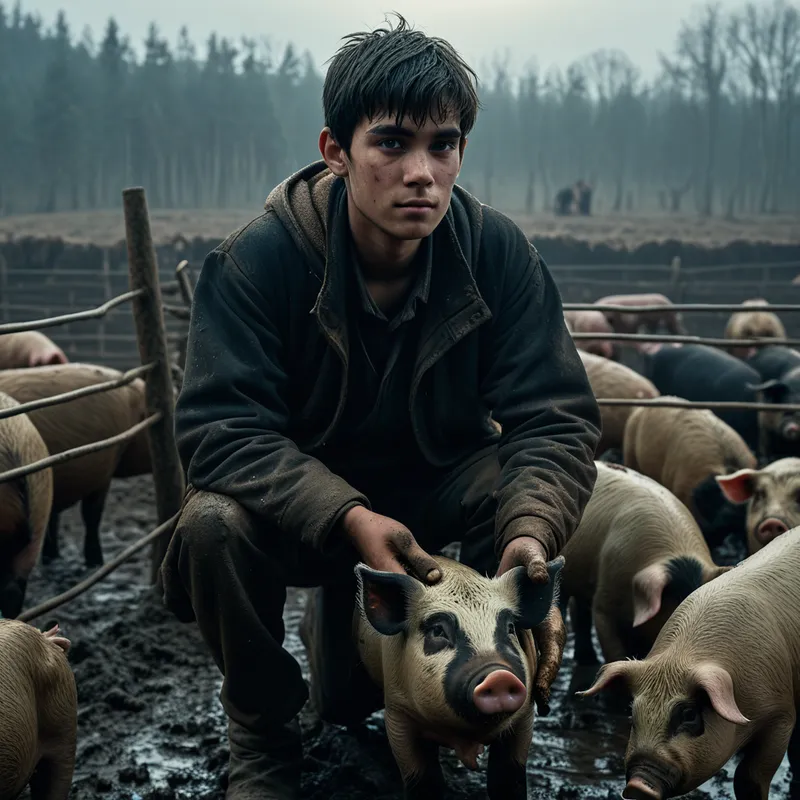
In his desperation, he attached himself to a citizen of that country, who sent him into the fields to feed the pigs. He would have gladly filled his belly with the pods that the pigs were eating, but no one gave him anything. Then, in the stench of the pigpen, with the grunting beasts his only companions, he came to himself. The phrase hangs in the air like a revelation. He said, “How many of my father’s hired hands have bread enough and to spare, but here I am dying of hunger! I will get up and go to my father, and I will say to him, ‘Father, I have sinned against heaven and before you; I am no longer worthy to be called your son; treat me like one of your hired hands.’”
So he set out. The road back was longer than the road away, each step a rehearsal of shame. But while he was still far off, his father saw him. The old man had been watching the horizon, his eyes wearing a path in the dust. He was filled with compassion. He ran—an undignified, robe-hitching sprint—and threw his arms around his son and kissed him. The son began his rehearsed speech: “Father, I have sinned…” But the father was already calling to his servants: “Quickly, bring out a robe—the best one—and put it on him; put a ring on his finger and sandals on his feet. And get the fatted calf and kill it, and let us eat and celebrate; for this son of mine was dead and is alive again; he was lost and is found!” And they began to celebrate.
Now the elder son was in the field. As he came near the house, he heard music and dancing. A servant told him the reason. He became angry and refused to go in. His father came out and pleaded with him. But the elder son answered, “Listen! For all these years I have been working like a slave for you, and I have never disobeyed your command; yet you have never given me even a young goat so that I might celebrate with my friends. But when this son of yours came back, who has devoured your property with prostitutes, you killed the fatted calf for him!” The father, standing in the space between the celebration and the cold anger of the field, said, “Son, you are always with me, and all that is mine is yours. But we had to celebrate and rejoice, because this brother of yours was dead and has come to life; he was lost and has been found.”
Cultural Origins & Context
This story is one of the parables of Jesus of Nazareth, recorded in the Gospel of Luke (Chapter 15). It was not a myth of the distant, primordial past, but a living teaching story told to a 1st-century Judean audience, a mix of the religiously observant and societal outcasts. Its primary function was not historical record but theological and ethical revelation. Jesus told it in direct response to the grumbling of Pharisees and scribes who criticized him for welcoming “sinners.”
In this context, the parable was a radical social and spiritual critique. It operated within a culture where honor, shame, inheritance, and familial duty were the bedrock of identity. For a son to demand his inheritance early was tantamount to wishing his father dead. To squander it was to annihilate the family’s future and one’s own social standing. The father’s response—running (a deeply undignified act for an elder), restoring symbols of sonship (robe, ring, sandals), and throwing a feast—was a shocking subversion of expected patriarchal justice. It painted a portrait of a divine love that actively seeks the lost, a concept that challenged the transactional religious morality of the time.
Symbolic Architecture
The myth’s power lies in its tripartite psychic structure, a map of the soul’s fragmentation and return.
The Younger Son represents the shadow and the id unleashed. He is the impulse for immediate experience, the reckless hunger for life beyond the law of the father. His journey is one of inflation (“all that is mine”) followed by utter deflation. The “distant country” is not just a geographical location but a state of psychic exile, where one lives on the capital of the Self without replenishing it. Hitting bottom in the pigpen—a place of ultimate ritual impurity for a Jewish audience—is the necessary humiliation that makes consciousness possible. “He came to himself” is the pivotal moment of ego-awareness emerging from the ruin of the persona.
The road of excess leads to the palace of wisdom, but only if one survives the journey and chooses to turn back.
The Father symbolizes the Self, the transcendent function that holds the tension of opposites. He does not chase the son into dissipation, nor does he lock the gate upon his return. He is the principle of unconditional, non-reactive love that waits and sees. His running is the active movement of grace toward the repentant ego. The robe, ring, and feast are not rewards for good behavior, but instantaneous restorations of identity. They signify that worth is not earned but inherent, a birthright that can be forgotten but never revoked.
The Elder Son is arguably the most challenging figure: the righteous persona, the ego that identifies wholly with duty, law, and transactional fairness. He is “always in the field,” working, his identity cemented in his obedience. His anger reveals the shadow of the “good” child: resentment, entitlement, and a profound alienation from the father’s heart. He is outside the celebration, not because he is banned, but because his own psychology cannot accept a love that is not merited. He represents the spiritual danger of never having left home, of a consciousness that has never been broken open by its own folly.

The Dreamer’s Resonance
When this myth stirs in modern dreams, it rarely appears as a biblical pastiche. Instead, the dreamer may find themselves in a series of potent images: frantically spending money that turns to leaves or sand; arriving filthy and ashamed at their childhood home to find the door already open and a light on; or watching a feast from outside a window, burning with a sense of unfair exclusion.
The somatic process is one of reckoning and reorientation. The body may carry the exhaustion of the “distant country”—a life lived on unsustainable extremes, a career, relationship, or addiction that has consumed one’s resources. The dream of return signals a deep, often painful, re-evaluation of one’s path. The psychological process is the ego’s confrontation with its own shadow—the wasted potential, the foolish choices, the buried shame. To dream of the father’s welcome is to feel, in the unconscious, the possibility of self-acceptance that the conscious mind cannot yet grant. To dream as the elder brother is to feel the rigid structures of one’s “good” identity cracking under the pressure of a more merciful, and thus more threatening, truth.

Alchemical Translation
The alchemical journey of the Prodigal Son is the individuation process in narrative form. It models the opus contra naturam—the work against one’s own fallen, or fragmented, nature.
-
Separatio (The Demand & Departure): The conscious ego (the son) actively separates from the unconscious totality (the father/family). This is necessary, if painful. One must claim one’s portion of the Self and venture out to experience life directly, to differentiate. The folly is not in leaving, but in believing the inheritance is meant only for consumption.
-
Mortificatio & Putrefactio (The Dissipation & The Pigpen): This is the nigredo. All illusions are stripped away. The inflated ego is humbled, reduced to its bare, starving essence. The “pigpen” is the vessel of putrefaction, where the old, entitled identity rots. This is the dark night of the soul, where one is forced to feed the basest, most ignored parts of oneself (the pigs).
-
Illuminatio (“He Came to Himself”): From the blackness emerges a spark of lucidity. This is not an intellectual understanding, but a visceral, whole-body knowing of one’s true state and origin. The rehearsed speech is the first fragile structure of a new, humble ego-consciousness, one built on truth rather than fantasy.
-
Coniunctio (The Return & The Embrace): This is the sacred marriage, the albedo and beyond. The differentiated, humbled ego returns to the Self. The embrace is the unio mentalis, the psychic union. The father’s gifts—the robe (a new persona of worth), the ring (the seal of eternal belonging), the feast (the nourishment of the whole psyche)—symbolize the creation of the filius philosophorum, the divine child born of this reconciliation.
The ultimate alchemy is not turning lead to gold, but transforming the experience of exile into the certainty of homecoming.
The unfinished ending—the elder brother still outside—reminds us that individuation is never complete. The psyche always contains the righteous, resentful voice of the old morality. The work is to hear the father’s final, inclusive plea: “All that is mine is yours.” The celebration is for the return of the lost part, but the inheritance was always available to the one who never left, if only he could step out of the field of his own righteousness and come inside.
Associated Symbols
Explore related symbols from the CaleaDream lexicon: