The Process of Nigredo Myth Meaning & Symbolism
The myth of the alchemical Nigredo, a descent into primal darkness where all form dissolves, initiating the soul's journey toward wholeness.
The Tale of The Process of Nigredo
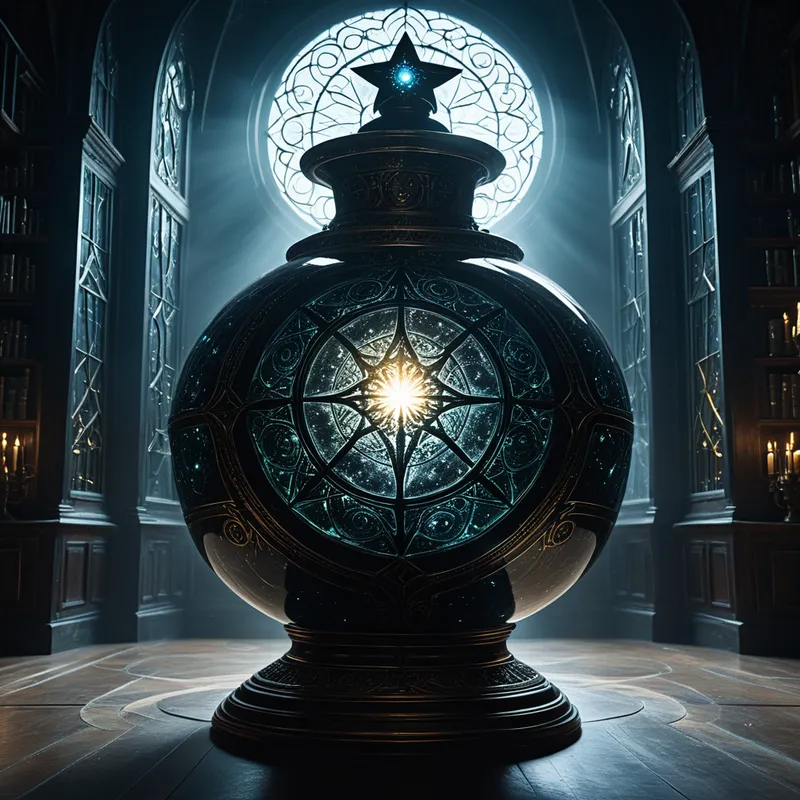
In the beginning, before the gold, there is only the lead. Not the metal you hold in your hand, but the lead of the soul—a heavy, cold, and silent thing. The story does not start with a hero in a sunlit field, but with a figure in a chamber where the air is still and smells of salt and old earth. This is the Vas Hermeticum, the sealed vessel of the world, and within it, the Great Work has stalled.
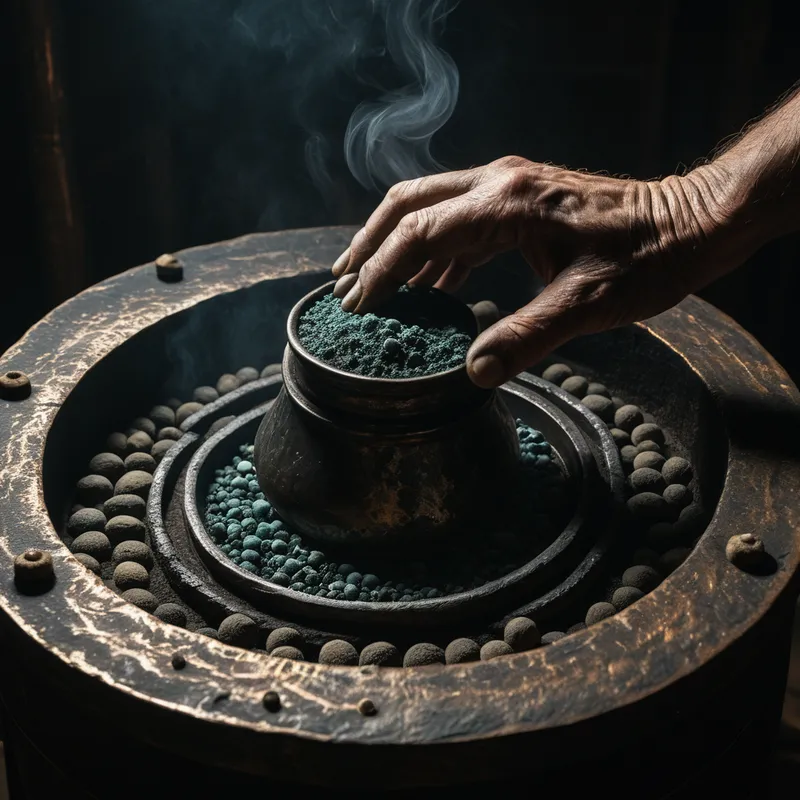
The substance within—once a proud compound of all the alchemist’s knowledge and hope—has grown dull. Its colors have fled. It lies inert, a corpse of potential. This is the moment of the Nigredo. The external fires of the furnace are banked, but an inner, invisible heat begins to rise. It is not the heat of creation, but of putrefaction.
A sigh seems to move through the vessel, a wind from nowhere. The matter within does not melt, but unravels. It loses its cohesion, its defined edges bleeding into one another. What was solid becomes a thick, tarry soup; what was distinct becomes a uniform and profound blackness—a black deeper than any pigment, a black that drinks the light from the very air. It is the black of the soil in the grave, of the void between stars, of the pupil of an eye seeing nothing but its own interior.
In this absolute darkness, strange movements stir. Not life, but the memory of life, or the promise of it. Shapes form and dissolve: the face of a forgotten shame, the cold touch of a long-buried grief, the bitter taste of envy not yet admitted. They swirl in the blackness, a churning Massa Confusa. The alchemist, watching, feels a corresponding chill in their own heart. The work on the bench mirrors the work within the soul. All certainty rots. All identity softens and runs like wax.
This is the reign of the Sol Niger. The sun has been eclipsed, turned inward upon itself. There is no guidance, no light from above, only the slow, fermenting heat of decay from within. The process feels like an eternity. It is a death without the dignity of an ending. Yet, in the deepest heart of that blackness, in the very center of the dissolution, a tension gathers. It is not hope, for hope is a thing of the light. It is a sheer, unavoidable pressure, the weight of all that blackness compressing itself. And in that silent, unbearable pressure, the first, almost imperceptible crack appears. Not a crack of light, but a crack in the darkness itself. A fissure through which something entirely new may, one day, emerge.
Cultural Origins & Context
The myth of the Nigredo is not a narrative passed down by bards, but a procedural and experiential truth recorded in the cryptic texts of European alchemy, spanning from the Hellenistic world through the Islamic Golden Age to the Renaissance. It was chronicled in encoded language—the language of the birds—within lavishly illustrated manuscripts like the Rosarium Philosophorum and the writings of figures such as Hermes Trismegistus. Its tellers were not entertainers but practitioners, often working in solitude or within secretive circles, for whom the laboratory process was an exact mirror of a spiritual ordeal.
Societally, it functioned on multiple levels. Exoterically, it was a framework for early chemistry and metallurgy, describing the literal breaking down of ores. Esoterically, and more profoundly, it served as a map for inner transformation. It provided a container—a vessel—for understanding periods of profound depression, spiritual dryness, and existential crisis not as failures, but as necessary, initiatory phases. In a culture where the Church promised salvation through grace, alchemy offered a parallel path of salvation through the confrontation and transmutation of one’s own inner darkness, a deeply personal and experiential gnosis.
Symbolic Architecture
The Nigredo is the archetypal symbol of the necessary first death. Its core meaning is dissolution for the sake of eventual coagulation. It represents the brutal, non-negotiable deconstruction of the ego’s conscious attitudes and the persona—the mask we show the world.
The seed cannot sprout unless the husk rots. The phoenix cannot rise unless it is first consumed by flame. The Nigredo is the husk-rotting, the self-immolation, enacted not in the physical world, but in the dark chamber of the soul.
The Sol Niger symbolizes the eclipse of the conscious mind (Sol) by the unconscious. It is a descent into the shadow, where all that has been repressed, denied, or deemed inferior rises to the surface in a chaotic, often terrifying, soup. The Vas Hermeticum is the total psychological situation—the sealed container of the ordeal, which can be a depression, a life crisis, or a dedicated introspective practice. One cannot flee the process; one must endure it within the vessel of one’s own being. The lead is the heaviness of the unexamined life, the weight of history, trauma, and unlived potential that must be acknowledged before it can be changed.
The Dreamer’s Resonance
When this myth stirs in the modern dreamer, it announces a somatic and psychological process of breaking down. Dreams become landscapes of decay: crumbling buildings, black water, descending into basements or caves, being buried in earth, or witnessing objects dissolve into black sludge. The dream ego often feels paralyzed, lost in fog, or trapped in a featureless, dark space.
Somatically, this can correlate with feelings of profound fatigue, heaviness in the limbs, a sense of being “weighed down,” or digestive disturbances—the body’s literal processing of “undigested” experience. Psychologically, it is the experience of the shadow’s emergence. Long-held beliefs about oneself are challenged. Repressed anger, grief, or shame may surface unexpectedly. It feels like a loss of identity, a “melting” of the familiar self. This is not a pathological state to be avoided at all costs, but the psyche’s innate corrective, initiating a purge of outworn structures to make space for new growth. The dreamer is in the athanor—the alchemical furnace—of their own unconscious.

Alchemical Translation
For the modern individual seeking wholeness (individuation), the Nigredo models the critical stage of shadow-work. The triumph is not in avoiding the blackness, but in consciously enduring it. The goal of psychic transmutation is not to skip from lead to gold, but to submit the lead to the process.
The gold is not found by avoiding the black, but is formed from the black, through the alchemist’s sustained, patient attention to the decay.
This means turning toward one’s depression, anxiety, or confusion with curiosity rather than immediate resistance. It is the practice of sitting in the discomfort of not knowing who you are anymore. It is allowing old narratives—“I am successful,” “I am kind,” “I am a victim”—to decompose, to reveal the contradictory, complex material beneath. The modern “alchemical vessel” might be the therapist’s office, the journal, the meditation cushion, or any disciplined practice that holds space for this disintegration without premature intervention.
The Nigredo teaches that light is born from the confrontation with darkness. The eventual stages of Albedo and Rubedo—the washing and the final union—are impossible without this first, harrowing return to the prima materia, the black, fertile mud of the soul. It is the myth that validates the darkest nights, assuring us that within the utter dissolution of all we thought we were, the pressure to become something true begins, at last, to build.
Associated Symbols
Explore related symbols from the CaleaDream lexicon: