
The primordial waters of Nun i Myth Meaning & Symbolism
Before time, before form, there was only Nun i—the infinite, dark, silent waters of pure potential from which the first consciousness arose.
The Tale of The Primordial Waters of Nun i
Listen. Before the word for ‘listen’ existed. Before the ear to hear it, or the tongue to speak it. There was… not nothing. That is the first mistake of the mind. There was something. But it was not a thing you could name.
It was the Nun i. The Waters. A sea without shore, a depth without bottom, a darkness that was not the absence of light, but the presence of everything that is not yet. It was cold and it was featureless. It was silent, but not with emptiness—with a fullness so complete it had no need for sound. It was the great potential. The seed of every mountain, every god, every human breath, every galaxy yet to spin, slept within it, dissolved, indistinguishable, dreaming.
And in that dreaming, a stirring. Not a movement, for there was no space to move within. A yearning. A desire for distinction. A whisper of “I am” that had no “I” to claim it. From the heart of the Nun i, a pressure grew—not a violence, but a gentle, inevitable insistence. The waters themselves began to turn inward, to gather around this nameless point of intention.
Then, the first act that was an act: Emergence.
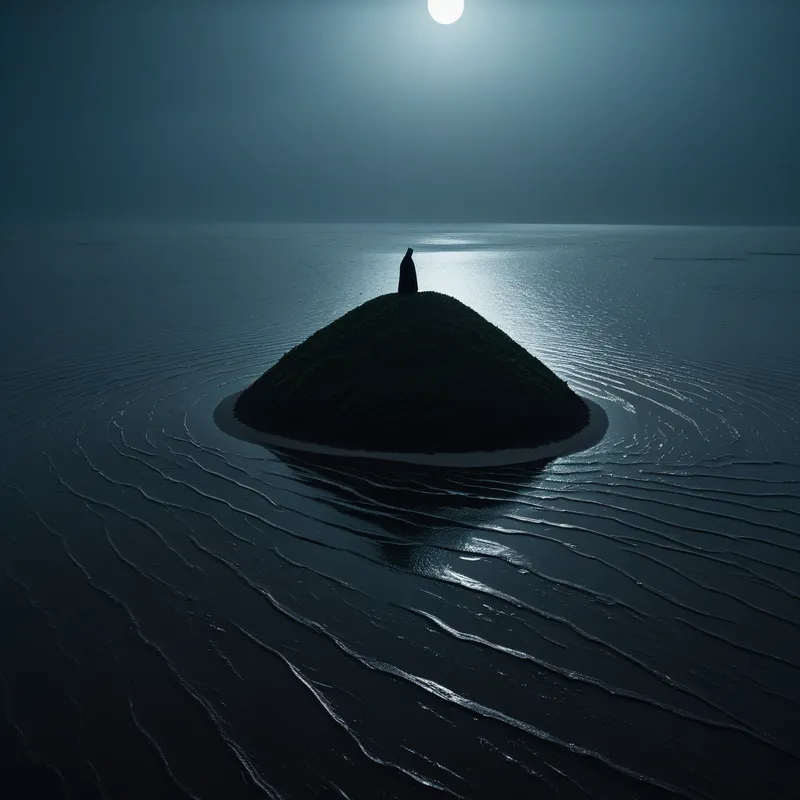
From the endless, placid face of the waters, a mound broke the surface. Not with cataclysm, but with the slow, sure grace of a thought becoming real. It was the Benben. A hillock of dark, rich, fertile silt, steaming with the warmth of first life. It was an island in the ocean of non-being. It was the first “here” as opposed to “there.”
And upon this mound, the first light blazed. It was not the sun—the sun was yet a dream in the waters. It was the light of consciousness itself. It took form as Atum, the Complete One. He stood upon the Benben, born from the Nun i and yet distinct from it. He opened his eyes, and in that looking, the world began to define itself. He was alone, but in his solitude was the power of all possibilities. From him, through his own creative will, the first pair would emerge, and from them, the tapestry of the cosmos would be woven.
But remember this: the Nun i did not vanish. It receded, but it remained, surrounding the created world on all sides and beneath its very foundations. It was the eternal womb and the eventual tomb, the source and the destination, the silent partner to all the noise of existence.
Cultural Origins & Context
The myth of Nun i (or Nun) finds its most elaborate expression in the cosmology of ancient Egypt, particularly from the Pyramid Texts (circa 2400-2300 BCE) onward. It is a creation story that belongs not to a single tribe or dynasty, but to the fundamental architectural blueprint of Egyptian thought. It was not a tale for the marketplace, but a sacred reality recited in the deepest chambers of pyramids and tombs by priests and kings, for it described the very nature of existence and the soul’s origin.
Its societal function was profound: it provided a metaphysical map. It explained how order (Maat) arose from chaos, legitimizing the Pharaoh’s role as the maintainer of that order on earth. More intimately, it offered a template for the soul’s journey after death—a return to and a navigation through those primordial waters before a hoped-for rebirth. The myth was a constant reminder that all structured life, from the state to the individual psyche, is a temporary island in an eternal sea of potential and dissolution.
Symbolic Architecture
The symbolism of Nun i is the symbolism of the Unconscious in its purest, most absolute form. It is not the personal unconscious of repressed memories, but the collective, transpersonal ground of being—what the psychologist Carl Jung might term the psychoid layer, where psyche and matter are not yet distinct.
The primordial waters are not a place you go to, but the substance from which you are made. To know them is to know your own pre-existence.
The Nun i represents pure potentiality. Every talent, every fear, every possible version of yourself and the world swims in that dark ocean, unformed. It is the state of being before differentiation, before the ego says “I.” The Benben mound is the birth of consciousness—the first act of self-reflection, the “I” emerging from the “All.” It is the ego’s necessary, heroic act of distinguishing itself from the undifferentiated mass of inner and outer experience. Atum, the light upon the mound, is the spark of awareness itself, the divine witness that turns potential into actuality through the act of perception.

The Dreamer’s Resonance
When this myth stirs in the modern dreamer, it often manifests not as a narrative, but as a somatic atmosphere. One dreams of being adrift in a vast, dark ocean under a starless sky, or floating in a weightless, silent void. There is no threat, only an immense, awe-full solitude. Alternatively, one might dream of a single, stark object—a black stone, a lone tree, a tiny island—emerging in an endless gray sea.
These dreams signal a profound psychological process: a regression to the source. It is the psyche’s return to the drawing board, often during periods of burnout, profound transition, or creative blockage. The ego’s familiar structures feel insufficient, and the self calls for a reset. The feeling is one of dissolution, of losing one’s shape. This is not pathological, but alchemical. The dreamer is being immersed in the Nun i of their own psyche to dissolve old, rigid forms and be re-sourced from the primal waters of potential.

Alchemical Translation
The journey of individuation—becoming who one truly is—mirrors the myth of Nun i precisely. We begin our psychological lives in a kind of inner Nun i, identified with family, culture, and complexes, with no distinct self. The first stage of awakening is the emergence of the Benben—the ego, a fragile but necessary island of self-awareness that says, “I am different.”
The great work is not to build a fortress on the mound, but to learn to breathe the waters.
The mature alchemical process, however, requires a courageous second movement. It is the conscious return to the waters. Not to drown, but to commune. This is the act of engaging with the deep unconscious through dream work, active imagination, or confronting one’s shadow. It is to willingly loosen the ego’s rigid boundaries and allow the fertile, chaotic waters of the Nun i to inform and reshape the self. The goal is not to live on the dry mound alone, but to become like Atum—a conscious light that knows its origin in the dark waters, and can therefore create from an infinite wellspring. One transmutes the fear of dissolution into the wisdom of source, realizing that the creative void is not outside, but is the very ground of one’s being.
Associated Symbols
Explore related symbols from the CaleaDream lexicon: