The Primordial Apsu and Tiamat Myth Meaning & Symbolism
The primordial union of sweet and salt waters is shattered by their divine children, leading to a cosmic war and the creation of the ordered world from chaos.
The Tale of The Primordial Apsu and Tiamat
In the beginning, before the naming of things, there was no sky named Anu, nor earth called Ki. There was only the mingling of two vast, dreaming waters. From the north flowed Apsu, the sweet [water](/myths/water “Myth from Chinese culture.”/), deep, calm, and silent. From the south surged [Tiamat](/myths/tiamat “Myth from Mesopotamian culture.”/), the salt [water](/myths/water “Myth from Chinese culture.”/), turbulent, wild, and roaring with potential. Their waters embraced in the endless dark, a single, boundless, and undifferentiated ocean of being. From this embrace, the first gods were stirred into life.
First came Lahmu and Lahamu, then Anshar and Kishar. Their children were mighty, and their children’s children more numerous still. The silence of [the abyss](/myths/the-abyss “Myth from Kabbalistic culture.”/) was shattered. The new gods, vibrant with energy and light, filled [the void](/myths/the-void “Myth from Buddhist culture.”/) with their clamor, their laughter, their divine games. They danced upon the waves of Tiamat, who watched with a mother’s fond, if weary, eye. But Apsu, the deep, sweet stillness, could bear it no longer.
“Their ways are loathsome to me!” Apsu cried to his consort. “By day I find no rest, by night no sleep. I will destroy them, that we may have quiet once more and return to our rest.”
Tiamat, [the great mother](/myths/the-great-mother “Myth from Jungian culture.”/) of all, raged at this. “Shall we destroy what we have made? Their ways are indeed troublesome, but let us be patient.” But Apsu’s counsel was taken by his vizier, Mummu, who whispered of the peace that once was.
The young gods heard of this plot. A terror fell upon them, and they fell silent, until the cleverest among them, Ea, devised a plan. He cast a powerful spell of sleep upon Apsu. As the sweet waters stilled into profound slumber, Ea approached. He stripped Apsu of his divine regalia, his crown and mantle, and slew him in his sleep. Upon the stilled body of the primordial father, Ea established his dwelling, naming it Apsu, and there he conceived a son of terrible brilliance: [Marduk](/myths/marduk “Myth from Mesopotamian culture.”/).
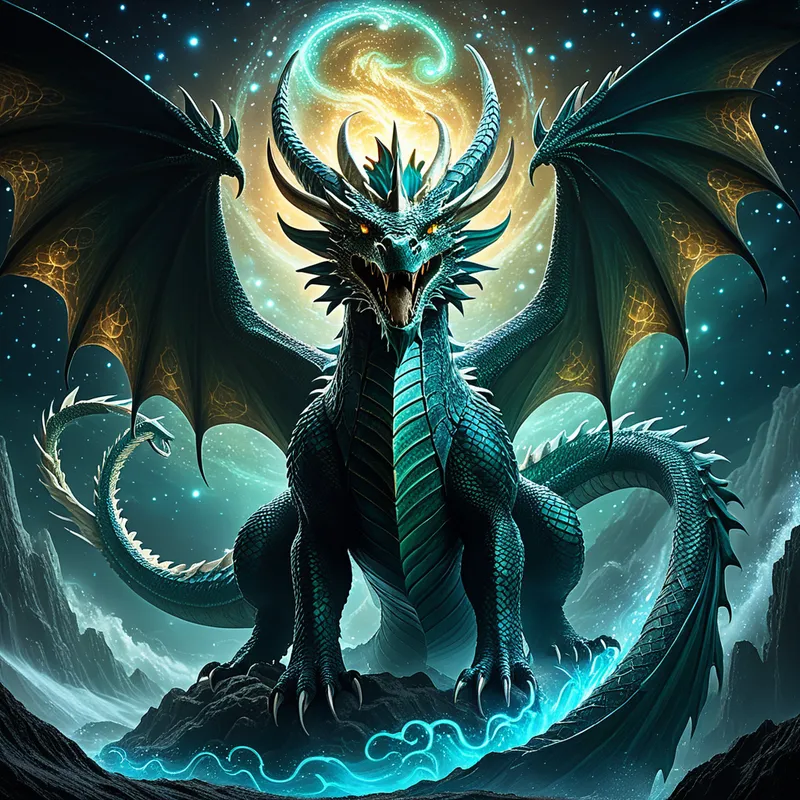
But a greater storm was brewing. Tiamat, who had counseled patience, now knew a wrath beyond measure. Her beloved was slain. The stillness was murdered. In her grief and fury, she resolved to avenge Apsu and unmake the noisy, ungrateful brood. She birthed a host of monstrous armies: serpent-demons with venom for blood, raging lion-demons, the Ušumgallu, the Ugallu, and the Kulullû. At their head, she placed Kingu, giving him the Tablet of Destinies and making him her champion.
The gods of the new generation trembled. No one could face Tiamat’s rage. Until Ea’s son, Marduk, radiant and mighty, stepped forward. He would face [the dragon](/myths/the-dragon “Myth from Chinese culture.”/) of chaos, but on one condition: if victorious, the assembly of gods must grant him kingship, supreme and unchallenged. Desperate, they agreed.
Marduk armed himself with a flood-storm, a mighty bow, a mace, and a net held by the four winds. He mounted his chariot of terrifying storms and rode out to meet the primordial mother. When he saw Tiamat, she was a vision of terrifying beauty—a roiling, cosmic serpent, her mouth agape to swallow the heavens. He challenged her, and she roared her acceptance. As she opened her maw to consume him, Marduk drove the evil winds into her belly, distending her. He shot an arrow that pierced her heart and split her skull. He stood upon her lifeless body.
From her corpse, he fashioned [the world](/myths/the-world “Myth from Tarot culture.”/). He split her carcass like a shellfish. One half he raised to become the heavens, where he set the stars and ordained their paths. From the other half, he made [the earth](/myths/the-earth “Myth from Hindu culture.”/). From her spittle, he formed the clouds and the mists. From her eyes, he let flow the great rivers, [the Tigris and Euphrates](/myths/the-tigris-and-euphrates “Myth from Mesopotamian culture.”/). From the blood of the defeated Kingu, he created humankind, to bear the toil of the gods. Order was established from chaos, structure from the formless deep. [The world](/myths/the-world “Myth from Tarot culture.”/) as known was born from the body of the first mother.
Cultural Origins & Context
This myth, known to us as the Enûma Eliš, was the central national epic of Babylon. It was recited, likely in a dramatic ritual performance, during the Akitu festival. This was not mere entertainment; it was a political and theological act of the highest order. By enshrining the local god Marduk as the supreme king of the gods who brings cosmic order, the myth legitimized the city of Babylon and its ruler as the center of the civilized world. It was a story told by priestly scribes on cuneiform tablets, a narrative that explained the very nature of reality—why there is order and chaos, land and sea, gods and humans. It served to reinforce the social and cosmic hierarchy, showing that kingship and law, however violently established, were necessary to hold the ever-present threat of chaos at bay.
Symbolic Architecture
At its [heart](/symbols/heart “Symbol: The heart symbolizes love, emotion, and the core of one’s existence, representing deep connections with others and self.”/), this is a myth about the necessary, violent [differentiation](/symbols/differentiation “Symbol: The process of distinguishing or separating parts of the self, emotions, or identity from a whole, often marking a developmental or psychological milestone.”/) of [consciousness](/symbols/consciousness “Symbol: Consciousness represents the state of awareness and perception, encompassing thoughts, feelings, and experiences.”/) from the unconscious. The primordial waters, Apsu and Tiamat, represent the undifferentiated state of being—the unconscious totality where all opposites are merged. Apsu is the deep, quiet, structuring potential (the latent order), while Tiamat is the dynamic, creative, and potentially overwhelming [flux](/symbols/flux “Symbol: A state of continuous change, instability, or flow, often representing the impermanent nature of existence and experience.”/) (the latent [chaos](/symbols/chaos “Symbol: In Arts & Music, chaos represents raw creative potential, uncontrolled expression, and the breakdown of order to forge new artistic forms.”/)). Their union is the blissful, unconscious state of non-[separation](/symbols/separation “Symbol: A spiritual or mythic division between realms, states of being, or consciousness, often marking a transition or loss of connection.”/).
The birth of consciousness is an act of rebellion against the primordial silence. It is noisy, disruptive, and inevitably provokes a crisis.
The younger gods symbolize the emerging contents of consciousness—thoughts, impulses, energies. Their “[noise](/symbols/noise “Symbol: Noise in dreams signifies distraction, confusion, and the need for clarity amidst chaos.”/)” is the [activity](/symbols/activity “Symbol: Activity in dreams often represents the dynamic aspects of life and can indicate movement, progress, and engagement with personal or societal responsibilities.”/) of a [psyche](/myths/psyche “Myth from Greek culture.”/) beginning to awaken. Apsu’s desire to destroy them is the unconscious’s pull back into oblivion, the temptation of depression or [dissolution](/symbols/dissolution “Symbol: The process of breaking down, dispersing, or losing form, often representing transformation, release, or the end of a state of being.”/). Ea’s slaying of Apsu represents the first great act of psychic differentiation: the establishment of a [realm](/symbols/realm “Symbol: The symbol of ‘Realm’ often signifies the boundaries of one’s consciousness, experiences, or emotional states, suggesting aspects of reality that are either explored or ignored.”/) of wisdom and cunning ([the ego](/myths/the-ego “Myth from Jungian culture.”/)) upon the [foundation](/symbols/foundation “Symbol: A foundation symbolizes the underlying support systems, values, and beliefs that shape one’s life, serving as the bedrock for growth and development.”/) of the subdued, [static](/symbols/static “Symbol: Static represents interference, disruption, and the breakdown of clear communication or signal, often evoking feelings of frustration and disconnection.”/) order.
But the greater challenge is Tiamat, the chaotic, creative, and devouring [aspect](/symbols/aspect “Symbol: A distinct feature, quality, or perspective of something, often representing a partial view of a larger whole.”/) of the unconscious. She is not evil, but she is totality in its raw, unmediated form. She is the [mother](/symbols/mother “Symbol: The symbol of ‘Mother’ represents nurturing, protection, and the foundational aspect of one’s emotional being, often associated with comfort and unconditional love.”/) who gives [life](/symbols/life “Symbol: The symbol of ‘Life’ represents a journey of growth, interconnectedness, and existential meaning, encompassing both the joys and challenges that define human experience.”/) and who, when her unity is violated, seeks to reclaim it. Marduk’s battle is the heroic ego’s struggle to confront, [structure](/symbols/structure “Symbol: Structure in dreams often symbolizes stability, organization, and the framework of one’s life, reflecting how one perceives their environment and personal life.”/), and make conscious the overwhelming power of the unconscious. His victory and the world-creation that follows symbolize the ultimate [task](/symbols/task “Symbol: A task represents responsibilities, duties, or challenges one faces.”/) of consciousness: to create a livable, ordered psyche (a “world”) from the raw [material](/symbols/material “Symbol: Material signifies the tangible aspects of life, often representing physical resources, desires, and the physical world’s influence on our existence.”/) of our inner chaos. The myth acknowledges that this process is foundational, creative, and inherently traumatic.
The Dreamer’s Resonance
When this myth stirs in the modern soul, it often manifests in dreams of overwhelming, primal forces. You may dream of vast, terrifying oceans rising up, of being pursued by a monstrous but strangely maternal figure, or of a chaotic, formless landscape that suddenly demands structure. You might dream of being part of a noisy, divine family in conflict, or of wielding a powerful artifact (like [the Tablet of Destinies](/myths/the-tablet-of-destinies “Myth from Mesopotamian culture.”/)) you feel unworthy to hold.
These dreams signal a profound somatic and psychological process: the ego is being challenged to grow. The “noise” of your emerging thoughts, feelings, or life changes has disturbed an old, deep stillness within you (Apsu). Now, a long-contained, creative, or chaotic energy (Tiamat) is rising in reaction—perhaps as rage, grief, or a burst of uncontrollable inspiration. The dreamer is at the precipice of a Marduk moment. The body may feel it as anxiety (the storm winds), a tightening in the chest (the net), or a sense of formidable resolve. The process is one of facing the internal “dragon” of unintegrated potential or trauma so that a new, more capacious psychic structure can be built from its remains.
Alchemical Translation
The alchemical journey mirrored in this myth is the opus contra naturam—the work against nature, which is the work of conscious development against the pull of unconscious inertia. [The prima materia](/myths/the-prima-materia “Myth from Alchemical culture.”/) is the undifferentiated, watery abyss of [the self](/myths/the-self “Myth from Jungian culture.”/). The first separation is the painful but necessary act of distinguishing oneself from the parental or cultural “waters” one was born into (slaying Apsu). This establishes a space for reflective consciousness (Ea’s dwelling).
But the real alchemical fire is the confrontation with Tiamat, the materia prima in its active, volatile state. This is the stage of [nigredo](/myths/nigredo “Myth from Alchemical culture.”/), the blackening, where one faces [the shadow](/myths/the-shadow “Myth from Jungian culture.”/), the chaos, [the devouring mother](/myths/the-devouring-mother “Myth from Various culture.”/) complex, or the sheer magnitude of one’s unlived life.
The hero’s battle is the ego’s crucible. To create a world, one must first consent to the terrible and glorious fight.
Marduk, the conscious will armed with intellect (the winds, the net) and purpose (the arrow), engages the chaos. His victory is not destruction, but transformation. He does not annihilate Tiamat; he slays her form to liberate her substance for creation. This is the alchemical [solutio](/myths/solutio “Myth from Alchemical culture.”/) and coagulatio: the dissolving of old, monolithic structures (the dragon) and the coagulation of their essence into new, ordered forms (the heavens and earth).
For the individual, this models the process of individuation. One must face the inner chaos—the roiling emotions, the fragmented traumas, the creative blocks—not to eliminate it, but to consciously structure it. From the “body” of that conquered chaos, you build the architecture of your authentic life: your values (the fixed stars), your daily reality (the earth), and your flowing vitality (the rivers). The creation of humankind from the blood of the rebel Kingu signifies that our conscious life is born from and forever carries the trace of that rebellious, dynamic spirit. We are not meant for silent oblivion, but for the noisy, difficult, and glorious work of building a world within and without.
Associated Symbols
Explore related symbols from the CaleaDream lexicon: