The Prambanan Temple Creation Myth Meaning & Symbolism
A princess demands a thousand temples by dawn as a marriage test; a powerful sage builds them, but his victory is shattered by betrayal and grief.
The Tale of The Prambanan Temple Creation
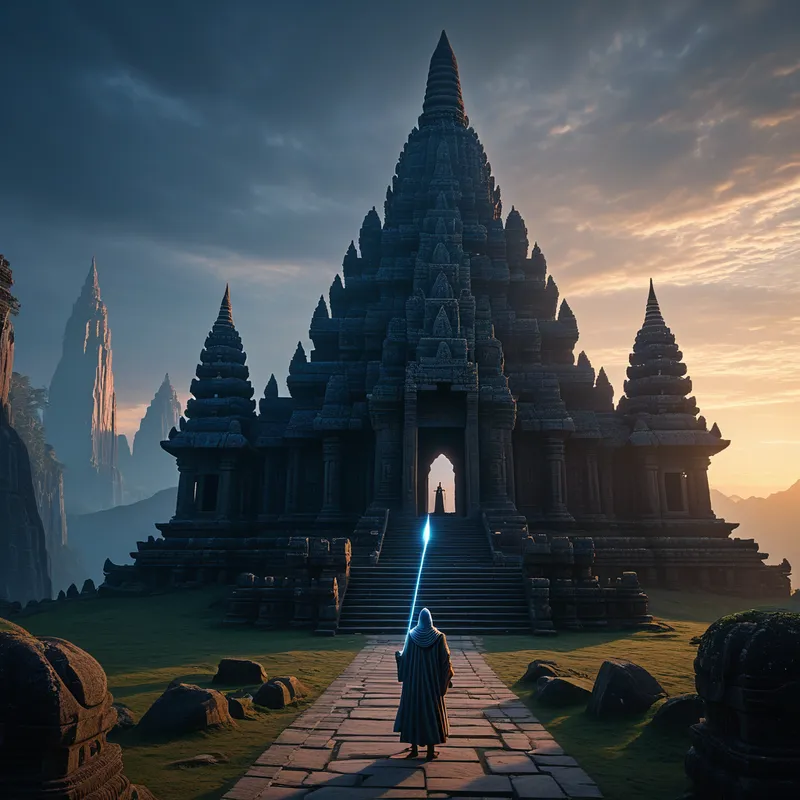
Hear now the tale whispered by the wind through the carved stone of a thousand temples. In the ancient land of Mataram, where the gods walked close to the earth, there lived a king, Prabu Baka, ruler of the dark kingdom of Prambanan. His daughter, Rara Jonggrang, was a maiden of such breathtaking beauty that her name meant “Slender Maiden,” and her grace was said to rival the apsaras themselves. Her beauty was a silent song that drew the gaze of princes and warriors, but her heart was a fortress, guarded by a grief as deep as the ocean.
Into this kingdom came Bandung Bondowoso, a prince and a mighty tapa. He was a man of immense spiritual power, a warrior who commanded a legion of spirits, the jin and the buta. With his strength, he defeated King Baka and laid claim to his kingdom. And when his eyes fell upon Rara Jonggrang, he was ensnared. He desired her as his queen.
But Rara Jonggrang looked upon Bandung Bondowoso not with love, but with the cold fire of vengeance for her fallen father. To refuse him outright was to invite destruction. So, from the depths of her cunning and despair, she wove a condition as impossible as catching moonlight in a jar. “I will marry you, great Bandung,” she said, her voice like distant temple bells, “if you can build for me one thousand magnificent temples in the span of a single night, before the first rooster crows at dawn.”
The sage-prince smiled, for he heard not a refusal, but a challenge that played to his greatest strength. As the sun sank below the horizon, painting the sky in hues of sorrow, Bandung Bondowoso retreated into deep meditation. He called upon the very bones of the earth and the legions of the unseen world. From the shadows, his spirit army emerged—countless jin and buta, their forms shifting like mountain mist. With a wave of his sacred staff, the work began.
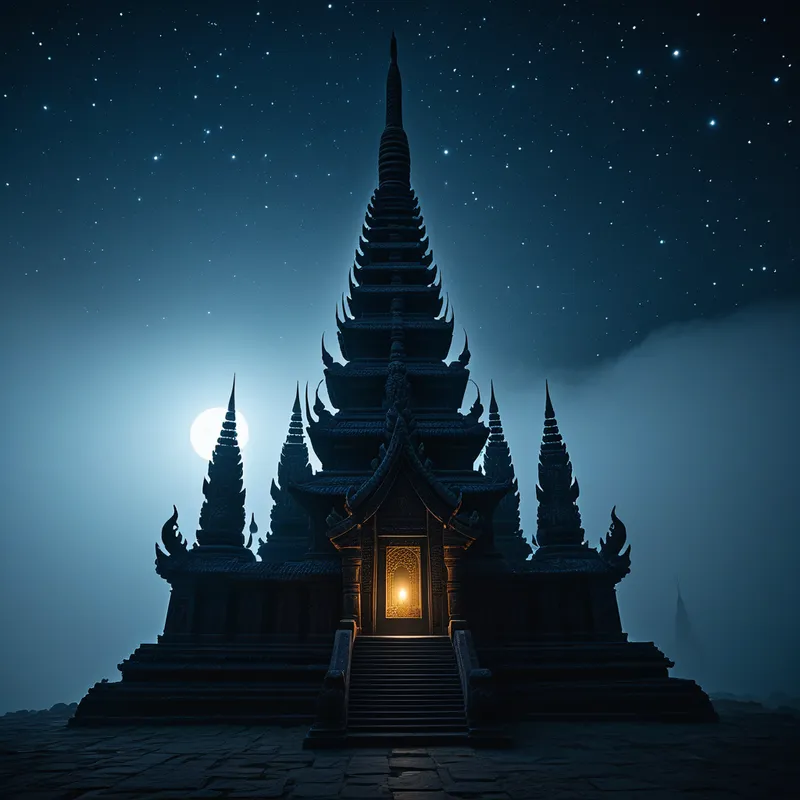
The night became a symphony of creation. Stone rose from the ground as if dreaming itself into form. The cling-clang of chisels on rock was a relentless, rhythmic heartbeat. Spires pierced the starry veil, courtyards unfolded like stone lotuses, and intricate carvings of gods and dancers bloomed upon walls still warm from their making. Temple after temple ascended towards the heavens, their silhouettes black against the Milky Way. Nine hundred and ninety-nine temples stood complete, their majesty humming with supernatural energy.
Watching from her palace, Rara Jonggrang felt a cold dread. The impossible was becoming reality. The symphony of creation was a dirge for her freedom. In a final, desperate act, she gathered her maidens. “Light the fires in the east,” she commanded. “Pound the rice mortars as if it were dawn. Make the village believe the sun is rising.” And so they did. Torches flared, mimicking the false dawn. The rhythmic thump-thump-thump of rice pounding echoed through the valley, the traditional sound of morning chores.
Hearing this, the cocks crowed, deceived by the light and sound. The spirits of the night, bound by the law of darkness, froze. Their work was undone by the breaking of the celestial contract. Bandung Bondowoso, emerging from his trance, saw the nine hundred and ninety-nine perfect temples and the one thousandth, left unfinished. He saw the false light in the east and understood the princess’s trickery.
A rage, cold and terrible, filled him. His love, already mixed with conquest, curdled into a potent curse. He turned to Rara Jonggrang, who stood defiant yet trembling. “You have made a vow of stone,” he intoned, his voice shaking the very foundations of the temples. “You have turned my creation into deception. So stone you shall become, to complete the thousandth temple.” He raised his hand, and his immense tapa power flowed forth. Where the princess stood, a statue of exquisite beauty and eternal stillness began to form. Rara Jonggrang was transformed into the stone image that forever stands in the north cella of the great Shiva temple, the final, silent monument to a love that was never love, but a collision of oath, vengeance, and impossible desire.
Cultural Origins & Context
This myth, known as Legenda Rara Jonggrang, is the etiological story for the Prambanan Temple complex. It is a classic example of a <abbr title=“A “talking” or origin myth that explains a natural or cultural phenomenon”>pourquoi tale deeply embedded in Javanese oral tradition, long told by village elders and dalangs (shadow puppeteers). Its transmission kept the memory of the temples alive even during centuries when the physical structures were reclaimed by the jungle and forgotten by history.
The story functions on multiple cultural levels. Historically, it reflects the tensions and synthesis between the indigenous animistic world of spirit armies (jin and buta) and the incoming Hindu cosmological order, with its emphasis on ascetic power (tapa) and divine architecture. Societally, it serves as a cautionary tale about the power of vows, the dangers of deceit, and the catastrophic consequences when duty (dharma) is subverted by personal emotion. The princess’s cunning is not celebrated; it is the flaw that leads to petrification. The sage’s power is not glorified; it is the instrument of a tragic, frozen resolution.
Symbolic Architecture
At its core, the myth is a profound [allegory](/symbols/allegory “Symbol: A narrative device where characters, events, or settings represent abstract ideas or moral qualities, conveying deeper meanings through symbolic storytelling.”/) of creation born from conflict and frozen in unresolved [tension](/symbols/tension “Symbol: A state of mental or emotional strain, often manifesting physically as tightness, pressure, or unease, signaling unresolved conflict or anticipation.”/). The one thousand temples represent a perfect, complete world—a [mandala](/symbols/mandala “Symbol: A sacred geometric circle representing wholeness, the cosmos, and the journey toward spiritual integration.”/) of order and spiritual ambition. Yet, their creation is motivated not by devotion, but by a possessive desire and a deceptive vow. The [architecture](/symbols/architecture “Symbol: Architecture in dreams often signifies structure, stability, and the framing of personal identity or life’s journey.”/) is spiritually potent but ethically flawed.
The unfinished temple is the psyche’s most sacred space: the wound that holds the blueprint for wholeness.
Rara Jonggrang symbolizes the [Anima](/symbols/anima “Symbol: The feminine archetype within the male unconscious, representing soul, creativity, and connection to the inner world.”/) that cannot be possessed through force or bargain. She is the [soul](/symbols/soul “Symbol: The soul represents the essence of a person, encompassing their spirit, identity, and connection to the universe.”/)’s autonomy. Her transformation into [stone](/symbols/stone “Symbol: In dreams, a stone often symbolizes strength, stability, and permanence, but it may also represent emotional burdens or obstacles that need to be acknowledged and processed.”/) is not merely a [punishment](/symbols/punishment “Symbol: A dream symbol representing consequences for actions, often tied to guilt, societal rules, or internal moral conflicts.”/), but a symbolic freezing of the [life](/symbols/life “Symbol: The symbol of ‘Life’ represents a journey of growth, interconnectedness, and existential meaning, encompassing both the joys and challenges that define human experience.”/) force, of eros itself, when it is met not with genuine [relationship](/symbols/relationship “Symbol: A representation of connections we have with others in our lives, often reflecting our emotional state.”/), but with the will to dominate. Bandung Bondowoso represents the towering, disciplined, yet ultimately unbalanced masculine [spirit](/symbols/spirit “Symbol: Spirit symbolizes the essence of life, vitality, and the spiritual journey of the individual.”/)—the Ego capable of miraculous feats of will, but blind to the true [nature](/symbols/nature “Symbol: Nature symbolizes growth, connectivity, and the primal forces of existence.”/) of the Other. His [curse](/symbols/curse “Symbol: A supernatural invocation of harm or misfortune, often representing deep-seated fears, guilt, or perceived external malevolence.”/) is the ego’s final act of control when faced with the uncontrollable: to make it [static](/symbols/static “Symbol: Static represents interference, disruption, and the breakdown of clear communication or signal, often evoking feelings of frustration and disconnection.”/), to turn [mystery](/symbols/mystery “Symbol: An enigmatic, unresolved element that invites curiosity and exploration, often representing the unknown or hidden aspects of existence.”/) into [monument](/symbols/monument “Symbol: A structure built to commemorate a person, event, or idea, often representing legacy, memory, and cultural identity.”/).
The Dreamer’s Resonance
When this myth pattern stirs in the modern dreamer, it often signals a profound inner conflict between creative will and authentic feeling. To dream of building vast, intricate structures under immense pressure may reflect an ego-driven pursuit of perfection that is exhausting the soul. The dreamer might be in a “Bandung Bondowoso” phase, using immense personal power (career ambition, intellectual prowess) to achieve an external goal, ignoring the inner “Rara Jonggrang” who feels betrayed and vengeful.
Dreams of being turned to stone, or of finding a beautiful but frozen figure, speak to areas of life where emotion has been petrified—where grief, rage, or betrayal have been silenced but not resolved. The somatic experience is one of stiffness, of being stuck, of a creative or emotional freeze. The pounding rice mortars in the dream may manifest as repetitive, anxious thoughts or a looming deadline that triggers a panic response, forcing a premature and inauthentic “dawn”—a rushed resolution that leaves the central work of the soul unfinished.
Alchemical Translation
The individuation process modeled here is the alchemical solve et coagula—dissolve and coagulate—applied to the heart. The initial state is one of primal conflict: raw, untransformed power (the sage) facing unintegrated grief and cunning (the princess). The “night of work” is the opus, the intense, often dark, period of psychological labor where we marshal all our inner resources (even our “demonic” drives and complexes) to build a structure for the soul.
The curse is not the end, but the prima materia. The stone statue contains the latent goddess, awaiting the water of consciousness to restore her to life.
The myth, in its traditional telling, stops at the coagulation into stone—a tragic stalemate. The alchemical task for the modern individual is to resume the story. This means recognizing the petrified parts within: our frozen griefs, our stony resentments, the relationships turned to statues. It involves applying the heat of honest reflection and the moisture of compassion to that stone. The completion of the one thousandth temple is not an external achievement, but the internal integration of the feminine principle—not as a possession, but as a recognized, sovereign part of the whole self. The final temple is the Self, built not by spirit armies in a night, but patiently, over a lifetime, honoring both the will to create and the truth of feeling. The true dawn that ends the work is not deception, but the illumination of consciousness that accepts the whole, flawed, and glorious tapestry of the psyche.
Associated Symbols
Explore related symbols from the CaleaDream lexicon:
- Temple — The central symbol of divine order, spiritual ambition, and the psyche’s sacred architecture, built from both devotion and conflict.
- Stone — Represents permanence, petrification, and the frozen emotional state that results from unresolved trauma or a curse of unexpressed feeling.
- Dawn — Symbolizes the boundary condition, the deadline of transformation, and the deceptive or authentic moment of revelation that ends a cycle of work.
- Ritual — The act of pounding rice, a daily ritual turned into a trick, representing how sacred routines can be subverted for personal ends, disrupting natural cycles.
- Sacrifice — Embodied in the princess’s ultimate transformation, representing the tragic sacrifice of autonomy and life force to fulfill a corrupted vow.
- Grief — The unspoken engine of the princess’s actions, the frozen core of the myth that motivates vengeance and leads to stasis.
- Pride — The driving force of the sage, the towering pride of creative power that seeks to possess beauty rather than commune with it.
- Mystical Temple — The 999 completed structures, representing miraculous achievement that remains spiritually hollow due to its flawed foundation in deception.
- Fires of Creation — The supernatural energy of the spirit army’s work, and the false fires lit by the princess, representing both genuine creative fury and its artificial, sabotaging imitation.
- Temple Bell — Evokes the call to prayer and the passage of time, its sound perverted in the myth into the signal of a false dawn that breaks a sacred contract.
- Shadow — Represented by the legions of jin and buta, the myth acknowledges that great creation often requires mobilizing the shadowy, unconscious, and “demonic” aspects of the self.
- Dream — The entire mythic night can be seen as a collective dream of creation, where the boundaries between possible and impossible, real and illusory, are fluid and potent.