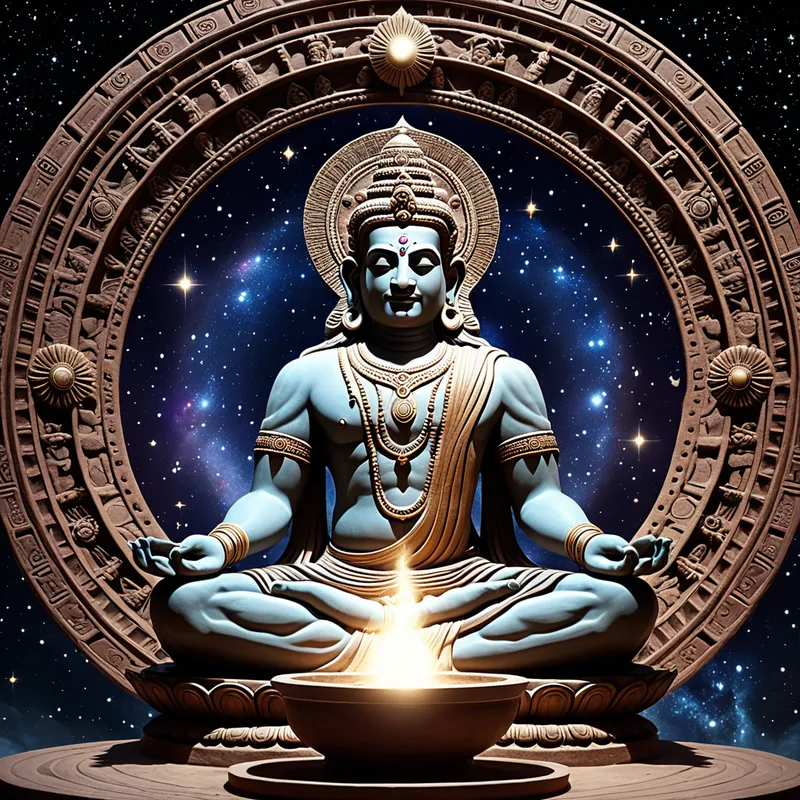
The Potter's Wheel Myth Meaning & Symbolism
A cosmic artisan shapes reality on his wheel, only to shatter his creation, teaching that true power lies in release, not possession.
The Tale of The Potter’s Wheel
In the time before time, when the universe was a single, silent breath held in the infinite dark, the great artisan awoke. He was Brahma, the one whose thoughts become substance. From [the void](/myths/the-void “Myth from Buddhist culture.”/), he summoned his tools: the primal waters of potential, [the earth](/myths/the-earth “Myth from Hindu culture.”/) of form, and the fire of will. But his greatest tool was the Wheel.
It was not a wheel of wood or stone, but a circle of divine intention, spinning on the axis of eternity. Its hum was the first sound, the primordial Om. Sitting before it, Brahma gathered the dark, wet clay of unmanifest matter. His four faces looked to the four directions, seeing all possibilities at once. With a touch, the Wheel began to turn.
And so, he shaped. He shaped mountains that scraped the belly of [the sky](/myths/the-sky “Myth from Persian culture.”/) and valleys that cradled whispering rivers. He shaped the great beasts that roared in the jungles and the tiny insects that glittered in the sun. He shaped the sun itself, a blazing pot of fire, and [the moon](/myths/the-moon “Myth from Tarot culture.”/), a cool, milky bowl. Finally, with the most delicate pressure of his thumbs, he shaped humanity. Each form was unique, each vessel designed to hold a spark of his own consciousness—a jiva.
He worked for ages, and his workshop became the cosmos. Pots of every size and purpose filled the shelves of space. He admired his work. The symmetry of a star cluster, the graceful curve of a gazelle’s neck, the clever complexity of the human mind. A profound satisfaction, warm and deep, settled in his being. He had made all this. It was his.
But the Wheel never stops. It is its nature to turn. And in its turning, a subtle shift occurred in the heart of the maker. Satisfaction curdled into attachment. Pride hardened into possession. The creator began to love the creation not as an expression of divine play, lila, but as a testament to his own skill. He would spend eages gazing at a single, perfect pot, fearing a flaw, dreading dust.
Then came the moment. A vessel, a particularly beautiful one shaped like a human kingdom, developed a hairline crack. Brahma’s face clouded. He tried to mend it, to force the clay back into perfection, but his anxious hands only made it worse. The crack deepened. A terrible frustration, hot and blinding, rose within him. This was his masterpiece, and it was defying him!
In a surge of that frustrated power, he did the unthinkable. He raised the perfect pot high above his head—this [thing](/myths/thing “Myth from Norse culture.”/) he had lovingly shaped from nothing—and with a cry that echoed through all his creations, he dashed it upon the unyielding floor of reality. It shattered into a million fragments of clay and starlight.
Silence. A silence more profound than the first. Brahma looked at the shards. The shock of the act cleared his vision. In the destruction, he saw not loss, but liberation. The form was gone, but the essence—the clay—remained. It was ready to be gathered, rewet, and thrown upon the Wheel once more. A slow, serene smile touched his lips. He understood. The true art was not in the holding, but in the making. And in the unmaking. He sat down again, gathered the fragments, and as the Wheel resumed its eternal spin, he began anew, his heart light, free from the weight of the pot.
Cultural Origins & Context
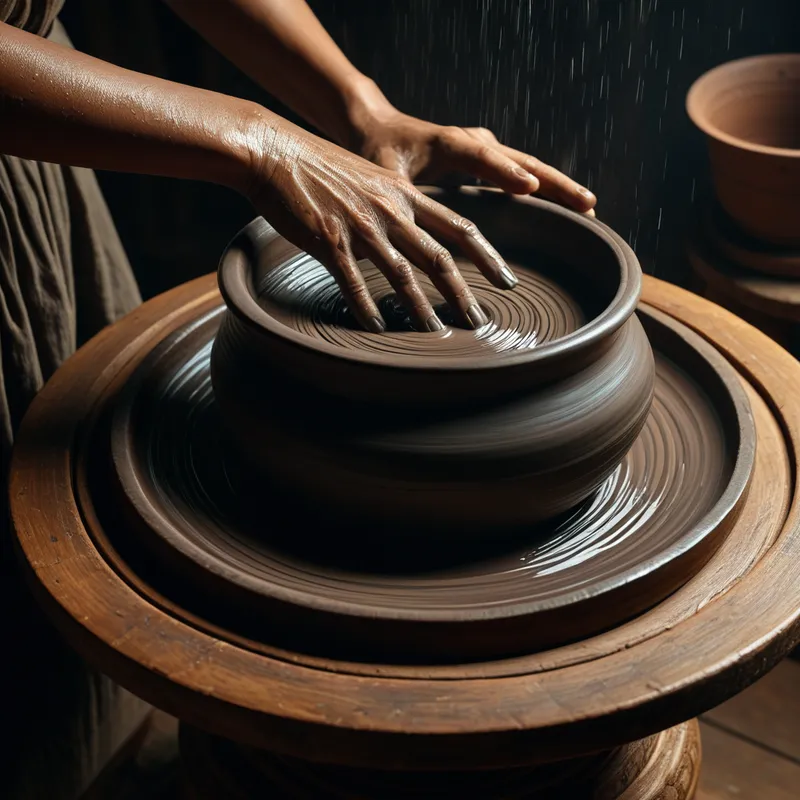
This allegory, while not a single, canonical myth from a text like the Itihasas, is deeply woven into the philosophical fabric of Hinduism. It finds its roots in the creator aspect of Brahma and is echoed in countless teachings, folk tales, and the explanations of gurus. It is a story passed down not to chronicle an event, but to illustrate a state of being—the ideal attitude of the divine, and by extension, the enlightened individual, toward work and creation.
Its primary societal function was pedagogical. Told by teachers to students, parents to children, and priests to congregations, it served as a core lesson in dharma and vairagya. In a culture with exquisite arts, crafts, and a rigorous social structure, the parable warned against the poison of identification with one’s role or creations. Whether you were a king, a potter, a parent, or an artist, your duty was to perform your action with excellence, but to hold the result lightly. The story spiritualized the very act of creation, making every artisan’s wheel a mirror of the cosmic one.
Symbolic Architecture
The myth is a perfect symbolic map of the [psyche](/myths/psyche “Myth from Greek culture.”/)’s [relationship](/symbols/relationship “Symbol: A representation of connections we have with others in our lives, often reflecting our emotional state.”/) with the process of bringing things into being.
The Wheel is the relentless turning of time (kala/kalachakra), the cycle of [birth](/symbols/birth “Symbol: Birth symbolizes new beginnings, transformation, and the potential for growth and development.”/) and [death](/symbols/death “Symbol: Symbolizes transformation, endings, and new beginnings; often associated with fear of the unknown.”/) ([samsara](/myths/samsara “Myth from Buddhist culture.”/)), and the dynamic principle of [reality](/symbols/reality “Symbol: Reality signifies the state of existence and perception, often reflecting one’s understanding of truth and life experiences.”/) itself. It is also the focused mind in a state of creative flow.
The [Clay](/symbols/clay “Symbol: Clay symbolizes malleability, creativity, and the potential for transformation, representing the foundational aspect of life and the ability to shape one’s destiny.”/) is primordial, unformed substance—prakriti. It is the raw [material](/symbols/material “Symbol: Material signifies the tangible aspects of life, often representing physical resources, desires, and the physical world’s influence on our existence.”/) of our lives: our experiences, emotions, relationships, and talents. It is neutral, holding the potential for any form.
Brahma, [the Potter](/myths/the-potter “Myth from Abrahamic culture.”/), represents the individual ego-[consciousness](/symbols/consciousness “Symbol: Consciousness represents the state of awareness and perception, encompassing thoughts, feelings, and experiences.”/) in its [role](/symbols/role “Symbol: The concept of ‘role’ in dreams often reflects one’s identity or how individuals perceive their place within various social structures.”/) as a [creator](/symbols/creator “Symbol: A figure representing ultimate origin, divine power, or profound authorship. Often embodies the source of existence, innovation, or personal destiny.”/). He is the [aspect](/symbols/aspect “Symbol: A distinct feature, quality, or perspective of something, often representing a partial view of a larger whole.”/) of us that takes raw experience and attempts to shape it into a coherent [identity](/symbols/identity “Symbol: Identity represents the sense of self, encompassing personal beliefs, cultural background, and social roles.”/), a [career](/symbols/career “Symbol: The dream symbol of ‘career’ often represents one’s ambitions, goals, and personal identity in a professional context.”/), a [life](/symbols/life “Symbol: The symbol of ‘Life’ represents a journey of growth, interconnectedness, and existential meaning, encompassing both the joys and challenges that define human experience.”/) [story](/symbols/story “Symbol: The symbol of ‘Story’ represents the narrative woven through our lives, embodying experiences, lessons, and emotions that shape our identities.”/)—a “pot.”
The tragedy of the potter is not in the shaping, but in the belief that the shaped vessel is himself.
The Shattering is the critical [moment](/symbols/moment “Symbol: The symbol of a ‘moment’ embodies the significance of transient experiences that encapsulate emotional depth or pivotal transformations in life.”/) of disillusionment. It symbolizes the inevitable failure of egoic possession. No form lasts. Every identity we cling to, every [achievement](/symbols/achievement “Symbol: Symbolizes success, mastery, or reaching a goal, often reflecting personal validation, social recognition, or overcoming challenges.”/) we claim as our permanent self, will crack. The shattering is not a [punishment](/symbols/punishment “Symbol: A dream symbol representing consequences for actions, often tied to guilt, societal rules, or internal moral conflicts.”/), but a divine necessity—the [universe](/symbols/universe “Symbol: The universe symbolizes vastness, interconnectedness, and the mysteries of existence beyond the individual self.”/)’s way of returning essence to potential.
The Dreamer’s Resonance
When this myth stirs in the modern unconscious, it often manifests in dreams of creation and catastrophic loss. You may dream of painstakingly building a model, writing a book, or nurturing a project, only to watch it collapse, burn, or be swept away. The somatic experience upon waking is often one of acute anxiety, a tightness in the chest—the grip of the potter who cannot let go.
Psychologically, this dream pattern signals a profound process of de-identification. The psyche is attempting to dismantle an outdated self-concept (the “pot”) with which you have become overly identified. This could be the “perfect parent” pot, the “successful professional” pot, or the “in-control” pot. The dream’s violence mirrors [the ego](/myths/the-ego “Myth from Jungian culture.”/)’s resistance to this necessary dissolution. The process feels like destruction, but in the economy of the soul, it is the prelude to renewal. The dream is the Wheel, actively breaking a form that has become too small, too rigid, to contain your expanding spirit.
Alchemical Translation
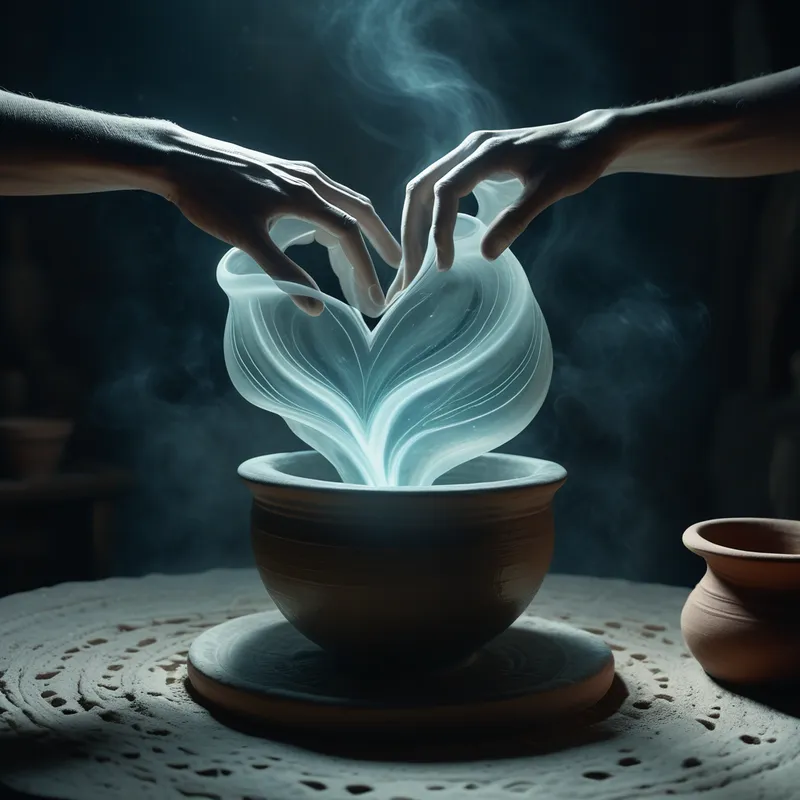
The alchemy modeled here is the transmutation of attachment into sacred artistry. The individuation journey requires us to become conscious potters. We must engage with the Wheel—our life’s work, our relationships, our passions. We must shape our clay with intention and skill, bringing our unique form into [the world](/myths/the-world “Myth from Tarot culture.”/). This is the opus of the first half of life.
[The crucible](/myths/the-crucible “Myth from Alchemical culture.”/), however, is the second act: the voluntary shattering. Individuation demands we develop the capacity to hold our creations—our identities, our achievements, even our spiritual insights—as temporary vessels.
The alchemical gold is not the perfect pot, but the potter’s free and empty hands.
The modern individual undergoes this alchemy when they can experience failure not as a negation of self, but as a return to essential clay. It is the executive who loses a career and discovers a vocation. The artist who destroys their old style to find a new voice. The parent who releases the ideal of a perfect child to love the real one. In each case, the shattered pot releases the trapped spirit of the potter. You are not [the thing](/myths/the-thing “Myth from Norse culture.”/) you made. You are the awareness that made it, and that can make again. The ultimate [triumph](/myths/triumph “Myth from Roman culture.”/) is not a flawless creation on a shelf, but the serene, detached, and endlessly creative consciousness that sits at the center of the ever-turning Wheel, equally at peace with the shaping and the shattering, knowing both are the dance of the one clay.
Associated Symbols
Explore related symbols from the CaleaDream lexicon: