The Potter's House Myth Meaning & Symbolism
A prophet watches a potter reshape flawed clay, receiving a divine message about Israel's fate and the power of being remade by a higher will.
The Tale of The Potter’s House
The word of the Sovereign came, not in the thunder of Sinai nor the whisper of a night wind, but in the common dust of a Jerusalem alley. It descended upon Jeremiah, a man whose soul was a vessel already cracked with the weight of pronouncements. “Arise,” the voice commanded, “and go down to the potter’s house. There I will cause you to hear my words.”
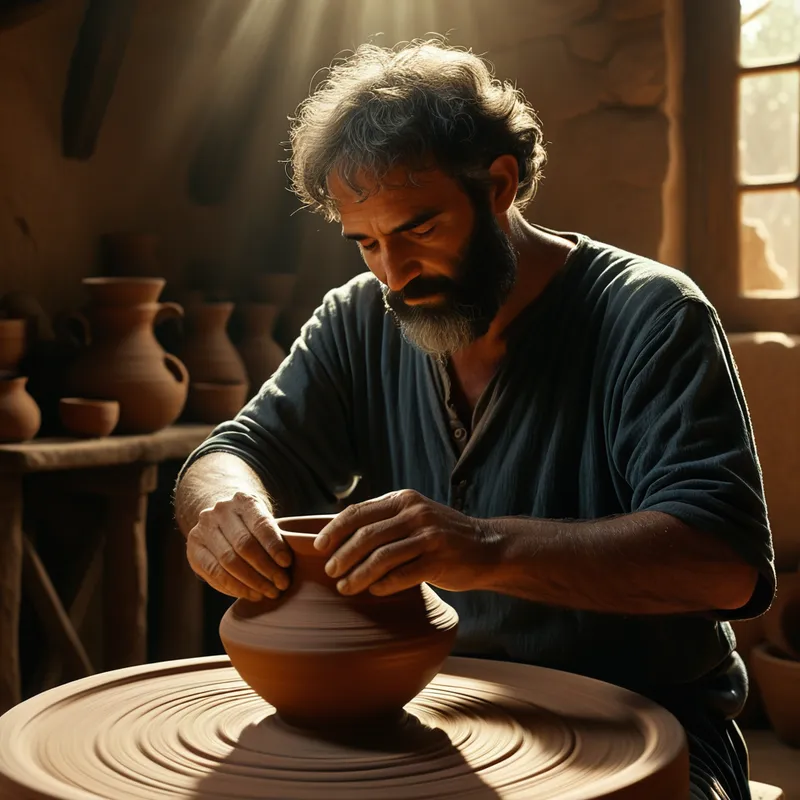
And so he went, the prophet becoming a pilgrim to the most humble of sanctuaries. The air was thick, a palpable soup of earth and water and heat. The scent of damp clay filled his nostrils, a primal smell of beginnings. The only sound was the rhythmic, grinding hum of the wheel—a stone disk turned by foot, a slow, patient orbit that was the heartbeat of the workshop.
In the center sat the potter, a man anonymous in his focus, his forearms corded with the memory of ten thousand shapes. His hands, caked in the grey-brown mud of the earth, embraced a growing mound of clay. They were not gentle, but they were supremely knowing. With a pressure that was both firm and tender, he coaxed the spinning earth upward, his thumbs hollowing a womb, his fingers drawing the walls thin and graceful. A vessel was being born from chaos, a form emerging from the formless.
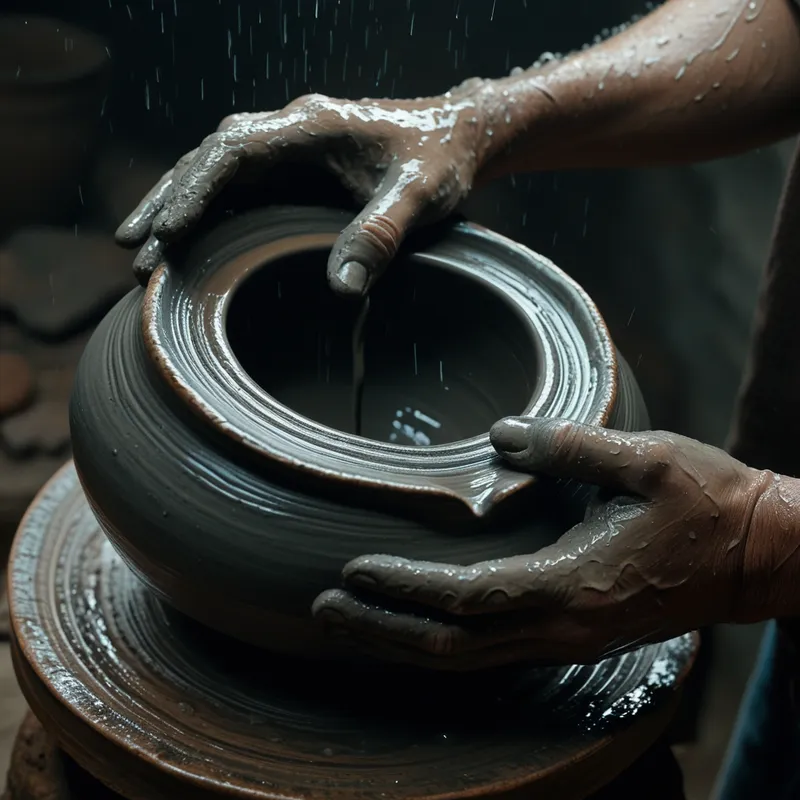
But then, a flaw. A hidden pebble, a pocket of air, an inconsistency in the clay itself. The symmetry shuddered. The rising wall wavered, buckled, and collapsed in upon itself. The beautiful form was marred, useless for its intended purpose.
The potter did not startle. He did not sigh in frustration or cast the spoiled clay aside. His movement was fluid, inevitable. He simply stopped the wheel. With those same knowing hands, he pressed the failed vessel back into a simple, obedient lump. No judgment, only assessment. Then, he set the wheel spinning once more. And from that same clay, from the very material of the failure, he began again. He shaped it into another vessel, as seemed good to the potter to make.
Jeremiah stood in the dust and watched the entire alchemy: the calling forth of form, the discovery of flaw, the patient dissolution, and the steadfast re-creation. He did not hear a voice in that moment. He saw the word. The sermon was written in mud and motion. The message was complete before the divine whisper returned, translating vision into oracle: “O house of Israel, cannot I do with you as this potter? Behold, as the clay is in the potter’s hand, so are you in mine.”
Cultural Origins & Context
This narrative is embedded in the Book of Jeremiah, a text emanating from one of the most turbulent periods in Judah’s history—the late 7th and early 6th centuries BCE. The kingdom faced the existential threat of the Babylonian empire, and Jeremiah’s prophetic mission was largely one of warning and lamentation.
The myth’s power derives from its mundane setting. Prophecy is taken out of the temple and the court and placed in a common artisan’s workshop. This was a deliberate theological move. It made the divine accessible and its logic observable in everyday, tangible processes. The potter was a universal figure, a cornerstone of agrarian and urban life. Everyone understood the necessity of his work and the authority of his skilled hands over his material.
The story functioned as a powerful political and spiritual metaphor. To a nation clinging to a notion of privileged, immutable destiny, it delivered a shattering and reassembling truth: covenant relationship was not a guarantee of permanence in a particular form. It was a dynamic process under divine sovereignty. The nation, like clay, could be reshaped—even through the traumatic collapse of exile—according to a will and a wisdom greater than its own. It was a myth of terrifying grace, asserting that destruction was not an end, but a potential prelude to re-formation.
Symbolic Architecture
At its core, the myth presents a radical model of relationship between the Self (the potter) and the ego or conscious identity (the vessel). The workshop is the world of manifestation, the wheel is the turning of time and circumstance, and the clay is the raw substance of a life—its inherited traits, experiences, and inherent potentialities.
The flaw is not a moral failure, but an existential fact; the collapse is not a punishment, but a necessity of the creative process.
The potter’s unwavering focus symbolizes the objective, purposeful drive of the Self toward wholeness, which often operates outside the ego’s comfort or comprehension. The critical moment is not the creation of the first vessel, but its collapse and the potter’s immediate, non-sentimental return to work. This embodies the psyche’s relentless urge toward integration. A neurosis, a life pattern that has become maladaptive, must be de-structured—pressed back into the psychic mud—before it can be reconstituted into a more functional form. The sovereignty of the potter represents the sometimes-uncomfortable truth that we are not the sole authors of our deepest transformation.

The Dreamer’s Resonance
When this myth stirs in the modern unconscious, it often manifests in dreams of profound reshaping. One might dream of their childhood home being gently dismantled brick by brick, or of a cherished possession melting like wax. There is a somatic quality to these dreams—a feeling of being kneaded, of bones softening, or of the ground itself turning like a wheel beneath one’s feet.
Psychologically, this signals a process of de-integration. The conscious attitude, the “vessel” one has carefully crafted for navigating the world, has been found wanting. A hidden “pebble”—perhaps a repressed trauma, an outgrown self-image, or an ignored calling—has made the structure unstable. The dream ego’s experience of being collapsed is not one of annihilation, but of yielding to a greater, impersonal force. The potent question the dream poses is: Can you surrender the form you have made of yourself, to become the material from which a truer form can be made? The anxiety is in the collapse; the promise is in the potter’s hands that never let go of the clay.

Alchemical Translation
In the alchemical journey of individuation, the Potter’s House models the stage of nigredo followed immediately by a guided albedo. The flawed vessel represents the persona or a rigid conscious complex that has served its purpose but now inhibits growth. Its necessary marring and collapse is the nigredo—the dark night, the confrontation with shadow, the feeling of failure and dissolution.
The alchemy occurs in the potter’s patience, in the refusal to discard the material. All experience, even failure, remains integral to the substance of the Self.
The modern individual undergoes this when a career ends, a relationship shatters, or a foundational belief is overturned. The alchemical translation is the shift from seeing this as a catastrophic end to recognizing it as a return to the wheel. The potter’s house within is the inner sanctum where one submits to the process. One must become both the clay—yielding, trusting, without a plan of its own—and, in a moment of profound consciousness, the witness who understands the potter’s hand at work. The triumph is not in preserving the first form, but in participating in the grace of being remade. The new vessel is not a return to the old, but a creation “as seemed good to the potter”—a movement toward a wholeness that the ego, left to its own devices, could never have designed.
Associated Symbols
Explore related symbols from the CaleaDream lexicon: