The Potter's Clay Myth Meaning & Symbolism
A prophet watches a potter reshape flawed clay, revealing a divine metaphor for human destiny, judgment, and the possibility of being remade.
The Tale of The Potter’s Clay
Hear now a vision, not of thunder on a mountain, but of dust and [water](/myths/water “Myth from Chinese culture.”/) in a quiet yard. The air in [Jerusalem](/myths/jerusalem “Myth from Biblical culture.”/) is thick, heavy with the promise of a word not yet spoken. The prophet Jeremiah walks, his spirit troubled by [the word](/myths/the-word “Myth from Biblical culture.”/) of YHWH that burns like a fire in his bones. The path leads him not to [the temple](/myths/the-temple “Myth from Jewish culture.”/), but down, into the valley of the son of Hinnom, past the gates, to a place of common craft.
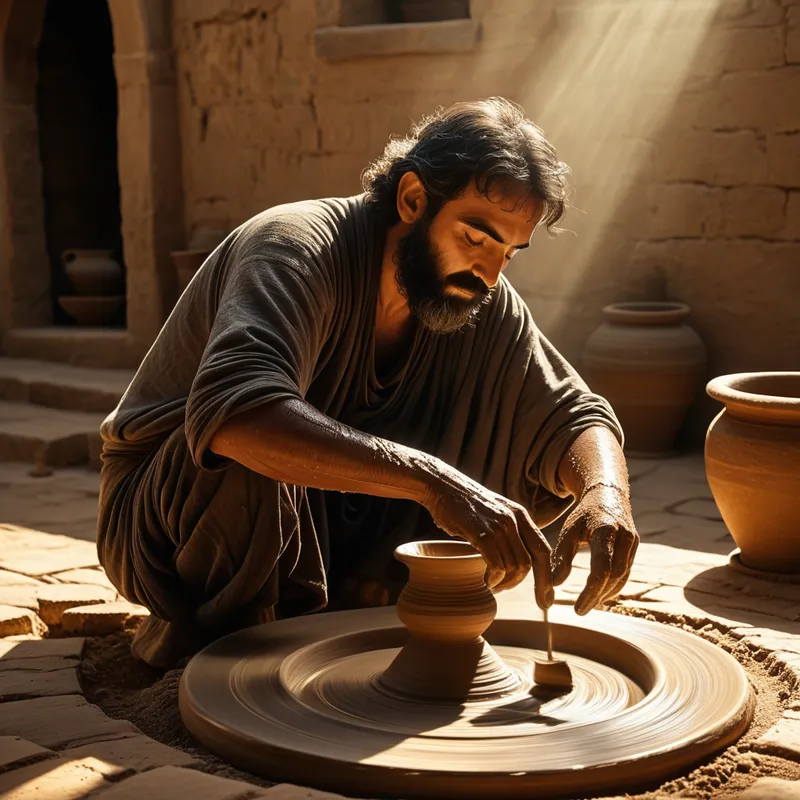
There, in a courtyard open to [the sky](/myths/the-sky “Myth from Persian culture.”/), a potter works at his wheel. The only sounds are the soft, rhythmic shush-shush of the wheel spun by foot, the wet slap of clay, and the quiet, focused breath of the artisan. The clay is a mound of ruddy earth, drawn from the very ground of Judah. Water from a jar mingles with it, and under [the potter](/myths/the-potter “Myth from Abrahamic culture.”/)’s strong, knowing hands, it yields. It rises. It begins to take form—a graceful curve for a water jar, a slender neck for a flask of oil.
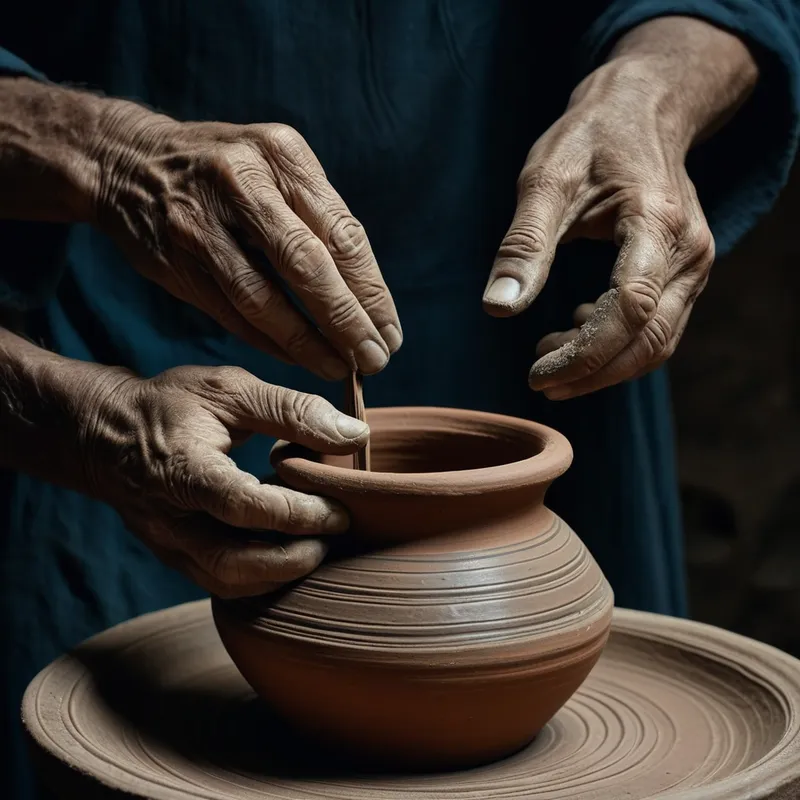
Jeremiah watches, his prophet’s eye seeing more than craft. He sees intention. He sees will made manifest in matter. The potter’s fingers press inward, coaxing the walls upward; his thumbs smooth the lip, defining its purpose. [The vessel](/myths/the-vessel “Myth from Alchemical culture.”/) is nearly complete, a [thing](/myths/thing “Myth from Norse culture.”/) of beauty emerging from formlessness.
But then—a flaw. A hidden stone, a pocket of air, a weakness in [the earth](/myths/the-earth “Myth from Hindu culture.”/) itself. The symmetry wavers. The wall buckles. The spinning form wobbles, collapses in on itself, becoming a lopsided, useless mass. The vision of the jar is shattered in the clay.
The prophet expects the potter to cast the ruined lump aside, to discard it with the other broken shards that litter the ground. But he does not. Without a word of frustration, without haste, the potter’s hands close over the failed form. He does not destroy it. He reconstitutes it. He presses the clay back into itself, a mound once more, wet and yielding. He adds a little water from the jar. And he begins again.
The same clay. The same hands. The same wheel. But a new intention. Perhaps this time, a simpler bowl. A stronger, humbler cup. The potter works, and from the very stuff of failure, a new vessel is born—flawless, whole, and fit for its new purpose. The wheel slows. The potter examines his work, and it is good. In that quiet yard, with the smell of damp earth and the feel of the sun on his neck, Jeremiah receives the word. The vision is complete. The parable is written in clay, water, and will.
Cultural Origins & Context
This vision is recorded in the eighteenth chapter of the Book of Jeremiah. It emerges from a specific and fraught historical moment: the late 7th to early 6th century BCE, on the eve of the Babylonian Exile. Jeremiah’s mission was to deliver a devastating, unwelcome prophecy of national collapse as divine judgment for societal corruption and covenant faithlessness.
The metaphor was not invented in a vacuum. Pottery was the plastic of the ancient world—ubiquitous, essential, and fragile. Every household knew the process, the feel of a new jar, the sound of a broken one. The prophet’s genius was to take this utterly mundane, daily reality and elevate it into a supreme theological and existential principle. He was likely speaking to the people, using this observed scene as a powerful oral parable. Its function was dual: to assert the absolute sovereignty of the divine will, and to introduce a critical, conditional clause into the narrative of national destiny. It was a warning with a hidden door—the door of repentance and re-formation.
Symbolic Architecture
At its core, the myth presents a radical ontology of [relationship](/symbols/relationship “Symbol: A representation of connections we have with others in our lives, often reflecting our emotional state.”/). The Potter is not a distant clockmaker but an intimate, engaged, and responsive shaper. The [Clay](/symbols/clay “Symbol: Clay symbolizes malleability, creativity, and the potential for transformation, representing the foundational aspect of life and the ability to shape one’s destiny.”/) is not inert matter but a substance with a quality of [response](/symbols/response “Symbol: Response in dreams symbolizes how one reacts to situations, often reflecting the subconscious mind’s processing of events.”/)-[ability](/symbols/ability “Symbol: In dreams, ‘ability’ often denotes a recognition of skills or potential that one possesses, whether acknowledged or suppressed.”/)—it can be marred, it can resist, it can yield.
The flaw is not in the clay’s essence, but in its formation. The destruction is not an end, but a return to potential.
The Wheel represents the turning circumstances of [life](/symbols/life “Symbol: The symbol of ‘Life’ represents a journey of growth, interconnectedness, and existential meaning, encompassing both the joys and challenges that define human experience.”/), [history](/symbols/history “Symbol: History in dreams often represents the dreamer’s past experiences, lessons learned, or unresolved issues that continue to influence their present.”/), and [fate](/symbols/fate “Symbol: Fate represents the belief in predetermined outcomes, suggesting that some aspects of life are beyond human control.”/)—the context in which formation happens. The [Water](/symbols/water “Symbol: Water symbolizes the subconscious mind, emotions, and the flow of life, representing both cleansing and creation.”/) is the [spirit](/symbols/spirit “Symbol: Spirit symbolizes the essence of life, vitality, and the spiritual journey of the individual.”/), the grace, the softening element that makes re-formation possible. The most profound [symbol](/symbols/symbol “Symbol: A symbol can represent an idea, concept, or belief, serving as a powerful tool for communication and understanding.”/) is the Hand. It is the point of contact between will and substance, the divine touch that is both creative and corrective. The myth dismantles any [notion](/symbols/notion “Symbol: A notion symbolizes an idea or belief that occupies one’s thoughts or consciousness.”/) of [static](/symbols/static “Symbol: Static represents interference, disruption, and the breakdown of clear communication or signal, often evoking feelings of frustration and disconnection.”/), fixed [identity](/symbols/identity “Symbol: Identity represents the sense of self, encompassing personal beliefs, cultural background, and social roles.”/). Identity here is a [verb](/symbols/verb “Symbol: A word expressing action, existence, or occurrence; in arts, it represents dynamic creative expression and the process of making.”/), not a [noun](/symbols/noun “Symbol: A word representing a person, place, thing, or idea. In dreams, it often symbolizes the dreamer’s attempt to name, define, or understand something fundamental.”/)—a continuous process of being-shaped.
Psychologically, the Potter represents the Self, the guiding, integrative center of the [psyche](/myths/psyche “Myth from Greek culture.”/). The clay is the ego and its contents—our plans, our self-[image](/symbols/image “Symbol: An image represents perception, memories, and the visual narratives we create in our minds.”/), our conscious [personality](/symbols/personality “Symbol: Personality in dreams often symbolizes the traits and characteristics of the dreamer, reflecting how they perceive themselves and how they believe they are perceived by others.”/). The flaw that appears on the wheel is the [eruption](/symbols/eruption “Symbol: A sudden, violent release of pent-up energy or emotion from beneath the surface, often representing transformation or crisis.”/) of the [shadow](/symbols/shadow “Symbol: The ‘shadow’ embodies the unconscious, repressed aspects of the self and often represents fears or hidden emotions.”/) or complex, revealing the inadequacy of our current “form” to contain the whole of our being.

The Dreamer’s Resonance
When this myth stirs in the modern unconscious, it often manifests in dreams of broken artifacts, malleable substances, or being reshaped. To dream of watching a potter may signal a nascent awareness of a guiding intelligence beyond [the ego](/myths/the-ego “Myth from Jungian culture.”/). To dream of being the clay is to experience the sometimes-terrifying, sometimes-relieving sensation of ego-dissolution.
Common motifs include:
- Shattering Vessels: Dreams of precious vases, bowls, or even one’s own body cracking. This is the somatic recognition of a life structure—a relationship, career, or belief—that has reached its limit and must fail. The feeling upon waking is often not pure grief, but a strange, raw openness.
- Formless Matter: Dreams of working with mud, dough, or melting wax. This indicates the psyche is in a state of potential, having returned to the “mound” for reconstitution. There is plasticity but also uncertainty.
- The Anonymous Artisan: A dream figure whose face is obscured, focused entirely on their work with your form. This is the direct encounter with the Self as shaper. The emotional tone can range from awe to profound vulnerability.
The process is one of surrender to a deeper will. The ego, which identifies with the specific form (the first intended vessel), must consent to its own deconstruction for the sake of a wholeness it cannot yet envision.
Alchemical Translation
The alchemical [nigredo](/myths/nigredo “Myth from Alchemical culture.”/) is vividly present here: the darkening, the collapse of the vessel on the wheel. This is the necessary first stage of individuation—the humiliation of the ego, the confrontation with one’s flaws and failures. The potter does not discard the clay; [the Self](/myths/the-self “Myth from Jungian culture.”/) does not abandon the psyche. The failed form is dissolved ([solutio](/myths/solutio “Myth from Alchemical culture.”/)) in the waters of reflection and unconscious fluidity.
The alchemy is in the patience of the hands. The transmutation occurs not by force, but by sustained, attentive pressure.
The re-shaping is the albedo and citrinitas—the emergence of a new, more authentic form from the same base material of one’s life experience. The final vessel, the [rubedo](/myths/rubedo “Myth from Alchemical culture.”/), is not a “perfect” person by worldly standards, but a fit vessel. Its purpose is integrated with its substance.
For the modern individual, the myth maps the journey from ego-driven ambition (the first, flawed vessel) to soul-directed purpose (the reconstituted form). It teaches that our breakdowns are not evidence of divine rejection, but often the very mechanism of divine re-creation. The call is to move from a psychology of self-making to one of allowing oneself to be made—to become conscious, responsive clay in the hands of the greater Self. The [triumph](/myths/triumph “Myth from Roman culture.”/) is not in never failing, but in discovering that we are made of a substance that can always begin again.
Associated Symbols
Explore related symbols from the CaleaDream lexicon: