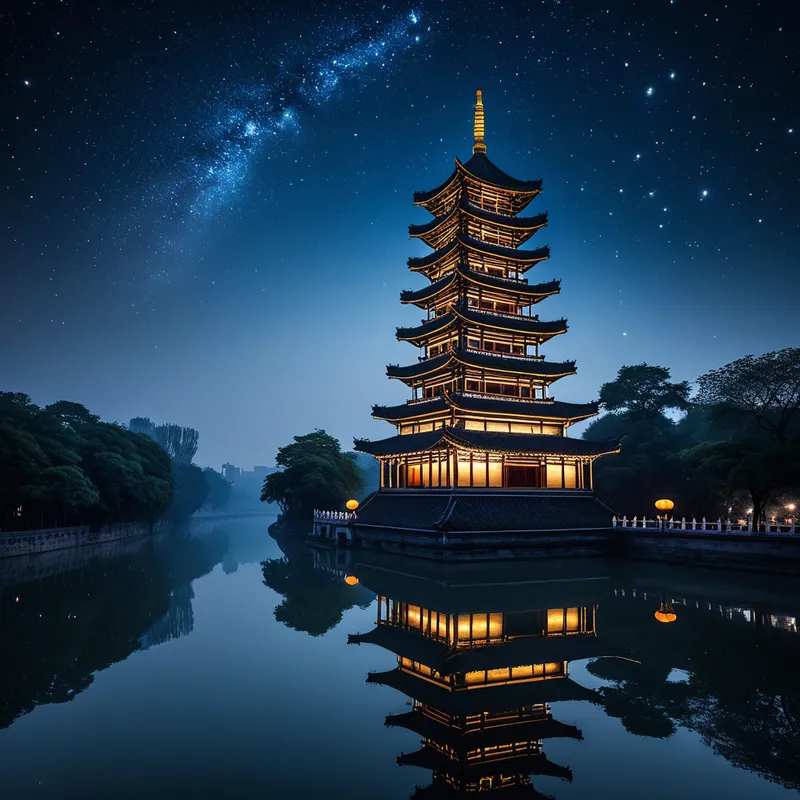
The Porcelain Pagoda of Nanjing Myth Meaning & Symbolism
An emperor's vow to build a luminous pagoda to honor his mother becomes a legendary tale of celestial design, earthly devotion, and the fragility of perfection.
The Tale of The Porcelain Pagoda of Nanjing
Hear now the tale that hangs in [the mist](/myths/the-mist “Myth from Celtic culture.”/) over the Qinhuai River, a story woven from moonlight and clay. In the heart of the Ming empire, under the reign of the Yongle Emperor, a profound silence fell upon the Son of Heaven. It was not the silence of peace, but the hollow echo of a son’s grief. His mother, the Empress Ma, a woman of profound virtue who had walked with the humility of the common folk, had departed this earthly realm. The Emperor’s heart, a vast kingdom in itself, was now a chamber of shadows.
From this chamber of grief, a vow was forged—not of conquest, but of creation. He would build a monument not of stone, but of light; not a tomb, but a beacon. He summoned the greatest minds of the empire: master architects who could read the angles of the stars, geomancers who understood the whispers of [the earth](/myths/the-earth “Myth from Hindu culture.”/), and potters whose hands were kissed by the elemental fire. “Build for her,” he commanded, his voice the low rumble of distant thunder, “a pagoda that will pierce the heavens. Let it be made of the essence of the earth, refined by fire, and blessed by [the sky](/myths/the-sky “Myth from Persian culture.”/). Let it be a ladder for her virtuous soul, a permanent prayer in [porcelain](/myths/porcelain “Myth from Chinese culture.”/).”
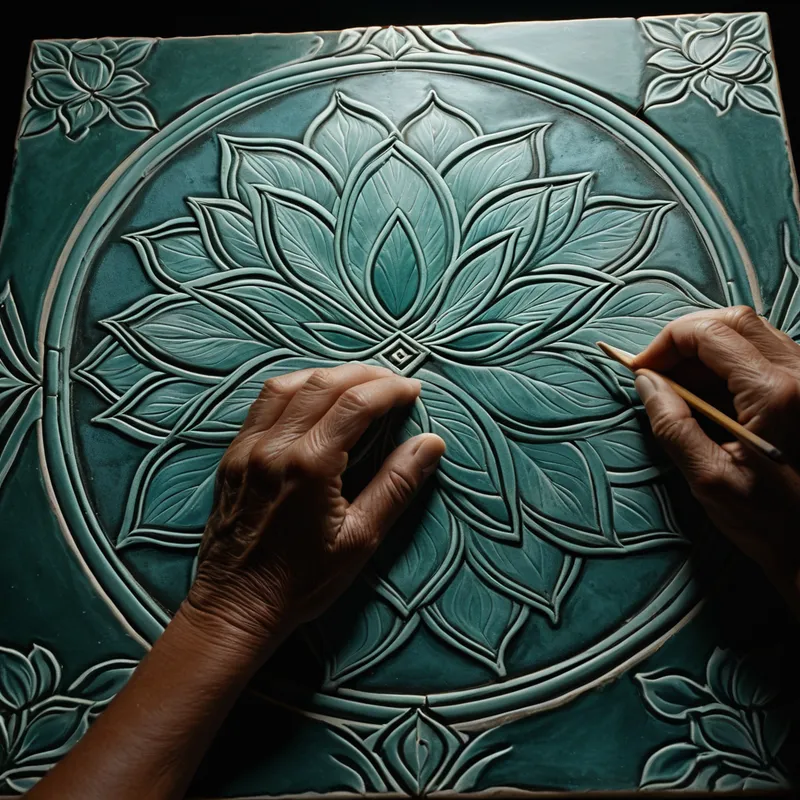
And so, [the great work](/myths/the-great-work “Myth from Alchemical culture.”/) began. For years, the site hummed with a sacred industry. Kilns blazed day and night, their bellies pregnant with clay that would emerge transformed—into tiles of jade green, lapis lazuli blue, and creamy white, each glazed to a liquid shine. Artisans, their faces etched with soot and concentration, fitted these luminous pieces together without mortar, each interlocking with a precision that defied the eye. They carved stories into the bricks: bodhisattvas in serene repose, celestial phoenixes in mid-flight, and endless chains of [lotus](/myths/lotus “Myth from Hindu culture.”/) blossoms, symbol of purity rising from mud.
As the structure rose, story by story—nine in total, reaching towards the Dome of Heaven—it ceased to be merely a building. By day, it stood as a serene giant, its colors soft and dignified. But by night… by night, it underwent a [transfiguration](/myths/transfiguration “Myth from Christian culture.”/). When [the moon](/myths/the-moon “Myth from Tarot culture.”/) rose, or when over one hundred and forty lamps were lit within its belly, the entire pagoda would glow. It became a column of captured moonlight, a radiant spine connecting the dark earth to [the star](/myths/the-star “Myth from Tarot culture.”/)-dusted sky. Travelers spoke of seeing its glow from leagues away, a silent, luminous promise on [the horizon](/myths/the-horizon “Myth from Various culture.”/). It was said that on the clearest nights, one could almost see the benevolent spirit of the Empress, smiling from its highest balcony, finally at peace, cradled in this masterpiece of filial devotion.
Cultural Origins & Context
[The Porcelain Pagoda](/myths/the-porcelain-pagoda “Myth from Chinese culture.”/), or Bao’en Si, was not merely a fanciful legend but a historical marvel, completed in the early 15th century. Its mythologization began almost immediately, born from the awe it inspired in all who witnessed it. It was chronicled by Chinese scholars and, later, by wide-eyed European travelers like Johan Nieuhof, who included an illustration of it in his writings, cementing its status as one of the wonders of [the world](/myths/the-world “Myth from Tarot culture.”/).
The tale was passed down not by a single bard, but by a chorus of voices: the boatmen on the Qinhuai who saw its nightly transformation, the artisans’ descendants who spoke of the sacred labor, and the scholars who recorded its perfection. Its societal function was multifaceted. It was a supreme act of filial piety, reinforcing a core Confucian virtue through breathtaking spectacle. It was also a statement of Ming power and cultural refinement—proof that the empire could harness the elements (earth, [water](/myths/water “Myth from Chinese culture.”/), fire) and human genius to create something of transcendent, almost divine, beauty. It served as a spiritual lighthouse, a bodhisattva’s vow made architectural, guiding the people towards ideals of virtue, harmony, and celestial aspiration.
Symbolic Architecture
Psychologically, the [Pagoda](/symbols/pagoda “Symbol: A Pagoda symbolizes spiritual enlightenment, cultural heritage, and the reaching of higher consciousness, often serving as a meditation or worship space.”/) is a sublime [symbol](/symbols/symbol “Symbol: A symbol can represent an idea, concept, or belief, serving as a powerful tool for communication and understanding.”/) of the conscious ego’s attempt to [structure](/symbols/structure “Symbol: Structure in dreams often symbolizes stability, organization, and the framework of one’s life, reflecting how one perceives their environment and personal life.”/) and beautify the raw [material](/symbols/material “Symbol: Material signifies the tangible aspects of life, often representing physical resources, desires, and the physical world’s influence on our existence.”/) of the [psyche](/myths/psyche “Myth from Greek culture.”/). The [grief](/symbols/grief “Symbol: A profound emotional response to loss, often manifesting as deep sorrow, yearning, and a sense of emptiness.”/) of the Emperor is the primal, unstructured affect—the “[clay](/symbols/clay “Symbol: Clay symbolizes malleability, creativity, and the potential for transformation, representing the foundational aspect of life and the ability to shape one’s destiny.”/)” of [human](/symbols/human “Symbol: The symbol of a human represents individuality, complexity of emotions, and social relationships.”/) [emotion](/symbols/emotion “Symbol: Emotion symbolizes our inner feelings and responses to experiences, often guiding our actions and choices.”/). The vow is the conscious [intention](/symbols/intention “Symbol: Intention represents the clarity of purpose and direction in one’s life and can symbolize motivation and commitment within a dream context.”/), the [logos](/myths/logos “Myth from Christian culture.”/) that seeks to give form to [chaos](/symbols/chaos “Symbol: In Arts & Music, chaos represents raw creative potential, uncontrolled expression, and the breakdown of order to forge new artistic forms.”/).
The pagoda is the psyche’s attempt to build a permanent sanctuary for what is lost, crafting memory into a luminous, ordered geometry.
Each of the nine [stories](/symbols/stories “Symbol: Stories symbolize the narratives of our lives, reflecting personal experiences and collective culture.”/) represents an [ascent](/symbols/ascent “Symbol: Symbolizes upward movement, progress, spiritual elevation, or striving toward higher goals, often representing personal growth or transcendence.”/), a step-wise refinement of base material into spiritual [insight](/symbols/insight “Symbol: A sudden, deep understanding of a complex situation or truth, often arriving unexpectedly and illuminating hidden connections.”/). The [porcelain](/symbols/porcelain “Symbol: A delicate, refined ceramic material symbolizing fragility, purity, and transformation through fire. Often represents beauty that requires careful handling.”/) itself is the perfect symbol of [alchemy](/symbols/alchemy “Symbol: A transformative process of purification and creation, often symbolizing personal or spiritual evolution through difficult stages.”/): common [earth](/symbols/earth “Symbol: The symbol of Earth often represents grounding, stability, and the physical realm, embodying a connection to nature and the innate support it provides.”/) (the unconscious, the [body](/symbols/body “Symbol: The body in dreams often symbolizes the dreamer’s self-identity, personal health, and the relationship they have with their physical existence.”/)) is mixed with [water](/symbols/water “Symbol: Water symbolizes the subconscious mind, emotions, and the flow of life, representing both cleansing and creation.”/) (emotion, the [soul](/symbols/soul “Symbol: The soul represents the essence of a person, encompassing their spirit, identity, and connection to the universe.”/)), shaped by human will ([the ego](/myths/the-ego “Myth from Jungian culture.”/)), and subjected to the transformative fire of the kiln (the ordeal, suffering, [passion](/symbols/passion “Symbol: Intense emotional or physical desire, often linked to love, creativity, or purpose. Represents life force and deep engagement.”/)). What emerges is neither [earth](/symbols/earth “Symbol: The symbol of Earth often represents grounding, stability, and the physical realm, embodying a connection to nature and the innate support it provides.”/) nor clay, but something new: a luminous, durable, yet fragile substance that reflects light. This is the individuated self—a unique entity forged through conscious engagement with [life](/symbols/life “Symbol: The symbol of ‘Life’ represents a journey of growth, interconnectedness, and existential meaning, encompassing both the joys and challenges that define human experience.”/)’s fires.
The fact that it was built without mortar speaks to a profound inner [integration](/symbols/integration “Symbol: The process of unifying disparate parts of the self or experience into a cohesive whole, often representing psychological wholeness or resolution of internal conflict.”/). Each [piece](/symbols/piece “Symbol: A ‘piece’ in dreams often symbolizes a fragment of the self or a situation that requires integration, reflection, or understanding.”/) must hold its [neighbor](/symbols/neighbor “Symbol: A neighbor in a dream often represents social interactions, community ties, and the influence of those around you.”/) through perfect fit and balance, a [metaphor](/symbols/metaphor “Symbol: A figure of speech where one thing represents another, often revealing hidden connections and deeper truths through symbolic comparison.”/) for a [personality](/symbols/personality “Symbol: Personality in dreams often symbolizes the traits and characteristics of the dreamer, reflecting how they perceive themselves and how they believe they are perceived by others.”/) where complexes and traits are not forcibly bound but harmoniously interlocked.
The Dreamer’s Resonance
To dream of the Porcelain Pagoda is to dream of a sublime, personal creation project within the psyche. The dreamer may be in a process of building something of great personal importance—a new identity after loss, a creative masterpiece, or a structured philosophy of life.
If the pagoda in the dream is complete and glowing, it suggests the dreamer is successfully integrating a profound experience into a beautiful and enduring part of their self-concept. There is a sense of peace, order, and luminous achievement. If the pagoda is under construction, the dreamer is actively engaged in this psychic alchemy, carefully placing each new insight, each hard-won realization.
However, if the pagoda is damaged, crumbling, or dim, it speaks to the vulnerability of this psychic structure. The dreamer may fear that their hard-won sense of order, their beautiful creation of self, is fragile and under threat. It can reflect anxiety about the [impermanence](/myths/impermanence “Myth from Buddhist culture.”/) of our psychological achievements or a feeling that the [inner light](/myths/inner-light “Myth from Buddhist culture.”/) is fading. The dream is a somatic reminder of both the glory and the profound fragility of the selves we build.
Alchemical Translation
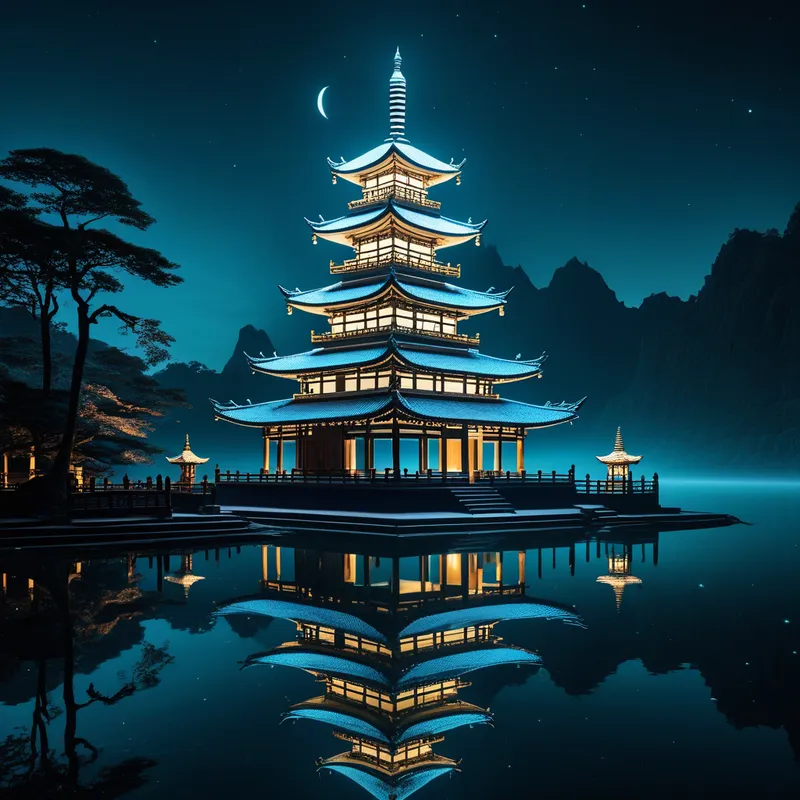
The myth models the full arc of psychic transmutation, or individuation. It begins in the [nigredo](/myths/nigredo “Myth from Alchemical culture.”/), the blackening: the Emperor’s grief, the formless, dark emotion. The vow initiates the albedo, the whitening: the clear, conscious intention to purify and elevate this material.
The decades of construction represent the citrinitas, the yellowing or dawning of the solar light of understanding—the slow, meticulous work of therapy, introspection, and creative effort. The firing of the porcelain tiles is the critical ordeal, the point where the nascent self must pass through the fire of conflict, doubt, and suffering to be hardened and glazed with wisdom.
The final, glowing pagoda is the rubedo, the reddening or culmination: the birth of the luminous, durable Self, which is both a masterpiece and a vessel. It is a structure that connects heaven and earth, conscious and unconscious, making the individual a conduit for something transcendent.
Yet, the historical pagoda was destroyed in the 19th century. This, too, is part of the alchemy. The myth does not promise eternal, static perfection. The completed Self is not an end state but a peak moment of harmony. Life, like history, brings new fires. The ultimate teaching is not in the permanent existence of the structure, but in the proof that such luminous order can be built at all. The modern individual’s journey is not to possess an indestructible pagoda, but to learn the sacred craft of building it, again and again, from the ever-new clay of their experience, holding the memory of its light even amidst the ruins.
Associated Symbols
Explore related symbols from the CaleaDream lexicon: