The Pooka Myth Meaning & Symbolism
A shapeshifting spirit of the Celtic wilds, the Pooka embodies nature's untamed chaos, offering terrifying rides that shatter illusion and reveal raw truth.
The Tale of The Pooka
Listen, and let the peat-smoke carry you. The hour is Samhain, when the veil is a spider’s thread. The sensible are indoors, but the land does not sleep. In the hollow hills and the blackthorn thickets, a presence stirs. It is the Pooka.
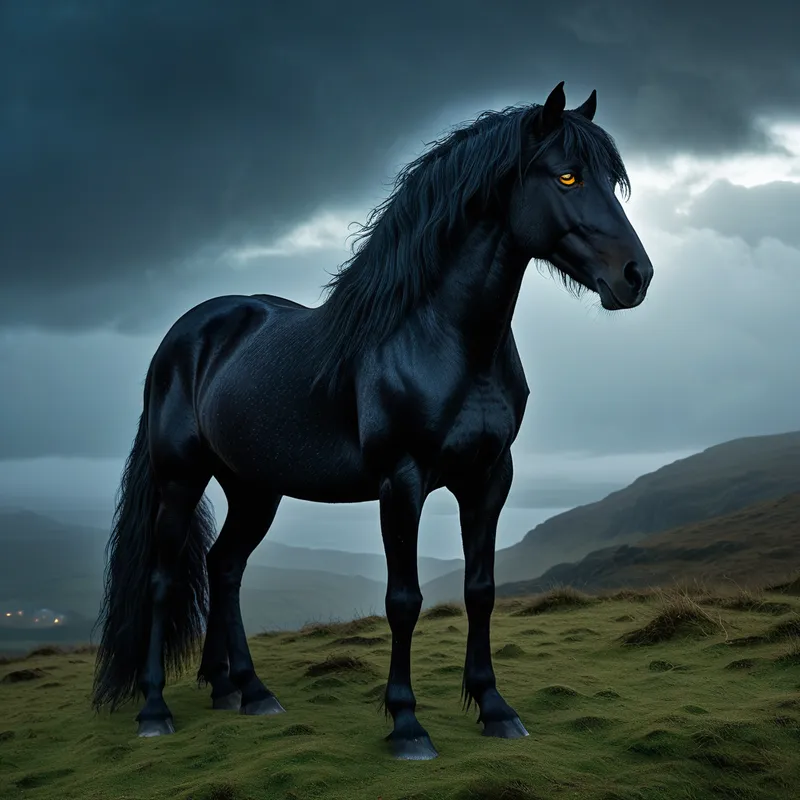
It comes with the west wind, a coalescing of mist and shadow. One moment, the moonlit path is empty. The next, he is there. Perhaps as a great black stallion, his coat drinking the starlight, his eyes like banked coals. Or as a twisted goat with horns of polished jet. Or a sleek hare with a knowing, unsettling gaze. He is the shape of the land’s wild humor, and his purpose is not to kill, but to unmake.
He finds them—the braggart leaving the tavern, the miser counting his coins by a lone window, the youth sneaking to a tryst. With a sound like a laugh caught in a gale, he is upon them. For the drunkard, he becomes a monstrous steed, hooves like thunder. The man is swept onto its back, not by force, but by a gravity of pure chaos. The ride begins.
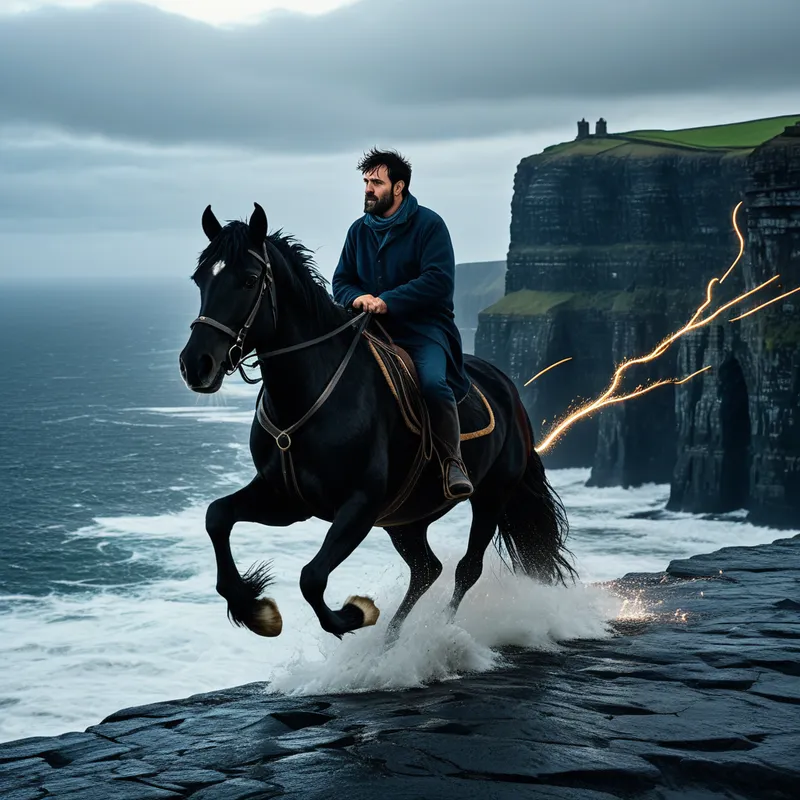
It is not a ride across earth, but across the soul’s own geography. They do not gallop on roads, but on the crests of waves, on the razor-edge of cliffs, through forests where the trees clutch at the rider’s soul. The Pooka speaks in a voice that is the crash of waves and the cry of the fox. He reveals truths: the wife’s secret scorn, the coin stolen from a brother, the cowardice dressed as pride. He shows the rider their life as it is, stripped of all comforting tales.
The climax is not a battle, but a dissolution. The world blurs into a torrent of sensation and terrifying clarity. Just as the rider’s mind threatens to shatter, as the ego drowns in this flood of raw being, the ride ends. The Pooka deposits his charge—shaken, sodden, often on a lonely roadside or a foreign hilltop—with a final, cryptic utterance. A prophecy of a good harvest, a warning of a coming storm, or a mocking chuckle that fades into the dawn mist. Then he is gone, leaving only the trembling human and the first pale light of a new day, which feels unbearably, brilliantly real.
Cultural Origins & Context
The Pooka (also Púca, Phooka) is a creature of Gaelic oral tradition, most firmly rooted in Ireland, with cousins in Welsh and broader Brythonic lore. This was not a myth confined to parchment, but a living story told by the hearth, a narrative breathed into the landscape itself. Every lonely fort (ráth), turbulent stretch of water, and particular mountain pass could be a “Pooka’s place.”
Its tellers were the community—the seanchaí (storyteller) formalizing it, but every farmer and fisherman knew its shape. The myth functioned as a social and psychological regulator. It explained the uncanny: the horse found sweating and terrified in its stall at dawn, the sudden, irrational fear on a lonely path. More profoundly, it enforced cultural boundaries. The Pooka was most active on liminal nights—Samhain, the eve of November, when the rules of the world softened. It punished transgression: greed, dishonesty, arrogance, and being out of place when one should be safe within the social unit of the home. The Pooka was the embodiment of the untamed wild asserting its law over the encroaching, often arrogant, order of human settlement.
Symbolic Architecture
The Pooka is not a demon to be exorcised, but a principle to be encountered. It is the archetypal Shadow of nature itself—not evil, but amoral, chaotic, and ruthlessly truthful. Its shapeshifting reveals its essence: it is the potential of all forms, the instability underlying apparent solidity. The black stallion represents untamed power and instinct; the goat, lust and base cunning; the hare, fertility and elusiveness.
The Pooka does not seek to destroy the rider, but to destroy the rider’s illusions. It is the psychopomp of brutal self-awareness.
The terrifying ride is a symbolic death-and-rebirth. The ego, with its carefully constructed identity and lies, is taken apart at speed. The familiar world is deconstructed. This is not a gentle therapy but a psychic ordeal. The truths it shrieks are the contents of one’s own personal shadow—the repressed shames, desires, and weaknesses. The resolution—being deposited unharmed but transformed—suggests that confrontation with this chaotic truth, while shattering, is ultimately integrative. One returns to the human world having seen the abyss, and thus appreciating the solid ground anew.
The Dreamer’s Resonance
When the Pooka gallops into modern dreams, it heralds a profound psychological event. To dream of being chased or mounted by a shapeshifting animal, especially one of dark power, signals that the unconscious is forcing a confrontation. The dream-ego is being taken for a “ride.”
Somatically, one might awaken with a racing heart, a sense of vertigo, or the phantom feeling of a fall. Psychologically, this indicates a period where life itself feels out of control—a career upheaval, a relationship crisis, a sudden collapse of a long-held self-image. The Pooka-dream says the chaos is not external; it is the internal shadow, long ignored, now taking the reins. The dream is the psyche’s attempt to initiate the terrifying but necessary process of ego-dismantling, forcing the dreamer to experience the raw, unfiltered truth of their situation or character.
Alchemical Translation
In the alchemical vessel of the soul, the Pooka represents the nigredo—the blackening, the putrefaction, the chaotic first matter essential for all transformation. The modern individuation journey often requires a similar brutal encounter with one’s own inner Pooka.
We spend years building a persona, a civilized self. But life, in its role as trickster, eventually offers us a ride. A failure, a betrayal, a loss—it seizes us and gallops us through the landscape of our deepest fears and denied truths. The initial experience is pure terror, the dissolution of all we thought was solid.
The alchemy occurs not in avoiding the ride, but in surviving it. The Pooka’s gift is the obliteration of the false self, leaving only the stark, authentic core from which genuine growth can begin.
The integration comes after the deposition. The task is to gather the shattered pieces, not to rebuild the old illusion, but to assemble a new consciousness that acknowledges the shadow’s power and the world’s inherent wildness. One becomes, in a sense, wiser and more grounded, having been ungrounded completely. The prophecy the Pooka leaves is the insight born from this ordeal—a clearer, if starker, vision of one’s path forward. To have met the Pooka and returned is to know that the greatest truths are not found in comfort, but in the terrifying, liberating ride through the chaos of our own souls.
Associated Symbols
Explore related symbols from the CaleaDream lexicon: