The Poisoned Apple Myth Meaning & Symbolism
A symbol of temptation and transformation, the poisoned apple represents the perilous gift that brings death to the old self to birth the new.
The Tale of The Poisoned Apple
Listen, and let the old truth settle in your bones. This is not a story of a single land, but a whisper that has traveled on every wind, a shadow that has fallen under every sun. It begins in a place of seeming perfection, a kingdom of order, a heart of innocence. Here, a figure of light dwells—a radiant one, beloved and protected, whose world is bounded by high walls and gentle songs.
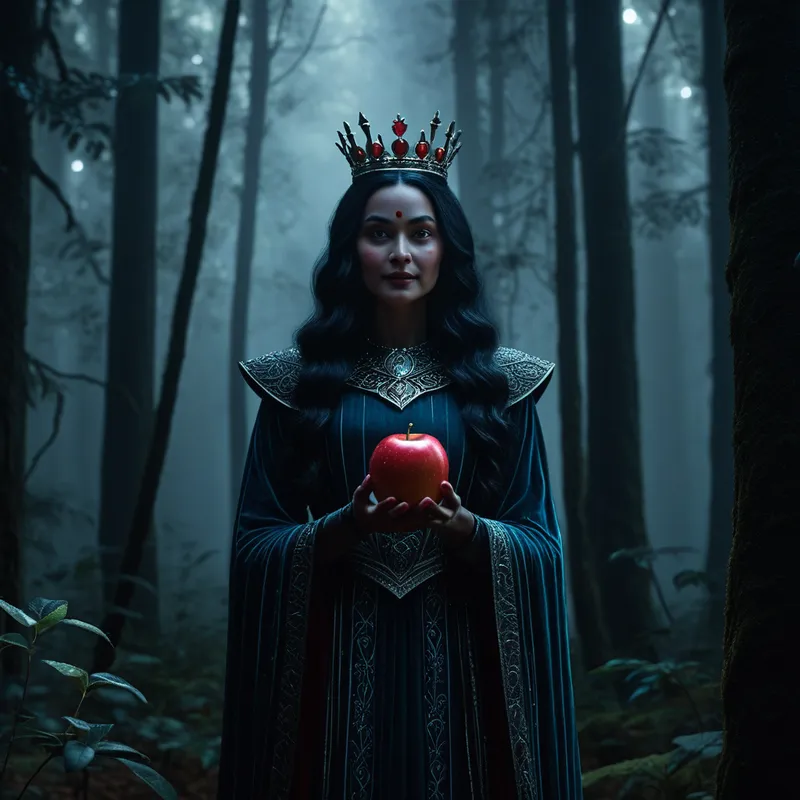
But beyond the wall, in the tangled wood where the roots know secrets and the branches scratch at the sky, there is another. She is the exiled queen, her majesty turned to bitterness, her mirror reflecting only absence. She watches the light in the tower, and in her heart, a cold seed grows—not of hatred, but of a terrible, focused desire. Not for destruction, but for a profound and irrevocable change.
She goes to her secret place, where mortar and pestle sing a dirge of crushed roots and distilled night. Here, she crafts her masterpiece. Not a blade, not a fire, but a perfect, laughing lie. She takes the fruit of life, the round, red heart of the earth, and into its flawless skin, she breathes a sleeping death. The poison does not mar the surface; it sinks deep into the sweet flesh, a hidden winter waiting in the core. The apple becomes more beautiful for its secret, a jewel holding darkness within.
Disguised, she crosses the threshold. She finds the radiant one in a sun-dappled glade, yearning for something she cannot name. The offer is not made with a snarl, but with a smile. The gift is not forced, but presented. “Taste,” the crone’s eyes seem to say, “and know what lies beyond your garden wall.” And the radiant one, driven by a curiosity deeper than fear, reaches out. The apple is cool and heavy in her palm. She brings it to her lips.
The bite is crisp. The juice is sweet. And then… the world tilts. Color drains from the leaves. The song of birds stretches into a silent scream. The apple falls from a hand gone limp. The light in the eyes dims, not to darkness, but to a profound stillness. She does not die as corpses die; she falls into a sleep that mirrors death, a suspension of all that was. The kingdom’s heart stops beating. Thorns rise. Winter claims the land in high summer.
This is the end of the first world. But the story whispers that it is not the final word. For a seeker will come—a prince, a hunter, a humble soul with courage in their veins. They will brave the thorns, which part not for strength, but for persistence. They will find the silent bier, and seeing not a corpse, but a mystery held in perfect pause, they will bend. Not with a sword, but with a kiss—a gesture of recognition, of love for the hidden life within the sleep. And in that touch, the hidden winter cracks. The poison, having done its work of ending one world, becomes the catalyst for another. The eyelids flutter. The breath returns, different, deeper. The apple’s work is complete. The old innocence is gone, but in its place is something awake, something that has tasted both the garden and the grave, and now may truly live.
Cultural Origins & Context
The motif of the poisoned apple is a true mythic vagabond, appearing in forms both stark and subtle across Eurasia. Its most famous Western incarnation is in the Grimm brothers’ “Snow White,” a Märchen that codified older oral traditions. Here, the apple is the third and successful attempt by the vengeful stepmother queen to eliminate her rival, a tale of feminine jealousy and succession. Yet, echoes resonate far earlier.
In Greek myth, the golden apple of discord, inscribed “for the fairest,” thrown by Eris at the wedding of Peleus and Thetis, is not physically poisonous but acts as a psychic poison, unraveling harmony and triggering the Trojan War. In Norse mythology, the goddess Frigg is tricked into promising the death of the beloved god Baldr by the mistletoe, a plant often bearing berry-like fruits, in a story of fate and unbreakable oaths. The apple appears as a symbol of eternal life in the Celtic otherworld, but to take it unworthily could trap or curse the seeker.
These stories were not mere entertainment. Told around fires and in hearth-side shadows, they served as profound societal containers. They taught about the dangers of envy and unchecked vanity, the perilous transition from childhood innocence to adult knowledge, and the ever-present shadow that lurks at the edges of the ordered community. The apple, as a common, nourishing fruit, made the lesson terrifyingly intimate: poison can be beautiful, and temptation resides in the most familiar of things.
Symbolic Architecture
At its core, the poisoned apple is the archetypal symbol of the tainted gift. It represents knowledge, experience, or an opportunity that is simultaneously alluring and destructive, a threshold object that cannot be integrated without first dismantling the conscious personality.
The apple is the fruit of the Tree of the Knowledge of Good and Evil made personal, a single, bite-sized destiny that forces a confrontation with the shadow.
The apple itself symbolizes wholeness, life, and desire (its round, seed-bearing form). The poison is the unconscious, transformative element—the repressed envy, the buried trauma, the necessary death-wish that must be incorporated. The figure who eats the apple is the ego, willingly engaging with a mystery it does not yet understand, driven by a curiosity that is the first spark of individuation. The exiled queen is the personified Shadow, often in its “negative feminine” aspect—the rejected wisdom, the fierce power, the envy that the conscious world cannot tolerate. She is not merely evil; she is the agent of initiation, forcing a crisis that the protected psyche would never choose.
The death-like sleep is not an end, but a state of psychic incubation. It is the necessary dissolution of the old ego-structure, a period of introversion where the conscious mind is offline so that deeper, archetypal processes can realign the soul. The awakening signifies rebirth into a new level of consciousness, where the poison has been transmuted into wisdom. One does not return from the sleep unchanged; one returns initiated.
The Dreamer’s Resonance
When this mythic pattern stirs in the modern dreamscape, it signals a profound crossroads in the dreamer’s psychological life. To dream of being offered a beautiful, yet suspicious fruit, or to find oneself eating it with a sense of dread and fascination, points to an encounter with a compelling but risky opportunity for growth.
Somatically, this may manifest as a feeling of thrilling nausea, a tightness in the throat, or a paradoxical sense of both vitality and paralysis upon waking. Psychologically, the dreamer is likely facing a situation where a deep, perhaps forbidden desire (for a new relationship, career path, or creative expression) is presenting itself. This desire feels nourishing and right (the apple), but is intertwined with the fear of loss, the envy of others, or the destruction of a current, safe identity (the poison). The dream is the psyche’s dramatic enactment of the dilemma: to remain in the known, sterile garden, or to bite into the unknown fruit and risk the transformative “death” of the current life-stage. The sleep state in the dream mirrors the dreamer’s potential feeling of being stuck, frozen, or in a holding pattern in waking life, unable to move forward or backward.
Alchemical Translation
The journey of the poisoned apple is a perfect map for the alchemical process of individuation. It begins with nigredo, the blackening. The pristine, innocent state (the albedo or whiteness) is confronted by the shadow (the exiled queen). The conscious choice to engage—to bite the apple—is the crucial, voluntary descent into the prima materia, the chaotic base matter of the soul. The poison is the agent of dissolution.
The sleep of death is the necessary mortificatio, where the old king—the ruling ego-complex—must die so that the new, more comprehensive consciousness can be conceived.
This period of stillness is not wasted time; it is the solutio, where rigid structures are dissolved, and the conjunctio, the marriage of opposites (life/death, beauty/poison), occurs in the unconscious. The protective thorns that grow represent the natural defenses of the psyche during this vulnerable, inward-turned phase.
The awakening kiss is the culmination of the work. It represents the intervention of a redeeming symbol—often emerging as love, a new insight, or the sustained attention of the observing Self. This act performs the albedo anew, but now a whiteness that has integrated the blackness, leading to the final rubedo, the reddening or golden dawn. The awakened one rises not as a naive innocent, but as a Self-realized individual. The poison, once an agent of paralysis, has been alchemized into the very catalyst for wholeness. The myth teaches that our most perilous temptations, our deepest wounds, often contain the exact seed of the transformation we most require. We must have the courage to take the bite, to endure the sleep, and to trust that a love greater than our fear will eventually sound the wake-up call.
Associated Symbols
Explore related symbols from the CaleaDream lexicon: