The Poetic Edda Fragments Myth Meaning & Symbolism
A myth of cosmic knowledge shattered by time, scattered across worlds, and the sacred quest to gather its fragments and hear the whispers of the gods again.
The Tale of The Poetic Edda Fragments
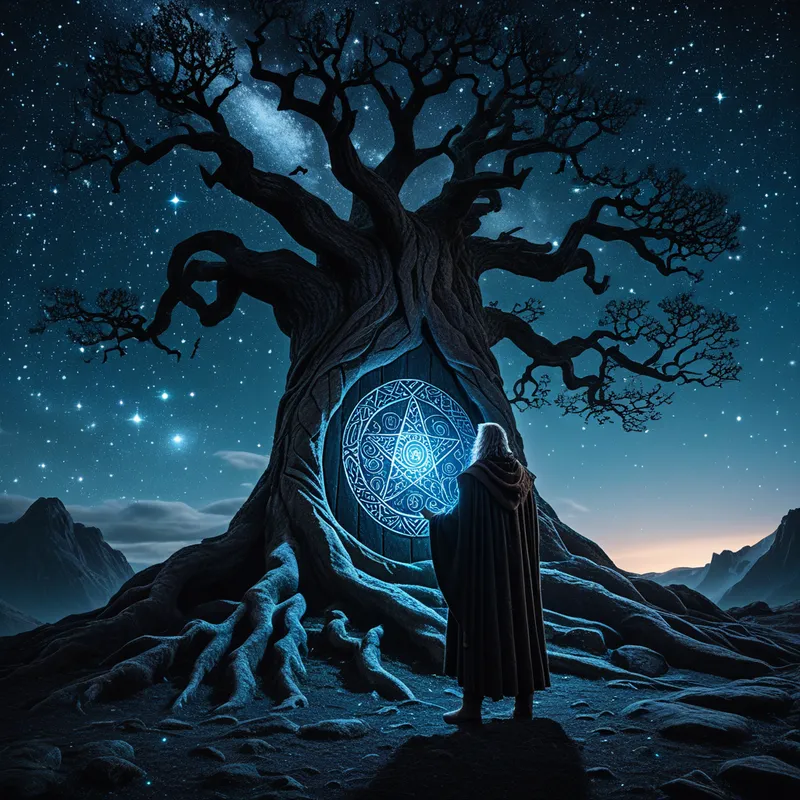
Listen. The fire is low, the night is deep, and the wind outside speaks with the voice of the forgotten. I will tell you not of a single hero, but of a great and terrible silence that fell upon the world. I will tell you of the Yggdrasil itself, whose roots drink from wells of memory so ancient even the Æsir dare not name them.
In the beginning, the songs were whole. Odin had hung upon the Tree, a sacrifice to himself, and the runes screamed their secrets into his blood. The Vanir knew the songs of earth and tide. The skalds in the halls of men could sing a lineage back to the first frost-giant, Ymir. Every deed, every prophecy, every name of every thing that was, is, or would be, was woven into a single, shimmering tapestry of verse. This was the First Song, the breath of the World-Tree.
But Ragnarök is not merely a future event; it is a constant gnawing at the roots of being. The great wolf Fenrir strains at his bonds, and with each tremor, a thread of the song snaps. The serpent Jörmungandr shifts in the deep, and the rhythm of the tide-song falters. Time itself, the great devourer, began its work. Kings fell, halls burned, ships were lost to the grey whale-road. With each fall, a keeper of a verse died with the words still on his tongue. With each fire, a carved stave blackened and cracked, its story turning to smoke.
The great tapestry was torn. Not in one cataclysm, but in a thousand small silences. A verse about the making of Mjölnir was lost in a smithy’s forgotten corner. A charm to calm the sea was swallowed by a wave that took the sailor who knew it. The true name of the first Valkyrie faded from the memory of the last god who loved her. The fragments scattered—some lodged in the bark of Yggdrasil, some sank into the mud of Urðarbrunnr, some were carried by crows to lonely mountain peaks, and some fell into the dreams of children yet unborn.
Now, the world is haunted by echoes. The wind in the pines sometimes forms a half-remembered kenning for “battle.” The crackle of a hearth-fire might rhyme with a lost description of Valhalla. A shard of a broken sword, found in a peat bog, hums with a ghost of the saga it witnessed. The duty fell—not to a god, for even Odin’s one eye cannot see all that is lost—but to the seeker. To the one who, in the quiet, hears the whisper behind the wind and feels the ache of the missing word. Their quest is not to slay a beast, but to listen. To gather the fragments from the dust of ages and the corners of the soul, and for a fleeting moment, let the First Song breathe again, however brokenly, before the silence reclaims it.
Cultural Origins & Context
The myth of the Fragments is not found in a single stanza of the Poetic Edda or the Prose Edda. It is the story of them. It is the cultural memory surrounding the transmission of Norse myth itself. These poems, our primary windows into this cosmology, survived not as complete, authorized codices, but in one major manuscript, the Codex Regius, discovered in the 17th century, with pages—and thus entire poems—missing.
This historical reality birthed a deeper, metaphysical narrative. The myths were passed down orally for centuries by skalds and poets, a living, fluid tradition vulnerable to the very things the myths warn of: war, migration, conversion, and forgetfulness. The societal function was dual: it was an act of sacred preservation, and a profound meditation on entropy. The story explained why the wisdom was incomplete, why the answers were elusive. It placed the burden of remembrance on every listener, making each person a potential guardian of a fragment. The myth thus reflects a worldview where knowledge is not static but a living, perishable thing, and where history is not a line but a scattering of luminous shards to be gathered.
Symbolic Architecture
At its core, the myth symbolizes the fragmentation of cosmic consciousness and the diaspora of meaning. The whole tapestry represents the unified field of ancestral wisdom, cultural memory, and psychic wholeness—what Jung might call the uncontaminated collective unconscious.
The fragment is not a ruin; it is a seed of the whole, containing its entire genetic code of meaning, waiting for the soil of a conscious mind to give it form.
The scattering forces—time, catastrophe, forgetfulness—are the agents of the personal and collective shadow, the forces of dissociation and trauma that break apart integrated experience. The Yggdrasil, with fragments lodged in its bark, becomes the archetypal Self, the central organizing principle of the psyche, wounded and scarred but still holding the pieces in its structure. The seeker is the ego, tasked with the impossible but essential work of re-membering—of bringing the dissociated parts (the lost verses of one’s own story, the denied aspects of heritage, the repressed personal memories) back into a meaningful, though never perfectly whole, narrative.
The Dreamer’s Resonance
When this myth stirs in the modern dreamer, it manifests as dreams of searching in ruins, libraries with incomplete books, or trying to solve a puzzle with missing pieces. There is a somatic quality of anxiety mixed with determination—a feeling of vital information being just out of reach. One might dream of hearing a beautiful song from another room but being unable to find the door, or of holding a precious, broken object whose original function is a mystery.
Psychologically, this indicates a process of recollection in the deepest sense. The psyche is signaling that essential parts of the dreamer’s identity, history, or potential have become fragmented through life experiences—a trauma, a lost relationship, an abandoned path. The dream is not merely about the loss, but about the active, often frustrating, always sacred work of gathering. The emotional tone—whether of despair, curiosity, or awe—reveals the dreamer’s current relationship to their own dismembered wholeness.
Alchemical Translation
The alchemical process mirrored here is solve et coagula: dissolve and coagulate. First, the solve: the necessary, often painful, fragmentation of naive wholeness. The ego’s initial, rigid structure must be broken apart by life (the wolves of time and fate) for a deeper, more resilient consciousness to be possible. We must lose the “complete” but superficial story to find the authentic, if fractured, truth.
The quest is not to restore the vase to its original, forgotten form, but to assemble the pieces with gold lacquer, creating a new whole whose scars are its most sacred scripture—the Japanese art of kintsugi as a model of individuation.
The coagula is the work of individuation. The seeker, the conscious ego, ventures into the underworld of memory (the roots of Yggdrasil), the forgotten corners of the personal past, and the collective storehouse of myth, to gather the sparsim—the scattered pieces. Each recovered fragment—a reclaimed emotion, an acknowledged shadow, an integrated complex—is a rune of power. The final goal is not a perfect, seamless whole, which would be a regression to unconsciousness, but a complexio oppositorum, a unification of opposites held in conscious tension. The reassembled “Edda” of the Self is a living, breathing document, its gaps allowing for new creation, its fractures holding the light of hard-won awareness. It is the wisdom that knows its own incompleteness, and in that knowing, finds a different, more profound kind of completion.
Associated Symbols
Explore related symbols from the CaleaDream lexicon: