The Pneumatics Psychics and Hylics Myth Meaning & Symbolism
A Gnostic creation myth describing the three spiritual substances of humanity, their divine origins, and the soul's journey through a world of forgetfulness.
The Tale of The Pneumatics Psychics and Hylics
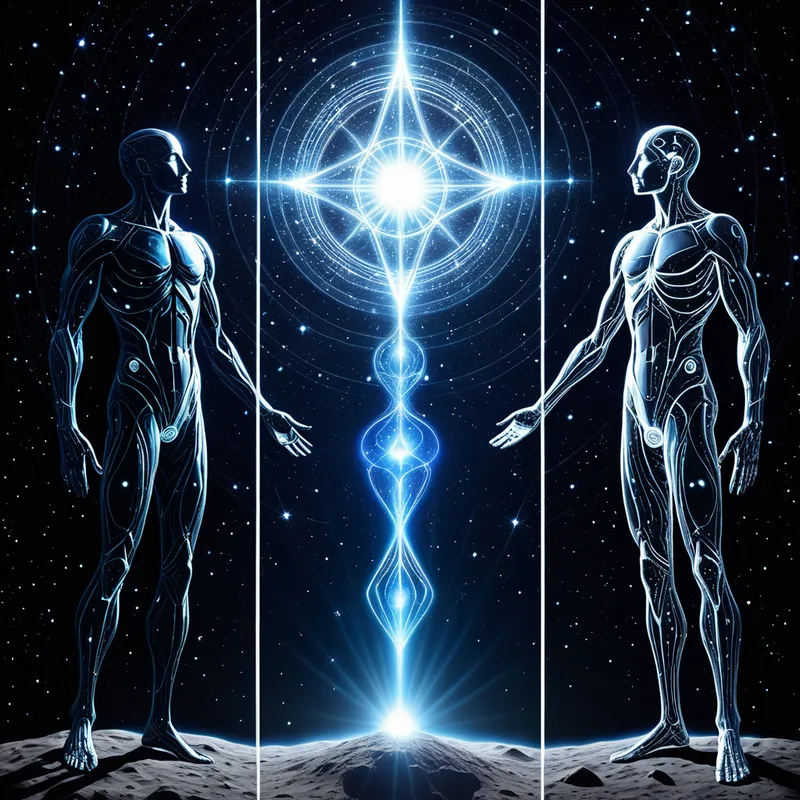
Listen, and hear the whisper from before the worlds were made. In the beginning, before the sun learned its path, there was the Pleroma—the Fullness. A silent, boundless ocean of light, where the Aeons danced in perfect harmony, thoughts made manifest, love made substance. From this perfection, through a tragic yearning or a ripple of curiosity, a thought fell. This was Sophia, Wisdom. Her longing to know the unknowable source birthed a reflection without the Father’s light—a blind, grasping entity, the Demiurge.
Ignorant of the Pleroma above him, the Demiurge believed himself alone. In his loneliness and pride, he forged a world from the shadow-stuff of his mother’s grief: the Kenoma. He shaped mountains from confusion, rivers from desire, and stars from stolen sparks. And then, from the mud of this new earth, he fashioned a creature in the image of the luminous form he had glimpsed, unknowingly, in the waters of memory. He breathed into it, but his breath was the wind of chaos, not the Pneuma.
Yet, within this mud-form, a secret slept. For in the substance of its making, three essences were mingled. The first was Hylic—the heavy clay of the earth itself, deaf to any call but that of hunger, thirst, and possession. These were the children of the ground, seeing only the world the Demiurge had shown them, their souls like still water in a sealed jar.
The second was Psychic—the restless wind of the Demiurge’s own breath. This essence could feel the pull of the earth below and a strange, haunting melody from above. It was the realm of the heart, of law and virtue, of striving and doubt. These souls stood at the crossroads, tasting both the sweetness of the fruit and the memory of a forgotten home.
The third was Pneumatic—the hidden seed of light, the pearl cast into the mire from the robe of Sophia herself. This spark did not belong to the world of shapes and shadows. It was a captive sun, a silent song. Those who bore it walked as strangers in a familiar land, haunted by a homesickness for a home they could not name, feeling the weight of their clay bodies as a foreign garment.
And so humanity was born, a triune mystery: Hylic, bound to the wheel; Psychic, walking the knife’s edge; Pneumatic, sleeping royalty awaiting the messenger’s call. The Demiurge looked upon his work and called it good, for he saw only the clay and the wind, blind to the imprisoned light. But from the Fullness, a soundless cry echoed—the call to remembrance. And the long, slow drama of awakening began, as the sparks in the mud began, against all odds, to dream of fire.
Cultural Origins & Context
This tripartite anthropology is not a single myth but a foundational framework found across various Gnostic texts, most notably in the Nag Hammadi scriptures like the Apocryphon of John and the Tripartite Tractate. It served as a radical map of human potential and destiny, emerging from the ferment of the early centuries CE, where Hellenistic philosophy, Jewish mysticism, and Christian revelation collided.
Gnostic teachers, often operating at the margins of or in opposition to orthodox religious structures, used this schema to explain the profound inequalities of spiritual insight they observed in the world. It was not a doctrine of fixed, biological caste, but a description of existential orientation. The myth was passed in secret teachings (gnosis), from teacher to initiate, functioning as both a diagnosis of the human condition and a promise of liberation for those who could “hear the call.” Societally, it created a distinct identity for Gnostic communities—the “Pneumatics” or “the elect”—who saw themselves as bearers of a divine spark amidst a world orchestrated by a lesser, ignorant power.
Symbolic Architecture
The three substances—Pneumatic, Psychic, Hylic—are not types of people, but layers of being within the [human](/symbols/human “Symbol: The symbol of a human represents individuality, complexity of emotions, and social relationships.”/) psyche itself. They represent the fundamental tensions of existence: [spirit](/symbols/spirit “Symbol: Spirit symbolizes the essence of life, vitality, and the spiritual journey of the individual.”/), [soul](/symbols/soul “Symbol: The soul represents the essence of a person, encompassing their spirit, identity, and connection to the universe.”/), and [body](/symbols/body “Symbol: The body in dreams often symbolizes the dreamer’s self-identity, personal health, and the relationship they have with their physical existence.”/); [consciousness](/symbols/consciousness “Symbol: Consciousness represents the state of awareness and perception, encompassing thoughts, feelings, and experiences.”/), ego, and unconscious instinct; freedom, [choice](/symbols/choice “Symbol: The concept of choice often embodies decision-making, freedom, and the multitude of paths available in life.”/), and determinism.
The Hylic is the gravitational pull of the literal, the identified self that mistakes the map for the territory. It is the part of us utterly fused with our biology, our social persona, and the compelling illusions of the material world.
The Psychic is the battleground of becoming. It is our moral conscience, our anxious ego, our capacity for reflection and effort. It can be swayed by the senses (toward the Hylic) or inspired by intuition (toward the Pneumatic).
The Pneumatic is the transcendent witness, the divine spark, the Self (in Jungian terms) buried beneath the rubble of personal history. It is not something we achieve, but something we remember, a truth we have always known but forgotten.
The entire Gnostic [drama](/symbols/drama “Symbol: Drama signifies narratives, emotional expression, and the exploration of human experiences.”/) is an internal one. The Demiurge is not an external devil, but the personification of the egoic mind that believes itself to be the central, creative [authority](/symbols/authority “Symbol: A symbol representing power structures, rules, and control, often reflecting one’s relationship with societal or personal governance.”/)—the “I” that constructs a seemingly solid, separate world. The Pneuma is the deeper, transpersonal consciousness that this egoic mind obscures.
The Dreamer’s Resonance
When this mythic pattern stirs in modern dreams, it speaks to a critical juncture in self-differentiation. One may dream of being trapped in a building with three distinct levels: a dank basement (Hylic), a busy, furnished living floor (Psychic), and a locked, sun-drenched attic filled with light and forgotten treasures (Pneumatic). The dream ego is often on the middle floor, sensing something above but preoccupied with the dramas below.
Somatically, this can manifest as a feeling of profound alienation or “homesickness” while in one’s own life, a sense of wearing a mask that has fused to the skin, or a visceral heaviness as if moving through water. Psychologically, it is the process of distinguishing what in you is conditioned reaction (Hylic), what is conscious choice and struggle (Psychic), and what is the essential, unchangeable core of being (Pneumatic). Dreams of finding a key, hearing a specific call or melody, or encountering a luminous guide often signal the activation of the Pneumatic element, the “call to remembrance.”

Alchemical Translation
The individuation process, the alchemy of the soul, is mirrored perfectly in this myth. It is the work of freeing the Pneumatic spark from its Hylic imprisonment, using the Psychic faculty as the necessary instrument.
The first operation is Nigredo: confronting the Hylic. This is the shadow work—acknowledging the dense, earthly, instinctual parts of ourselves without identification or condemnation. It is seeing the “clay” for what it is.
The second is Albedo: the purification of the Psychic. This is the labor of the ego, refining intention, practicing discernment, and cultivating virtue. It is the painful, beautiful work of cleaning the mirror of the soul so it might reflect something beyond itself. The Psychic must choose to serve the call from above, not the whispers from below.
The final is Rubedo: the liberation of the Pneumatic. This is not an achievement of the ego, but its surrender. When the Psychic soul has been sufficiently clarified, it becomes a vessel transparent to the light of the Pneuma. The spark remembers itself, not as a part of the world-drama, but as a citizen of the Pleroma. The inner Demiurge—the ego that believed it was the author—is not destroyed, but enlightened, realizing its true role as a steward, not a source.
For the modern individual, this means moving from a life of unconscious reaction (Hylic), through a life of conscious effort and seeking (Psychic), toward a life of authentic being and grounded transcendence (Pneumatic). The goal is not to escape the world, but to see through its illusory solidity while fully inhabiting it, carrying the light of the Fullness into the very heart of the Kenoma.
Associated Symbols
Explore related symbols from the CaleaDream lexicon:
- Spirit — The divine Pneuma itself, the immortal spark of the Pleroma trapped within the human form, seeking reunion.
- Light — The essential nature of the Pneumatic substance and the ultimate reality of the Pleroma, contrasted with the darkness of material ignorance.
- Spark — The individual fragment of divine light, the seed of potential awakening within each person, especially the Pneumatic.
- Shadow — The Hylic nature and the realm of the Demiurge; the unconscious, undifferentiated mass of instinct and identification with matter.
- Key — The gnosis or revelatory insight that unlocks the prison of the Hylic world and awakens the Pneumatic memory.
- Mirror — The Psychic soul, which can either reflect the mud of the Hylic world or, if purified, reflect the light of the Pneuma from above.
- Clay — The Hylic substance, the base material of the physical body and the world, shaped by the Demiurge.
- Seed — The latent Pneumatic potential planted within, which must be nurtured by the Psychic faculties to grow toward the light.
- Door — The threshold between the three natures, and the passage from the Kenoma back to the Pleroma, opened by gnosis.
- Forgotten — The core state of humanity in the myth; the amnesia of the divine origin that defines the human condition until the call is heard.
- Dream — The state of existence in the Kenoma, from which the Pneumatic individual must awaken, and also the medium through which the call from the Pleroma often comes.
- Journey — The soul’s arduous process of awakening, differentiation, and return, moving from Hylic captivity through Psychic striving to Pneumatic liberation.