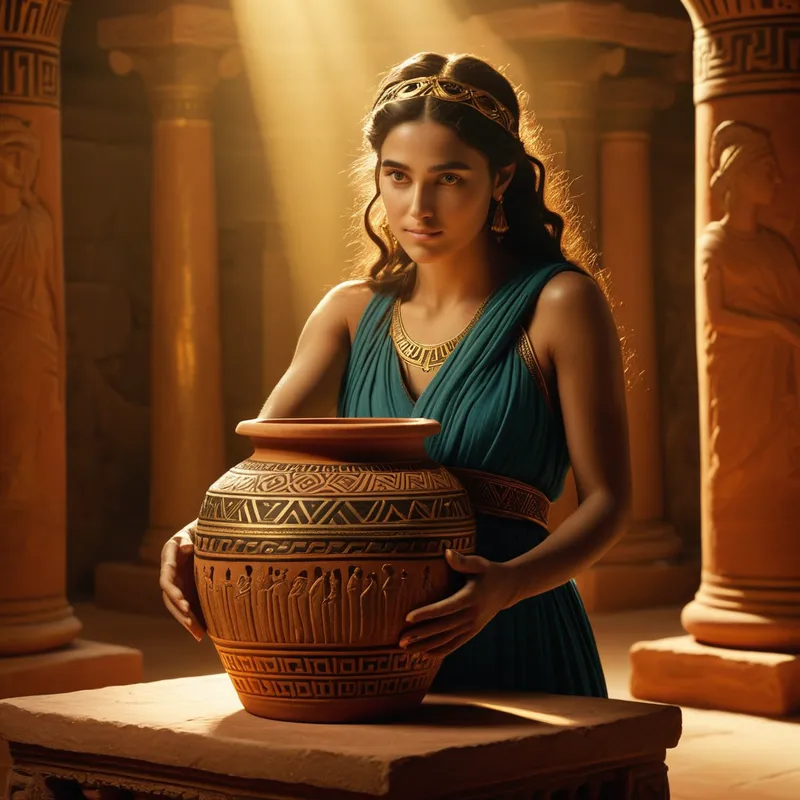
The Pithos of Pandora Myth Meaning & Symbolism
The first woman, Pandora, opens a divine pithos, releasing suffering into the world but trapping hope inside, a foundational myth of human nature.
The Tale of The Pithos of Pandora
Hear now the tale of the shaping of sorrow and the seed of solace, a story spun in the age when gods and men were newly estranged. The air still hummed with the memory of [Prometheus](/myths/prometheus “Myth from Greek culture.”/)’s theft, and the halls of Olympus echoed with a cold, unforgiving wrath. The Father of Gods and Men, Zeus, whose thunderbolts had scorched the thief, now crafted a more subtle vengeance—a gift wrapped in divine artistry, a poison for the heart of mankind.
He summoned the smith-god [Hephaestus](/myths/hephaestus “Myth from Global/Universal culture.”/), and commanded him to mix earth and [water](/myths/water “Myth from Chinese culture.”/), to shape from the clay of [the world](/myths/the-world “Myth from Tarot culture.”/) a being in the likeness of [the immortal](/myths/the-immortal “Myth from Taoist culture.”/) goddesses. [Hephaestus](/myths/hephaestus “Myth from Global/Universal culture.”/) labored, and from his hands emerged not a lump of earth, but a maiden of breathtaking form, with a face that held the light of dawn and limbs of perfect grace. Yet she was hollow, a beautiful vessel awaiting its content. Then Aphrodite leaned close, breathing over her the shimmering mist of desire and cruel longing. Athena girded her in silvery raiment and taught her the intricate crafts of the loom. [Hermes](/myths/hermes “Myth from Global/Universal culture.”/), [the trickster](/myths/the-trickster “Myth from Various culture.”/), placed in her breast a dog-like mind and a deceitful nature, and gave her a voice of irresistible persuasion. They named her [Pandora](/myths/pandora “Myth from Greek culture.”/), the All-Gifted, for each Olympian had bestowed upon her a seed of their power.
Her final endowment was a great pithos, not a small box as later tongues would tell. It was a jar of sturdy earth, as tall as her thigh, its surface sealed with a massive, fitted stone. It was heavy with a secret burden, a weight that seemed to hum from within. Zeus presented her, this radiant calamity, to Epimetheus, the Afterthinker. Though his stolen brother Prometheus had warned him to accept no gift from Olympus, Epimetheus looked upon Pandora and all wisdom fled. He welcomed her, and with her, the sealed jar into his home.
For a time, the pithos sat in the corner of their dwelling, a silent guest. But the gift of Hermes worked within Pandora—a burning, itching curiosity about the jar’s contents. What splendid treasure did the gods send? What divine provision lay sealed within? The humming grew louder in her mind, until one day, driven by a force she could not name, she approached the great jar. Her hands found the cool, rough edge of the stone lid. With a grunt of effort, she shifted it, just a crack.
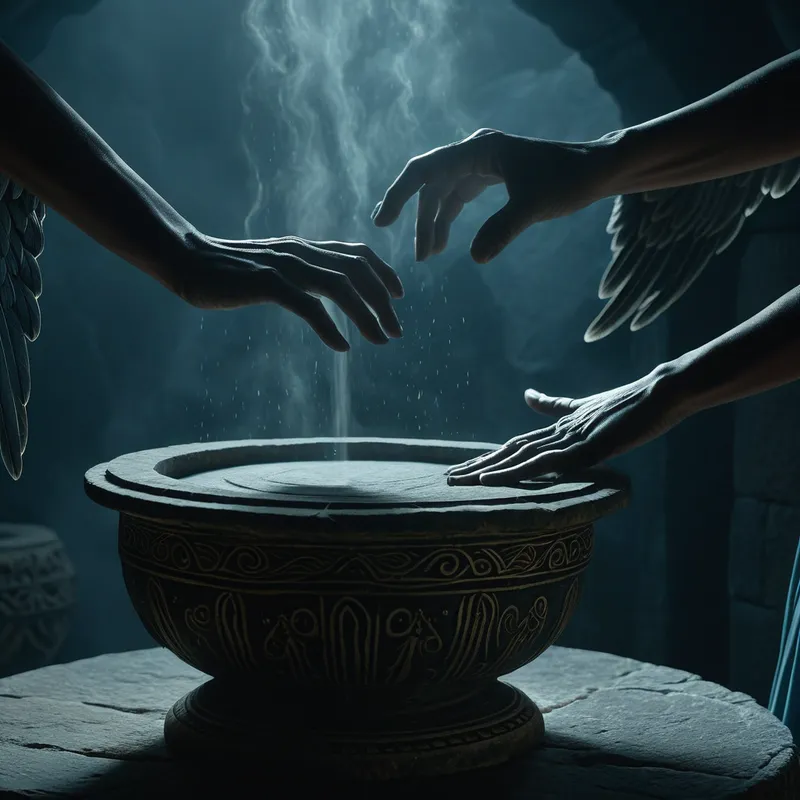
It was not a sound, but a sudden, silent release. From that narrow opening poured a shrieking, swirling torrent—not of things, but of essences. Grief, hard and sharp as flint, flew out first, followed by a plague of labors, sicknesses, and sorrows. Envy, with its green-tinged wings, and bitter Old Age, and all the myriad pains that stalk the days of mortals streamed into the room, then through the door, and out into the wide world, where they have nested in the hearts of men ever since. Pandora, stricken with terror, slammed the heavy stone back into place. But she was too late. The world was already changed, infected with a suffering it had never known. All that remained, trapped beneath the hastily replaced lid, fluttering against the clay walls in the sudden dark, was one final [thing](/myths/thing “Myth from Norse culture.”/): Elpis, Hope.
And so the first woman stood in the quiet aftermath, the empty vessel at her feet, the world outside now echoing with cries it had never uttered before, and the last, fragile gift of the gods sealed away once more.
Cultural Origins & Context
The myth of Pandora finds its earliest and most authoritative telling in the epic poetry of Hesiod, in both his Theogony and Works and Days (c. 700 BCE). For Hesiod, a poet-farmer often embittered by the hardships of life and what he saw as the deceitful nature of women, the story was not mere entertainment. It was an aetiology—a mythic explanation for the origin of human suffering. It answered the perennial question: Why is life so hard?
In the patriarchal, agrarian society of Archaic Greece, the myth served multiple functions. It reinforced a worldview where the gods were powerful, capricious, and not to be trusted blindly. It explained the human condition as one of inherent struggle, a post-Promethean fall from a simpler state. Crucially, it positioned woman (Pandora) as a divinely crafted punishment, a “beautiful evil,” cementing a deep-seated cultural ambivalence and anxiety. The story was passed down not as a sacred text, but as part of the oral and later written poetic tradition, a shared cultural narrative that framed their understanding of disease, toil, and the precariousness of existence.
Symbolic Architecture
The myth’s power lies not in its misogynistic framing, but in the profound symbols that transcend it. The pithos itself is central. It is not a personal [jewelry](/symbols/jewelry “Symbol: Jewelry often symbolizes personal identity, social status, and emotional connections, reflecting how individuals curate their identities and express their values through adornments.”/) box but a large [storage](/symbols/storage “Symbol: Storage symbolizes the preservation of memories, knowledge, emotions, or physical belongings, often reflecting the subconscious mind’s organization.”/) jar for provisions—a [vessel](/symbols/vessel “Symbol: A container or structure that holds, transports, or protects something essential, representing the self, emotions, or life journey.”/) of sustenance that becomes a vessel of affliction. It represents the [collective unconscious](/symbols/collective-unconscious “Symbol: The Collective Unconscious refers to the part of the unconscious mind shared among beings of the same species, embodying universal experiences and archetypes.”/) of humanity, the sealed repository of all potential experience, both terrible and redeeming.
The pithos is the human psyche itself: a sealed vessel containing the totality of latent possibilities, both the shadow and the light, awaiting the catalyst of consciousness to be made real.
Pandora is not merely a [scapegoat](/myths/scapegoat “Myth from Biblical culture.”/); she is the first [human](/symbols/human “Symbol: The symbol of a human represents individuality, complexity of emotions, and social relationships.”/) [consciousness](/symbols/consciousness “Symbol: Consciousness represents the state of awareness and perception, encompassing thoughts, feelings, and experiences.”/), the embodied [psyche](/myths/psyche “Myth from Greek culture.”/) endowed with all divine attributes (“all-gifted”). Her defining trait, curiosity, is the very spark of consciousness that disturbs the unconscious whole. To open the jar is to enact [the Fall](/myths/the-fall “Myth from Biblical culture.”/) into conscious experience—the necessary, painful [separation](/symbols/separation “Symbol: A spiritual or mythic division between realms, states of being, or consciousness, often marking a transition or loss of connection.”/) from a state of unconscious unity that brings [knowledge](/symbols/knowledge “Symbol: Knowledge symbolizes learning, understanding, and wisdom, embodying the acquisition of information and enlightenment.”/), [differentiation](/symbols/differentiation “Symbol: The process of distinguishing or separating parts of the self, emotions, or identity from a whole, often marking a developmental or psychological milestone.”/), and suffering.
The released evils are the inevitable contents of a conscious [life](/symbols/life “Symbol: The symbol of ‘Life’ represents a journey of growth, interconnectedness, and existential meaning, encompassing both the joys and challenges that define human experience.”/): differentiation brings conflict, time brings decay, [awareness](/symbols/awareness “Symbol: Conscious perception of self, surroundings, or internal states. Often signifies awakening, insight, or heightened sensitivity.”/) brings pain. Yet, Hope (Elpis) remains inside. This is the myth’s most debated and crucial [symbol](/symbols/symbol “Symbol: A symbol can represent an idea, concept, or belief, serving as a powerful tool for communication and understanding.”/). Is Hope a cruel additional [torment](/symbols/torment “Symbol: A state of intense physical or mental suffering, often representing unresolved inner conflict, guilt, or psychological distress.”/), a false promise kept from us? Or is it the final, saving grace, preserved within [the vessel](/myths/the-vessel “Myth from Alchemical culture.”/) so that humanity may access it internally? The latter interpretation is more psychologically resonant. Hope is not in the world; it is sealed within the human vessel itself, the irreducible inner resource that persists even when all external conditions are [despair](/symbols/despair “Symbol: A profound emotional state of hopelessness and loss, often signaling a need for transformation or surrender to deeper truths.”/).

The Dreamer’s Resonance
When this myth stirs in the modern dreamer, it often manifests as dreams of forbidden containers—locked rooms, sealed envelopes, mysterious packages, or smartphones with hidden files. The somatic feeling is one of intense, anxious curiosity mixed with dread, a compulsion to “know” warring with a fear of what that knowledge will unleash.
Psychologically, this dream pattern signals a critical threshold in the process of individuation. The dreamer is at the point of opening a “pithos” within their own psyche—perhaps confronting a repressed memory, acknowledging a shadow aspect of their personality, or initiating a major life change they know will be painful. The act of opening represents the conscious integration of previously sealed-off psychic material. The “evils” released are the temporary but necessary sufferings of this integration: grief for an old self, anxiety about the new, the labor of the process itself. The dream is a rehearsal for the courage required to lift the lid, trusting that the essential capacity for hope—the ability to find meaning and forward motion—remains intact within [the self](/myths/the-self “Myth from Jungian culture.”/), even amidst the turmoil.

Alchemical Translation
The alchemical journey, like the path of individuation, begins with the [prima materia](/myths/prima-materia “Myth from Alchemical culture.”/)—the raw, unconscious mass of the psyche, symbolized by the sealed pithos. Pandora’s act is the [nigredo](/myths/nigredo “Myth from Alchemical culture.”/), the blackening. It is the necessary descent into chaos, suffering, and confrontation with [the shadow](/myths/the-shadow “Myth from Jungian culture.”/). This is not a mistake, but the first, crucial operation. One must open the vessel and allow the hidden, often painful, contents to surface. To avoid this is to remain in a state of unconscious naivete, a perpetual Epimethean folly.
The released sufferings are the [separatio](/myths/separatio “Myth from Alchemical culture.”/), the dividing of the pure from the impure, the conscious from the unconscious. This stage feels like dissolution, as old certainties and comforts are carried away on dark wings. Yet, the process is contained within [the sacred vessel](/myths/the-sacred-vessel “Myth from Various culture.”/) of the self. The work is not done in the world, but within the interior vas of the psyche.
The alchemical gold is not found in avoiding the pithos, but in discovering that Hope was never lost in the world; it was the latent, transformative spark sealed at the very center of the vessel all along.
Finally, Hope (Elpis) trapped within, represents the albedo and [rubedo](/myths/rubedo “Myth from Alchemical culture.”/)—the whitening and reddening. It is the enduring, transformative principle that emerges only after the confrontation with the shadow. This is not naive optimism, but the profound, hard-won conviction that meaning can be forged from suffering, that consciousness itself is [the crucible](/myths/the-crucible “Myth from Alchemical culture.”/) where base experience is transmuted into wisdom. The modern individual’s [triumph](/myths/triumph “Myth from Roman culture.”/) is not in having a life free of Pandora’s releases, but in becoming the vessel that can hold both the suffering and the hope, understanding that the latter is the secret, immortal gift at the foundation of the human experiment.
Associated Symbols
Explore related symbols from the CaleaDream lexicon: