The Philosopher's Stone in alc Myth Meaning & Symbolism
The eternal quest for the Stone, an inner jewel forged from the soul's base matter through a sacred, transformative ordeal of fire and dissolution.
The Tale of The Philosopher’s Stone in alc
Listen. In the beginning, there was only the Prima Materia—a dark, chaotic sea of longing. From this abyss, a whisper arose, not in words, but in a yearning for light, for order, for a name. This was the birth of the Alchemist, not as a man, but as a spirit of inquiry, a spark in the cosmic night.
This Alchemist-Spirit descended into the realm of matter, into the great laboratory of the world. It found the elements in disarray: Earth was heavy with forgetfulness, Water flowed with unchecked emotion, Air was scattered with thought, and Fire raged with untamed passion. The Alchemist saw that these were not enemies, but orphaned children of a forgotten king. The quest was not to conquer them, but to reunite them.
The first operation was Nigredo. The Alchemist gathered the base matter of the soul—its pride, its fears, its shame—and placed it in the sealed vessel of solitude. A fire was lit beneath, not of wood, but of profound despair. For forty nights and forty days, the matter boiled. It blackened. It screamed. It dissolved into a uniform, starless night. All form was lost. This was the descent into the black sun, where the only light was the terrible certainty that the old self was dying.
From that absolute blackness emerged the second operation, Albedo. As if weeping for its own dissolution, the matter released a silver dew, a lunar water that washed over the blackened mass. The chaos began to clarify. The emotions settled. Thoughts became reflective like moonlit pools. A white rose bloomed in the ashes, fragile and pure. This was the soul washed clean, but it was cold, distant, merely reflective, not yet generative.
Then came the trial of Citrinitas. The white matter was subjected to a gentler, solar fire. It did not burn, but warmed. It began to yellow, like ancient parchment or ripe wheat. A dawn intelligence awoke within it—not the blinding noon of knowledge, but the first golden light of understanding. The soul began to remember its purpose.
Finally, the fire was stoked to its most fierce and precise heat for the Rubedo. The white and gold swirled in the crucible, locked in a passionate, agonizing dance. This was the coniunctio, the sacred marriage of the lunar soul and the solar spirit. For a moment, it seemed the vessel would shatter from the intensity of this union. Then, a silence deeper than the Nigredo fell.
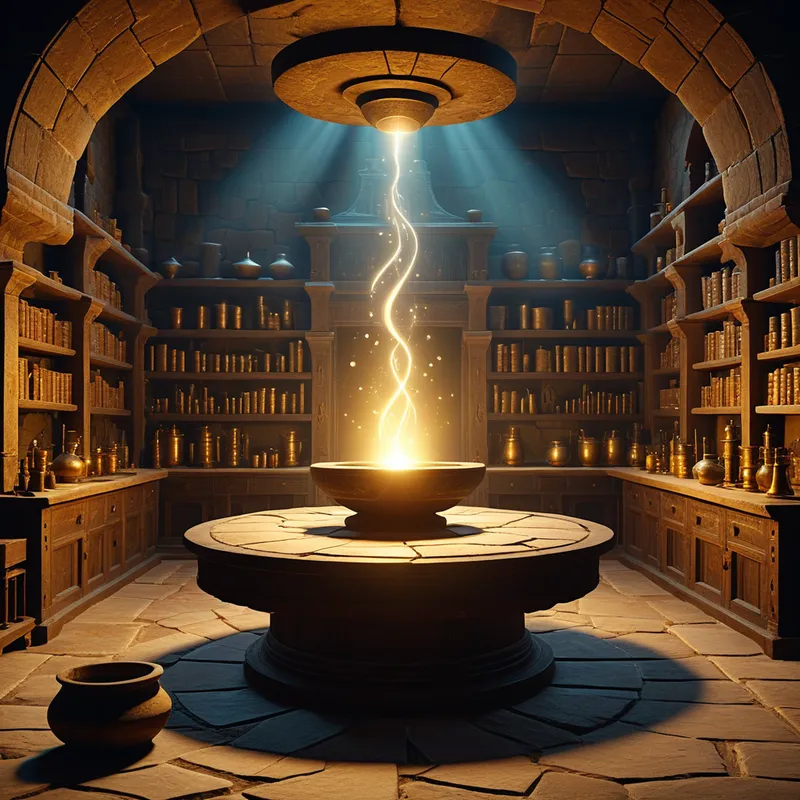
In that silence, at the heart of the fire, a new sun was born. It was not in the sky, but in the crucible. The matter had not been destroyed, but utterly transmuted. It had become the Lapis Philosophorum, the Philosopher’s Stone. It was a small, heavy, warm thing, radiating a light that did not blind but illuminated from within. It was red as blood, dense as a star, and hummed with a quiet, eternal song. With a touch, it healed the fractured elements, turning the lead of the mortal condition into the gold of a realized spirit. The Alchemist-Spirit did not possess the Stone; the Alchemist-Spirit had become the Stone. The seeker and the sought were one.

Cultural Origins & Context
The myth of the Philosopher’s Stone is perhaps the most persistent and universal of all esoteric narratives, transcending any single culture to become a global archetype. Its roots are tangled in the sands of Hellenistic Egypt with the figure of Hermes Trismegistus, flowed through the Islamic Golden Age in the works of scholars like Jabir ibn Hayyan, and found fertile ground in Medieval and Renaissance Europe. It was never merely a recipe for gold. It was the central allegory of Western esotericism, a coded language of the soul passed down in cryptic texts, ornate illustrations, and oral traditions within guilds and secret societies.
Its societal function was dual. Exoterically, it drove proto-scientific inquiry into chemistry and medicine, as adepts literally worked with metals and minerals. Esoterically, and more importantly, it provided a complete psychological map for the individual’s journey toward spiritual perfection. It was a myth for initiates, for those who felt the “inner call” to move beyond dogma and undertake the direct, perilous experiment of self-transformation. The laboratory was a sacred space where the macrocosm of the universe and the microcosm of the human soul were seen as mirrors.
Symbolic Architecture
The myth is not about creating an external object, but about catalyzing an internal event. The Prima Materia is the unexamined, unconscious psyche—our raw potential mixed with our inherited wounds and instincts. The Alchemist is the nascent consciousness, the ego that decides to undertake the work of becoming whole.
The Stone is not found, but forged in the furnace of one’s own experience. It is the psychic center that emerges when opposites are held in tension, not resolved.
The four cardinal operations—Nigredo, Albedo, Citrinitas, Rubedo—are not sequential steps but overlapping states of a profound psychological death and rebirth. Nigredo symbolizes the confrontation with the Shadow, the depression and confusion that comes when our persona cracks. Albedo is the subsequent purification, a withdrawal and reflection where we wash our perceptions of their emotional distortions. Citrinitas is the dawning of wisdom, the “philosophical gold” of insight that emerges from the ordeal. Finally, Rubedo represents the full integration of the conscious and unconscious, the creation of the Self. The Stone is the embodied symbol of this Self: indestructible, radiant, and capable of “transmuting” the leaden moments of life into meaningful experience.

The Dreamer’s Resonance
When this myth stirs in the modern unconscious, it often manifests in dreams of profound transformation centered on objects or spaces. A dreamer may find themselves in a vast, intricate basement (the unconscious) filled with strange, archaic laboratory equipment. They may be tasked with tending a furnace that contains something precious yet terrifying. They might discover a small, impossibly heavy stone in a pocket, or be given one by a mysterious, aged figure.
Somatically, these dreams are often accompanied by sensations of intense heat or pressure, or conversely, a chilling, cleansing cold. Psychologically, they signal that the dreamer is in the throes of a necessary Nigredo. An old identity structure is breaking down. The dream laboratory is the psyche’s workshop, where this dissolution is not a crisis but a sacred process. The appearance of the Stone, even as a fragment or an unpolished gem, hints at the nascent Self beginning to coalesce from the chaos. It is the psyche’s assurance that the current suffering has a purpose and a direction, however obscure.

Alchemical Translation
For the modern individual, the myth models the entire journey of Individuation. We begin as Prima Materia: a complex of family, culture, and trauma. The call to adventure is the first stirring of discontent, the feeling that there must be “more.” We then voluntarily enter our own Nigredo—perhaps through therapy, a creative block, a spiritual crisis, or the breakdown of a relationship. This is the essential sacrifice: the willingness to let our certainties blacken and dissolve.
The crucible is the container of conscious attention. We must hold our pain within it, observing without fleeing, to allow the transmutation to occur.
The subsequent stages—the reflective Albedo of self-care and insight, the dawning Citrinitas of understanding our patterns—lead to the Rubedo. This is not a state of perfect happiness, but of profound vitality and connection. The modern “Philosopher’s Stone” is the achieved integration where one’s contradictions are no longer sources of conflict but poles of a generative tension. It is the “red gold” of a personality that has metabolized its suffering into compassion, its chaos into creativity, and its isolation into a genuine connection with the world. The Stone grants no literal immortality, but it confers the only immortality that matters: the experience of being fully, authentically alive in the fleeting moment. The work is never truly finished, for the Stone must be continually nourished, but once forged, it becomes the unshakable core from which we meet the world.
Associated Symbols
Explore related symbols from the CaleaDream lexicon: