The Philosopher's Stone Myth Meaning & Symbolism
The quest for the legendary Stone, a substance said to transmute base metals into gold and grant immortality, symbolizing the soul's journey to perfection.
The Tale of The Philosopher’s Stone
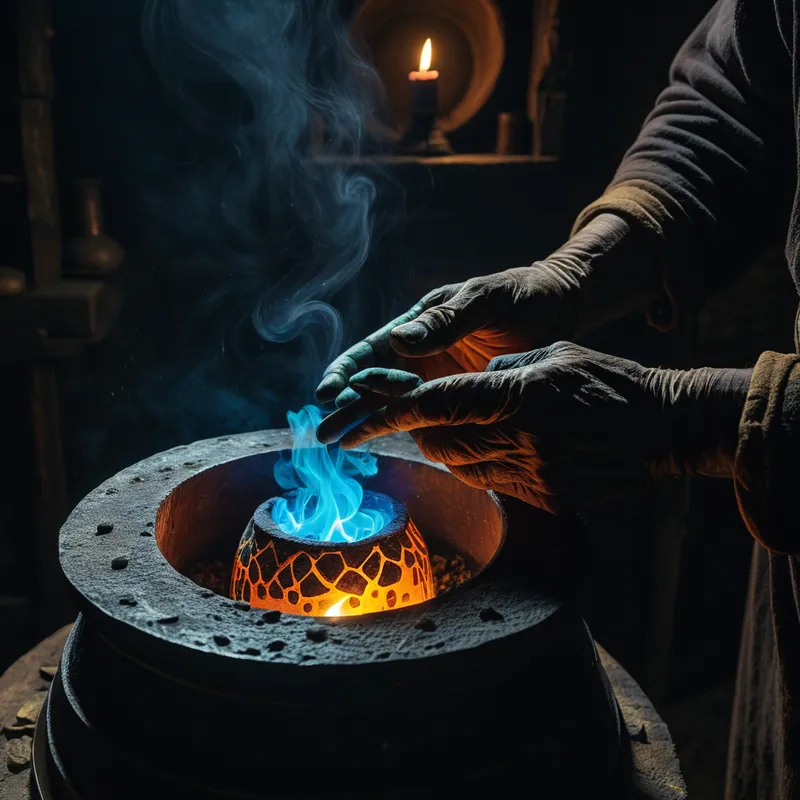
Listen, and I will tell you of the greatest secret, a secret not hidden in a vault of stone, but in the very heart of matter and the silent chambers of the soul. It begins not with a king or a warrior, but with a solitary figure in a chamber thick with the scent of sulfur and longing. The fire of his small furnace is the only sun in his world of shadow and glass.
He is the Adept, and his kingdom is a wilderness of alembics and ash. His quest is not for lands or titles, but for the key to the prison of nature itself. He has studied the whispers of the ancients, the cryptic diagrams of the Mutus Liber, and the dance of the seven planets in their celestial spheres. He knows the legend: that deep within the gross, sleeping body of the world lies a perfect, incorruptible spirit—the Philosopher’s Stone.
His work is a descent. He takes the common, the base—lead, symbol of Saturnine melancholy—and submits it to the ordeal. In the sealed vessel, the Vas Hermeticum, a terrible darkness descends. This is the Nigredo, the long night of the soul. All color flees, leaving only a foul, chaotic blackness. It is death. The Adept must endure this dissolution, this murder of the familiar world, holding faith in a light he cannot see.
From the blackness, a miracle of washing begins—the Albedo. A pure, lunar white emerges, like the first light of dawn on water. It is the silver consciousness, purified but still separate, cool and reflective. Yet the work is not done. The furnace’s heat intensifies. The white substance blushes, then burns with a fierce, passionate crimson—the Rubedo. This is the fire of the heart, the sulfurous will that must marry the mercurial mind.
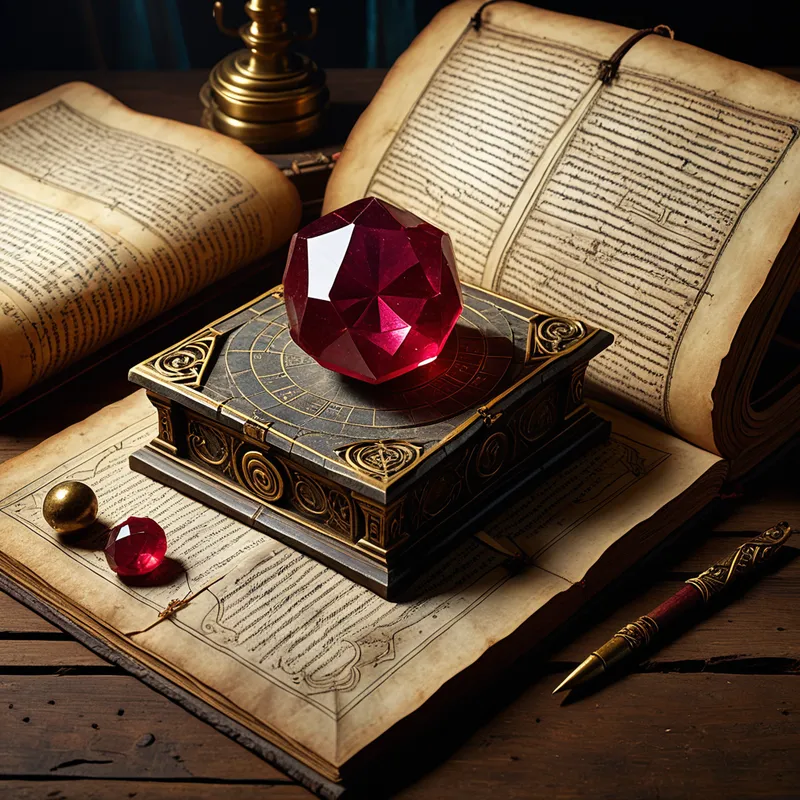
And then, in a moment of perfect, silent equilibrium, the final union occurs. The red and the white, the fixed and the volatile, the king and the queen, dissolve into one another. From their sacred marriage in the fiery tomb, it is born: a tiny, heavy grain of a stone that is not a stone. It glows with its own serene, ruby light. It is dense as a sun and gentle as a rose. This is the Stone. A touch of its powder upon base lead causes a shudder of gold to bloom through the metal like a sunrise. A taste of its elixir brings not mere longevity, but a profound sense of eternal life within time. The Adept weeps, for he has not created gold; he has awakened the gold that was always sleeping in the dark.
Cultural Origins & Context
The myth of the Philosopher’s Stone is the central narrative of Western alchemy, a tradition spanning from Hellenistic Egypt through the Islamic Golden Age to the Renaissance courts of Europe. It was never a single, standardized tale but a living, breathing corpus of symbols passed down through encrypted texts, such as those attributed to Hermes Trismegistus, and the lush, enigmatic imagery of works like the Rosarium Philosophorum.
This myth was not for the masses. It was transmitted in a “language of the birds,” a coded dialect of metaphor meant to conceal its truths from the literal-minded (the “vulgar”) and the greedy princes who sought only material wealth. Its tellers were monks, physicians, and natural philosophers operating in a twilight zone between proto-science, mysticism, and devotional practice. Societally, it functioned as a container for the deepest human questions about the nature of matter, spirit, and the possibility of redemption—not just of the soul, but of the entire fallen, “base” material world.
Symbolic Architecture
The Stone is the ultimate symbol of the Self, the psychic center that transcends the conflict of opposites. It is not something to be found, but something to be coagulated from the scattered fragments of one’s own being.
The Philosopher’s Stone is the psyche’s own perfect pattern, hidden within the chaos of the personal and collective unconscious.
The base metal represents the crude, unrefined personality—our leaden habits, depressive thoughts, and unconscious impulses. The series of operations (Solve et Coagula) maps the brutal, necessary process of psychological breakdown and reintegration. The Nigredo is the confrontation with the shadow, a depressive, chaotic state where old identities rot away. The Albedo symbolizes the emergence of a purified, conscious awareness (often associated with the anima or animus). The Rubedo is the fiery integration of this consciousness with the passionate, embodied will to live—the sacred marriage that births the enduring, golden consciousness of the Self.
The Dreamer’s Resonance
When this myth stirs in the modern dreamer, it often signals a profound process of psychic transmutation already underway. Dreaming of a search for a lost, precious gem or a mysterious red stone points to an intuition of the nascent Self. Dreams of furnaces, laboratories, or chaotic, transforming substances reflect the somatic reality of the Nigredo—the body and psyche feeling “in the crucible,” dissolving under the heat of life’s pressures or a therapeutic process.
A dream of successfully creating gold, or of a glowing, geometric object at the center of a maze, signifies the coagulation of the Stone—a moment of hard-won inner integrity. The dreamer is not merely having a dream; they are dreaming the alchemical opus, their unconscious psyche laboring in the symbolic vessel to unite what life has torn asunder.
Alchemical Translation
For the modern individual, the myth models the path of individuation. Our “base metal” is the conditioned personality, the false self built from expectations and trauma. The “fire” is the unavoidable suffering, conflict, and self-examination that life provides.
The first matter for the Work is always the raw, unexamined content of one’s own life.
The process begins with Calcination—the burning away of ego-inflation through failure or humiliation. This leads to Dissolution, where emotional floods wash away rigid structures, often felt as a crisis or depression (Nigredo). In Separation, we learn to discern what is truly “us” from internalized voices and complexes. Conjunction is the conscious engagement with the inner other—the anima or animus—leading to a new creative attitude.
The final stages—Fermentation, Distillation, Coagulation—represent the slow, iterative refinement of this new consciousness. Insights are integrated (fermented), purified of personal bias (distilled), and finally solidified into a stable, new way of being (coagulated). The resulting “Stone” is not perfection, but a durable, centered Self capable of transmuting the “lead” of daily suffering into the “gold” of meaning. The Elixir of immortality it offers is the experience of living from this timeless center, participating in the eternal while fully embodied in the now. The laboratory was never a physical room; it is the human soul, and the Stone is its own redeemed nature.
Associated Symbols
Explore related symbols from the CaleaDream lexicon:
- Gold
- Subject
- Mixer
- Inner
- Cash
- Material
- Quarter
- Completely
- Diamond
- Magical
- Science
- Apt
- Celine
- Symbol
- Battery
- Potential
- Interest
- Application
- Nestled Acorn
- Nanotechnology
- Candied Ginger
- Glass Prism
- Timeless Hourglass
- Clear White Prism
- Pyrite Nugget
- Citrine Gemstone
- Agate Geode
- Fluorite Cube
- Bismuth Crystal
- Topaz Brooch
- Fluorite Prism
- Citrine Sunstone
- Tanzanite Gem
- Pyrite Cube
- Tektite Rock
- Sodalite Cube
- Zircon Gemstone
- Cubic Zirconia Frost
- Pyrite Glimmer
- Gold Nugget
- Yttrium Shimmer
- Thorium Pulse
- Rhodium Essence
- Phosphorescent Salt
- Dazzling Iridium
- Iridescent Indium
- Sublime Samarium
- Tantalizing Tantalum
- Pulsing Americium
- Saffron Field
- Crystalized Yew
- Crystalized Petals
- Crystalized Succulent
- Sea Glass
- Tough Groundhog
- Sapphire Manticore
- Phoenix Gem
- Secret Lab
- Dedicated Researcher
- Glass Beaker
- Digital Tablet
- Tuning Fork
- Scavenger Hunt
- Game Tokens
- Rubik’s Cube
- LED Lights
- Origami Paper
- Tesla’s Coil
- Marie Curie’s Laboratory
- Da Vinci’s Sketchbook
- Renaissance Painting
- Scientist’s Microscope
- Marie Curie’s Lab Coat
- Coco Chanel’s Perfume Bottle
- Dreamlike Stencil
- Alchemical Symbols
- Symbolic Metaphor
- Evolving Character
- Magic Level
- Mirrored Trowel
- Marble Mortar
- Stylish Pouf
- Illuminated Night Table
- Adjustable Bed Frame
- Artisan Coffee Grinder
- Mixing Spoon Set
- Marble Mortar and Pestle
- Microwave Oven
- Mixing Bowl
- Silicone Baking Mat
- Silk Cravat
- Stud Earrings
- Glass Art Pendant
- Battery Pack
- Streamlining Laptop
- Calculator Whirl
- Pencil Sharpener
- Computer Mouse
- Marble Collection
- Electric Keyboard
- Earthship
- Silo Conversion
- Intricate Puzzle Room
- Fossilized Relics
- Horizon of Thought
- Crystalized Ideas
- Key to Insight
- Alchemy Table
- Charmed Flames
- Buried Seed
- Dragon Pearl
- Taoist Alchemy
- Alchemical Process
- Individuation Process
- Nft Art
- Sublimation
- Euler’s Identity
- Neutron Star
- Riemann Hypothesis
- The Amendment
- Metaphor
- Affix
- Conditional
- Metonymy
- Compress
- Metabolism
- Value
- Arbitrage
- Commodity
- Investment
- Interestrate
- Coagulation
- Cibation
- Azoth
- Alembic
- Enthalpy
- Goldwatch
- Syringe
- Semen
- Spicule
- Condensing
- Geode
- Microcosm
- Breakthrough
- Aged
- Alkaline
- Iodine
- Civet
- Diamond Dust
- Termite Mound
- Zircon Rock