The Philosopher's Path Myth Meaning & Symbolism
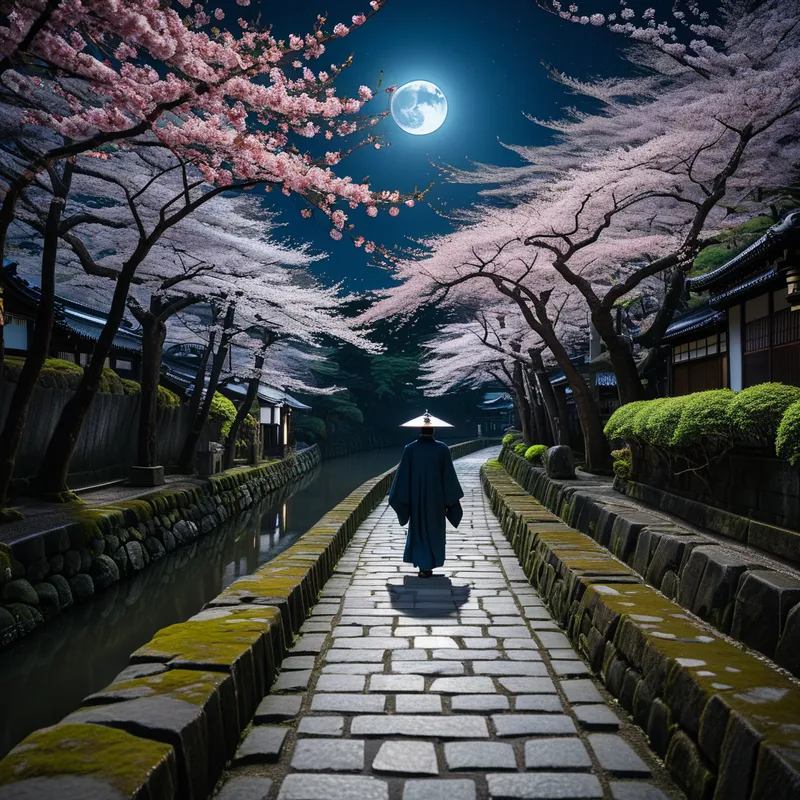
A seeker walks a stone path beside a canal, guided by whispers and cherry blossoms, to find not an object but the transformation of their own perception.
The Tale of The Philosopher’s Path
Listen, and let the silence between the words speak. This is not a tale of gods clashing in the heavens, but of a quiet tremor in the human soul, given form in stone and water and blossom.
In the old capital, where the hills cradle the city like a sleeping dragon, there was a path. It was not grand, not paved with gold or lined with statues of fierce guardians. It was a simple, meandering ribbon of stone, laid beside a narrow, gentle canal they called the Shishigatani. The water did not roar; it murmured. It carried the whispers of the distant mountains, the secrets of the deep earth, down to the world of men.
The path was known, but not understood. People walked it to go from temple to temple, from the silver-pavilioned Ginkaku-ji to the solemn gates of Nanzen-ji. They saw the cherry trees that lined its way, the maples that burned crimson in autumn, the moss that softened every sharp edge of the world. They saw, but they did not see.
Then came a seeker, a soul with a quiet unrest. His mind was a scroll filled with dense, black characters of knowledge, yet the meaning danced just beyond his grasp. He came to the path not at noon, when the sun painted it in tourist colors, but in the blue hour of dusk, when shadows grew long and the world held its breath.
He placed his foot upon the first stone. And the path changed.
It was not the stones that moved, but the air. The murmur of the canal became a voice, speaking in the language of flowing things. The rustle of the leaves overhead was not wind, but the soft, patient exhalation of the trees themselves. With each step, the weight of his questions—What is truth? What is the self? What is the nature of reality?—did not vanish, but began to sink. They seeped from his frantic mind down through his body, into the soles of his feet, and were given to the stone.
He walked. The sky deepened to indigo. Lanterns glowed like captive fireflies along the water’s edge. He passed under the canopy of a great cherry tree, not in bloom, but in the fullness of its green silence. And there, he heard it: not a sound, but a presence. It was the spirit of the path, the accumulated intention of every contemplative step ever taken there. It was not a deity with a name, but a kami of process, a guardian of the journey itself.
The seeker felt a question form within him, not from his intellect, but from his marrow. The path-kami did not answer with words. It answered with a sensation: the cool, enduring solidity of the stone beneath him. The relentless, gentle journey of the water beside him. The patient, cyclical death and rebirth of the trees above him.
He reached the end, where the path met the temple grounds. He turned and looked back the way he had come. The path was just a path again. The water just murmured. But he was not the same. He had not found a treasure, a secret text, or a magical formula. He had found the act of seeking itself, purified into being. The path had not led him to wisdom; it had become the wisdom, etched into his nervous system, step by deliberate step.
Cultural Origins & Context
The Philosopher’s Path, or Tetsugaku-no-michi, is a real, physical place in Kyoto’s Higashiyama district. Its mythological status is a modern alchemy, born from the 20th century. It is named for Nishida Kitaro, a founding figure of the Kyoto School of philosophy, who was said to walk this path daily in meditation as he formulated his ideas on the concept of “pure experience” and the unity of subject and object.
This transforms the path from a mere scenic route into a living narrative. The myth was not passed down by ancient bards, but by university students, by guides, by the cultural memory of a nation that deeply respects the connection between landscape and inner life. Its societal function is subtle yet powerful: it sanctifies the act of contemplation. It creates a temenos in the modern world, a psychic container where walking is not transportation, but a form of prayer, and thinking is not an abstract exercise, but an embodied dialogue with nature. It bridges the profound Zen Buddhist practice of kinhin with the everyday, offering a template for finding the sacred in the simple, repetitive act of putting one foot in front of the other with awareness.
Symbolic Architecture
The myth’s power lies in its starkly simple, yet infinitely deep, symbolic architecture. It is a map of the individuation process rendered in landscape.
The Stone Path is the conscious ego, the disciplined mind. It is the chosen structure, the “way” (michi or -do, as in bushido or sado). It represents the focused intention, the daily practice, the sometimes arduous commitment to a line of inquiry or self-examination. It is solid, sequential, and grounding.
The Flowing Canal is the unconscious, the deep, emotional, and intuitive self. It is life in its ceaseless, mysterious flow. It does not follow a straight line but meanders according to its own nature. It carries nutrients (insights) and reflects the sky (the Self). The path does not fight the canal; it walks beside it, in parallel. This is the critical relationship: consciousness journeying alongside the unconscious, listening to its murmurs, reflected in its surface.
The true philosopher does not conquer the river of the unconscious with a dam of intellect, but learns to hear its music from the bank.
The Cherry Blossoms (sakura) are the moments of luminous, transient insight. They are the beautiful, heartbreaking epiphanies that bloom suddenly, shower the seeker with their beauty, and then are gone. They symbolize the non-attachment required for wisdom: one must appreciate the insight without clinging to it, letting it fall so new understanding can bud.
The Seeker is not a hero who slays a dragon, but an ego that consents to be changed by the journey. His triumph is not an acquisition, but a dissolution of the rigid boundary between the walker and the path, the thinker and the thought.

The Dreamer’s Resonance
When this myth stirs in the modern psyche, it often manifests in dreams of purposeful wandering. The dreamer may find themselves on a path in a twilight forest, in an endless museum corridor, or along a rooftop ledge overlooking a strange city. The key somatic feeling is not panic, but a profound, focused calm—a sense of necessary motion.
Psychologically, this dream pattern signals a process of psychic integration. The conscious mind (the path) is actively engaging with material from the unconscious (the flowing water, the strange landscapes beside the path). The dreamer is “walking it out.” They are not analyzing the problem from a static position, but allowing the very movement of their attention—step by step, thought by thought—to process and metabolize a complex life situation, a philosophical dilemma, or a deep emotional truth. The dream is the kinhin of the soul, a walking meditation through the interiors of the self. If the path ends abruptly or is blocked, it may reflect a conscious resistance to this integrative process, a fear of where the inner journey might lead.

Alchemical Translation
The alchemy of The Philosopher’s Path is the transmutation of quest into embodiment. The modern individual often seeks transformation through consuming information, achieving goals, or obtaining possessions—a spiritual materialism. This myth models the opposite.
The prima materia, the leaden starting state, is the fragmented self: the mind buzzing with abstract questions, disconnected from the body and the living world. The alchemical vessel is the path itself—the commitment to the daily, repetitive practice, be it journaling, therapy, art, or mindful ritual. The fire is the focused attention of the walk, the heat of sustained contemplation.
The goal of the path is to realize you are not walking on it, but that you and the path are walking each other into being.
The process is one of solve et coagula: dissolve and coagulate. First, the rigid ego (the seeker with all his answers) must dissolve (solve) into the experience of the walk—the sound of water, the feel of stone, the fall of light. His intellectual certainties soften. Then, a new understanding coagulates from this direct experience. It is not a new belief system, but a new mode of perception—a way of seeing where the boundary between the observer and the observed becomes fluid, like the reflection of trees in the canal.
The lapis philosophorum, the philosopher’s stone, is not found at the end. It is the realized state where one understands that the act of conscious, attentive journeying is the gold. The transformed perception—where everyday life itself becomes the sacred text, and every step holds the potential for revelation—is the ultimate transmutation. The path teaches that wisdom is not a destination to be reached, but a manner of traveling through the world and through the self.
Associated Symbols
Explore related symbols from the CaleaDream lexicon: