The Pharos of Alexandria Myth Meaning & Symbolism
A story of a king who dared to build a tower of light to tame the sea, challenging the gods and illuminating the boundary between order and chaos.
The Tale of The Pharos of Alexandria
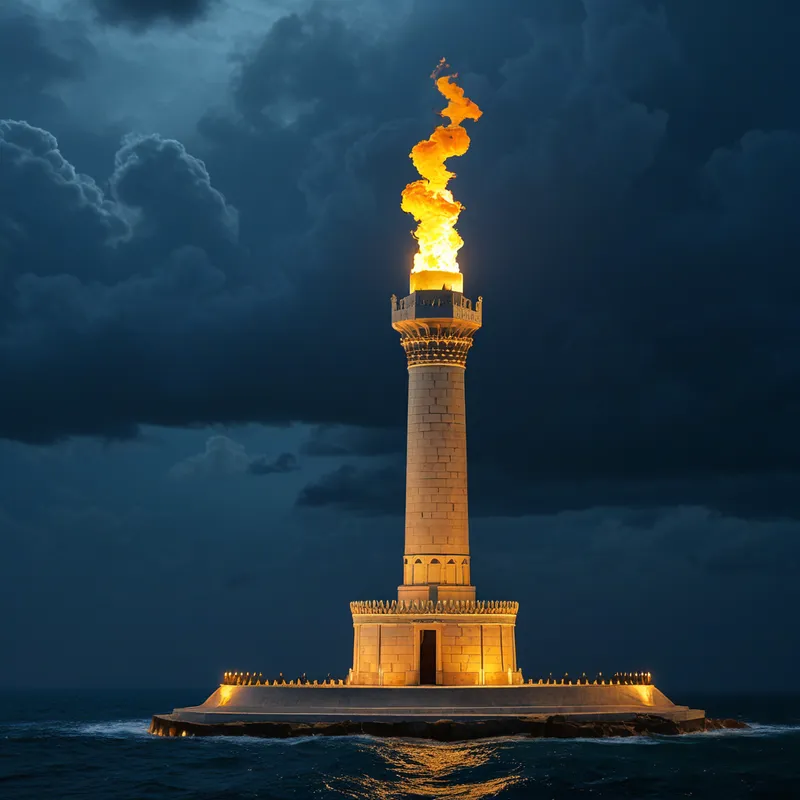
Hear now the tale of the Pillar of Fire, the defiance raised not against a city of men, but against the very throat of [the abyss](/myths/the-abyss “Myth from Kabbalistic culture.”/). In the time when Ptolemy I Soter dreamed of a city to outshine Athens, where the silt of the Nile met the salt of the Middle Sea, there lay a coast hungry for ships and darker still for their bones. The harbor of Alexandria was a jewel set in a claw—a welcome embrace by day, but when [Poseidon](/myths/poseidon “Myth from Greek culture.”/) drew his starless cloak across [the sky](/myths/the-sky “Myth from Persian culture.”/), it became a mouth of jagged rock and deceptive currents, swallowing wood and hope with equal ease.
The king’s dream was a simple, impossible [thing](/myths/thing “Myth from Norse culture.”/): to build a mountain where there was none. To plant a star upon [the earth](/myths/the-earth “Myth from Hindu culture.”/) that would not set. He summoned the master-builder, Sostratus of Cnidus, and laid the charge upon him. “Build me a finger to point [the way](/myths/the-way “Myth from Taoist culture.”/). Build me a tooth to bite back the night. Let its gaze be so fierce and constant that [the sea](/myths/the-sea “Myth from Greek culture.”/) herself will learn the paths of men.”
For years, the island of Pharos groaned under the weight of ambition. Mountains of white marble from Paros were shaped; forests of timber were hauled from Lebanon. [The tower](/myths/the-tower “Myth from Tarot culture.”/) rose, tier upon tier—a square of strength, an octagon of grace, a cylinder reaching for the heavens. At its crown, they built a chamber not of stone, but of cunning: great polished bronze mirrors, curved to catch and hurl the smallest spark. And in the center, a furnace that never slept, fed day and night with resinous wood and oil, until its flame was a roaring, living thing.
The night it was lit, [the world](/myths/the-world “Myth from Tarot culture.”/) changed. From the chaos of the wine-dark sea, a thin, unwavering blade of light cut the darkness. It swept across the waves, touching the sails of ships far out in the trackless deep, turning them from ghosts into vessels of surety. The fisherman, pulling his net from the inky [water](/myths/water “Myth from Chinese culture.”/), could see the glint of scales by its distant glow. The merchant, trembling in a sudden squall, could fix his eye upon that unwavering eye and remember the shape of home. The lighthouse did not calm the sea—Poseidon’s wrath was eternal—but it drew a line of gold between the chaos of the deep and the order of the shore. It was a promise whispered in fire: Here. This way. You are not lost.
And it is said that Sostratus, in a final act of defiance against time and tyrants, carved his name deep into [the foundation stone](/myths/the-foundation-stone “Myth from Mesopotamian culture.”/), then covered it with plaster bearing the king’s praise. He knew the plaster would crumble with the years, and the sea winds would one day reveal the truth: that the will to make a mark, to cast light into the unknown, belongs not to kings, but to the human hand and spirit that dares to build.
Cultural Origins & Context
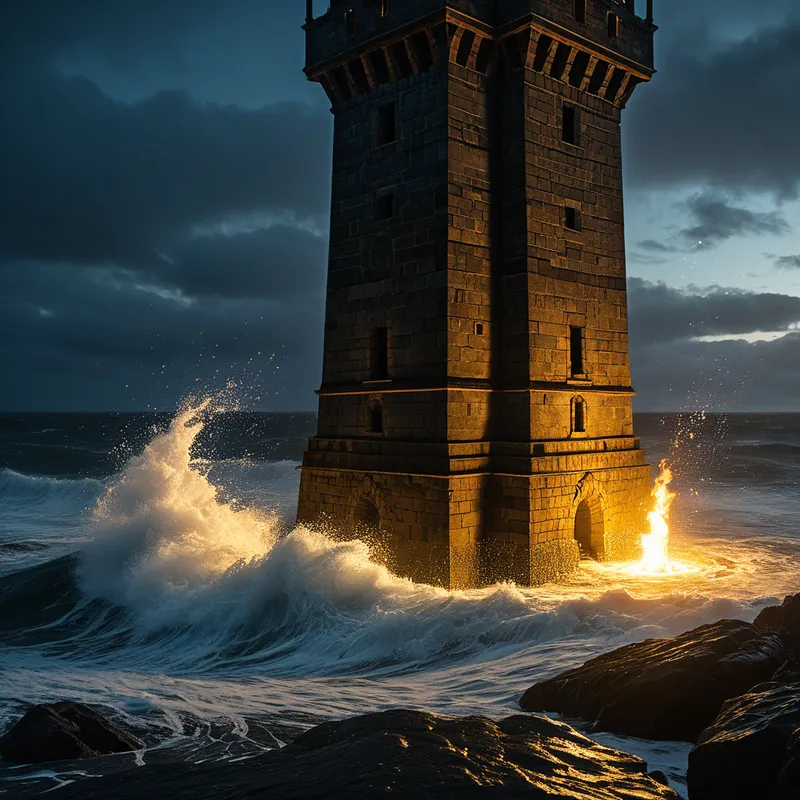
The Pharos was no myth born in the misty age of heroes, but a legend growing from the very real, staggering achievement of the Hellenistic world. Constructed in the 3rd century BCE, it was one of the Seven Wonders, a testament to the fusion of Egyptian resources and Greek engineering under the Ptolemaic dynasty. The mythologizing of the Pharos began almost as soon as its light first pierced the Mediterranean night.
Travelers, poets, and historians like Strabo and Pliny the Elder spread its fame, their accounts blurring the line between report and wonder. It was said its light could be seen from thirty miles away, that its mirrors could detect and burn enemy ships before they reached shore. These tales served a profound societal function: they were propaganda of the highest order, demonstrating the power, wealth, and enlightened civilization of Alexandria. The lighthouse was a physical and symbolic anchor, asserting that human reason ([Logos](/myths/logos “Myth from Christian culture.”/)) could impose a point of orientation upon the formless, threatening unknown (Chaos). It was a beacon of Hellenism itself, guiding the world to its intellectual and commercial capital.
Symbolic Architecture
The myth of the Pharos is a masterful [allegory](/symbols/allegory “Symbol: A narrative device where characters, events, or settings represent abstract ideas or moral qualities, conveying deeper meanings through symbolic storytelling.”/) of [consciousness](/symbols/consciousness “Symbol: Consciousness represents the state of awareness and perception, encompassing thoughts, feelings, and experiences.”/) itself. The [tower](/symbols/tower “Symbol: The tower symbolizes protection, aspirations, and isolation, representing both stability and the longing for higher achievement.”/) is the individuated [psyche](/myths/psyche “Myth from Greek culture.”/), structured and rising from the unstable [foundation](/symbols/foundation “Symbol: A foundation symbolizes the underlying support systems, values, and beliefs that shape one’s life, serving as the bedrock for growth and development.”/) of the [island](/symbols/island “Symbol: An island represents isolation, self-reflection, and the need for separation from the external world.”/) ([the personal unconscious](/myths/the-personal-unconscious “Myth from Jungian Psychology culture.”/)) to project [awareness](/symbols/awareness “Symbol: Conscious perception of self, surroundings, or internal states. Often signifies awakening, insight, or heightened sensitivity.”/) into the collective darkness.
The lighthouse does not illuminate the land, which is already known, but turns its face perpetually to the sea—the vast, unconscious, and potentially destructive realm from which all novelty and all terror emerge.
The ever-burning fire represents the sustained [effort](/symbols/effort “Symbol: Effort signifies the physical, mental, and emotional energy invested toward achieving goals and personal growth.”/) of consciousness, [the ego](/myths/the-ego “Myth from Jungian culture.”/)’s vigilant [attention](/symbols/attention “Symbol: Attention in dreams signifies focus, awareness, and the priorities in one’s life, often indicating where the dreamer’s energy is invested.”/) that must be constantly fueled. The intricate bronze mirrors symbolize the faculty of [reflection](/symbols/reflection “Symbol: Reflection signifies self-examination, awareness, and the search for truth within oneself.”/)—the [ability](/symbols/ability “Symbol: In dreams, ‘ability’ often denotes a recognition of skills or potential that one possesses, whether acknowledged or suppressed.”/) to take the raw [energy](/symbols/energy “Symbol: Energy symbolizes vitality, motivation, and the drive that fuels actions and ambitions.”/) of instinct and [emotion](/symbols/emotion “Symbol: Emotion symbolizes our inner feelings and responses to experiences, often guiding our actions and choices.”/) and focus it into a coherent, guiding [beam](/symbols/beam “Symbol: A structural support element in architecture, symbolizing stability, connection, and the framework that holds things together.”/) of understanding. The treacherous sea is the Self in its oceanic, pre-formal state, containing both [life](/symbols/life “Symbol: The symbol of ‘Life’ represents a journey of growth, interconnectedness, and existential meaning, encompassing both the joys and challenges that define human experience.”/)-giving [depth](/symbols/depth “Symbol: Represents profound layers of consciousness, hidden truths, or the unknown aspects of existence, often symbolizing introspection and existential exploration.”/) and ship-shattering [turbulence](/symbols/turbulence “Symbol: A state of violent disturbance or agitation, often representing emotional chaos, creative disruption, or life transitions in dreams.”/). The Pharos does not conquer the sea; it establishes a [relationship](/symbols/relationship “Symbol: A representation of connections we have with others in our lives, often reflecting our emotional state.”/) with it. It creates a [boundary](/symbols/boundary “Symbol: A conceptual or physical limit defining separation, protection, or identity between entities, spaces, or states of being.”/) where there was [none](/symbols/none “Symbol: The absence represented by ‘none’ can signify emptiness, potential, or a yearning for substance.”/), a liminal [space](/symbols/space “Symbol: Dreaming of ‘Space’ often symbolizes the vastness of potential, personal freedom, or feelings of isolation and exploration in one’s life.”/) where the known self meets the unknown other.
The Dreamer’s Resonance
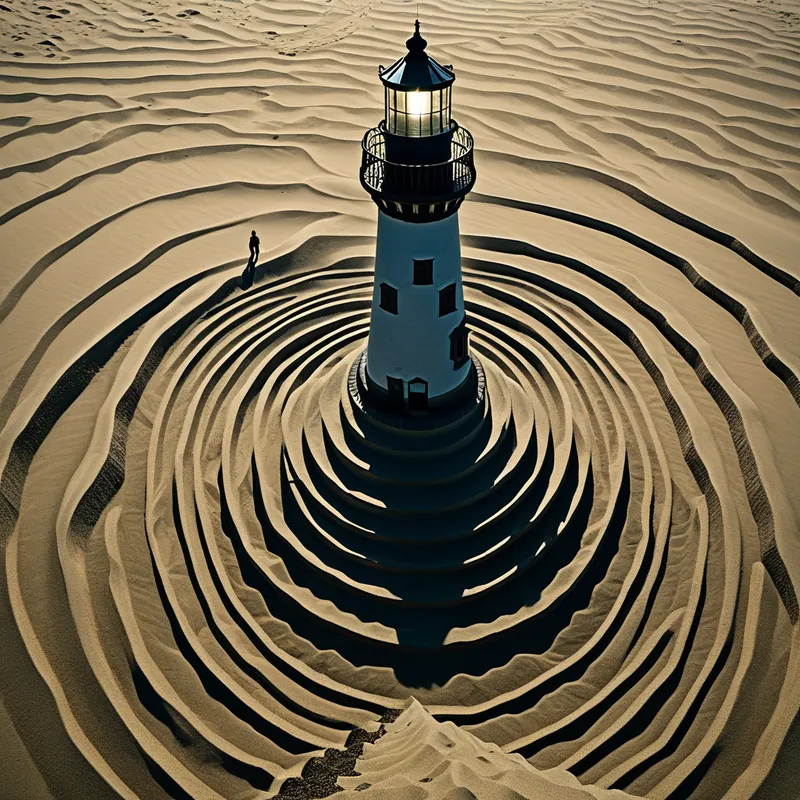
To dream of a lighthouse, particularly one of such ancient and colossal grandeur as the Pharos, signals a critical moment of orientation in the dreamer’s inner life. The somatic feeling is often one of relief mixed with awe—a solid structure beneath the feet amidst a vast, disorienting expanse.
Psychologically, this dream emerges when the conscious mind (the tower) is actively engaged in a difficult, sustained act of navigation through unconscious material (the dark sea). Perhaps the dreamer is struggling with a flood of repressed emotion, a moral dilemma with no clear shore, or a creative endeavor that feels formless and threatening. The dream-Pharos affirms that the psyche is building or has built a capacity for guidance. The conflict lies in the maintenance of the light: Is the fuel running low? Are the mirrors tarnished? Is the storm threatening to overwhelm the tower? Such dreams ask the dreamer to identify what sustains their [inner light](/myths/inner-light “Myth from Buddhist culture.”/)—their values, their introspection, their community—and to tend to it diligently against the erosive forces of doubt and chaos.
Alchemical Translation
The alchemical process mirrored in the Pharos myth is that of Coagulatio—the fixing of the volatile into the solid, the bringing of light out of darkness. It models the individuation journey where the diffuse, water-like states of the unconscious (the sea) are confronted and given form by the focused, fiery power of consciousness (the beacon).
The initial [Nigredo](/myths/nigredo “Myth from Alchemical culture.”/), the blackening, is the dark, shipwrecking coast and the formless sea. The king’s command represents the spark of the Scintilla, the call from [the Self](/myths/the-self “Myth from Jungian culture.”/) to begin [the great work](/myths/the-great-work “Myth from Alchemical culture.”/). The construction itself is the arduous Albedo—the whitening—involving the careful selection and structuring of materials (psychological insights, disciplined habits, intellectual frameworks) into a stable, ascending form. The final lighting of the flame is the [Rubedo](/myths/rubedo “Myth from Alchemical culture.”/), the reddening or enlightenment, where the work becomes a living, functioning entity that serves a purpose beyond itself.
The ultimate alchemical secret of the Pharos is that the gold it produces is not the tower, but the safe passage it enables. The transformed psyche’s triumph is not in being isolated and brilliant, but in becoming a point of orientation that connects the depths to the shore, enabling the continuous journey of the soul.
For the modern individual, the myth calls for the construction of an inner lighthouse: a principled, enduring structure of self-knowledge. It requires us to fuel our awareness, polish our capacity for reflection, and courageously direct that light into the darkest, most chaotic areas of our life and world, not to eliminate the mystery, but to make a path through it. We are both Sostratus, the builder who leaves his true name in the foundation, and the grateful sailor guided home by the light of our own making.
Associated Symbols
Explore related symbols from the CaleaDream lexicon: