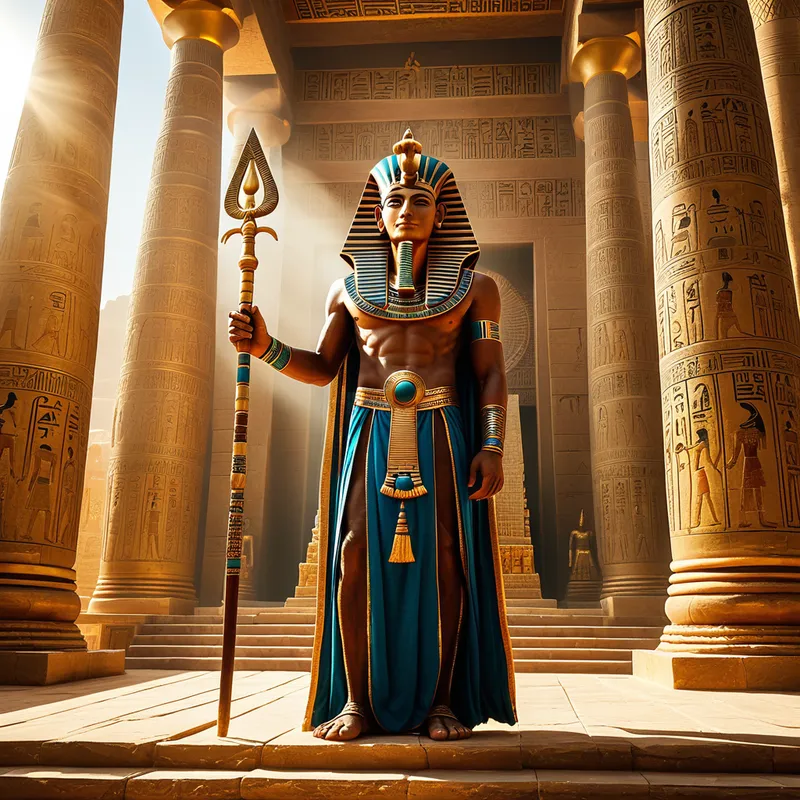
The Pharaoh as High Priest Myth Meaning & Symbolism
The Pharaoh, as High Priest, performs the sacred rites to maintain cosmic order, binding the human world to the divine through ritual and royal will.
The Tale of The Pharaoh as High Priest
Hear now the tale of the Two Lands, of [the horizon](/myths/the-horizon “Myth from Various culture.”/)-dweller who walks as a god among men. The sun, Ra, has begun his perilous journey into [the underworld](/myths/the-underworld “Myth from Greek culture.”/), and [the world](/myths/the-world “Myth from Tarot culture.”/) holds its breath. Shadows stretch long across the white-washed walls of Ipet-Isut, and a silence falls, deeper than that of the tomb. It is the hour of the twilight offering.
In the innermost sanctuary, the naos, the air is thick with the scent of myrrh and the memory of incense. Before the gilded shrine, a figure stands alone. He is the Son of [Horus](/myths/horus “Myth from Egyptian culture.”/), the Living Image of Amun-Ra, the Lord of the Two Lands. To his people, he is [Pharaoh](/myths/pharaoh “Myth from Egyptian culture.”/). But in this silent, sacred dark, he is simply the Servant of the God. The High Priest.
He raises the nemset jar. The [water](/myths/water “Myth from Chinese culture.”/), drawn from the primordial Nun, falls in a pure stream, washing the divine countenance of the statue within. He does not see stone or gold; he sees the god’s true face, felt in the trembling of his own ka. With precise, ancient motions, he dresses the god in linen, brighter than moonlight. He anoints the brow with green eye-paint, opening the god’s sight to the world. He offers bread, beer, beef, and fowl—the sustenance of life itself.
This is not ceremony. This is necessity. For beyond these walls, the serpent Apep coils in the depths, seeking to devour the sun-barge and plunge creation back into formless night. [The desert](/myths/the-desert “Myth from Biblical culture.”/) sands whisper of entropy. The Nile may flood or fail. The people may forget their prayers. Maat—the delicate order of the cosmos—is not a given. It is a verdict, renewed daily by this act.
[The Pharaoh](/myths/the-pharaoh “Myth from Egyptian culture.”/)’s voice, low and resonant, fills the chamber. He recites the words of power, the hekau, given to him at his coronation. He is the hinge between the pet and the ta. His ritual is the rope that binds heaven to earth. His will is the dam holding back the waters of chaos. As he offers the final censer, the smoke rising in a perfect, straight column to the ceiling’s star-painted vault, a warmth fills the sanctuary. The god is satisfied. The sun will rise again. Maat is restored for another day. [The Pharaoh](/myths/the-pharaoh “Myth from Egyptian culture.”/), his divine duty fulfilled for this sacred hour, turns from the naos. The weight of the Double Crown settles back upon him, not as ornament, but as yoke. The High Priest recedes; the King returns to his throne.
Cultural Origins & Context
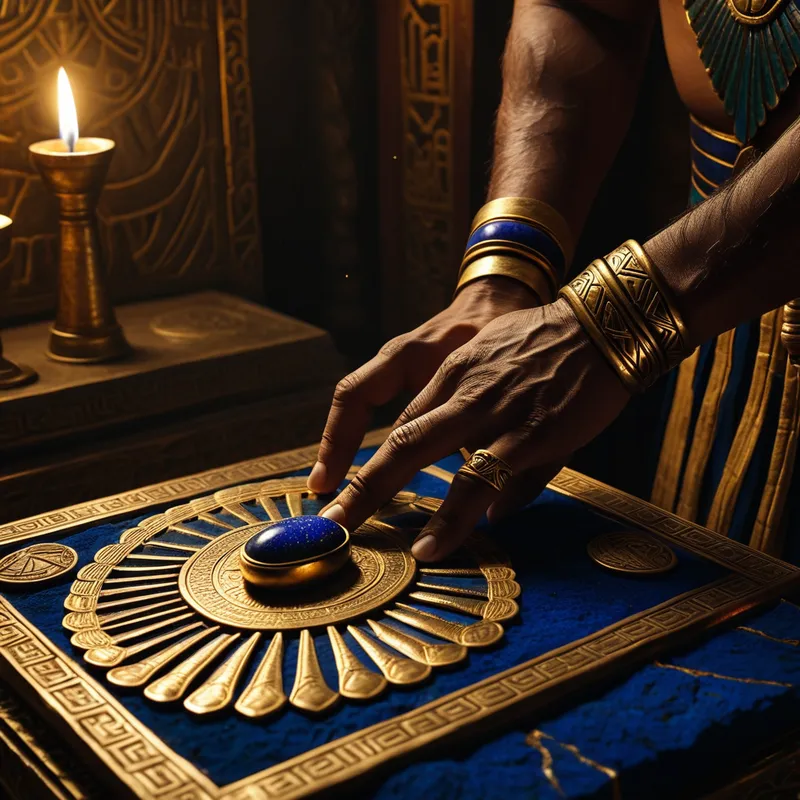
This was not a single myth inscribed on one [papyrus](/myths/papyrus “Myth from Egyptian culture.”/), but the living, breathing ideology of kingship woven into the very fabric of ancient Egyptian civilization for over three millennia. It was enacted daily in every major temple, from the sun temples of Abu Ghurab to the vast columned halls of Karnak. The Pharaoh was the sole, legitimate high priest of every god in Egypt; all other priests acted in his name and with his authority.
This concept was passed down through ritual texts, temple reliefs, royal annals, and coronation ceremonies. It was taught to the prince from birth and witnessed by the populace during great festivals like the [Sed Festival](/myths/sed-festival “Myth from Egyptian culture.”/), where the king’s physical and ritual potency was renewed. Its societal function was absolute: it provided the cosmological justification for the Pharaoh’s absolute power. He ruled not by mere human right, but by divine mandate. His primary job was not administration or conquest (though those were vital), but ritual maintenance—to ensure the gods were content so the Nile would flood, the crops would grow, and chaos would be kept at bay. The stability of the state and the cosmos depended on his correct performance of this priestly office.
Symbolic Architecture
At its core, this myth is a profound map of mediated [consciousness](/symbols/consciousness “Symbol: Consciousness represents the state of awareness and perception, encompassing thoughts, feelings, and experiences.”/). The Pharaoh represents the central, organizing principle of the [psyche](/myths/psyche “Myth from Greek culture.”/)—[the ego](/myths/the-ego “Myth from Jungian culture.”/), or the conscious self, at its most developed and responsible.
The true ruler is not he who commands armies, but he who maintains the inner covenant between the depths and the heights.
The [temple](/symbols/temple “Symbol: A temple often symbolizes spirituality, sanctuary, and a deep connection to the sacred aspects of life.”/) is the structured, sacred [space](/symbols/space “Symbol: Dreaming of ‘Space’ often symbolizes the vastness of potential, personal freedom, or feelings of isolation and exploration in one’s life.”/) of the cultivated self—the [persona](/symbols/persona “Symbol: The social mask or outward identity one presents to the world, often concealing the true self.”/), values, and disciplines we build. The inner sanctuary (naos) is the innermost [chamber](/symbols/chamber “Symbol: A private, enclosed space representing the inner self, hidden aspects, or a specific stage in life’s journey.”/) of the [heart](/symbols/heart “Symbol: The heart symbolizes love, emotion, and the core of one’s existence, representing deep connections with others and self.”/), where the ultimate value, the Self (symbolized by the god’s [statue](/symbols/statue “Symbol: A statue typically represents permanence, ideals, or entities that are revered.”/)), resides. The daily [ritual](/symbols/ritual “Symbol: Rituals signify structured, meaningful actions carried out regularly, reflecting cultural beliefs and emotional needs.”/) is the practice of attending to this inner divinity, this core of meaning and order. The offerings—purification, clothing, [food](/symbols/food “Symbol: Food in dreams often symbolizes nourishment, both physical and emotional, representing the fulfillment of basic needs as well as deeper desires for connection or growth.”/)—symbolize the dedication of one’s [energy](/symbols/energy “Symbol: Energy symbolizes vitality, motivation, and the drive that fuels actions and ambitions.”/), [attention](/symbols/attention “Symbol: Attention in dreams signifies focus, awareness, and the priorities in one’s life, often indicating where the dreamer’s energy is invested.”/), and [life](/symbols/life “Symbol: The symbol of ‘Life’ represents a journey of growth, interconnectedness, and existential meaning, encompassing both the joys and challenges that define human experience.”/)-force to a [purpose](/symbols/purpose “Symbol: Purpose signifies direction, meaning, and intention in life, often reflecting personal ambitions and core values.”/) greater than the individual ego.
The ever-present [threat](/symbols/threat “Symbol: A threat in dreams often reflects feelings of vulnerability, anxiety, or fear regarding one’s safety or well-being. It can indicate unresolved conflicts or the presence of external pressures.”/) of Apep is the constant pull of the unconscious, of [entropy](/symbols/entropy “Symbol: In arts and music, entropy represents the inevitable decay of order into chaos, often symbolizing creative destruction, impermanence, and the natural progression toward disorder.”/), depression, [fragmentation](/symbols/fragmentation “Symbol: The experience of breaking apart, losing cohesion, or being separated into pieces. Often represents disintegration of self, relationships, or reality.”/), and meaninglessness. Maat is not [static](/symbols/static “Symbol: Static represents interference, disruption, and the breakdown of clear communication or signal, often evoking feelings of frustration and disconnection.”/) [peace](/symbols/peace “Symbol: Peace represents a state of tranquility and harmony, both internally and externally, often reflecting a desire for resolution and serenity in one’s life.”/), but dynamic balance—the hard-won state of psychological [integration](/symbols/integration “Symbol: The process of unifying disparate parts of the self or experience into a cohesive whole, often representing psychological wholeness or resolution of internal conflict.”/). The Pharaoh’s struggle is the ego’s eternal [task](/symbols/task “Symbol: A task represents responsibilities, duties, or challenges one faces.”/): to consciously relate to the powerful forces of the unconscious (the gods and [chaos](/symbols/chaos “Symbol: In Arts & Music, chaos represents raw creative potential, uncontrolled expression, and the breakdown of order to forge new artistic forms.”/)) without being swallowed by them, thereby creating a livable, ordered world.
The Dreamer’s Resonance
When this myth stirs in the modern dreamer, it often manifests as dreams of immense responsibility in a crumbling or sacred space. You may dream of being the only one who knows how to perform a critical, ancient ritual in a forgotten building, while others are oblivious. You might be in your childhood home or a corporate office, but it has become a temple, and you must light a specific fire or align certain objects before a deadline, feeling a somatic weight of dread or solemn duty.
This dream pattern signals a moment in the psyche where the conscious mind (the Pharaoh) is being called to acknowledge and formally engage with a deep, structuring value or truth (the inner god). It is a call to priesthood over one’s own life. The anxiety in the dream is the fear that this inner order will collapse—that you will fail in your duty to your own soul, leading to a psychic flood of chaos (anxiety, depression, dissociation). The dream is a somatic rehearsal for taking conscious, ritualistic responsibility for your own psychological and spiritual maintenance.

Alchemical Translation
The alchemical process mirrored here is the opus contra naturam—the work against nature, or more precisely, the work of cultivating conscious order from unconscious instinct. The Pharaoh’s daily rite is the model for the modern individual’s journey of individuation.
Individuation begins not with finding oneself, but with serving the mystery within with disciplined reverence.
First, [Separatio](/myths/separatio “Myth from Alchemical culture.”/): The Pharaoh must separate himself from the mundane world to enter [the temple](/myths/the-temple “Myth from Jewish culture.”/). This is the act of creating inner space through reflection, meditation, or journaling—withdrawing the [projection](/myths/projection “Myth from Alchemical culture.”/) of the divine onto external authorities to find it within.
Second, Mortificatio & Purificatio: The washing and clothing of the god. This is the often-painful process of cleansing old, ego-driven attitudes (guilt, shame, inflated self-image) and “dressing” the core Self in honest self-assessment and renewed intention.
Third, Coniunctio: The offering and the god’s acceptance. This is [the sacred marriage](/myths/the-sacred-marriage “Myth from Various culture.”/), the moment of alignment when the conscious ego’s actions are in harmony with the deep needs and patterns of [the Self](/myths/the-self “Myth from Jungian culture.”/). Energy flows unimpeded; life feels meaningful and directed.
Finally, Circulatio: The Pharaoh returns to rule the kingdom. The integrated energy from the inner ritual is now available for outer life. One does not stay in the sanctuary. The wisdom gained must be applied in relationships, work, and creativity, bringing the order of Maat to the earthly realm of ta.
The myth teaches that sovereignty—true rulership of one’s life—is ultimately a priestly act. It is the daily, humble, and awe-inspiring duty of mediating between the chaos of potential and the order of manifestation, between [the divine spark](/myths/the-divine-spark “Myth from Gnostic culture.”/) within and the world waiting outside the temple gate.
Associated Symbols
Explore related symbols from the CaleaDream lexicon: