The Personal Unconscious Myth Meaning & Symbolism
A tale of the forgotten inner world, a shadowy realm of lost memories and hidden feelings that must be bravely explored to become whole.
The Tale of The Personal Unconscious
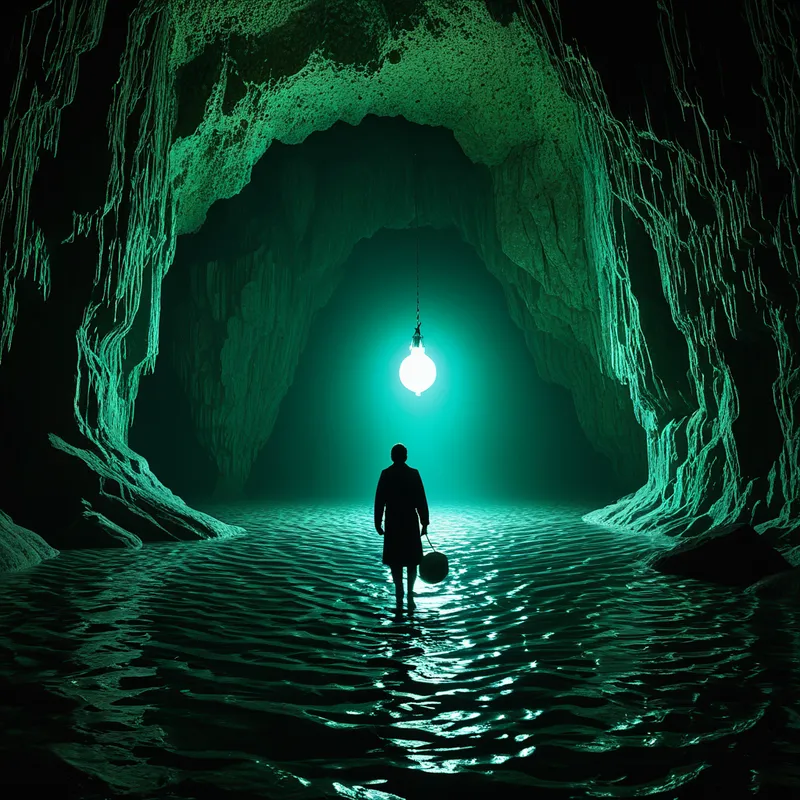
Listen. There is a world beneath your feet, a kingdom you rule but have never seen. It is not a land of soil and stone, but of memory and feeling, a vast, echoing cavern that stretches as deep as your years. They call it the Personal Unconscious.
In the beginning, there is the bright citadel of the Ego, built upon the sunlit plains of waking life. Here, you dwell, believing your kingdom to be only what your eyes can see. But from this citadel, a winding, seldom-used stair descends into the earth. Its entrance is often disguised as a forgotten door, a crack in the floorboards, or the sudden, inexplicable chill of a remembered scent.
The descent is not for the faint of heart. The air grows thick with the humidity of old emotions. The walls are not rock, but strata of time: here, a layer of childhood laughter fossilized into silence; there, a vein of adolescent heartbreak, glittering and sharp. Lost things gather in the corners: a forgotten birthday wish, the exact timbre of a voice you can no longer name, the sharp shame of a minor betrayal you committed at seven years old. These are the Complexes, the living knots of memory that hum with a power of their own. They are the ghosts of this underworld, not malevolent, but insistent, tugging at the hem of your awareness.
At the heart of this realm lies a pool, dark and perfectly still. This is the Shadow. When you peer into it, you do not see your familiar face. You see the one you could have been, the urges you disowned, the anger you swallowed, the creativity you buried as impractical. It is you, and yet not you—a sibling of the soul, waiting in the silence.
The journey through this land has no single monster to slay, but a thousand subtle trials. You must sit with the weeping child-complex in the dark. You must listen to the furious, silenced artist pounding on the walls of its prison. You must gather the scattered, shining shards of forgotten joys and piece them together, not to return to the past, but to reclaim their light. The resolution is not an explosion, but a slow integration. You do not conquer this underworld; you befriend it. You learn its language of symbol and symptom. And when you ascend the stair once more, you are not the same ruler. You are heavier with truth, but lighter for having carried it into the light. The citadel of the Ego now has a cellar, and from its depths comes a strange, steady strength.

Cultural Origins & Context
This is not a myth carved in temple stone, but one inscribed in the case studies and clinical observations of the 20th century. Its primary bard was Carl Gustav Jung, who, from his practice in Zürich, began to map this interior territory. He listened not to epic poets, but to the dreams and fantasies of his patients, recognizing in their recurring patterns and forgotten memories the contours of a shared, yet deeply personal, psychological landscape.
The myth was passed down through a new oral tradition: the analytic hour. It spread through scholarly tomes like Psychology of the Unconscious, through the intimate dialogue between analyst and analysand, and later through lectures and the work of his followers. Its societal function was revolutionary: to provide a modern, psychologically coherent narrative for internal suffering and transformation. In an age increasingly skeptical of religious dogma, it offered a sacred map for a secular pilgrimage—the journey inward. It gave a name and a dignity to the “merely neurotic,” framing personal turmoil not as a failure of morality or will, but as a summons to explore this forgotten kingdom.
Symbolic Architecture
The myth of the Personal Unconscious is a profound map of the psyche’s hidden geography. Its symbols are not arbitrary, but essential keys to understanding the self.
The Personal Unconscious is the psychic attic of the soul, where we store what is too painful, too beautiful, or too confusing for the tidy rooms of daily consciousness.
The descent symbolizes a necessary regression, a voluntary move away from conscious adaptation to confront the raw material of one’s history. The cavern represents the containing, womblike nature of the psyche itself—a place of both burial and potential rebirth. The strata of time illustrate how our past is not gone but psychologically present, layered and influencing the present from below.
The Complexes are perhaps the most dynamic figures in this myth. They represent autonomous psychic entities, “splinter psyches” that form around core wounds or intense experiences. A mother complex, a power complex, an inferiority complex—each acts like a sub-personality with its own memory, emotion, and will, capable of “possessing” the conscious ego. To integrate a complex is not to destroy it, but to break its autonomy and return its energy to the whole self.
Finally, the Shadow pool is the myth’s central moral and psychological mirror. It represents everything we refuse to acknowledge in ourselves, both dark and light (for we often repress our genius as fiercely as our spite). Meeting the Shadow is the first, crucial encounter on the road to Individuation.
The Dreamer’s Resonance
When this myth stirs in the modern dreamer, it announces a time of psychic housekeeping. The dreams become the royal road not to a universal unconscious, but to this very personal one.
You may dream of forgotten houses—childhood homes, schools, or strange mansions with rooms you never knew existed. Exploring these spaces is the ego exploring the architecture of the personal past. Finding a locked door or a hidden basement signals an encounter with repressed material. Dreams of losing vital objects (keys, wallets, phones) or searching for a specific person from your past often point to a complex at work, a feeling that some essential part of you is missing or inaccessible.
Somatically, this process can feel like a low-grade fever of the soul: a persistent anxiety with no clear object, a melancholy nostalgia, or somatic symptoms that defy medical explanation—the body speaking what the mind has forgotten. Psychologically, it is a process of recollection in the deepest sense: a re-gathering of the scattered self. The dreamer is undergoing a natural, often necessary, regression in service of the ego, being called to account for lost memories and disowned feelings to create a more complete self.

Alchemical Translation
The myth of the Personal Unconscious is a manual for psychic alchemy. Its core struggle—facing the forgotten and the disowned—models the first, crucial stage of Individuation: Nigredo, the blackening.
To become whole, one must first become acquainted with the fragments. The base material of the soul is not pure gold, but the leaden weight of all we have tried to leave behind.
In alchemical terms, the descent into the personal unconscious is the dissolution of the persona—the polished mask we show the world—in the aqua regia of self-honesty. The repressed memories and complexes are the prima materia, the worthless, chaotic matter that contains the secret of the philosopher’s stone. The work is one of separatio and coniunctio: separating the useful truth from the painful memory, then conjoining it with conscious awareness.
The Shadow is the caput corvi, the Raven’s Head, the blackness that must be endured. Integrating it is not adopting its traits wholesale, but acknowledging, “This, too, is me.” This act transmutes raw, autonomous darkness into a source of personal substance and vitality. The energy once used to keep a memory repressed is liberated for life. The modern individual performing this alchemy does not need a laboratory, but a practice of honest reflection, active imagination, and the courage to heed the clues offered by slips of the tongue, persistent moods, and the enigmatic narratives of their own dreams. The goal is not a perfect self, but a more authentic one—a being who rules the sunlit citadel while knowing and respecting the deep, shadowed lands that give it foundation.
Associated Symbols
Explore related symbols from the CaleaDream lexicon: