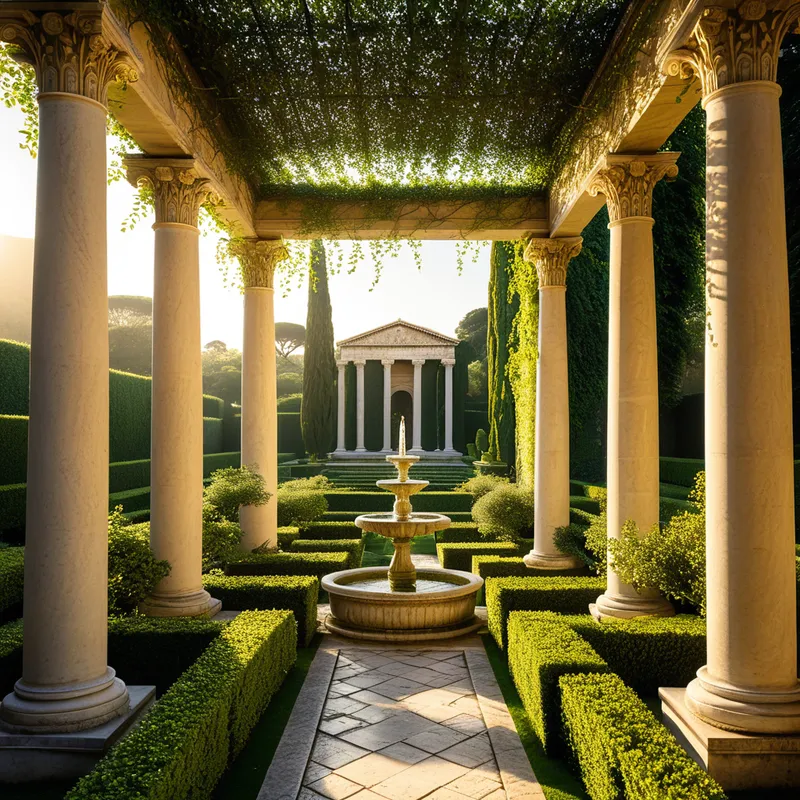
The Peristyle Garden Myth Meaning & Symbolism
A myth of a soul, lost in a wilderness of its own making, who must build a sacred inner garden to find peace and commune with the divine.
The Tale of The Peristyle Garden
Listen, and let the scent of crushed herbs and sun-warmed stone carry you back. There was a soul, not a man or a woman, but a spark of consciousness, cast into the world. It found itself not in a city or a field, but in a vast, trackless saltus. The earth was a tangle of root and thorn, the sky a capricious dome of searing sun and sudden, drenching storms. The soul wandered, buffeted by every wind, pierced by every bramble, its thoughts as scattered as the leaves in a gale. It knew only chaos, a raw, unbounded materia with no form, no boundary, no center.
One evening, as a violet dusk bled into the land, the soul collapsed by a small, muddy spring. Its tears fell into the water. And in that mingling, a whisper arose, not from the air, but from the very bones of the earth. It was the voice of Vesta, gentle as ember-glow. “You dwell in potential,” the whisper sighed, “but you live in tumult. Even the wildest river is given banks. Even the most sacred flame needs a hearth.”
The soul looked at its bleeding hands, at the chaotic thicket. “What can I do? I am no Janus to see the way, no Vulcan to shape the mountains.”
“Look to your feet,” whispered Vesta. “The first boundary is not of stone, but of intention.”
With a resolve born of utter exhaustion, the soul reached into the mud and pulled forth a stone, rough and cold. It placed it beside the spring. Then another. A line began to form, a simple, crooked square. The act was agonizingly slow. Doubt, like a hot wind, tried to scatter the stones. Memory, like a clinging vine, tried to pull the soul back into the thicket. But with each stone laid, a strange quiet descended. The line defined an inside and an outside.
Seasons turned. The soul learned to cut the wild grasses, not to destroy, but to pattern them, creating a soft triclinium of green. It cleared a space in the center and found, beneath the mud, a flat slate. Upon this, it let the spring water gather, not as a muddy pool, but as a clear, shallow impluvium, reflecting the sky. It trained the wild vines to climb wooden posts, which over years were replaced with rough-hewn columns, creating a shaded walkway—a peristyle.
This was no palace garden. Its beauty was in its order, its sacred geometry. The chaos was not banished; it was now the view beyond the columns. The wildflowers were invited inside the pattern. One day, as the soul sat by its impluvium, it saw not just its own reflection, but a second presence reflected beside it. It was Genius Loci, the spirit of the place, now fully formed. It had not been summoned, but had emerged from the relationship between the soul’s intention and the land’s potential. The garden was complete. The soul was no longer a wanderer in the saltus, but a custodian of a cosmos in miniature. The whisper of Vesta was now the silent, humming peace of a world in balance.

Cultural Origins & Context
The myth of the Peristyle Garden is not found in a single epic like those of Aeneas. It is a cultural myth, woven into the very fabric of Roman domestic and spiritual life. It was passed down not by bards in halls, but by fathers showing sons the property line, by mothers tending the household shrine, by architects laying out a new villa. Its societal function was foundational: to encode the principle that civilization, and by extension the civilized self, is not a natural state, but a sacred, hard-won achievement.
The Roman mind was profoundly spatial and legalistic. The rituals of augury divided the sky into templed regions. The act of inauguratio for a new city was a magical imposition of order on chaos. The peristyle garden of a Roman domus was the microcosm of this world-view. It was the point where the wild (ferox) met the cultivated (humanus), where the public world of the atrium transitioned into the private realm of the family. This myth served as the psychic blueprint for that transition, teaching that personal peace and familial piety (the domain of Vesta and the Lares) depended on first establishing a bounded, ordered interiority.
Symbolic Architecture
At its core, the myth is an allegory for the creation of consciousness itself. The unbounded saltus represents the undifferentiated, overwhelming flow of the unconscious—a realm of raw potential, instinct, and psychic materia prima. The soul’s initial state is one of being acted upon by these forces, a passive victim of internal and external weather.
The first act of the self is not to conquer the wilderness, but to build a wall against it. A boundary is not a rejection, but the creation of a vessel.
The single stone is the initial act of will, the first conscious decision to differentiate. The line becomes the pomerium of the psyche. The impluvium is the reflective pool of self-awareness, the speculum animae, where the soul finally sees itself clearly enough to recognize the Genius that has always been there. The peristyle columns are the supporting structures of habit, discipline, and persona that allow one to walk through one’s own inner world without being consumed by it. The garden is the achieved ego, not as a fortress against the unconscious, but as a cultivated space within it, from which the wild depths can be safely appreciated.

The Dreamer’s Resonance
When this myth stirs in the modern dreamer, it often manifests in periods of overwhelming flux, psychic spillage, or a loss of personal definition. The dream imagery is telling: being in a house with no walls, trying to hold water in cupped hands, or lost in a labyrinthine, overgrown park. These are somatic experiences of boundary failure.
The dreaming psyche is initiating a process of containment. To dream of building a wall, even a fragile one, or of carefully arranging stones, is the unconscious collaborating in the soul’s work. It is a somatic rehearsal for creating internal structure. A dream of discovering a hidden, geometric garden within a chaotic forest signals that the work is nearing completion—the Self is revealing the latent order beneath the chaos of the personal history. The emotional tone is rarely one of excitement, but of profound, quiet relief, a cooling of psychic fever.
Alchemical Translation
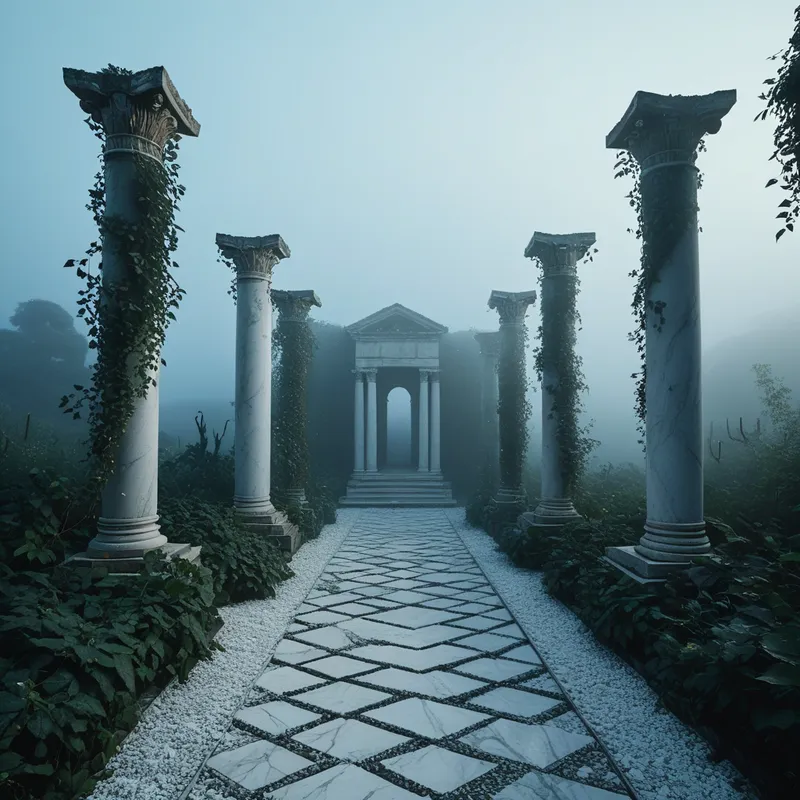
The myth models the alchemical opus of individuation with elegant precision. The initial nigredo, the blackening, is the soul’s despair in the trackless saltus, the experience of being dissolved in one’s own unresolved complexes and affects. The first stone is the commencement of the albedo, the whitening, where a conscious attitude begins to separate from the murk.
The transmutation occurs not in the grand gesture, but in the patient, repeated act of placing one stone of intention after another.
The building of the garden is the long work of citrinitas, the yellowing, where the structures of the personality are laboriously formed and integrated. The final appearance of the Genius Loci beside the impluvium is the rubedo, the reddening—the arrival of the Self, the transcendent function that was always immanent within the chaos. The soul does not become the Genius; it creates the conditions—the sacred, bounded space—in which the Genius can manifest and be recognized. The completed Peristyle Garden is the symbol of the individuated psyche: a whole, balanced system where consciousness (the cultivated center) and the unconscious (the wild beyond the columns) exist in a respectful, life-giving relationship. The struggle is the daily choice for order; the triumph is the enduring peace that is its fruit.
Associated Symbols
Explore related symbols from the CaleaDream lexicon: