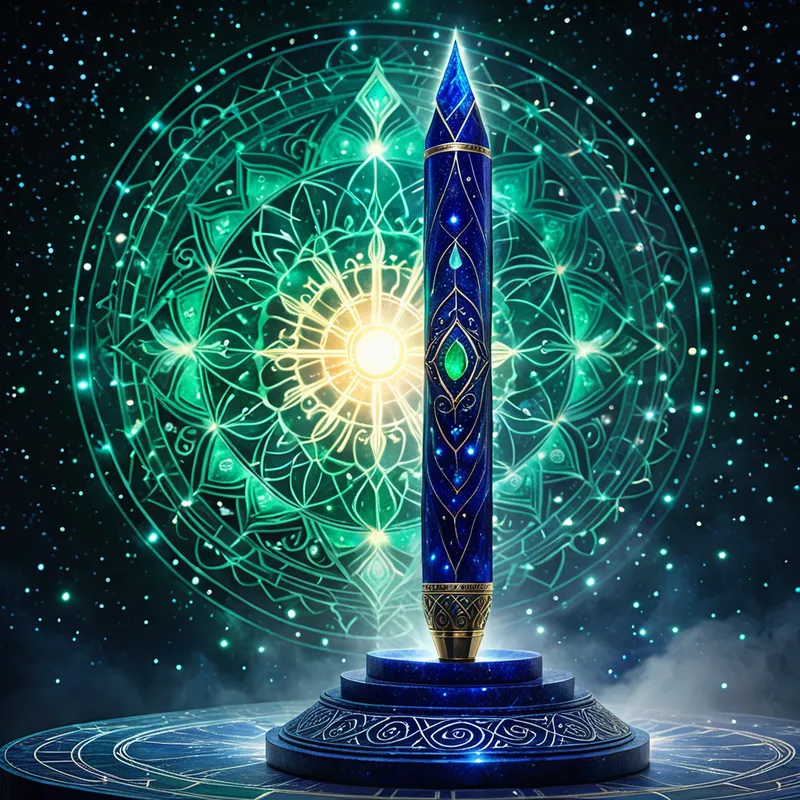
The Pen of Divine Decree Myth Meaning & Symbolism
A celestial pen, commanded by the Divine, inscribes all that was, is, and will be upon a cosmic tablet before the dawn of creation.
The Tale of The Pen of Divine Decree
Before time was a river, before space was a stage, there was the Command. In the fathomless, silent dark before the First Light, the Uncreated spoke a single, sovereign Word: “Be.”
And from that Word, a Presence coalesced. It was not form, but the essence of intention. It was the Qalam. Forged not of matter but of pure command, it stood—a pillar of living light, a shaft of focused decree. Its tip was a star awaiting its constellation.
Then came the Lauh al-Mahfuz. It manifested not as stone or metal, but as the very skin of possibility, vast and deep as eternity itself. Its surface was the color of a still ocean under a forgotten sky, veined with the potential of all stories.
A tremor passed through the Qalam, a vibration of the initial “Be.” It was not given ink, for it wrote with its own substance, with the light of divine knowledge. It bent, not in servitude, but in perfect resonance with the will that had uttered it into being.
And then, it began to write.
The sound was the first music: a whisper that was also a hymn, a scratch that was also a creation. Where its luminous tip met the tablet, reality sparked into being—not the world itself, but its blueprint. Every leaf that would ever tremble in the wind was named. Every tear of joy and sorrow was accounted for. The rise and fall of empires, the flight of a sparrow, the secret thought in the deepest heart of a human yet unmade—all flowed from the Pen in a river of radiant script.
It wrote the past that had never been, the present that was always becoming, and the future that would forever unfold. It inscribed the laws that bind the stars and the mercy that unbinds the soul. The writing was not a dictation of imprisonment, but a recording of a symphony whose every note, from the crashing crescendo to the silent pause, was known to the Composer.
For fifty thousand years of celestial reckoning, the Pen moved. It did not tire, for its action was its being. It did not hesitate, for its knowledge was complete. Finally, with a final, graceful stroke that contained the echo of the first Command, it ceased. The last glyph shimmered on the Tablet. All that was to be, was written.
The Pen straightened, its work complete. The Tablet glowed with an inner fire, a silent, majestic library of existence. In that suspended moment between the writing and the unfolding, the cosmos held its breath. The blueprint was finished. The story was set. And then, from the same Source of the Command, came the breath that would animate the tale: “Let there be Light.” And the drama of time began.
Cultural Origins & Context
The myth of the Qalam and the Lauh al-Mahfuz is woven into the tapestry of Islamic cosmology, finding its roots in the Quran and the sayings of the Prophet Muhammad (PBUH). It is not a folktale but a foundational cosmological narrative, passed down through scholars, mystics, and theologians. In Surah 68, the Quran begins with the solemn oath: “Nun. By the pen and what they inscribe…” This elevates the Pen to a symbol of such profound significance that God swears by it.
The myth functioned as a profound answer to ultimate questions in medieval Islamic society. It addressed the tension between divine omnipotence/omniscience and human free will—a central debate in Kalam. It provided a cosmic framework for fate (Qadar), assuring believers that the chaos of history and the intimacy of personal life were not random but recorded in a divine, purposeful order. For mystics (Sufis), it became a key to understanding the relationship between the Unmanifest Divine and the manifest world—the Pen being the first differentiation, the primal act of creative expression from the Unity.
Symbolic Architecture
The myth presents a profound symbolic architecture for understanding consciousness, creation, and the nature of reality itself.
The Qalam symbolizes the active, masculine principle of Divine Intelligence—the Logos. It is the focused will that translates abstract, infinite potential into specific, knowable form. Psychologically, it represents the human faculty of intention, the focused mind that gives shape to our inner world and, through action, to our outer reality.
The Pen is the bridge between the thought and the thing, the dream and its manifestation.
The Lauh al-Mahfuz symbolizes the receptive, feminine principle—the cosmic womb or the substrate of all possibility. It is the memory of God, the Akashic Record, the collective unconscious where every archetype and every potential life story resides. It is not a prison of fate, but the complete script from which the soul chooses its role, guided by divine wisdom.
The act of writing, lasting fifty thousand years, symbolizes the meticulous, deliberate, and compassionate nature of creation. Nothing is rushed; nothing is omitted. This counters the anxiety of meaninglessness, suggesting that our existence, with all its complexities, is not an accident but a carefully inscribed word in a grand narrative.
The Dreamer’s Resonance
When this myth stirs in the modern unconscious, it often surfaces in dreams of writing, forgotten books, or cosmic lists. To dream of a pen that writes on its own, or a book containing one’s own life in detail, signals a profound somatic and psychological process: the individual’s confrontation with their own entelechy or destined pattern.
The dreamer may be grappling with a sense of predetermination versus agency. The somatic feeling can be one of awe mixed with anxiety—the weight of a “script” they feel compelled to follow. Alternatively, finding the pen in a dream can symbolize a reclaiming of personal authority, the awakening of one’s own creative will to “write” the next chapter. The Tablet often appears as a mirror, reflecting not just what is, but the totality of what the dreamer could be, forcing an integration of ignored potentials and accepted limitations. It is the psyche’s way of asking: “Are you living the life that was inscribed in your deepest soul, or have you strayed from the text?”
Alchemical Translation
The alchemical process modeled here is the individuation journey from unconscious unity, through the painful differentiation of the ego, to a conscious reunion with the Self.
Initially, we exist in a kind of psychic Lauh al-Mahfuz—a state where all our potentials are latent but unactualized, governed by the unconscious patterns of family, culture, and archetype. The first stage of alchemy, nigredo (the blackening), is the moment the Qalam is commanded to write. It is the crisis, the call, or the suffering that forces differentiation: “I must become something specific.”
The writing itself is the long, often arduous work of albedo (whitening) and citrinitas (yellowing)—the clarification and spiritualization of the soul. We must take up our own pen, our conscious intention and will, and engage with the tablet of our life. We discover our talents, our wounds, our loves, and our burdens—all the “script” we were born with. This is not passive acceptance, but active engagement and interpretation.
The triumph is not in changing the text, but in understanding it so deeply that you become its co-author.
The final stage, rubedo (reddening), the achievement of the Philosopher’s Stone, is represented by the completion of the writing. Here, the individual achieves a paradoxical state. They fully own their unique, inscribed destiny—their specific life with all its joys and sorrows. Yet, in that total acceptance, they also transcend it, realizing their identity with the conscious Source that both holds the Pen and is the Tablet. The soul realizes it is not merely the written word, but also the Writer and the Page. The separation between creator, tool, and creation dissolves, and one returns to unity, now fully conscious of the glorious, intricate story that is, and always was, their own.
Associated Symbols
Explore related symbols from the CaleaDream lexicon: