The Peach of Immortality Myth Meaning & Symbolism
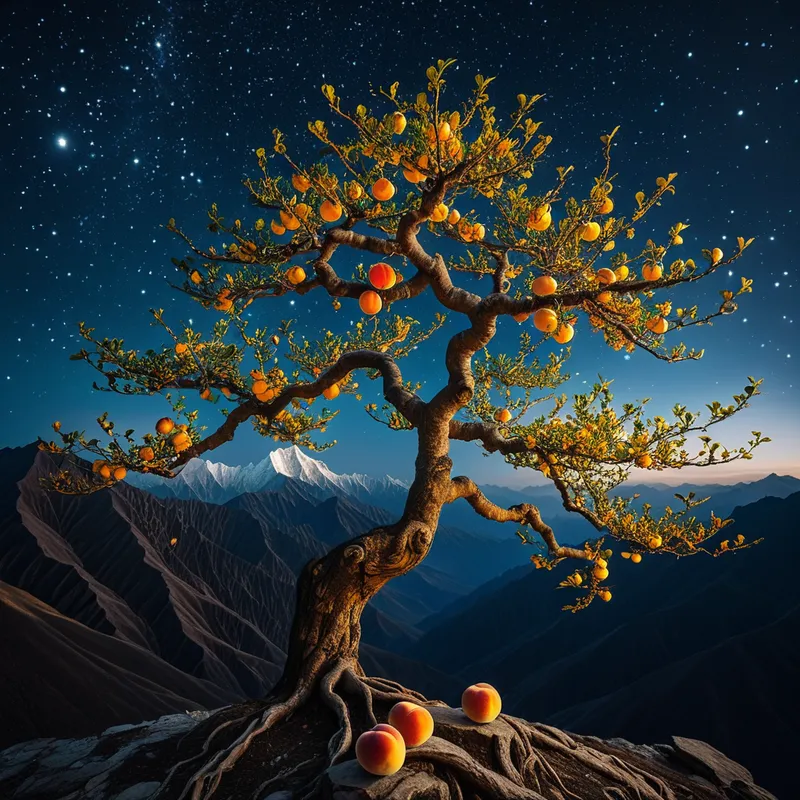
The celestial Peach Tree of the goddess Xiwangmu, whose fruit grants immortality, is the centerpiece of a cosmic banquet that defines divine order and mortal yearning.
The Tale of The Peach of Immortality
High above the mortal world, where the earth meets the vault of heaven, lies the sacred Kunlun Mountains. Here, in a palace of jade and cloud, resides the Xiwangmu, the Queen Mother of the West. Her gardens are not of common flowers, but of cosmic wonders. And at their heart grows a tree unlike any other—the Pantao.
Its trunk is ancient, gnarled like dragon bone, and its leaves shimmer with a silver dew that is the condensation of time itself. But its fruit… its fruit is the reason for the grandest gathering in all the cosmos. For this tree does not follow the seasons of earth. Its peaches ripen only once every three thousand years. When they do, they swell with a golden light, their skin blushing with the pink of a perpetual dawn, and their scent is the very fragrance of eternity.
Then, the celestial drums sound. A summons echoes through the nine heavens and the ten earths. The Jade Emperor arrives first, his presence bringing a hush of reverence. He is followed by all the pantheon: the star deities, the dragon kings, the sages who have transcended mortal flesh, and the honored immortals who have earned their place through lifetimes of cultivation. This is the Pantao Hui, the Feast of Peaches.
The air thrums with divine energy. Celestial maidens glide with trays bearing the sacred fruit. To partake is to have one’s immortality renewed, one’s divine status affirmed. It is a ritual of cosmic maintenance, a reaffirmation of the celestial order. The peaches are consumed with solemn joy, their juice a nectar that seals one’s place in the eternal hierarchy.
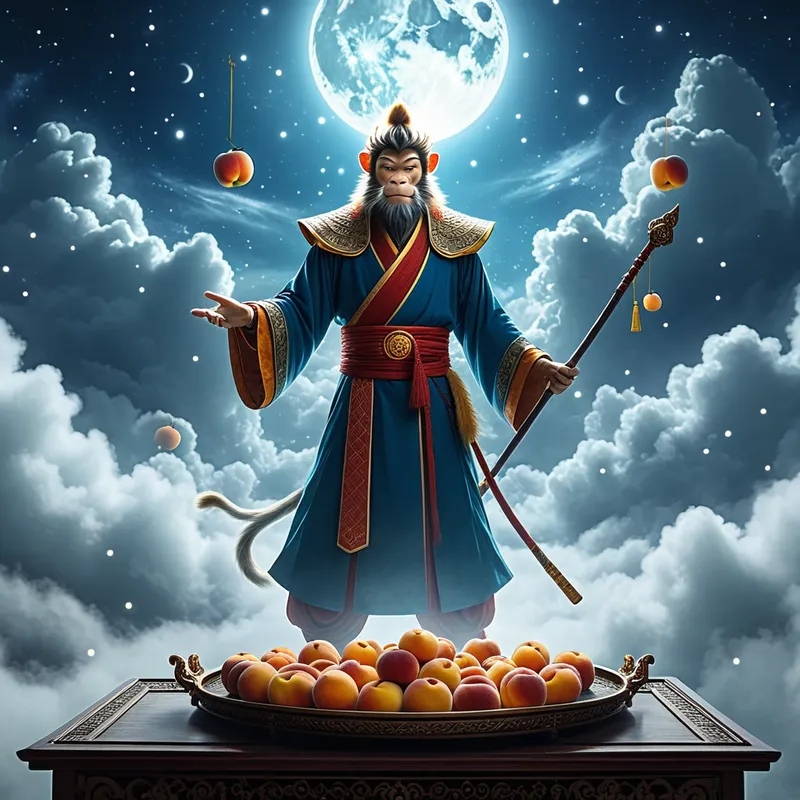
But order is sometimes challenged by chaos, and the feast once witnessed an uninvited guest. A being of immense power and cunning, born from stone and ambition—the Sun Wukong. Denied an invitation, his pride ignited into a brilliant, destructive scheme. He disguised himself, slipped into the heavenly gardens, and beheld the laden boughs. Not content with one peach, he devoured them, the finest and ripest, gulping down millennia of concentrated time in a fit of glorious, rebellious gluttony. He shattered the vessels of celestial wine and scattered the delicacies meant for the gods. In that moment, the perfect ritual was violated, the order momentarily broken by a force that recognized no law but its own appetite for supremacy and eternal life.
Cultural Origins & Context
The myth of the Peach of Immortality is woven from threads of early Chinese shamanistic beliefs, Daoist alchemical pursuits, and later literary elaboration. Its earliest roots likely connect to ancient Daoist practices seeking physical longevity and spiritual transcendence. The peach tree itself was a common folk symbol of longevity, protection, and exorcism; door gods were often painted on peach wood.
The figure of Xiwangmu evolved from a potentially fearsome, plague-bearing deity of the west into the benevolent keeper of the elixir of life and hostess of the celestial feast. This transformation mirrored the Daoist pursuit of harmony and eternal life. The myth was codified and popularized through texts like the Shan Hai Jing and, most famously, the Ming dynasty novel Journey to the West, which embedded the Peach Feast and Sun Wukong’s theft into one of Chinese literature’s most beloved narratives.
Societally, the myth functioned on multiple levels. It reinforced a cosmological model of a structured, bureaucratic heaven mirroring the imperial court. It provided a narrative for the reward of virtuous conduct and spiritual cultivation (being invited to the feast). Simultaneously, through tales like Sun Wukong’s, it gave voice to a rebellious, individualistic challenge to that very order, a tension deeply resonant within any hierarchical society.
Symbolic Architecture
The Peach of Immortality is not merely a magical fruit; it is a dense symbol of the ultimate prize in the human—and cosmic—drama. The Pantao tree represents the axis mundi, the world tree connecting heaven, earth, and the underworld, its roots in the primordial and its fruit in the transcendent.
The peach is the concretized desire for wholeness—a perfection that exists outside of time’s corrosive flow.
Its tripartite ripening cycle (three, six, and nine thousand years for different grades of fruit) mirrors the stages of spiritual alchemy and initiation. To eat the peach is to internalize this perfected order, to become one with the eternal Dao. Xiwangmu, as its guardian, is the archetypal custodian of the ultimate mystery, the Great Mother who grants the boon of eternal life only to those who are prepared and worthy within the cosmic system.
The Pantao Hui is the ritual of renewal. It symbolizes the necessary periodic reaffirmation of one’s highest values, spiritual commitments, and place in a meaningful cosmos. Sun Wukong’s theft is the psyche’s shadow side—the impulsive, egocentric desire to seize transcendence by force, to bypass the arduous journey of cultivation. His act, while chaotic, is also a necessary disruption that ultimately leads to his own difficult path of integration.
The Dreamer’s Resonance
When the Peach of Immortality appears in a modern dream, it rarely comes with a heavenly banquet. More often, it manifests as a singular, potent image: a lone, luminous fruit in an otherwise ordinary setting, or a tree seen from a distance, forever out of reach. This is the psyche signaling a profound encounter with the Self, the potential for wholeness.
The somatic sensation is often one of aching longing mixed with awe—a tightness in the chest, a quickening of the pulse. Psychologically, the dreamer is at a threshold. They may be yearning for a profound transformation, a feeling of being stuck in mortal, time-bound concerns, and seeking a taste of something timeless. The peach represents the possibility of transcending a current limitation, be it a psychological complex, a fear of death, or a sense of meaninglessness.
If the dreamer steals the peach, it speaks to an impatient, perhaps arrogant, part of the psyche trying to force enlightenment or a solution. If they are offered it, it may indicate a readiness to receive a gift of insight or a new stage of life. If it rots in their hand, it points to a missed opportunity for integration or a fear of truly embracing a transformative change.
Alchemical Translation
The myth models the individuation process—the journey toward psychic wholeness—with stark clarity. The initial state is one of yearning for the immortal peach, representing the ego’s desire for perfection and permanence. The celestial garden is the symbolic realm of the unconscious, where the treasures of the Self reside.
The disciplined path is embodied by the immortals who gain an invitation through cultivation. This is the slow, committed work of psychology: confronting shadows, integrating anima/animus, engaging with dreams, and building a conscious relationship with the unconscious. The feast is the moment of synthesis, where hard-won insights are “consumed” and become a permanent part of the personality structure, renewing one’s psychological vitality.
The true alchemy is not in consuming the fruit, but in becoming the tree—rooted in reality, yet bearing the fruit of timeless meaning.
Sun Wukong’s path is the more tumultuous, yet equally valid, road. His theft represents the eruption of the unconscious (the shadow, the trickster) that forcibly brings the ego into contact with the Self. The chaos that follows—his battle with heaven—is the necessary crisis that dismantles the old, rigid personality structure (the heavenly bureaucracy of the ego’s defenses). His subsequent subjugation and journey in Journey to the West is the long, arduous process of integrating that rebellious, divine energy into service of a greater purpose.
For the modern individual, the myth asks: Are you seeking your peach through patient cultivation of consciousness, or is a rebellious, hungry part of you trying to steal it? And ultimately, it suggests that immortality is not about endless duration, but about achieving a state of being so aligned with the fundamental patterns of existence that one participates in the eternal. It is the immortality of the fully realized Self, a psychic state that tastes of the peach’s golden nectar.
Associated Symbols
Explore related symbols from the CaleaDream lexicon: