
The Peach Blossom Spring Myth Meaning & Symbolism
A fisherman discovers a timeless utopia hidden behind a mountain of peach blossoms, a paradise forever lost once he tries to return to the mundane world.
The Tale of The Peach Blossom Spring
Let me tell you of a loss that is also a finding, of a place that exists only in the moment of its vanishing.
It began with a fisherman of Wuling, a man whose life was the river’s rhythm—cast, pull, mend, sail. One day, the current grew whimsical. It carried his boat farther than his charts knew, past the known bends where willows weep, into a stretch of water hushed and strange. The banks grew tall, closing in like silent sentinels. Then, he saw them.
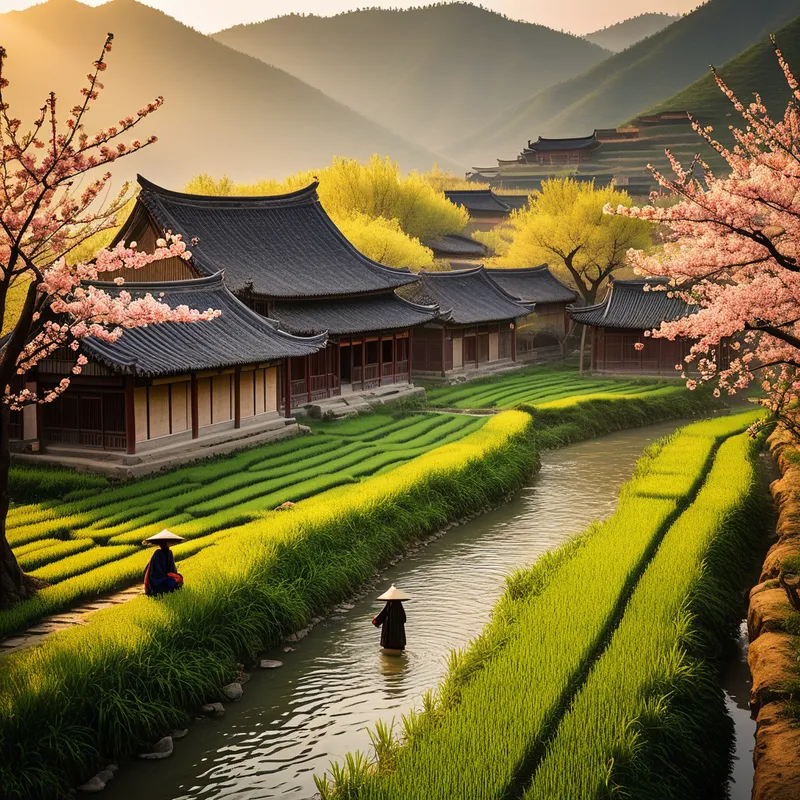
The air itself turned pink. A fragrance, sweet and light as a forgotten joy, filled his lungs. For miles, where rock and soil should be, there was only blossom. A mountain of peach trees in full, riotous bloom, carpeting the world in petals that fell like silent rain onto his boat and the dark water. No leaf, only flower. It was a beauty so complete it felt like a command. He rowed on, driven by a compulsion deeper than curiosity, to where the blossom-wall was thickest.
There, at the mountain’s foot, was a faint light. A small opening in the rock, hidden behind a waterfall of petals. Leaving his boat, he squeezed through the narrow, earth-scented darkness. Fifty paces of doubt. Then, the tunnel widened, the light exploded, and the world opened anew.
He stumbled into a vast, sun-drenched valley. The air was clear and kind. Neat fields, brimming with emerald rice and lush mulberry, stretched to serene ponds. Dikes and paths wound with an elegant, purposeful grace. In the distance, the sounds of fowl and dogs mingled with laughter. The houses were simple, sturdy, and welcoming. And the people… their clothes were of a strange cut, not of his time, yet their faces held a peace he had never seen. They moved without hurry, their eyes clear of worry’s shadow.
They saw him, this man from the outside, and were not afraid, but profoundly surprised. They feasted him, asking of the world beyond their mountains. They spoke of their ancestors, who in a time of great war and chaos—the Qin dynasty—had fled with their families and found this sanctuary. They had severed the thread of history, knowing nothing of the dynasties that had risen and fallen since. To them, the Han was a name from a dead past.
For days, he lived in this gentle eternity. But a thread, thin and persistent, tugged at his heart—the thread of his old life, his home, his duties. With great regret, he bid farewell. “Do not speak of us to the world,” they gently warned. He promised.
He retraced his steps, marking the path carefully. He found his boat, now buried in a fresh shroud of pink. He returned to the prefecture, to the magistrate, and spoke of the wonder. Men were dispatched, but the fisherman, for all his marks, could never find the luminous crack in the blossom-mountain again. Later seekers, driven by the tale, also searched in vain.
The mountain of flowers remained, but the passage to the world within was sealed, as if it had only ever opened for a single, destined heart, and then closed forever.
Cultural Origins & Context
This story is not a myth of gods, but of the human heart. It was penned by the poet and official Tao Yuanming (also known as Tao Qian) around 421 CE, during a period of political fragmentation and turmoil following the fall of the Han. Tao himself was a man who famously rejected the corruption and pretense of official life, choosing instead a life of rustic simplicity and poetry. “The Peach Blossom Spring” is thus a deeply personal political allegory and a philosophical ideal.
It exists in the space between poetry and prose, a “record” (ji) that feels tantalizingly real. Its power lies in its ambiguity: is it a literal lost village, a spiritual realm, or a metaphor for a state of mind? It was passed down not as religious scripture, but as a beloved piece of literature, a shared cultural daydream. Its societal function was multifaceted: a subtle critique of oppressive governance, a Daoist-inspired vision of natural harmony and non-action, and a Confucian model of a simple, ethical, and self-sufficient community. It gave a name, Shìwài Táoyuán, to the universal longing for a place untouched by time and strife.
Symbolic Architecture
The myth’s power is not in its plot, but in its symbolic architecture, which builds a palace of longing in the psyche.
The fisherman is the ego, journeying on the river of life. The mountain of peach blossoms represents a radical threshold. In Chinese symbology, the peach tree is sacred, a symbol of immortality, protection, and marriage. This barrier is not of thorn or stone, but of breathtaking, transient beauty—a test of sensibility. Only one who can be arrested by pure beauty, who can follow its scent, finds the passage.
The utopia is not a place, but a state of consciousness—the Self realized, where inner conflicts are harmonized and one lives in accord with one’s essential nature.
The cave is the classic vas or womb of transformation. The tight, dark passage is the ego’s dissolution into the unconscious. The villagers represent aspects of the psyche that have lived in peaceful, unconscious integration, unaware of the “history”—the personal traumas and complexes—of the outer world. The fisherman’s visit is the momentary, grace-filled alignment of the ego with this inner wholeness.
The true, devastatingly beautiful core of the symbol is the irretrievability. The return and the marking of the path are the ego’s fatal attempt to systematize, control, and possess the numinous experience. The act of telling the magistrate is the profanation of the sacred by the demands of the collective, outer world. The paradise, by its nature, cannot be owned or mapped. It can only be visited.

The Dreamer’s Resonance
When this myth patterns a modern dream, the dreamer is at a profound crossroads between the inner and outer worlds. To dream of discovering a hidden, perfect village or garden is to have brushed against the Self. The somatic feeling is often one of immense peace, lightness, and rightness—a deep, nostalgic homecoming.
The conflict arises upon waking or within the dream itself, as the dreamer tries to “return” or “report.” This mirrors a psychological process where an individual has a genuine moment of insight, healing, or creative inspiration (the utopia), but then immediately tries to commodify it, explain it to others, or force it to fit into their life plan (marking the path). The ensuing frustration and loss in the dream reflect the soul’s grief when a transcendent experience is reduced to a mundane goal. The dream is a reminder: some treasures of the psyche are destroyed by the very desire to possess them. The dreamer is being taught the discipline of sacred silence, of holding a wonder close without needing to exploit it.

Alchemical Translation
The alchemical process modeled here is not of conquering a dragon, but of learning how to lose a paradise correctly. The nigredo is the fisherman’s mundane, perhaps weary, life on the river—the unconscious longing. The albedo is the blinding beauty of the peach blossoms and the luminous valley—the direct experience of the Self.
The critical alchemical stage is the return. This is the citrinitas. His failure to return is not a failure of the process, but its culmination.
The true transmutation is the internalization of the paradise, not the colonization of it. The gold produced is not the hidden land, but the permanent change in the fisherman’s soul—the indelible memory of harmony that now colors his perception of the ordinary world.
For the modern individual, the myth instructs us in a non-possessive individuation. We all find our peach blossom springs: in a moment of love, in flow state, in spiritual epiphany, in the perfect peace of nature. The alchemical work is to forbear from immediately posting it, monetizing it, or turning it into a life-hack. It is to let the experience change us in secret, to carry its fragrance within as we navigate the outer world’s currents. The paradise is lost to the map, but it is forever found in the heart’s orientation. We become, like Tao Yuanming, not rulers of a hidden valley, but poets who remember its song, living in the world but forever tinged with the memory of a different, more real, reality. The search never ends because the destination was never a place, but a quality of being that, once felt, makes all of life a bittersweet and beautiful search for its echo.
Associated Symbols
Explore related symbols from the CaleaDream lexicon: