The Passover Angel of Death Myth Meaning & Symbolism
The myth of a divine judgment separating bondage from liberation, where a marked threshold spares the faithful from a final, terrifying plague.
The Tale of The Passover Angel of Death
Listen. The air of Egypt grew thick, a silence so profound it pressed upon the ear like a weight. Nine plagues had scarred the land, turning the Nile to blood, summoning frogs and lice, beasts and boils, hail and locusts, and a darkness so tangible it could be tasted. Yet Pharaoh’s heart, a stone clenched in a fist of pride, remained unmoved. The children of Israel remained in chains.
Then came the word, whispered from the Tetragrammaton to Moshe: a final decree. On this night, the Destroyer would pass through the land. Not a plague of pestilence, but the very essence of termination. It would not discriminate by nation or station, but by the sign upon the door.
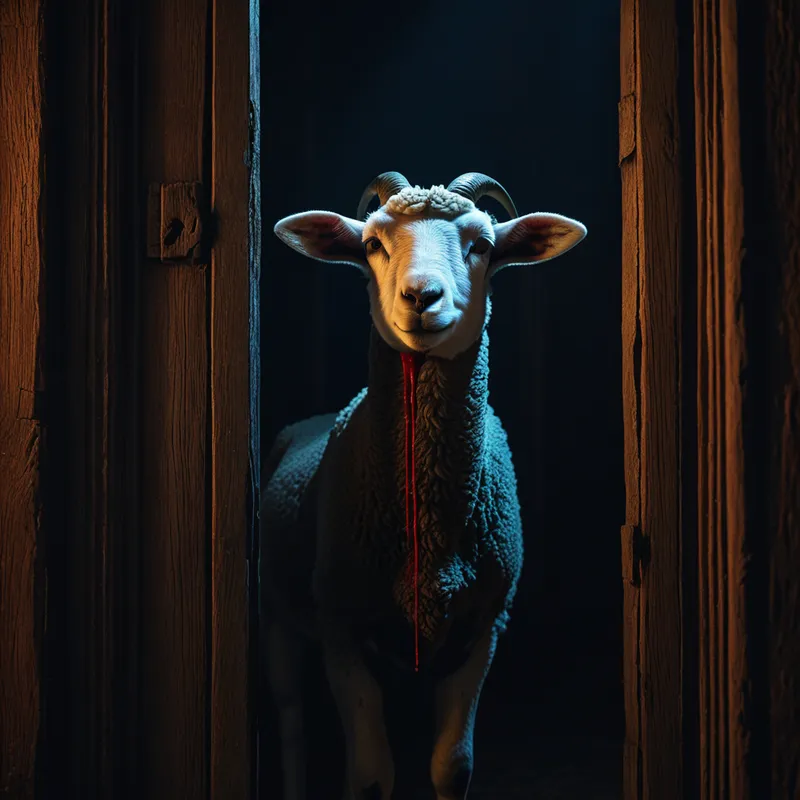
In every Israelite household, a ritual of trembling hands. An unblemished lamb, selected days before, was brought to the threshold. Its life, a gentle thing, was given. Its blood, still warm, was taken in a basin of hyssop. And with a solemn, desperate care, it was smeared upon the lintel and the two doorposts of each home. A crimson mark. A sign of obedience, of faith, of a terrible covenant. “And the blood shall be to you for a token upon the houses where ye are,” came the instruction. “And when I see the blood, I will pass over you.”
Inside, families gathered. They roasted the lamb with fire, ate it with bitter herbs and unleavened bread—food of haste, food of urgency. They ate with their loins girded, sandals on their feet, staff in hand. They were poised between a death behind and a wilderness ahead. And they waited.
Midnight.
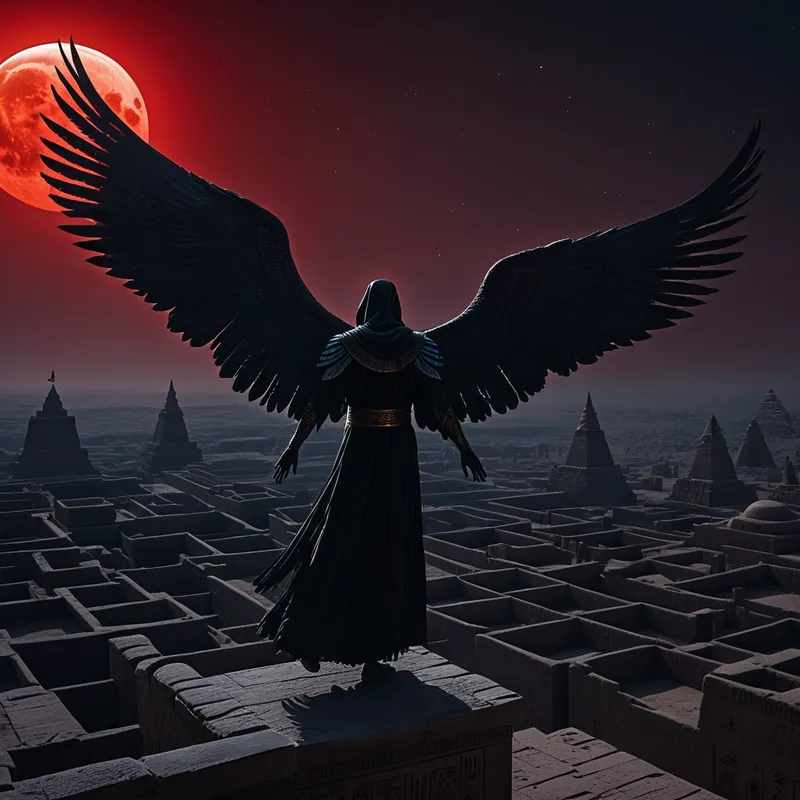
A sigh moved through the world, a wind that was not a wind. It was the unfolding of a presence—the Mashchit. No form could contain it, yet it was perceived as a vastness of shadow, a silence with wings that blotted out the stars. It passed not with a roar, but with the terrible, intimate sound of a final breath being drawn from a thousand thousand throats at once. It moved from house to house, a divine and awful scythe.
Where the door bore no mark, it entered. Not through the wood, but through the very air. A coldness touched the firstborn, from the son of Pharaoh on his throne to the son of the maid behind the mill, even to the firstborn of the cattle in the stalls. A touch, and a life was gathered. A great cry went up in Egypt, a sound of raw, uncomprehending grief, for there was not a house where there was not one dead.
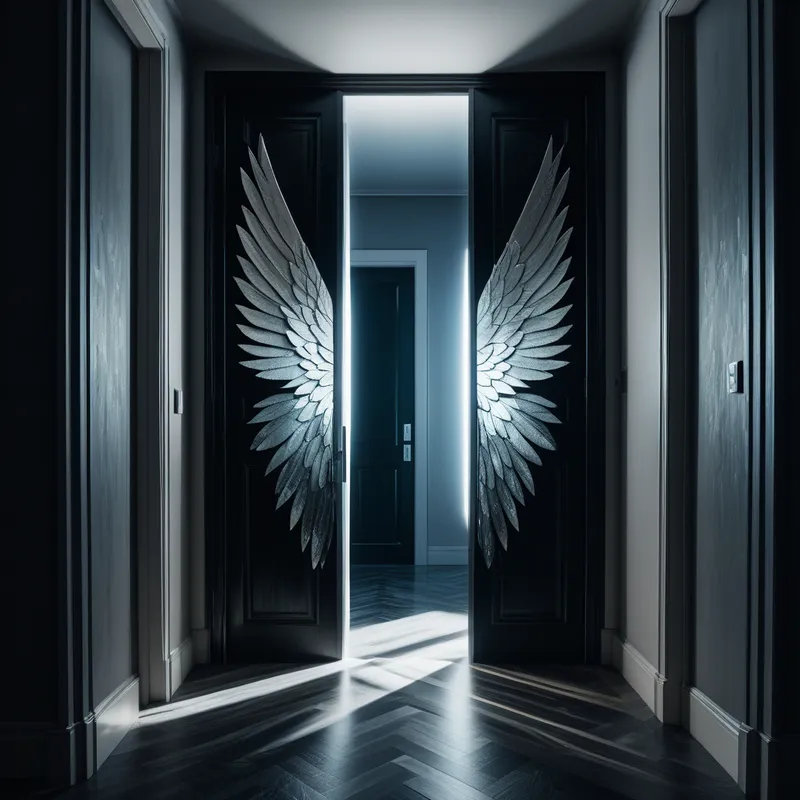
But where the doorframe bore the sign—that stark, red tav of an earlier script—the presence halted. It passed over. Inside, the children huddled close to their parents, hearing the wail outside, feeling the terror brush against their walls like a storm, yet held within a bubble of inexplicable peace. The blood was the boundary. The sacrifice was the shield. That night, in the land of bondage, two realities existed side-by-side: the realm of utter judgment, and the realm of miraculous sparing.
With the dawn came a liberation born of unparalleled grief. The Israelites, marked and spared, were thrust forth not by negotiation, but by the shattered will of a broken empire. They walked out of Egypt, not as fugitives, but as a people claimed by a power greater than any Pharaoh, carrying with them the memory of the night the Destroyer passed by.
Cultural Origins & Context
This foundational narrative is embedded in the Torah, in the Book of Shemot (Exodus). It is not merely a historical account but the central etiological myth of the Pesach (Passover) holiday. Its primary societal function was and remains identity-forming. The ritual retelling during the Seder, with its specific foods, questions, and recitations, is designed to make each generation feel as if they themselves personally went out from Egypt.
The myth was passed down through a sacred, participatory liturgy. The storytellers were the parents, instructed to explain the symbols to their children. The function was multifaceted: to explain the origin of a people’s freedom, to establish a covenant relationship with a God who acts in history, and to inculcate a profound sense of chosenness and moral responsibility born from the experience of redemption. It served as a perpetual reminder that their identity was forged in the crucible of a divine judgment that distinguished between the oppressed and the oppressor, demanding both ritual precision and ethical action.
Symbolic Architecture
At its core, this myth is about the [architecture](/symbols/architecture “Symbol: Architecture in dreams often signifies structure, stability, and the framing of personal identity or life’s journey.”/) of [differentiation](/symbols/differentiation “Symbol: The process of distinguishing or separating parts of the self, emotions, or identity from a whole, often marking a developmental or psychological milestone.”/) and the price of transition. The Mashchit is not a malevolent [demon](/symbols/demon “Symbol: Demons often symbolize inner fears, repressed emotions, or negative aspects of oneself that the dreamer is struggling to confront.”/) but an agent of divine will, an executor of a necessary, cosmic judgment. It represents the inexorable consequence of systemic [injustice](/symbols/injustice “Symbol: A perceived violation of fairness, rights, or moral order, often evoking a sense of imbalance or ethical breach.”/) and hardened hearts. Pharaoh’s Egypt symbolizes the entrenched, oppressive psyche—the “narrow place” (the meaning of Mitzrayim, Egypt)—that must be shattered for new [life](/symbols/life “Symbol: The symbol of ‘Life’ represents a journey of growth, interconnectedness, and existential meaning, encompassing both the joys and challenges that define human experience.”/) to emerge.
The threshold is the sacred space where destiny is decided. The mark upon it is not magic, but the external sign of an internal choice—alignment with the liberating force.
The [lamb](/symbols/lamb “Symbol: A symbol of innocence, purity, sacrifice, and new beginnings, often representing vulnerability and gentleness.”/)’s [blood](/symbols/blood “Symbol: Blood often symbolizes life force, vitality, and deep emotional connections, but it can also evoke themes of sacrifice, trauma, and mortality.”/) is the pivotal [symbol](/symbols/symbol “Symbol: A symbol can represent an idea, concept, or belief, serving as a powerful tool for communication and understanding.”/). It is life given, not taken. It represents substitution, dedication, and the tangible, vulnerable act of [faith](/symbols/faith “Symbol: A profound trust or belief in something beyond empirical proof, often tied to spiritual conviction or deep-seated confidence in people, ideas, or outcomes.”/). Smeared on the [door](/symbols/door “Symbol: A door symbolizes transition, opportunity, and choices, representing thresholds between different states of being or experiences.”/), it transforms the [entrance](/symbols/entrance “Symbol: An entrance symbolizes new beginnings, opportunities, or transitions, reflecting the dreamer’s readiness to face changes.”/) into a sacred [boundary](/symbols/boundary “Symbol: A conceptual or physical limit defining separation, protection, or identity between entities, spaces, or states of being.”/). This act creates a psychological and spiritual container—a marked self—that can withstand the annihilating winds of change or consequence. The myth posits that liberation from bondage (internal or external) is never free; it requires a sacrifice, a deliberate marking of one’s [space](/symbols/space “Symbol: Dreaming of ‘Space’ often symbolizes the vastness of potential, personal freedom, or feelings of isolation and exploration in one’s life.”/), and a willingness to stand in the terrifying space between the [death](/symbols/death “Symbol: Symbolizes transformation, endings, and new beginnings; often associated with fear of the unknown.”/) of the old and the [birth](/symbols/birth “Symbol: Birth symbolizes new beginnings, transformation, and the potential for growth and development.”/) of the new.
The Dreamer’s Resonance
When this mythic pattern surfaces in modern dreams, it seldom appears with biblical literalism. Instead, one may dream of a looming, impersonal force—a silent shadow, a pervasive cold, a sense of impending termination—approaching one’s home or psyche. The somatic experience is often one of dread, a freezing in place, a profound vulnerability.
The critical element in the dream is the door or boundary. Is it marked? Is there a recognizable, perhaps irrational, symbol of protection? The dream may present the task: finding the “blood” to apply. This represents the dreamer’s unconscious recognition that a profound psychological shift is required to pass through a crisis. The “Destroyer” symbolizes the necessary death of an old identity, a outmoded complex, or a toxic pattern. The terror is real, for the psyche knows that some part of the self must end. The dream asks: What sacrifice of a cherished attitude (“the unblemished lamb” of one’s self-image) is required? What act of commitment (the marking) must be made to differentiate the nascent, authentic self from the doomed structures of the past?
Alchemical Translation
Psychologically, the Passover myth models the alchemical stage of separatio and the ordeal of the nigredo—the blackening. The oppressive “Egypt” is the dominant, conscious attitude that has become a prison. Pharaoh is the tyrannical ego-complex, refusing to heed the calls of the Self (the Tetragrammaton) for change.
The plagues represent the increasing, often chaotic, pressure from the unconscious to force a crisis. The final, ultimate pressure is the threat of total psychic death—the annihilation of the old way of being. The individuating ego here faces its most critical task: it must actively participate in its own redemption. It must find and sacrifice what is pure and innocent within the old system (the lamb) and use its essence (the blood) to clearly demarcate its new boundary.
Individuation requires a conscious, ritual act of self-definition in the face of the inner Destroyer—the shadow of transformation that feels like annihilation.
To “apply the blood” is to make a solemn, perhaps irrational, commitment to the new orientation. It is to say, “This is where I end, and the old pattern ends.” The Angel passes over this marked space because the work of separation has been done internally. What is “killed” is the “firstborn” of Egypt—the primary product and heir of the old, oppressive system. The liberated individual then steps into the “wilderness,” a state of fragile, unknown potential, carrying only the memory of the night they were spared, forever changed by the intimate knowledge of the cost of their own freedom.
Associated Symbols
Explore related symbols from the CaleaDream lexicon:
- Blood — The central symbol of life given in sacrifice, representing covenant, protection, and the tangible cost of marking a boundary between death and liberation.
- Door — The critical threshold of the home and the self, the interface where an external sign determines internal fate, separating safety from judgment.
- Angel — The divine agent of execution, representing an impersonal, terrifying aspect of the sacred that enforces cosmic law and necessary endings.
- Sacrifice — The conscious offering of something precious and unblemished (the lamb) to secure passage and protection through a period of profound crisis and transformation.
- Shadow — The Angel of Death as the ultimate shadow archetype, embodying the terrifying but necessary force of termination that must be faced and navigated for growth.
- Ritual — The prescribed, precise actions of selecting the lamb, applying the blood, and eating the meal, which transform faith into a tangible, protective reality.
- Journey — The immediate exodus from Egypt into the wilderness, representing the abrupt, disorienting transition from structured bondage to uncharted freedom.
- Order — The divine decree and the precise instructions for the Passover, representing a cosmic law and structure that supersedes human political and social order.
- Fear — The palpable, collective terror of the midnight judgment, a necessary emotional crucible that shatters old resistances and makes liberation inevitable.
- Light — The promise of survival and the dawning of a new day after the darkness of judgment, symbolizing the hope and guidance that follows a harrowing ordeal.
- Rebirth — The emergence of the Israelite people as a distinct nation, born from the womb of a night of death, symbolizing the new identity forged through a traumatic passage.
- Destiny — The marked households are spared not by chance but by alignment with a divine plan, representing the call to a fate larger than individual circumstance.