The Parable of the Sower Myth Meaning & Symbolism
A teacher shares a story of a sower whose seed falls on four types of ground, revealing the fate of the sacred word within the human soul.
The Tale of The Parable of the Sower
Listen. Come close to the water’s edge, where the crowd presses in, a sea of hungry faces turned toward the lone figure on the boat. The air is thick with the smell of fish and dust, of unwashed wool and desperate hope. He sits, this teacher from Nazareth, the lake a rippling silver mirror behind him. He begins to speak, and his voice is not a shout, but a low, carrying tone that stills the murmur of the multitude.
“A sower went out to sow.”
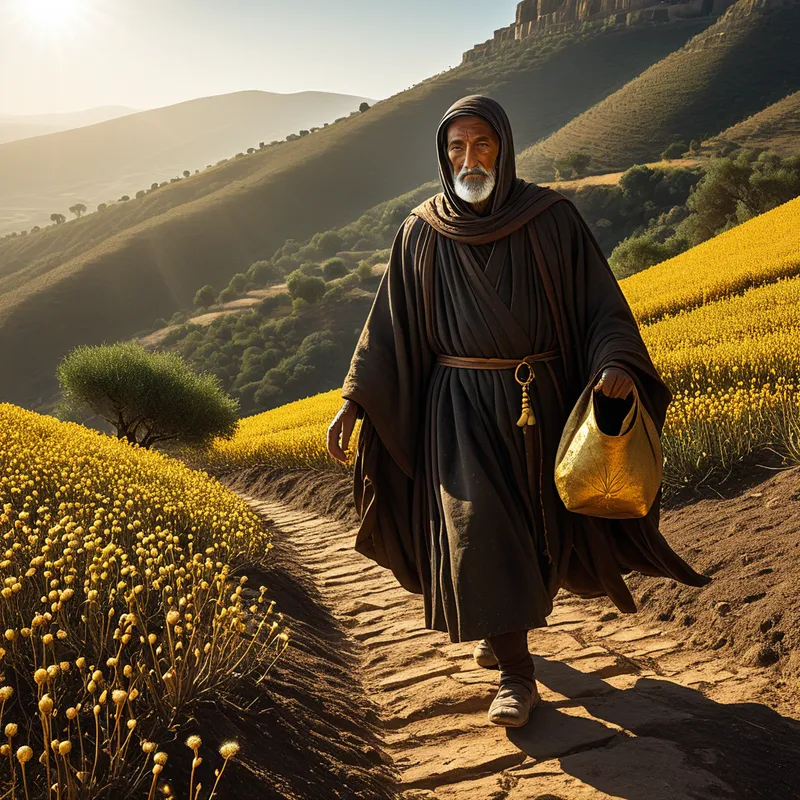
See him now, in the mind’s eye he conjures. A man of the earth, his tunic stained with soil, a heavy pouch slung across his chest. The sun is a hammer on the back of his neck as he walks the boundary of his field. With a broad, practiced arc of his arm, he casts the seed. It flies from his hand like flecks of captured sunlight.
But the path is hard, trodden by countless feet. The seed falls there, and before it can even dream of burial, the dark shadows descend—the birds of the air. They come in a flurry of wings and sharp cries, and they devour every last grain.
Other seed falls where the earth is thin, a mere skin of soil over a shelf of relentless stone. It springs up with a joyful, urgent green—but it has no depth. When the sun ascends its throne and pours down its fury, the tender shoot is scorched. It withers, rootless, because it could find no anchor in the rock.
Still other seed falls among thorns. It too grows, pushing through the soil, but it is not alone. The thorns, old and entrenched and hungry, rise up with it. They clutch and choke the life from the young plant, crowding it, stealing its light and its nourishment until it is strangled, yielding nothing.
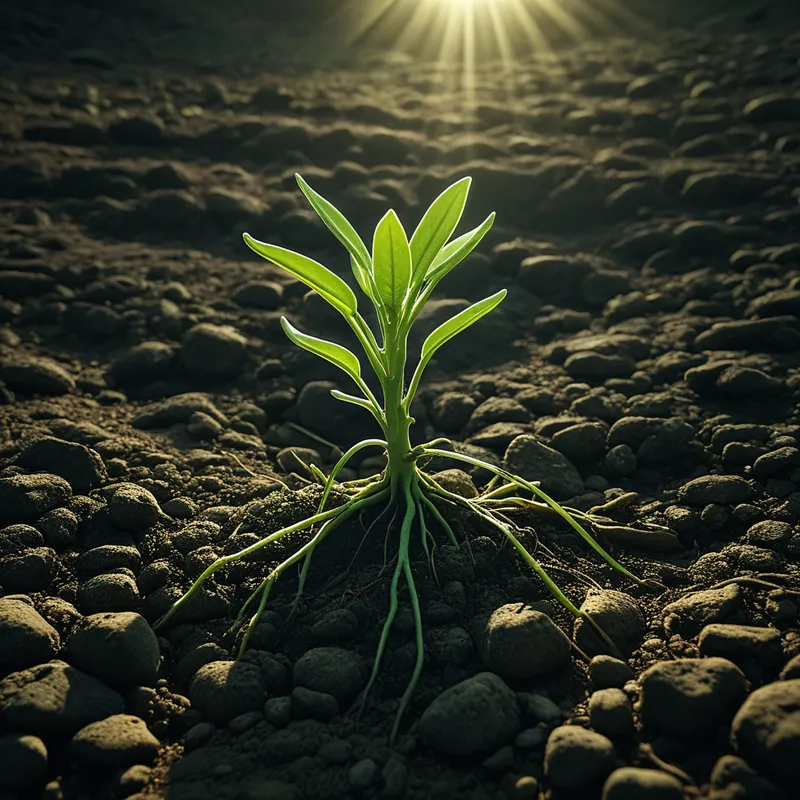
But some seed—ah, listen—some seed falls on good soil. It finds earth that is deep, dark, and open. It is received. It is buried. In that secret, fertile darkness, it splits its own heart open. A root drives down, seeking the hidden waters. A stem pushes up, seeking the true sun. And it grows, and it thrives, and it bears fruit: thirtyfold, sixtyfold, a hundredfold. A harvest of impossible abundance from a single, forgotten grain.
He finishes speaking. The parable hangs in the air, simple as a tool, mysterious as a locked box. The crowd is silent, some faces blank, some alight with a dawning, troubled wonder. He says to them, “He who has ears to hear, let him hear.” And the invitation, like the seed itself, falls upon every type of ground present.
Cultural Origins & Context
This story originates from the Synoptic Gospels, a core teaching of Jesus delivered during his itinerant ministry in first-century Roman-occupied Judea and Galilee. It is a quintessential parable, a form of wisdom teaching that uses an everyday, agrarian scenario to veil and reveal a deeper, spiritual truth. In an oral culture where most livelihoods were tied to the land, the image of the sower was immediately accessible.
The parable was not merely religious instruction; it was a diagnostic tool and a mirror. Told to vast, mixed crowds from fishermen to Pharisees, it functioned societally to explain the perplexing results of the teacher’s own mission. Why did some hear and transform, while others remained indifferent or hostile? The story provided a framework, placing the onus not on the quality of the seed (the message) or the skill of the sower, but on the conditioned state of the receiving heart—the psychē or soul. Its preservation and interpretation by the early Christian community underscored its central importance as a key to understanding the nature of faith, resistance, and spiritual growth.
Symbolic Architecture
At its core, the parable is a profound map of consciousness. It is not about agriculture, but about the reception of meaning—the gnosis—into the human psyche.
The Sower represents the source of transformative insight, whether imagined as the divine, the unconscious Self, or a moment of profound external wisdom. The Seed is the living word, the potent idea, the call to awakening. It is pure potential. The drama lies entirely in the Ground, the four states of the human soul.
The path is the defended psyche, where consciousness is hardened by convention, trauma, or cynicism. The insight cannot penetrate; it is snatched away by the “birds”—the distracting, critical, and literalistic thoughts of the everyday mind before it can ever take root.
The rocky ground is the psychology of enthusiastic but shallow identification. The idea is embraced with fervor, but only by the conscious ego. It lacks connection to the deep, moist soil of the body, the instincts, and the enduring structures of the soul. When the heat of life’s trials arrives, this rootless enthusiasm burns away.
The thorny ground is the crowded inner world. Here, the seed of new potential must compete with the entrenched, choking “thorns” of anxiety, worldly cares, the lust for results, and the ego’s endless wants. The new growth is suffocated by the old, habitual complexes.
The good soil is the soul made receptive through preparation—through suffering that softens, through introspection that clears, through a humility that allows for deep burial. Here, the seed is allowed to die as a seed. It decomposes its old form so that its essence can reorganize into something entirely new: a rooted, resilient, and fruit-bearing life.

The Dreamer’s Resonance
When this mythic pattern stirs in the modern dreamscape, it signals a critical moment of psychic reception. To dream of seeds may indicate a new idea, feeling, or calling seeking incarnation. The condition of the ground in the dream—whether you are walking on a hard path, struggling through thorns, or feeling rich soil—is a direct somatic report on your current capacity for integration.
Dreaming of barren earth or hungry birds might reflect a period of intellectual or spiritual aridity, where nothing seems to “stick,” and insights are quickly dismissed or forgotten. A dream of a plant withering under a harsh sun could point to a nascent project, relationship, or aspect of the self that was launched with passion but is now faltering due to a lack of foundational support or depth of commitment. Choking thorns in a dream often manifest as familiar, nagging anxieties or the faces of those who drain your energy, symbolizing internalized pressures that stifle growth. Conversely, a dream of planting in dark, fertile soil and tending a thriving plant is a powerful affirmation from the unconscious: the psyche is in a state of readiness, and the work of deep transformation is underway.

Alchemical Translation
The parable models the complete alchemical cycle of individuation. The nigredo, or blackening, is the necessary “falling to the ground” and the burial—the humiliation of the brilliant idea into the darkness of the unconscious, where it must decompose. The ego does not cultivate the seed; it must first consent to be cultivated by it.
The stone, the thorns, and the path are not failures, but necessary revelations. They are the prima materia of the soul—the raw, flawed, and resistant stuff that must be recognized and worked with. Becoming conscious of one’s own rocky shallowness or weedy anxieties is the first, crucial step in tilling the inner field.
The goal is not merely to receive the seed, but to become the good earth itself—a vessel of fertile darkness. This requires the hard, patient work of clearing (confronting complexes), breaking up the fallow ground (softening rigid attitudes), and composting the old (integrating shadow material). The fruit—thirty, sixty, a hundredfold—symbolizes the emergent property of this process. It is not the ego’s achievement, but the soul’s natural, abundant yield: creativity, compassion, wisdom, and a life that nourishes others. The sower sows indiscriminately, but the harvest depends entirely on the alchemical preparation of the vessel. The parable, therefore, is an eternal map for the transformation of potential into being, of the word into flesh, within the sacred ground of a single human life.
Associated Symbols
Explore related symbols from the CaleaDream lexicon: