The Papyrus Plant Myth Meaning & Symbolism
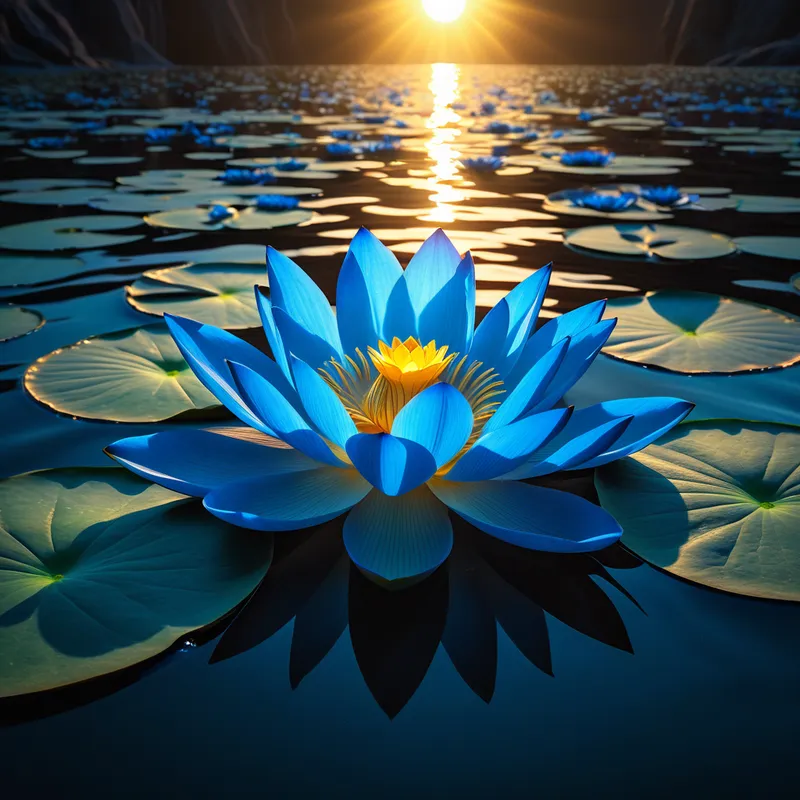
A myth of cosmic birth where the sun god Ra emerges from a primordial lotus, rising from the dark waters of Nun to bring light and order to the world.
The Tale of The Papyrus Plant
In the time before time, there was only the dark, silent, endless [water](/myths/water “Myth from Chinese culture.”/). This was Nun, a fathomless ocean without shore, without light, without form. It was the great potential, [the womb](/myths/the-womb “Myth from Various culture.”/) of all that ever could be, but it slept in a dreamless, motionless night. There was no up, no down, only the cold, wet embrace of [the void](/myths/the-void “Myth from Buddhist culture.”/).
Then, in the heart of that infinite dark, a stirring began. Not a sound, for there was no air to carry it, but a vibration—a yearning. From the deep, unseen bed of Nun, a green shoot began to rise. It was not a plant as we know it, but the first idea of a plant, the shen of life itself. It pushed upward through the heavy, resisting waters, a single point of intention in the formless expanse. This was the Sesen, the primordial [lotus](/myths/lotus “Myth from Hindu culture.”/).
Its journey was an eternity. It climbed through the crushing weight of non-being, driven by a force not yet named. Finally, its closed bud broke the skin of the waters, piercing the surface of Nun into… nothing. An emptiness as vast as the waters below. Yet here, at this impossible interface between the deep and the void, the bud paused. It gathered the last of the ancient power from [the abyss](/myths/the-abyss “Myth from Kabbalistic culture.”/) below. And then, it began to open.
The unfurling of its petals was the first act. It was the first movement, the first separation. Each petal, a brilliant, luminous blue, peeled back from the center, and with it, light spilled forth. Not the light of a sun, but the light of awareness, of existence acknowledging itself. And in the very heart of the flower, seated upon the golden anther, was a child. A radiant, divine infant, glowing with a gentle, fierce warmth. This was Ra, [the self](/myths/the-self “Myth from Jungian culture.”/)-created one.
He opened his eyes. And that was the first dawn. His gaze swept across the petal of [the lotus](/myths/the-lotus “Myth from Hindu culture.”/), which became the first land, the Benben stone. His breath became Shu, the atmosphere. The moisture of his first cry became Tefnut. From the platform of [the lotus](/myths/the-lotus “Myth from Hindu culture.”/), standing upon the mound that rose from Nun, Ra began to speak [the world](/myths/the-world “Myth from Tarot culture.”/) into being. The lotus itself, its stem now the pillar of the world, its flower the cradle of the sun, remained. It would close each night, drawing Ra back into its protective embrace as he traveled through [the underworld](/myths/the-underworld “Myth from Greek culture.”/), and open each dawn to birth him anew into [the sky](/myths/the-sky “Myth from Persian culture.”/). The first journey was complete. Order, Maat, had been drawn, shimmering and fragile, from the waiting, eternal chaos of the deep.
Cultural Origins & Context
This creation narrative is not a single, canonical text but a foundational motif woven into the fabric of Egyptian theological and cosmological thought. It is most famously associated with the theology of Iunu (Heliopolis), where the cult of Ra was paramount. The imagery of the lotus-born sun god appears in [Pyramid Texts](/myths/pyramid-texts “Myth from Egyptian culture.”/), the oldest religious writings in the world, carved into the burial chambers of pharaohs to guide their solar rebirth. It is elaborated in Coffin Texts and later, the Book of the Dead.
The myth was not merely a story of the past; it was a continuous, lived reality. Every sunrise was a re-enactment of this primordial event. [The pharaoh](/myths/the-pharaoh “Myth from Egyptian culture.”/), as the son of Ra, embodied this principle of cyclical renewal. The architectural and artistic language of Egypt is saturated with it: lotus columns held up temple roofs, symbolically supporting the sky; ritual libations were poured from vessels shaped like lotuses; and in daily life, the sight of the blue lotus (Nymphaea caerulea) closing at night and reopening with the morning sun was a daily, observable miracle that reinforced the myth. It was a core metaphor for understanding existence itself—as a perpetual, fragile victory of conscious form over unconscious potential.
Symbolic Architecture
The myth presents a profound map of psychic origination. Nun represents the undifferentiated unconscious—the state of potential containing all possibilities but no distinct forms. It is the psychological “ground of being,” the inner [ocean](/symbols/ocean “Symbol: The ocean symbolizes the vastness of the unconscious mind, representing deeper emotions, intuition, and the mysteries of life.”/) of dreams, instincts, and unformed [energy](/symbols/energy “Symbol: Energy symbolizes vitality, motivation, and the drive that fuels actions and ambitions.”/).
The lotus rising from the waters is the archetypal symbol of the Self emerging from the unconscious. It is the first act of differentiation, where a point of identity begins to distinguish itself from the boundless whole.
The lotus plant itself is a perfect [symbol](/symbols/symbol “Symbol: A symbol can represent an idea, concept, or belief, serving as a powerful tool for communication and understanding.”/) for this process. Rooted in the muddy, chaotic [depths](/symbols/depths “Symbol: Represents the subconscious, hidden emotions, or foundational aspects of the self, often linked to primal fears or profound truths.”/) (the unconscious), its stem passes through the waters (the process of emerging), and it blooms, pristine and beautiful, in the air and light (the [realm](/symbols/realm “Symbol: The symbol of ‘Realm’ often signifies the boundaries of one’s consciousness, experiences, or emotional states, suggesting aspects of reality that are either explored or ignored.”/) of [consciousness](/symbols/consciousness “Symbol: Consciousness represents the state of awareness and perception, encompassing thoughts, feelings, and experiences.”/)). It is not rejecting its [source](/symbols/source “Symbol: The origin point of something, often representing beginnings, nourishment, or the fundamental cause behind phenomena.”/) but is inextricably linked to it, drawing nourishment from the very [chaos](/symbols/chaos “Symbol: In Arts & Music, chaos represents raw creative potential, uncontrolled expression, and the breakdown of order to forge new artistic forms.”/) it transcends.
Ra, the [child](/symbols/child “Symbol: The child symbolizes innocence, vulnerability, and potential growth, often representing the dreamer’s inner child or unresolved issues from childhood.”/) of the lotus, symbolizes the nascent ego-consciousness, the “I” that first becomes aware of itself. His first act—creating Shu and Tefnut (air and moisture)—represents the establishment of psychic [space](/symbols/space “Symbol: Dreaming of ‘Space’ often symbolizes the vastness of potential, personal freedom, or feelings of isolation and exploration in one’s life.”/) and the flow of [emotion](/symbols/emotion “Symbol: Emotion symbolizes our inner feelings and responses to experiences, often guiding our actions and choices.”/), the necessary conditions for a structured inner world. The entire [cosmos](/symbols/cosmos “Symbol: The entire universe as an ordered, harmonious system, often representing the totality of existence, spiritual connection, and the unknown.”/) he then creates is the ordered [psyche](/myths/psyche “Myth from Greek culture.”/), built upon the foundational principle of Maat (cosmic order and [truth](/symbols/truth “Symbol: Truth represents authenticity, honesty, and the quest for knowledge beyond mere appearances.”/)), which in psychological terms is the integrative, balancing function of the Self.
The Dreamer’s Resonance
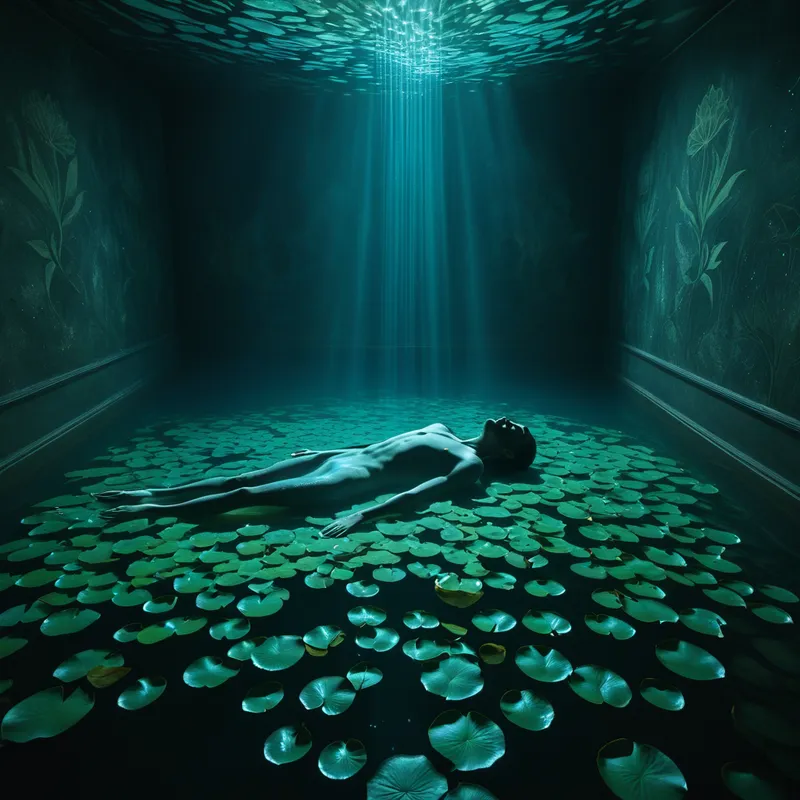
When this mythic pattern stirs in the modern dreamer, it often signals a profound process of inner genesis or rebirth. To dream of being submerged in dark, calm, or sometimes threatening waters speaks to a state of immersion in the unconscious. One may feel lost, directionless, or in a period of potent incubation.
The appearance of a plant—specifically a lotus or a tall, graceful reed like [papyrus](/myths/papyrus “Myth from Egyptian culture.”/)—breaking the surface of these waters is the dream’s announcement of an emerging new consciousness. This is not an intellectual idea, but a somatic, living growth from the depths of the dreamer’s being. It may feel fragile, miraculous, or desperately urgent. The dreamer might be the plant, feeling the struggle to rise, or they might be an observer, witnessing this sacred event within themselves.
Such dreams often accompany life transitions where a new aspect of the personality or a new level of awareness is struggling to be born: the end of a major life chapter, a creative awakening, a spiritual crisis, or the slow recovery from trauma. The somatic sensation is one of pressure, then release; of being held down, then finding an innate, upward-driving force. The psyche is performing its most ancient ritual: drawing forth light from its own inner darkness.
Alchemical Translation
The alchemical process mirrored in this myth is the [Nigredo](/myths/nigredo “Myth from Alchemical culture.”/), the descent into the primal, chaotic matter (Nun), followed by the Albedo, the emergence of the white, purified spirit (the luminous lotus and the radiant Ra). For the modern individual, this is the model of psychic transmutation we call individuation.
The journey begins with a voluntary or involuntary immersion in one’s own Nun—[the shadow](/myths/the-shadow “Myth from Jungian culture.”/), the repressed memories, the un-lived life, the chaotic swirl of unlanguaged emotion. This is the dark night. [The ego](/myths/the-ego “Myth from Jungian culture.”/), accustomed to its small, ordered world, feels annihilated. Yet, this is not an end, but the necessary return to the source material of the Self.
The struggle of the lotus stem is the pain of growth, the friction required for consciousness to differentiate itself from the unconscious matrix. There is no other way.
The blooming is the moment of insight, the “Aha!” that comes not from linear thinking, but from a deep, organic unfolding. The new consciousness (Ra) that is born is not the old ego, inflated. It is a more connected, solar awareness that recognizes its origin in the dark waters and its role in maintaining inner Maat. It understands that to remain vital, it must, like the sun, descend each night (acknowledge the unconscious) and be reborn each dawn (renew conscious engagement).
Thus, the myth teaches that our deepest creativity, our most authentic self, is not built through willpower alone, but is born from the silent, fertile darkness within us. Our task is not to flee the waters of Nun, but to learn to stand, like the first land, upon them, allowing the lotus of awareness to root in our depths and bloom in our lived experience, again and again.
Associated Symbols
Explore related symbols from the CaleaDream lexicon: