The Pantheon Myth Meaning & Symbolism
The story of the Olympian gods, born from primordial chaos and titanic struggle, establishing a cosmic order of divine powers and human fate.
The Tale of The Pantheon
Listen. Before the sun knew its path and the sea its shore, there was only a yawning, formless chasm: Chaos. From its dark womb emerged the first powers: the wide-bosomed Earth, Gaia, and the starry, desiring Sky, Ouranos. Their union birthed the Titans, mighty and ancient, and the Cyclopes, with their storm-forging hands. But Ouranos, fearing their strength, shoved them back into Gaia’s dark depths. Her womb became a prison; her pain, a plot.
She fashioned a sickle of adamant and whispered to her youngest Titan son, Kronos. “Take this. Free your siblings. End his tyranny.” In the violet twilight where sky met earth, Kronos lay in wait. When Ouranos descended to embrace Gaia, Kronos struck. The sickle flashed. Ouranos was severed, his reign bleeding into the ether. From that spilled divine blood, new furies and giants were born. Kronos claimed the throne.
But a prophecy echoed in his new halls: “You too shall be overthrown by your own child.” Fear, the seed of his father, took root. When his sister-queen Rhea bore their children—Hestia, Demeter, Hera, Hades, Poseidon—Kronos did not cradle them. He opened his vast maw and swallowed each whole, consigning them to the silent, churning dark within him. The universe held its breath.
Rhea, wracked with a grief as deep as Gaia’s, fled to a Cretan cave when her sixth child quickened. There, amidst the sound of bees and the smell of damp earth, she bore Zeus. She wrapped a stone in swaddling clothes and presented it to Kronos, who devoured it without a glance. The true infant, hidden in the cave, was nourished by the goat Amaltheia, while the Kouretes clashed their spears on shields to drown out his cries.
Zeus grew, and a fire kindled in him that was more than lightning. He sought out the Titaness Metis. Together, they crafted a potion of powerful emetics. Disguised as a cupbearer, Zeus served it to his father. Kronos drank, and his body convulsed. He vomited forth the stone first, then his children, whole and unharmed, emerging not as infants but as glorious, fully-formed gods, their eyes blazing with the wisdom of the abyss. The war that followed—the Titanomachy—shook the pillars of the cosmos. The Olympians, freed and furious, allied with the Cyclopes and Hecatoncheires Kronos had imprisoned. The Cyclopes forged Zeus his thunderbolt, Poseidon his trident, Hades his helm of darkness.
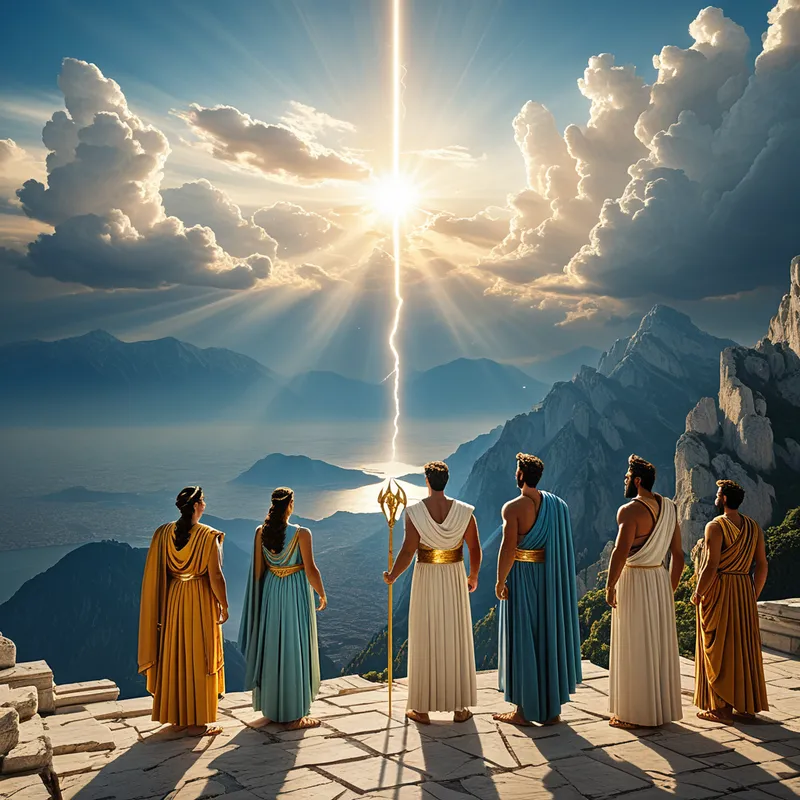
For ten years, heaven and earth were a battlefield. Finally, the Olympians prevailed. They cast the defeated Titans into the deepest pit, Tartarus, and appointed the Hecatoncheires as their eternal guards. The old order, ruled by fear and consumption, was broken. The three brothers drew lots for their realms: Zeus won the sky, Poseidon the sea, Hades the underworld. They ascended to the sunlit peaks of Mount Olympus, not as solitary tyrants, but as a council, a pantheon. A new order was born, one of law, domain, and intricate, often tumultuous, relationship. The age of gods who reflected the full spectrum of existence—love, war, wisdom, craft, and fate itself—had begun.
Cultural Origins & Context
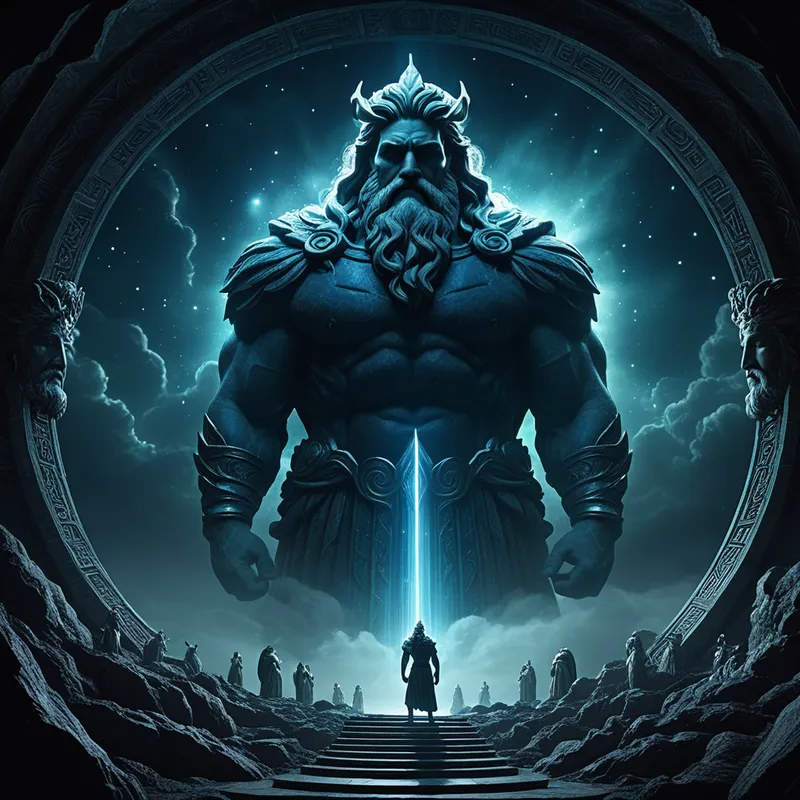
This foundational narrative is not the product of a single author, but the coalescence of centuries of oral tradition across the Greek world. It was the currency of bards like Homer and Hesiod, who, in the 8th century BCE, gave it its most enduring literary forms in the Iliad, the Odyssey, and the Theogony. These works were not scripture, but a shared cultural bedrock performed at festivals and in royal courts. The myth served a critical societal function: it explained the origin of the world (cosmogony) and justified the current divine and, by extension, social order. The pantheon mirrored the Greek city-state (polis), with Zeus as its king, a council of specialized deities, and a complex system of alliances, rivalries, and jurisdictions. It taught that order—however hard-won and imperfect—was preferable to primordial chaos or tyrannical stagnation, and that power must be earned and shared, not merely seized and hoarded.
Symbolic Architecture
The Pantheon myth is a grand allegory for the structuring of consciousness itself. The formless Chaos represents the undifferentiated unconscious. From it emerge the primordial opposites—Earth and Sky, feminine and masculine principles—whose conflict generates the first structures: the Titans. They symbolize the archaic, instinctual powers of the psyche, immense but often cruel and unconscious.
The act of Kronos castrating Ouranos is the psyche’s first, violent attempt to separate from the overwhelming totality, to create distinction, but it is an act born of fear, not wisdom.
Kronos’s subsequent swallowing of his children is the ultimate image of psychic stagnation: the ego (Kronos) consuming its own potential, refusing to let new consciousness be born for fear of being superseded. The children in his belly are the latent archetypal forces—sovereignty, the underworld, the emotional depths, nourishment—waiting to be realized.
Zeus’s liberation represents the emergence of the differentiating ego-consciousness. He does not simply repeat his grandfather’s tyranny; he enlists cunning (Metis) and forges alliances. His victory establishes a hierarchical psyche, where different archetypal energies (the Olympians) have distinct domains and can be called upon. This is the birth of a conscious, if complex, internal order.
The Dreamer’s Resonance
When the dynamics of the Pantheon play out in modern dreams, the dreamer is often in a profound state of psychic reorganization. Dreaming of being trapped in a dark, enclosed space may echo the swallowed siblings, signaling a feeling that one’s talents, emotions, or potential are being suppressed by an old, fearful pattern (a “Kronos complex”). A dream of a great, chaotic battle between elemental forces often precedes a significant life transition, mirroring the Titanomachy—the inner conflict between outdated, monolithic aspects of the self and emerging, more nuanced capacities.
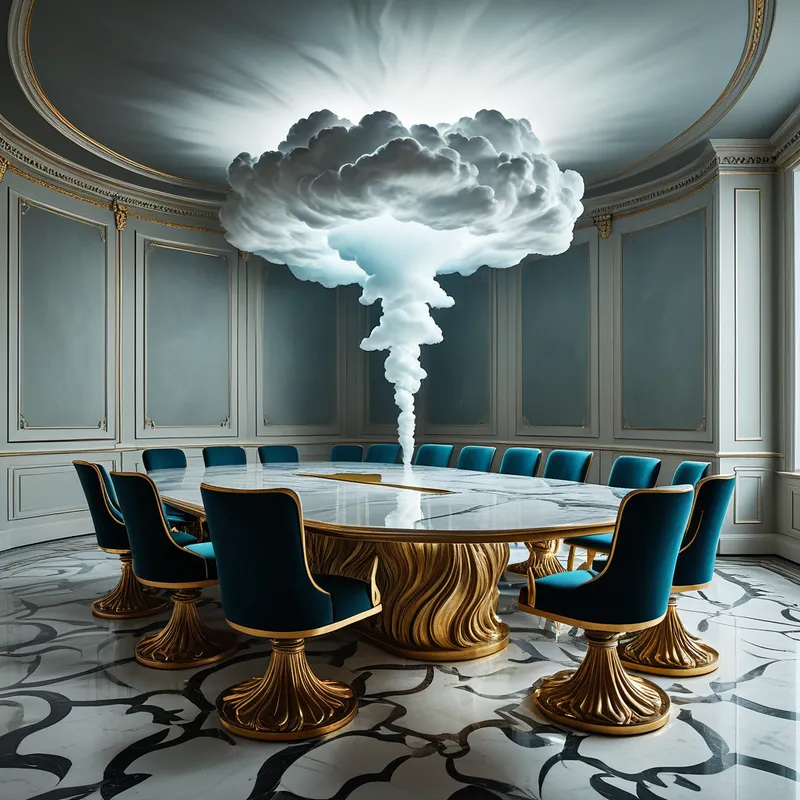
Dreaming of a council meeting, a gathering of distinct powerful figures, or receiving a specialized tool (like a trident or a helm) suggests the psyche is actively differentiating. It is moving from a state of confused, global anxiety or depression (chaos/Titanic rule) toward a more articulated self-understanding, where different parts—the inner ruler, lover, warrior, sage—are taking their rightful seats at the table of consciousness.
Alchemical Translation
The myth models the alchemical process of individuation—the journey toward psychic wholeness. The initial state is nigredo, the black chaos. The rule of Ouranos and Kronos represents a stuck, repetitive circumambulatio around the problem of the oppressive Father/ego. The key turning point is the separatio and solutio facilitated by the feminine: Gaia’s cunning and Rhea’s deception. The potion given by Zeus is the coniunctio of masculine will and feminine wisdom that dissolves the hardened, devouring complex.
The vomiting forth of the gods is the psychic albedo, the whitening: a purgative release of previously swallowed contents, now returned not as threats, but as allies.
The war and subsequent drawing of lots symbolize the coagulatio—the re-forming of these freed energies into a stable, operational structure. The established Pantheon on Olympus represents the rubedo, the reddening or culmination: not a state of perfect peace, but a dynamic, conscious system capable of engaging with the full spectrum of life’s experiences. The modern individual undergoes this same transmutation when they stop being ruled by a single, fearful, consuming complex (a career, a trauma, an addiction) and instead work to liberate and integrate their diverse inner “gods”—their capacity for authority, depth, passion, intellect, and creativity—into a functioning, self-governed whole.
Associated Symbols
Explore related symbols from the CaleaDream lexicon: