
The Pandit's Hat Myth Meaning & Symbolism
A learned pandit's prized hat becomes a vessel for a profound lesson on the nature of true wisdom and the emptiness of conceptual knowledge.
The Tale of The Pandit’s Hat
Listen, and let the winds of the high plateau carry this tale to you.
In a monastery perched like an eagle’s nest upon the spine of the world, there lived a pandit named Lobsang. His knowledge was as vast as the sky, his memory a flawless mirror reflecting every sutra, every commentary, every philosophical nuance. But his greatest treasure, the jewel of his identity, was his hat. It was no ordinary headpiece. It was a towering, intricate construction of brocade and gold thread, a rigs-nga, a crown of scholarship. Each fold held a treatise, each color a school of thought. To see it was to see knowledge itself, walking.
One day, a great master, a Mahasiddha known for his piercing simplicity, came to the monastery. The air itself seemed to still in his presence. The pandits gathered, Lobsang at their forefront, his hat a proud banner. They prepared for a grand debate, a festival of intellect to honor the master.
The master sat in silence. Lobsang began, his voice a river of elegant logic, quoting Nagarjuna and Dignaga, building castles of concepts in the air. The master listened, a faint smile on his lips. When Lobsang finished, breathless with the exertion of his own brilliance, the master simply pointed to a wild lotus growing by a murky pond at the courtyard’s edge.
“Bring me that flower,” he said.
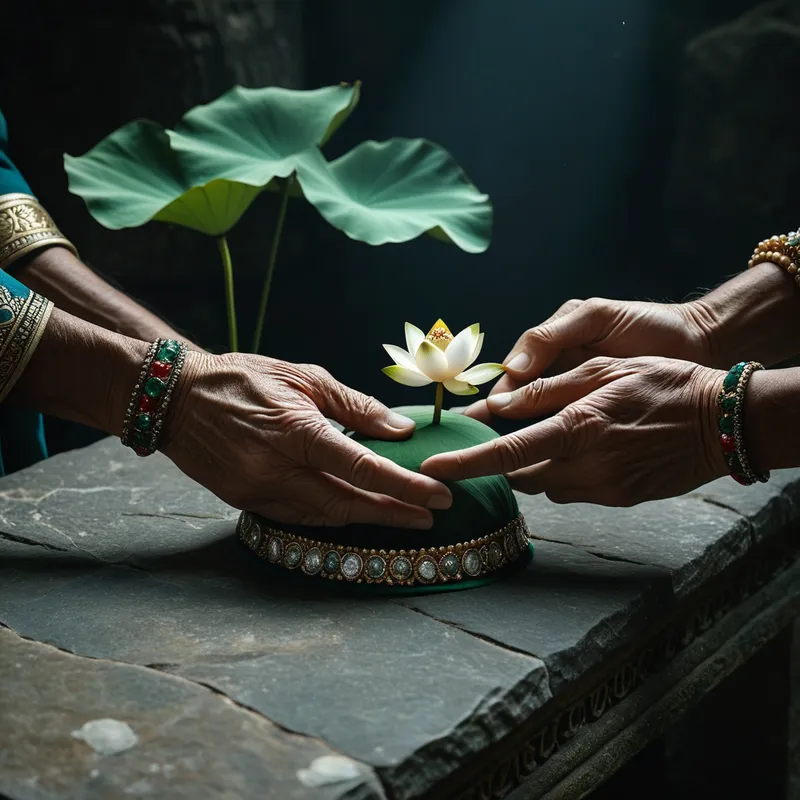
Puzzled, Lobsang retrieved the lotus, its petals still damp with pond water. The master took it. Then, with a gesture of infinite gentleness, he placed the simple, muddy lotus on top of Lobsang’s magnificent, jeweled hat.
A profound silence fell. The pandit stood frozen, feeling the absurd weight of the flower upon the monument of his learning. He waited for a refutation, a counter-argument, a philosophical riposte. None came. The master only gazed at him, his eyes holding the quiet of a mountain lake.
And in that endless moment, something within Lobsang broke. Not his knowledge, but the fortress he had built around it. The towering hat, his pride and his prison, suddenly felt unbearably heavy, ludicrously ornate next to the flawless, silent teaching of the lotus. A hot shame washed over him, followed by a cool, expanding emptiness. He did not understand with his mind, but he knew. The conceptual edifice collapsed, and in its place was… space. A vast, open sky where before there had only been the intricate architecture of his own ego.
Without a word, Lobsang removed his great hat, placed it on the stone bench, and laid the lotus upon it. He bowed deeply to the master, and then to his own abandoned crown. He walked away, not as a pandit, but as a student again, his head bare to the sun and the wind, finally ready to learn.
Cultural Origins & Context
This story, in its many variations, is a classic Jataka or Dharma tale, circulating orally for centuries within Tibetan and broader Mahayana Buddhist communities. It belongs not to the canonical sutras but to the living tissue of pedagogical folklore, told by teachers to students grappling with the paradox of “studying emptiness.” Its primary function is corrective, aimed at the perennial danger of the scholarly path: the confusion of intellectual mastery for spiritual realization. In a culture that venerates learning and debate, this myth serves as a necessary iconoclast, a reminder that the map is not the territory. It was likely told in monastic colleges (Shedras) when a student became puffed up with book-knowledge, or to introduce the crucial leap from conceptual understanding (shes-rab) to transcendent wisdom (prajnaparamita).
Symbolic Architecture
The myth’s power lies in its stark, almost alchemical, symbolism. Each element is a precise pointer to an inner state.
The Pandit’s Hat is the ego-identity constructed from achievement, status, and conceptual knowledge. It is elaborate, heavy, and visible to all—a self-created crown that simultaneously honors and imprisons. It represents the constructed self, the “I” that knows.
The Lotus is the symbol of innate, pristine wisdom (Buddha-nature) that grows from the mud of samsara but remains unstained. It requires no elaboration, no construction. It simply is. Its placement on the hat is the masterstroke.
The Master embodies non-conceptual, direct awareness. He does not argue within the pandit’s framework; he acts outside it entirely. His gesture bypasses the intellect to speak directly to the intuitive heart.
The conflict is not between knowledge and ignorance, but between the architecture of knowing and the spaciousness of unknowing.
The dramatic resolution—the removal of the hat—is the moment of kensho, the shedding of the conceptual burden. The bare head symbolizes the openness and vulnerability of true beginners’ mind (shoshin). The abandoned hat with the lotus atop it becomes a silent shrine to the paradox: the highest wisdom does not destroy conventional knowledge but renders it transparent, placing it in service to something far more simple and profound.

The Dreamer’s Resonance
When this myth stirs in the modern psyche, it often manifests in dreams of profound sartorial anxiety or transformation. You may dream of wearing an impossibly heavy, ornate uniform or crown to an important event, only to find it crumbling or becoming unbearably hot. You may dream of being asked to give a speech and finding your notes—or your entire thesis—have turned to lotus flowers. The somatic feeling is one of constriction followed by release, of a weight you didn’t know you were carrying suddenly being lifted.
Psychologically, this dream-pattern signals a crisis of identity built on achievement. The dreamer is often a “pandit” in their own life—the expert, the responsible one, the one whose value is tied to their competence, intellect, or role. The psyche is signaling that this constructed identity has become a prison, separating them from a more authentic, spontaneous, and simple state of being. The dream is an invitation to a sacred humiliation, a necessary de-throning of the ego so that the soul, symbolized by the lotus, can finally be felt.
Alchemical Translation
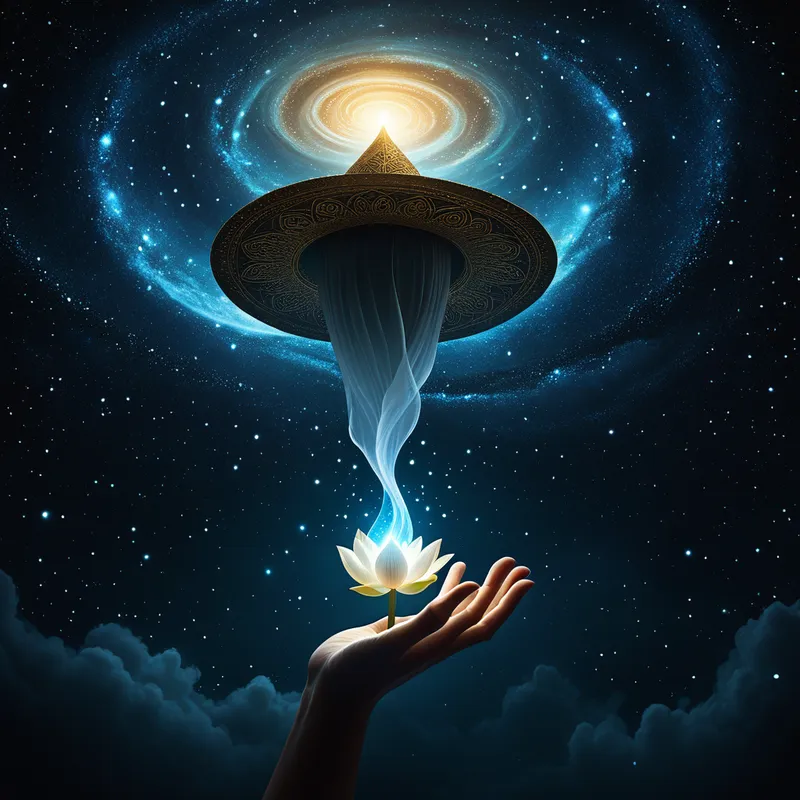
For the modern individual navigating the path of individuation, the myth of The Pandit’s Hat models the critical transition from the Persona to the Self. We all craft hats—identities as professionals, parents, intellectuals, activists. These are necessary and good. But individuation requires we see them as costumes, not as our essence.
The alchemical process here is one of calcinatio and sublimatio. The fiery shame Lobsang feels is the calcinatio—the burning away of pride and attachment to the persona. The resulting emptiness and openness is the sublimatio—the distillation of the spirit, freed from the heavy dross of the constructed self.
The work is not to stop building hats, but to stop believing you are the hat. True wisdom is the space in which all hats are worn lightly and can be laid down at any moment.
The modern “master” is not an external guru, but that inner voice of stark, simple truth—the Self that cuts through our self-justifications. To engage in this alchemy is to regularly ask: “What lotus needs to be placed upon my most prized hat? What role, achievement, or piece of knowledge have I mistaken for my self?” The triumph is not in becoming hatless forever, but in achieving the freedom to wear any hat, or none, from a place of grounded emptiness. It is to move from being a scholar of the sacred to being a vessel for it, where knowledge, humbled, becomes the fertile mud from which the flower of direct experience can bloom.
Associated Symbols
Explore related symbols from the CaleaDream lexicon: