The Palm Column Myth Meaning & Symbolism
A myth of the world's creation, where a divine palm tree becomes the first pillar, holding chaos at bay and offering the promise of eternal return.
The Tale of The Palm Column
In the time before time, when all was the dark, silent waters of Nun, a whisper stirred the deep. Not a sound, but a yearning. From the limitless, formless potential, the first thought of a world arose: a single point of will, the Benben. It broke the surface, a tear of solidity in the liquid night.
Upon this mound, the creator [Khepri](/myths/khepri “Myth from Egyptian culture.”/) manifested, [the self](/myths/the-self “Myth from Jungian culture.”/)-created one. He looked upon the endless, churning Nun and knew a world of light and life could not float upon such chaos. It needed an anchor. A support. From his own essence, he planted a seed into the heart of the primeval mound. It was not a seed of barley or fig, but a seed of endurance.
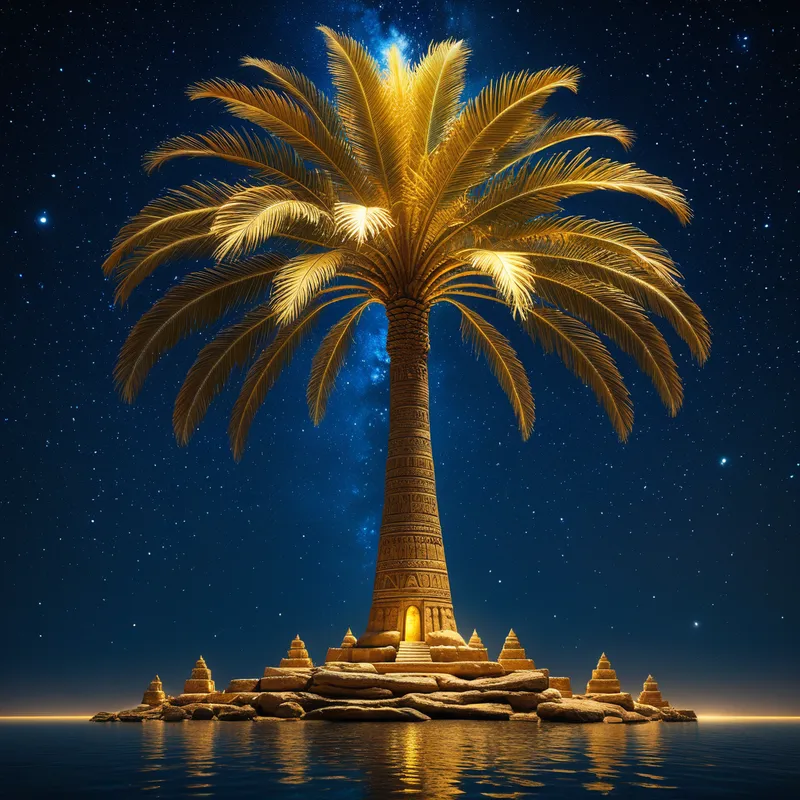
It grew not with the slowness of earthly trees, but with the swift certainty of a divine decree. A trunk, thick as the body of [the earth](/myths/the-earth “Myth from Hindu culture.”/), shot upward. It was a palm, but unlike any seen by mortal eyes. Its bark was like hammered copper, its fronds were vast fans of malachite and turquoise, whispering with the voices of winds yet to be born. It grew and grew, its crown pressing against the very fabric of potentiality above. This was the First Column, the Iwn.
And then came the great separation. [The sky](/myths/the-sky “Myth from Persian culture.”/), Nut, lay pressed upon the earth, Geb, in an eternal, fertile embrace. But for life to breathe, for the sun to travel, they had to be parted. The air god, Shu, entered the space. With a groan that shook the foundations of the Benben, he placed his hands upon Nut and his feet upon Geb, and he pushed.
The strain was cosmic. Geb trembled, threatening to sink back into Nun. Nut cried out, fearing she would fall and crush all creation. It was then that the Palm Column revealed its purpose. It moved, not of its own will, but by the necessity of the cosmos. It positioned itself directly beneath the arch of Nut’s straining body, its crown meeting the small of her celestial back. A sigh of relief echoed through the newly formed air. The Column held. It absorbed the unbearable pressure, becoming the central pillar of [the world](/myths/the-world “Myth from Tarot culture.”/), the axis upon which the dome of heaven turned. Its roots drank deep from the waters of Nun, transmuting chaos into stability, and its crown became the fixed point around which the stars would forever wheel.

Cultural Origins & Context
The concept of the world-supporting pillar is not a single, codified myth from one [papyrus](/myths/papyrus “Myth from Egyptian culture.”/), but a profound and pervasive cosmological theme woven into the fabric of Egyptian temple architecture and royal ideology. It was told not by bards in halls, but by priests in the dim, incense-filled sanctuaries of temples like Karnak and Dendera. The great stone columns of these temples—often shaped like bundles of [papyrus](/myths/papyrus “Myth from Egyptian culture.”/) or [lotus](/myths/lotus “Myth from Hindu culture.”/) stalks—were direct architectural echoes of this primordial Palm Column. They were not mere roof supports; they were the petrified forms of the first vegetation, holding up the “sky” of [the temple](/myths/the-temple “Myth from Jewish culture.”/)‘s ceiling, which was painted with stars and the body of Nut.
The myth functioned on multiple societal levels. For the state, it legitimized [the pharaoh](/myths/the-pharaoh “Myth from Egyptian culture.”/)‘s role as the sustainer of Maat (cosmic order). Just as the Column held chaos at bay, [the pharaoh](/myths/the-pharaoh “Myth from Egyptian culture.”/) upheld order against the ever-present threat of Isfet. For the common person, it explained the very structure of their reality—why the sky did not fall—and offered a symbol of resilience. The palm tree itself, a source of food, wine, and wood, was a [tree of life](/myths/tree-of-life “Myth from Kabbalistic culture.”/), and its elevation to cosmic status blurred the line between the nourishing earth and the supporting heavens.
Symbolic Architecture
At its core, the [Palm](/symbols/palm “Symbol: The palm tree symbolizes resilience, victory, and peace, often associated with tropical climates.”/) [Column](/symbols/column “Symbol: A vertical architectural support representing strength, stability, and connection between earth and sky. It symbolizes structure, tradition, and spiritual ascent.”/) is the [archetype](/symbols/archetype “Symbol: A universal, primordial pattern or prototype in the collective unconscious that shapes human experience, behavior, and creative expression.”/) of the [Axis](/symbols/axis “Symbol: A central line or principle around which things revolve, representing stability, orientation, and the fundamental structure of reality or consciousness.”/) Mundi—the world axis, the central pillar that connects the [underworld](/symbols/underworld “Symbol: A symbolic journey into the unconscious, representing exploration of hidden aspects of self, transformation, or confronting repressed material.”/), the earthly [realm](/symbols/realm “Symbol: The symbol of ‘Realm’ often signifies the boundaries of one’s consciousness, experiences, or emotional states, suggesting aspects of reality that are either explored or ignored.”/), and the heavens. It is the [conduit](/symbols/conduit “Symbol: A passage or channel that transfers energy, information, or substance from one place to another, often hidden or structural.”/) through which divine [energy](/symbols/energy “Symbol: Energy symbolizes vitality, motivation, and the drive that fuels actions and ambitions.”/) flows into the world and through which the [soul](/symbols/soul “Symbol: The soul represents the essence of a person, encompassing their spirit, identity, and connection to the universe.”/) can aspire to ascend.
Psychologically, it represents the [spine](/symbols/spine “Symbol: The spine symbolizes strength, support, and the foundational structure of one’s life and identity.”/) of the [psyche](/myths/psyche “Myth from Greek culture.”/)—the central, integrating [structure](/symbols/structure “Symbol: Structure in dreams often symbolizes stability, organization, and the framework of one’s life, reflecting how one perceives their environment and personal life.”/) that allows for the [separation](/symbols/separation “Symbol: A spiritual or mythic division between realms, states of being, or consciousness, often marking a transition or loss of connection.”/) of opposites ([heaven](/symbols/heaven “Symbol: A symbolic journey toward ultimate fulfillment, spiritual transcendence, or connection with the divine, often representing life’s highest aspirations.”/) and [earth](/symbols/earth “Symbol: The symbol of Earth often represents grounding, stability, and the physical realm, embodying a connection to nature and the innate support it provides.”/), [spirit](/symbols/spirit “Symbol: Spirit symbolizes the essence of life, vitality, and the spiritual journey of the individual.”/) and matter, conscious and unconscious) so that a livable, breathable “[space](/symbols/space “Symbol: Dreaming of ‘Space’ often symbolizes the vastness of potential, personal freedom, or feelings of isolation and exploration in one’s life.”/)” for [consciousness](/symbols/consciousness “Symbol: Consciousness represents the state of awareness and perception, encompassing thoughts, feelings, and experiences.”/) can exist. It is the [capacity](/symbols/capacity “Symbol: A measure of one’s potential, limits, or ability to contain, process, or achieve something, often reflecting self-assessment or external demands.”/) to hold [tension](/symbols/tension “Symbol: A state of mental or emotional strain, often manifesting physically as tightness, pressure, or unease, signaling unresolved conflict or anticipation.”/) without collapsing.
The true pillar is not made of stone, but of the will to stand between chaos and order, to bear the weight of the sky so that life may have room to breathe.
The Column is also a [symbol](/symbols/symbol “Symbol: A symbol can represent an idea, concept, or belief, serving as a powerful tool for communication and understanding.”/) of eternal renewal. The [palm tree](/symbols/palm-tree “Symbol: The palm tree symbolizes tropical paradise, relaxation, and resilience, often reflecting a sense of freedom.”/) was sacred to the [goddess](/symbols/goddess “Symbol: The goddess symbolizes feminine power, divinity, and the nurturing aspects of life, embodying creation and wisdom.”/) [Hathor](/myths/hathor “Myth from Egyptian culture.”/) in her form as the “[Lady](/symbols/lady “Symbol: The symbol of the ‘Lady’ often signifies femininity, grace, and the complexities of the female experience, representing aspects of nurturing, intuition, and empowerment.”/) of the Sycamore,” a [tree](/symbols/tree “Symbol: In dreams, the tree often symbolizes growth, stability, and the interconnectedness of life.”/) that offered shade and sustenance to the souls of the dead. Thus, the Column bridges creation and [afterlife](/symbols/afterlife “Symbol: A symbolic journey beyond death, representing transition, the unknown, and ultimate questions about existence, purpose, and what follows life.”/), suggesting that the foundational support of the [cosmos](/symbols/cosmos “Symbol: The entire universe as an ordered, harmonious system, often representing the totality of existence, spiritual connection, and the unknown.”/) is also a promise of [regeneration](/symbols/regeneration “Symbol: The process of renewal, restoration, and growth following damage or depletion, often representing emotional healing, transformation, or a fresh start.”/). It is steadfast, yet alive; rigid in its [purpose](/symbols/purpose “Symbol: Purpose signifies direction, meaning, and intention in life, often reflecting personal ambitions and core values.”/), but fed by the ever-flowing waters of the unconscious (Nun).
The Dreamer’s Resonance
When the image of the Palm Column arises in a modern dream, it speaks to a critical moment of psychic infrastructure. The dreamer is likely in a life phase where they feel the immense, often unbearable, pressure of holding things together—a career, a family, a personal identity. The “sky” of their responsibilities or aspirations feels like it is crushing down upon the “earth” of their physical and emotional resources.
To dream of a strong, shining Palm Column is a profound reassurance from the deep unconscious. It signifies that the dreamer possesses, or is in the process of developing, an inner axis of great resilience. They are finding their core strength, their non-negotiable values, which allow them to create space and order in the midst of chaos.
Conversely, to dream of a cracking, splintering, or bending Column is a somatic alarm. The psyche is warning of impending collapse from carrying too much weight alone. The dream may be accompanied by sensations of back pain, breathlessness, or vertigo—direct bodily echoes of Shu’s strain. This dream is a call to examine what burdens are not truly theirs to bear, or to seek the “roots” that can provide better nourishment and stability, perhaps through grounding practices, therapy, or community support.
Alchemical Translation
The myth of the Palm Column is a masterful blueprint for the alchemical process of individuation—the journey toward becoming an integrated, self-supporting individual. It maps the crucial stage of [separatio](/myths/separatio “Myth from Alchemical culture.”/) and the creation of the vas ([the vessel](/myths/the-vessel “Myth from Alchemical culture.”/)).
Initially, the psyche is in a state of massa confusa, symbolized by the unified embrace of Nut and Geb. All potentials are there, but they are entangled and unconscious. The first act of consciousness (Shu) is to create a distinction—to separate the spiritual aspirations (sky) from the instinctual base (earth). This is a painful, straining process, fraught with the anxiety of collapse.
The Palm Column represents the emergent Self, the central, synthesizing archetype that makes this separation possible and sustainable. It is [the ego](/myths/the-ego “Myth from Jungian culture.”/)‘s discovery of a transpersonal foundation. One does not become the god straining to hold the weight; one becomes the pillar that makes the strain purposeful and endurable.
Individuation is not about escaping the tension between opposites, but about becoming the stable column that allows that tension to generate the psychic space for a authentic life.
The alchemical work is to “plant one’s seed on the Benben”—to find that one point of solid intention in the swamp of confusion—and to allow the inner column to grow. This column is fed by drawing nourishment from the depths of one’s own unconscious chaos (Nun), transmuting raw, chaotic emotion into structured resilience. The ultimate [triumph](/myths/triumph “Myth from Roman culture.”/) is not to defeat chaos, but to stand firmly within it, providing the axis around which the constellations of one’s character can finally, and gracefully, turn.
Associated Symbols
Explore related symbols from the CaleaDream lexicon: