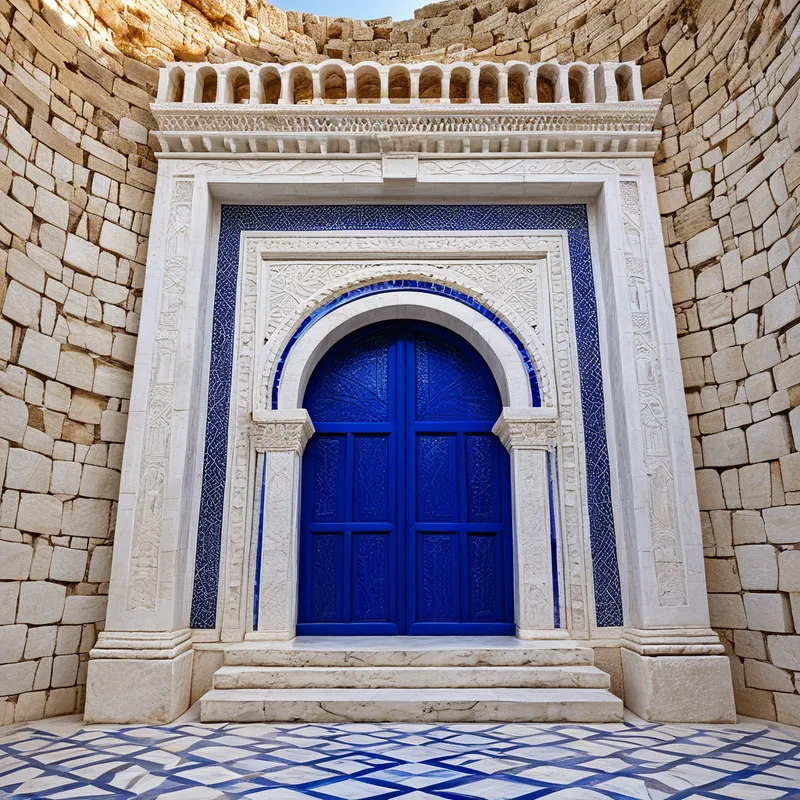
The Palace of Minos Myth Meaning & Symbolism
A king's hubris, a monstrous son, and a divine maze. The myth of the Palace of Minos reveals the labyrinth within the human soul.
The Tale of The Palace of Minos
Hear now of a palace born from divine insult and mortal pride, a gleaming cage for a king’s shame. On the isle of Crete, where the wine-dark sea whispers secrets to the shore, King [Minos](/myths/minos “Myth from Greek culture.”/) ruled. He prayed to [Poseidon](/myths/poseidon “Myth from Greek culture.”/) for a sign of favor, a bull from the waves to sacrifice. [The Earth](/myths/the-earth “Myth from Hindu culture.”/)-Shaker heard. From the foaming brine emerged a bull of such stunning perfection, white as sea-foam and strong as a tidal wave, that [Minos](/myths/minos “Myth from Greek culture.”/)’s heart clenched with greed. He could not bear to spill its divine blood. He hid the glorious beast and sacrificed another in its stead.
[The sea](/myths/the-sea “Myth from Greek culture.”/) is not so easily deceived. Poseidon’s wrath was a slow, cruel poison. He afflicted Pasiphaë, the queen, with a monstrous and unquenchable desire for the very bull her husband had stolen. Consumed by this divine curse, she enlisted the genius of the artisan Daedalus. From wood and hide, he fashioned for her a hollow cow, a deceptive shell. Within its dark confines, the queen waited. The bull was fooled. From this blasphemous union was born a creature of nightmare: a boy with the head and tail of a bull, a roaring hunger in his eyes. They named him the [Minotaur](/myths/minotaur “Myth from Greek culture.”/).
[The child](/myths/the-child “Myth from Alchemy culture.”/)’s bellow echoed through the marble halls, a sound of pure, untamed instinct that shattered the palace’s civilized silence. King Minos, drowning in shame and fury, turned again to Daedalus. “Build me a prison,” he commanded, “a place from which this… [thing](/myths/thing “Myth from Norse culture.”/)… can never emerge, and from which no one who enters can ever find their way out.” And so Daedalus, his art now in service to concealment, conceived the [Labyrinth](/myths/labyrinth “Myth from Various culture.”/). It was not a crude dungeon but a masterpiece of confusion, a stone puzzle with a monstrous heart. Walls curved back upon themselves, corridors led only to dead ends, and the very air grew thick with despair. Here, in the sunless center, [the Minotaur](/myths/the-minotaur “Myth from Greek culture.”/) paced, fed on the terrible tribute of seven Athenian youths and seven maidens, sent every nine years to sate the beast and appease Minos’s wrath.
But a thread of hope was spun in far-off Athens. The prince [Theseus](/myths/theseus “Myth from Greek culture.”/), son of Poseidon or of the mortal king Aegeus—his lineage was as tangled as the maze he would confront—volunteered to be part of the sacrificial tribute. His heart was set on ending the cycle of fear. In Crete, the king’s daughter, Ariadne, saw him and was pierced by love’s arrow. She sought out Daedalus, the maze’s maker, and learned its secret: you cannot think your way out, you must feel your way back. She gave [Theseus](/myths/theseus “Myth from Greek culture.”/) a skein of thread. “Tie this to the entrance,” she whispered, her voice trembling in the palace shadows. “Unwind it as you go. It will be your memory, your connection to [the world](/myths/the-world “Myth from Tarot culture.”/) above.”
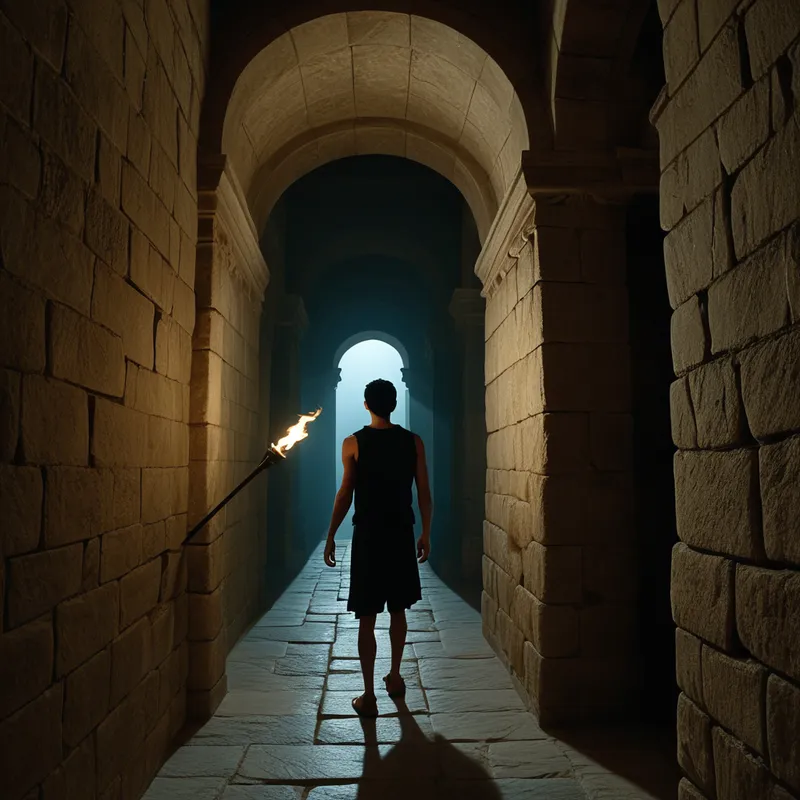
Into the swallowing dark Theseus went. The silence was absolute, broken only by the scrape of his sandals and the distant, resonant snort of the beast. The thread trailed behind him, a slender, glowing lifeline in the oppressive black. He followed the sound, the stench of hay and blood, until he stood in the central chamber. There it was: the Minotaur, a monument to broken boundaries, all muscle and rage and profound sorrow. No words were exchanged. Only the roar, the clash of bronze, the struggle of order against chaos, of named identity against nameless instinct. With a final, mighty effort, Theseus prevailed. The monster fell silent.
Then came the true test: finding [the way](/myths/the-way “Myth from Taoist culture.”/) out. In the echoing stillness, his own panic could have become a new maze. But he looked down, saw the thread gleaming faintly on the stone floor, and followed it—back through the twists, past the false turns, retracing the path of his own courage. He emerged, blinking, into the light, pulling the thread of his salvation back into the world, a conqueror not just of a beast, but of the ultimate prison of the mind.
Cultural Origins & Context
The myth of the Palace of Minos is not merely a fireside tale, but a foundational narrative deeply entangled with the historical identity and geopolitical anxieties of the ancient Greek world. It originates in the oral traditions of the Bronze Age, a time when the magnificent palace-complex at Knossos was a real and potent memory—or perhaps a ruin—that loomed in the Greek imagination. For the later, mainland Greeks (the Mycenaeans and their descendants), the Minoan civilization of Crete represented a sophisticated, powerful, and potentially oppressive maritime empire. The myth encodes this relationship: Athens, representing the emerging Greek polis, is subjugated and forced to pay tribute to the thalassocratic ruler of Crete.
The primary tellers of this tale were the epic poets, like those behind the fragments of the Theseus cycle, and later, great tragedians and historians. In the works of Euripides, Thucydides, and most vividly in the Bibliotheca of Pseudo-Apollodorus, the story was crystallized. Its societal function was multifaceted: it explained Athenian ritual and festival origins (like the Oschophoria), provided an aetiology for Minoan decline, and served as a powerful parable about the dangers of hubris—both the king’s, for cheating a god, and the city’s, for any weakness that invites domination.
Symbolic Architecture
The [Palace](/symbols/palace “Symbol: A palace symbolizes grandeur, authority, and the pursuit of one’s ambitions or dreams, often embodying a desire for stability and wealth.”/) of Minos is the [psyche](/myths/psyche “Myth from Greek culture.”/) itself—a dazzling, ordered façade of [consciousness](/symbols/consciousness “Symbol: Consciousness represents the state of awareness and perception, encompassing thoughts, feelings, and experiences.”/) and ego (the court, the rituals, the royal power) built directly atop a hidden, chaotic, and unconscious [foundation](/symbols/foundation “Symbol: A foundation symbolizes the underlying support systems, values, and beliefs that shape one’s life, serving as the bedrock for growth and development.”/). The [Labyrinth](/symbols/labyrinth “Symbol: The labyrinth represents a complex journey, symbolizing the intricate path toward self-discovery and understanding one’s life’s direction.”/) is not an external [structure](/symbols/structure “Symbol: Structure in dreams often symbolizes stability, organization, and the framework of one’s life, reflecting how one perceives their environment and personal life.”/) but the intricate, defensive [architecture](/symbols/architecture “Symbol: Architecture in dreams often signifies structure, stability, and the framing of personal identity or life’s journey.”/) of a complex.
The Labyrinth is the mind’s brilliant solution to a problem it cannot face: how to hide a truth too terrible to behold.
[King](/symbols/king “Symbol: A symbol of ultimate authority, leadership, and societal order, often representing the dreamer’s inner power or external control figures.”/) Minos represents the ruling consciousness, [the ego](/myths/the-ego “Myth from Jungian culture.”/) that attempts to manage the psyche through order, law, and control. His fatal [error](/symbols/error “Symbol: A dream symbol representing internal conflict, perceived failure, or a mismatch between expectations and reality.”/)—keeping the divine [bull](/symbols/bull “Symbol: The bull often symbolizes strength, power, and determination in many cultures.”/) (a [symbol](/symbols/symbol “Symbol: A symbol can represent an idea, concept, or belief, serving as a powerful tool for communication and understanding.”/) of raw, instinctual power and vitality) for himself—is [the ego](/myths/the-ego “Myth from Jungian culture.”/)’s attempt to possess and harness unconscious energies for its own glory, without making the required sacrifice. The result is the [birth](/symbols/birth “Symbol: Birth symbolizes new beginnings, transformation, and the potential for growth and development.”/) of the [Minotaur](/symbols/minotaur “Symbol: The Minotaur, a creature from Greek mythology, is often interpreted as a symbol of inner turmoil and the struggle between human and beast.”/): the [symptom](/symbols/symptom “Symbol: A physical or emotional sign indicating an underlying imbalance, distress, or message from the unconscious mind.”/), the neurosis, the complex. It is the “monstrous” [child](/symbols/child “Symbol: The child symbolizes innocence, vulnerability, and potential growth, often representing the dreamer’s inner child or unresolved issues from childhood.”/) of a repressed instinct (the [bull](/symbols/bull “Symbol: The bull often symbolizes strength, power, and determination in many cultures.”/)) and a conscious mind driven to unnatural contortions (Pasiphaë in the wooden cow). It is the part of [the self](/myths/the-self “Myth from Jungian culture.”/) that feels [alien](/symbols/alien “Symbol: Represents the unknown, otherness, and the exploration of new ideas or experiences.”/), shameful, and ravenously hungry, locked away in the dark center of one’s being.
Theseus is the heroic [aspect](/symbols/aspect “Symbol: A distinct feature, quality, or perspective of something, often representing a partial view of a larger whole.”/) of the ego that must descend into this complex. He is not a distant [savior](/symbols/savior “Symbol: A figure representing rescue, redemption, or deliverance from crisis, often embodying hope and external intervention in times of need.”/), but the part of us that finally says, “I must face this.” Ariadne’s thread is perhaps the most profound symbol: it is the thread of consciousness, of relatedness. It is not brute force or intellect that navigates the [maze](/symbols/maze “Symbol: A maze represents confusion, complexity, or a search for truth, often reflecting life’s challenges or inner turmoil.”/), but the [capacity](/symbols/capacity “Symbol: A measure of one’s potential, limits, or ability to contain, process, or achieve something, often reflecting self-assessment or external demands.”/) to stay connected—to love, to [memory](/symbols/memory “Symbol: Memory symbolizes the past, lessons learned, and the narratives we construct about our identities.”/), to a promise made in the light. It is the therapeutic [alliance](/symbols/alliance “Symbol: A formal or informal union between individuals or groups for mutual benefit, support, or protection.”/), the [journal](/symbols/journal “Symbol: A journal represents self-reflection, personal growth, and the exploration of inner thoughts and emotions.”/) entry, the mindful [awareness](/symbols/awareness “Symbol: Conscious perception of self, surroundings, or internal states. Often signifies awakening, insight, or heightened sensitivity.”/) that allows one to venture into the darkness of a [trauma](/symbols/trauma “Symbol: A deeply distressing or disturbing experience that overwhelms the psyche, often manifesting in dreams as unresolved emotional wounds or psychological injury.”/) or complex without becoming permanently lost in it.
The Dreamer’s Resonance
When the motifs of this myth surface in modern dreams, the dreamer is navigating a profound process of confronting a personal “Minotaur”—a complex or shadow aspect that has been walled off, yet demands tribute in the form of life energy, joy, or freedom.
Dreaming of being lost in a complex, endless building or maze signals a feeling of being trapped by one’s own psychology, circling repetitive thoughts or behavioral patterns with no clear exit. The somatic experience is often one of mounting anxiety, shortness of breath, and a heavy sense of confinement. To dream of a monstrous, hybrid creature in the basement or center of a house points directly to an encounter with [the shadow](/myths/the-shadow “Myth from Jungian culture.”/)—a part of the self perceived as ugly, dangerous, or unacceptable, yet which is intrinsically a part of the dreamer’s wholeness. The dream may present a “thread”—a phone line that still has dial tone, a trail of glowing marks, a voice guiding from another room. This symbolizes the nascent, fragile connection to the observing ego or to supportive internal resources that make the descent bearable and the return possible.
Alchemical Translation
The myth models the complete alchemical process of individuation, or psychic transmutation. It begins with the [nigredo](/myths/nigredo “Myth from Alchemical culture.”/), the blackening: the shame of Minos, the birth of the monster, the descent into the black maze. This is the necessary confrontation with the shadow, the “lead” of the personality.
The slaying of the Minotaur is not an act of eradication, but of integration. The beast is not killed to be rid of it, but to transform its boundless, chaotic energy into a source of strength for the conscious self.
Theseus’s journey is the mortificatio and [separatio](/myths/separatio “Myth from Alchemical culture.”/)—the killing and separating. He distinguishes himself from the undifferentiated terror of the complex. But the work is not done with the victory in the dark. The crucial phase is the albedo, the whitening: the following of the thread back out. This is the conscious integration of the insight gained, the bringing of the unconscious material into the light of day. Theseus emerges, but he then fails the final test—he forgets to change his ship’s black sails to white, causing his father’s death. This reminds us that integration is a continual process, fraught with forgetfulness and old patterns.
For the modern individual, the myth instructs: Your labyrinth—your anxiety, your addiction, your recurring wound—was built to contain something vital that you were taught was monstrous. The heroic task is not to live perfectly on the sunlit upper floors, ignoring the sounds below. It is to gather your thread (courage, support, awareness) and descend. To meet the Minotaur not as an enemy to be destroyed, but as a disowned part of your own soul, starving for acknowledgment. To reclaim that instinctual energy and, by threading it back through the maze of your life’s experiences, re-weave it into the fabric of your conscious being. The palace is not abandoned; it is made whole. The center is no longer a prison of shame, but a sacred chamber where the totality of the self is finally at home.
Associated Symbols
Explore related symbols from the CaleaDream lexicon: